Saturday, 7 October 2017

The rainy season is here!

THE RAINY SEASON IS HERE

Hard to believe that it is October already. But it is, and that means the rainy season has arrived. We have had almost 50mm so far and life is beginning to happen. I have been doing a lot of high altitude work lately and have been chased down once or twice by lightning cracking through the air. I have also seen some beautiful vistas, as you would expect, and flowers beginning to bloom. Here is a little gallery of some of those things I managed to photograph:

A spectacular view of the estate from the tippy top of the Razorback road


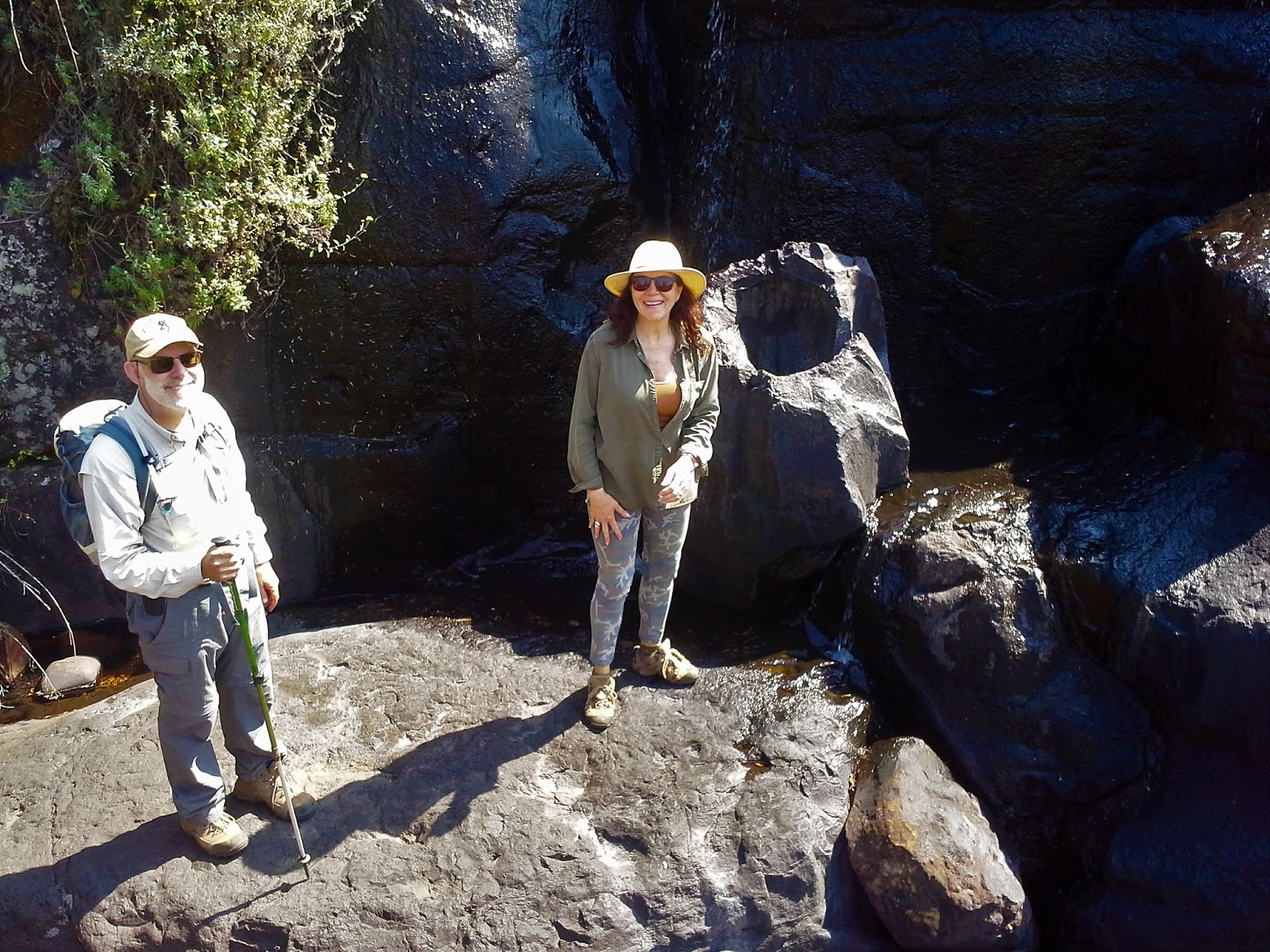
Gary and Sue Harwood from Bulldozer Creek standing beside the single boulder pothole by the high altitude waterfall above Trout Kloof.
Me holding the skull of a long dead White-tailed Gnu (Black Wildebeest) high up on the plains of Goudkoppie


An up close of a Coertse's Hillside Brown butterfly resting on a lichen covered boulder

The flowers of the succulent, Crassula pelucida, hugging the rockface
Mount Anderson, our majestic landmark, viewed from the North
A new species of Heath for my list. I found these bushes above 2000m on a rock face that becomes a waterfall during the rains
A Breyer's Lon-tailed Seps. This (almost) legless lizard is quite common here in the grasslands. With only small forelegs and no rear legs this lizard swims through the grasses
A Natal Crocus, Apodilirion buchananii, from the Amaryllis family
Gerbera piloselloides
South valley, from the East
A grass Aloe, Aloe chortorliriodes. These beautiful Aloes decorate the high altitude cliffs throughout the estate. But you have to climb high to see them!


The remains of a Protea on top of the world. We call this sort of tree a Posthumus arborescens

As you can see, it is time to get out into the grasslands here in the mountains. With over 500 species of plant, 46 species of mammal, 174 birds, 19 reptiles, 13 frogs all so far recorded right here on the estate, there is plenty of life to observe....

Friday, 1 September 2017

Community Service with a twist!

SOME COMMUNITY SERVICE NEWS

Community service required by some schools is a great benefit to the Estate as previously mentioned. This past weekend, James Van Heerden and his cuz did a four hour stint with me. There were a bunch of Wattles growing from the cliffs above S7, now flowering, that needed removing. They used a boat, a ladder and lots of effort to remove and treat ALL the wattles on the cliff face. Excellent! I didn't have to worry too much about them falling from the cliffs as they showed me afterwards! Check it out...
The hardest part was getting the ladder into position. See all the Black Wattles with their yellow flowers?

Both hard at work

There's James in mid air. Showing me my concern was unfounded!

The water was real cold so a speedy exit was required
Yep! Community service is fighting the good fight. Though rarely filled with the joys of swimming, it certainly gives the kids a feeling of accomplishment and I promise, they're always good and tired afterwards.

Thursday, 31 August 2017

Kenna's Brown

KENNA'S BROWN

I enjoy getting photos of people and activities from the members. This was one is of young Kenna Twiggs with a beautiful Brown she caught from SPK 2 recently. In fact, she always out there catching! Quite the angler.


Thursday, 17 August 2017

Some recent activities here on the Estate

SOME RECENT ACTIVITIES


We certainly have had a mild winter here this year. It has been cold, don't get me wrong, but not as cold as it can and does usually get. Cold or not, being an outdoors place, many activities have taken place recently, besides the excellent fishing!

It hasn't just been play, play, play, lots of kids have been willing to work too, both with me and my alien plant clearing activities, and with Simon in the hatchery.

Below is a photographic summary of some of these activities...

Fraser Moore logging community service hours destroying Pine with my team. That's a massive tree he is ring-barking!

While walking back from work with Fraser, we glimpsed a pair of porcupines sleeping in an old mine digging.

On another occasion, Both Fraser and Helen Moore logging community service hours.

A hike to the top of the world with the Rivett-Carnat's of Pebble Creek in late June.

Louise Twiggs hugging a massive Mountain Hard Pear hidden in a forest on a gorge walk also in late June.

Kenna, Ashley and Louise emerging from the gorge high up in the North Eastern side of the Estate.

Louise Twiggs and Nick Moore risking a cliff to try photograph a special narrow endemic, the Mount Anderson Everlasting.

Mount Anderson Everlasting, Helichrysum summon-montanum.

The very fit Ashfeilds from Rod's Rest having a short break at the beacon on the very tippy top of Mount Anderson.


Judy Slettevold and the gang on a hike up to the top of the cliffs below Potato Seed Production. It was a real tough one because all the paths I remembered were.....no longer there? See the Majubane waterfall far in the backround...

The Rogans from Morrin Pools loving it up high in early July.

Fraser Moore from Rock Solid preparing to take on "Knife edge Gorges" in July. See Mount Anderson in the distance in front of him.

The girls from The Crofts helping Simon and staff bring in the nets in the hatchery.

A Cape Clawless Otter pup scampers past Ashley Twiggs after emerging from the Laundry room.

Sundowners at the end of South Valley last week.

The Moores, from Rock Solid, and I enter the plains of Hartebeesvlakte on an overnight hike this week.

The Moore kids and I at the Stables Hut on the Fanie Botha Trail before our return to the Estate yesterday morning.

On our way back over the Hartebeesvlakte. We are the speck to the right of the centre of the panorama.

Enjoying a bit of kite flying on the top of the escarpment before dropping back to the Steenkamps valley.

Never a boring moment! Please remember, if you want to go for a hike (anytime) or you want your kids to accumulate Community Service hours (only during work days), don't hesitate to contact me, Jimmy, either over the radio when you are here, or by email to jimmy@finsbury.co.za beforehand. We are looking forward to your following visit...


Saturday, 12 August 2017

New house on the block!

THERE'S A NEW HOUSE ON THE BLOCK!


The next time you arrive at Finsbury, as you pass "Elsmere" (unit 11), and are about to descend towards the Central area, you will notice a beautiful new house on the banks of the Kliprots River just North of it's confluence with the Hatchery stream. This new house on the block has been built as my new accommodation and, yes, I am absolutely over the moon!

It's a spacious three bedroomed, two bathroomed cottage with a massive stoep for me to sit on and read my kindle on Sundays.

Firstly a huge thank you to Dawn and Neville Organ who got the ball rolling. Then a special thanks to the board, particularly Hannes Potgieter, for building it, and Mike Beaumont for organizing everything. And lastly, a deep heartfelt thank you to you, the members, for all you have done (and Grant Lotter, was it you that designed it?).

The view from the office

The view from the road as you pass Elsmere


 Do pop in for tea...

Monday, 10 July 2017

Finsbury Leopards


FINSBURY LEOPARDS

A new little girl that is establishing a territory beside Mom's in the Steenkamp Valley
We have been having quite a few leopard sightings on the estate in the last few months. This can be attributed to the fact that there are three sets of cubs on the estate. We had the Steenkamps female with three cubs sighted quite regularly by staff in the last year in that valley. One of those cubs may have been drowned during the Dineo weather front because only two cubs were seen after that flood. I think these are the cubs, who are now independent of their mother, who were sighted by Don and Anne in their second month here in Nooitgedacht farm.

Another female leopard with two large cubs was sighted in February by The Van Heerdens and others above K15. I had a good look at the mother and was pretty sure it was not the Steenkamps female, she looked a lot older.
Then Don found an eland carcass on the access road to Rod's Rest (unit #7). According to the wounds on the carcass, it appears the eland was dispatched by another eland during a fight. Don erected a temporary camera trap at the scene and got some special shots of a mother leopard with only one 3-5 month old cub. This cub is younger than the rest and should still be with its mother for another six months or more.

The youngest of the known cubs, a single child
Mom with her single cub at a Eland carcass near Rod's Rest


I have been sending photos of Finsbury leopards with coordinates to the Mpumalanga Tourism and Parks' Predator Specialist, Gerrie Comacho, who is mapping the Mpumalanga leopards. He uses the unique spot patterns of leopards to identify individuals from the data he receives.

Now, on Friday I got to see a large young male leopard at K33. He hung around there the entire day and was spotted by the Ririe's of Kingfisher Lodge (Unit #6) later that afternoon. This is now a new boy on the block and I suspect he won't be around for too long because he will drift away from his father's territory in good time. I have managed to confirm a photograph of him (using spot pattern)when he was about 6 months old up at the cycle path. His mother is the old Granny Leopard that has always been sighted here and his father is, I believe, the massive Big Boy leopard that has dominated this area for a long time. In fact, according to Comacho, Big Boy was caught on a cctv camera in the town of Sabie in 2012! I think he is the father because last month I got a photo of the Big Boy male on the cycle path camera and a minute later this youngster was photographed following him. A young male would not follow a big male that was not directly related unless he was suicidal!

This young male, who I will call "TIGER" because he has a mane like a tiger, is very relaxed with vehicles and will be spotted more often while he is in the area. Behavioral traits are also hereditary and relaxed leopards are usually shot out in areas where they are not protected, leaving only very skittish genes in the population. But in areas where they are more protected, like Finsbury now, the relaxed genes can show themselves again and even proliferate. 
Tiger when he was less than 6 months old sniffing around the camera up at the base of the cycle track on Loop road: 05 July 2015
Tiger caught on James Mackenzie's camera mounted on the chain pole at the bottom of the Razorback road: 03 May 2017, making him around two and a half years old.
Tiger spotted by me on the game path leading from Loop road down to K33 on Friday.

There has always been leopards in these valleys but there were times when they were more heavily persecuted than now. With the understanding and protection of our leopards now, the populations will not only increase but relaxed individuals will become more prominent.

It is a great honour to have these majestic cats in our presence but visitors need to be aware of them. They are not dangerous to humans and will avoid us at all costs. They are dangerous, however, to dogs and very small children if they are on their own. So please be aware! Do not let your dogs sleep outside or let them run about out side on their own. Also keep an eye on young children and have a bigger child or adult accompany them if they are playing away from the unit.
As for your freedom on the estate? Do not let the presence of leopards restrict you. Enjoy the cycling, walking or hiking that you normally do. I have spent more than 25 years living in areas where large predators exist and have had many experiences with wild leopards. The best way to react to a leopard if you accidently encounter one in the bush is to pretend that you did NOT see it. Unlike a lion where it is best to stare it down and challenge it, a leopard will not attack if it believes it has not been seen or that you are not going to react after seeing it. Look the other way and keep on walking (Johnny Walker style!). VIVA LE LEOPARD!


Wednesday, 3 May 2017

The last April long weekend


The last of the long weekends in this long string of holidays has come and gone. In fact, it was busier than the Easter weekend and the rivers still produced trout from all the popular weirs. The weather was poor, though, with wind and rain for a lot of the time, giving us 21mm over the period.

A rainbow over the flood plains of the Spekboom river.

 Here's a little gallery of some of the things that were seen on the Estate over this jolly time:

Well, not so jolly for all! Anna accumulating some community hours for school by killing young wattles that have invaded the previously cleared areas in the Upper Majubane.

Lamprophis guttatis, a Spotted House Snake, spotted (Har Har) by me beside K14. He was limp and flattened out on a clearing enjoying the brief sunshine. This is a new species for my Finsbury Reptile List.


The weather finally lifted enough for the Nicholson clan to hike the 12km route from K33 to Central via Goudkoppies and Troutkloof Waterfall.


It seems that even in the grassveld without trees, autmn colours can still be found. These rosettes are the leaves of a little colony of Mole's Spectacles, Craterostigma wilmsii, found on the plateau of Goudkoppies.


Talk about beautiful autumn colours in the grasslands? How's the mist condensing on the fading leaves of Psammotropha breviscapa, a high altitude, mat-forming plant.


The specially beautiful, fading leaves of the succulent, Crassula setulosa, growing on a damp rock in amongst another lithophyte which I am still to identify. The plants in all three of the above pictures have very attractive flowers. It seems that their leaves can be just as attractive.


The hike took us past some newly flowering Cliff Aloes, Aloe arborescens. The plain they are hiking on is the last step before descending into the steep valley leading to the high altitude waterfall high above Troutkloof.


The cold weather made this Large-scaled Grass Lizard, Chamaesaura macrolepis, easy to handle. Initially, it appears rather like a snake but if you look closely, it has eyelids (which snakes do not); Scales covering it's ears (snakes have no external ears); and minute vestiges of what remain of it's hindlegs visible. The loss of its limbs together with a few other adaptions, like scales sharpened on the trailing edge for grip on grass stems, make it an efficient grassland reptile.


The small daisy flowers of the Bush Tea, Athrixia phylicoides, the stems of which are exceptionally sought after for the hand brooms so synonymous with rural African scenes. The dried leaves also produce a very healthy green tea whose health benefits are said to rival those of cultivated green teas.
Well, as you can see, a lot of fun was had again  at Finsbury Estate during the April holidays. But winter is on its way and since we've had lots of late rain the dew is thick on the grass in the mornings. Soon, very soon, it's going to be thick, icy frost and these mountains become a true South African winter wonderland. See you then, looking forward...