Thursday, 28 March 2019

March 2019

MARCH 2019


There we go! March is already finished! It seems like the rain might also be, with only 76mm falling this month. Although we have had less, this season, it has fortunately fallen during the growing season, not, like the last few years, from mid summer to autumn. So this, together with the effects of August's run-away fire has made the Estate as green and lush as can be, even though the river levels are quite low for this time of the year.

And in the green and lush, life abounds! Below are some fun and interesting things I stumbled upon while working in this special environment:


The cosmopolitan Spotted Maize Beetle, Astylus atromaculatus, is a common site as they gather in groups on all flowers, eating pollen, socializing and mating. Afterwards, eggs are laid in clusters under leaf litter and the larvae burrow into the topsoil and eat decaying vegetation. Strangely, they also enjoy eating germinating maize seeds, which makes them a pest to maize farmers the world over. This individual must have thought he'd died and gone to heaven, landing on a platter of pollen in the form of the flower head of an Umbrella flower, Helichrysum umbraculigerum.


This Garden Locust nymph (no wings yet), Acanthacris ruficornis, is enjoying a meal of Red-hot Poker. It will grow up to be a large, elegant grasshopper but not this season since it is already the end of March. This individual is probably a second or third generation nymph this season so it will have to try to survive the cold winter, making it amongst the first from next season to lay eggs (if it's a female) after the first rains. Most adults will be laying large eggs in loosely turned soil now, where the eggs will over-winter and hatch in spring. The adult resembles the less colourful Brown Locust but has more powerful legs which can inflict a wound on any handler.


Oh I love this! I've always pointed out how the flower of the Northern Shellflower, Bowkeria cymosa, resembles a toad's mouth and if you gently squeeze the flower on the two ends, the mouth opens and closes. Well, on this tree, most the flowers have a pair of unopened buds above the flower which from the front and the side make them look like eyes. A real frog-like cartoon character! But besides being happy flowers, they also produce a protein-rich oil which is rather sought after by oil collecting bees of the Rediviva genus from the Melittidae family of bees. These bees mix the oil with pollen and stuff it into subterranean chambers they have constructed, in which they lay an egg per chamber. This protein-rich food is there for the larvae when they hatch.


The other day I landed up walking quite some distance in the grasslands and I stumbled upon 9 species of orchid. March is definitely a good time to go orchid hunting! This one, a Granny Bonnet Orchid, Disperis renibractea, was part of a colony growing close to Little Joker mine. It also produces a high protein oil that is gathered by their sole pollinators, oil-collecting bees, as referred to above.


This Common Fungus-growing termite, Odontotermes badius, is a winged-alate and the potential queen of a future colony. After rains the workers of a colony expose themselves while they open the hatches to their tunnels and urge hundreds or thousands of specially bred male and female winged reproductives (winged-alates) to embark on their maiden flight and go establish new colonies! This maiden flight is fraught with danger as the termites are a special source of protein for anything that is not vegetarian. In fact, I have watched Blue Waxbills and fire finches gobbling them down before and these birds are seed eaters! I encountered this princess as she landed near the helipad at the central area She promptly shrugged off her wings and then raised her abdomen to the sky, emitting a pheromone into the air which, if sensed by a male, will cause him to hone in on the source, land beside the her, shrug off his wings and run behind her, in tandem, until she finds a suitable spot for them to start digging. They will dig a chamber under the hard soil, mate and she will lay eggs which they will tend together. After hatching, these will be the first workers of a new colony. The specific name, badius, refers to the fact that these are the termites that like to eat the wood in our houses! 


...and right then this romantic story was shattered! The area was streaming with Pugnacious Ants, Anoplolepis custodiens, and it was only a matter of time before the termite princess was discovered. You will know these ants if you have fly-fished, in the heat of the day, at K9 from the eastern side on those flat rocks at the water's edge. The Pugnacious Ants scramble up your legs and the more you agitate, the more frenzied they become! Biting, they will devour anything they can over-power. I remember once releasing a small, 25cm long sand snake  in the vicinity of these ants. I landed up having to rescue the snake and remove the ants as they were beginning to over-power it. The specific name of this ant, custodiens, refers to their habit of tending Scale insects on their plant hosts. The Scale, a bug from the Hemiptera, colonise a plant host plant and begin to suck up it's juices. They secrete a sweet honeydew while they feed, attracting the ants who relish the secretion, swarm over the colony of Scales and attack any enemy of the Scales that may arrive, therefore being the custodians of the Scale insects!  


Look at those funky eyes. I found this Wahlberg's Velvet Gecko, Homopholis wahlbergi, at Kingfisher Lodge (Unit 6) while doing a bit of chain sawing. They are active in the night and the day, foraging for insects big and small, even large millipedes. Apart from having scansors on the underside of their feet that allow them to find purchase on almost any substrate, geckos differ from other lizards in not having eyelids (like snakes). Unlike snakes, though, they clean the eye scale with their broad tongues, like windscreen wipers. They also store calcium in special glands in their necks which allows them to lay hard-shelled eggs, unlike most other reptiles. They lays two eggs in a communal nest together with other females' eggs although no parental care is given after that.


I initially thought this was a baby millipede but have since learned that it is an adult Flat-backed or Keeled millipede from the Polydesmida order. This little chap was around a half an inch long and is a full grown adult who, by the looks of the pale carapace, has recently moulted. Although the normal millipede we see is very common, the order that this one belongs to is the biggest in the millipede class but they are all small and easily escape notice. They do, however, have a special defense in the form of Hydrogen Cyanide which they excrete from their carapaces that will repel most predators, even the notorious Pugnacious Ant.


A Spider Dung Beetle, Sisyphus sp., gathering dung from an Eland-with-the-runs' pat. In greek mythology, Sisyphus was the king of Ephyra. Because of his self-aggrandizing nature and his deceitfulness he was punished by the gods to roll a boulder up a hill. Each time he was almost at the top, the boulder would roll down again and he would have to try again. For eternity. These beetles roll their balls for a much better reason: Males and females meet on a fresh pat of dung and enjoy a feast of it while they get to know each other. The newly paired couple will then mold a ball of dung and roll it away to a suitable spot where it will be buried about 5cm deep and a single egg laid within. Later, the larva will hatch and consume the ball from within, pupate in the empty shell and emerge as an adult the following season. Interestingly, these are also the only dung beetles regularly encountered on large carnivore droppings.


I have posted a photo of one of these caterpillars on a previous blog and still have not found out to which lepidopteran it belongs. It is just difficult to ignore the psychedelic colour scheme. 


I encountered large patches of these beautiful Pink Strawflowers, Helichrysum adenocarpum, also near Little Joker Koppie, giving an electric flash of colour to the high altitude grasslands! Aside from the disc florets losing some of their lustre, the flower remains firm and colourful for months, even years, after it has been picked, making it a fovourite in dry-flower arrangements. While I was approaching this particular patch of flowers for a photograph, a young Oribi ram stood up from amongst them and bounded off, giving a show of it's stotting pronk. Spectacular!


This splendidly-coloured Foam Grasshopper, Taphronota sp., feeds on the leaves and stems of the numerous small, woody plants found in our grasslands. As I have mentioned in a previous blog concerning the Koppie Foam Grasshopper from the same family, Pyrgomorphidae, the nymph feeds on Milkweed plants and retains the poison from the plant within its body.
If molested, a toxic foam bubbles out from the warty thoracic shield which can be fatal to enemies as big as dogs. Look but don't touch. 


The Elegant Witchweed, Striga elegans, is a tiny little plant that stands less that 10cm tall and so, even though the flower is a bright red colour, is easy to miss in the grasslands. It is a hemi-parasite that attaches itself to the roots of a grass plant and extracts its mineral and water requirements from its host. It does have small, scale-like leaves that photosynthesise and provide the plant with energy.


Although it initially looks like a worm, this tiny, endemic snake with its metallic scales is only about 3mm thick and 130 mm long. It's a burrowing snake that burrows itself into the subterranean passages constructed by termites, its sole food source. Once inside the termite colony, the snake secretes a pheromone that placates the soldier termites who then refrain from attacking the intruding snake as it devours the worker termites. Clever, huh? Although it only has a single lung like more modern snakes, its pelvic bones hint at its primitive roots. This individual was found for me by James Mackenzie from Pebble Creek (unit 25) while him and his brother, Andrew were slaving away (community service) between K9 and Finsbury house removing Stinkblaar weeds. 


One of the butterflies fluttering around this month was the Spotted Sailor, Neptis saclava. Sailors are forest butterflies and have a characteristic floating flight, occasionally flapping its wings three to four meters above ground then settling with wins half open. The larvae feed off plants from the Euphorbiaceae and Fabaceae families, both well represented on the Estate. 


Another common butterfly encountered during the month of March, is the Bush Beauty, Paralethe dendrophilus. Very difficult to photograph with its wings open because they settle with closed wings but I finally managed to get off a shot. this species is different from its close cousin, the Mountain Beauty, by its strict habitat preference of moist temperate forest while the latter prefers open, mountainous grassland. Commonly seen feeding on fermenting fruits, the Bush Beauty has not been recorded feeding from flowers.


Once you enter the dark, temperate forests on the Estate you will notice many types of plants growing as epiphytes (on tree branches and trunks) and lithophytes (on rocks). These strange-looking, fleshy lithophytes are from the Pepper family and lacking an English name, the Peperomia retusa, stands less than 60mm tall. The little black balls attached to the flowering stems are the seeds and if you scrape them off into your hand, pop them into your mouth and chew them with your molars you will experience a sharp, strong black pepper taste, like from the grinder!


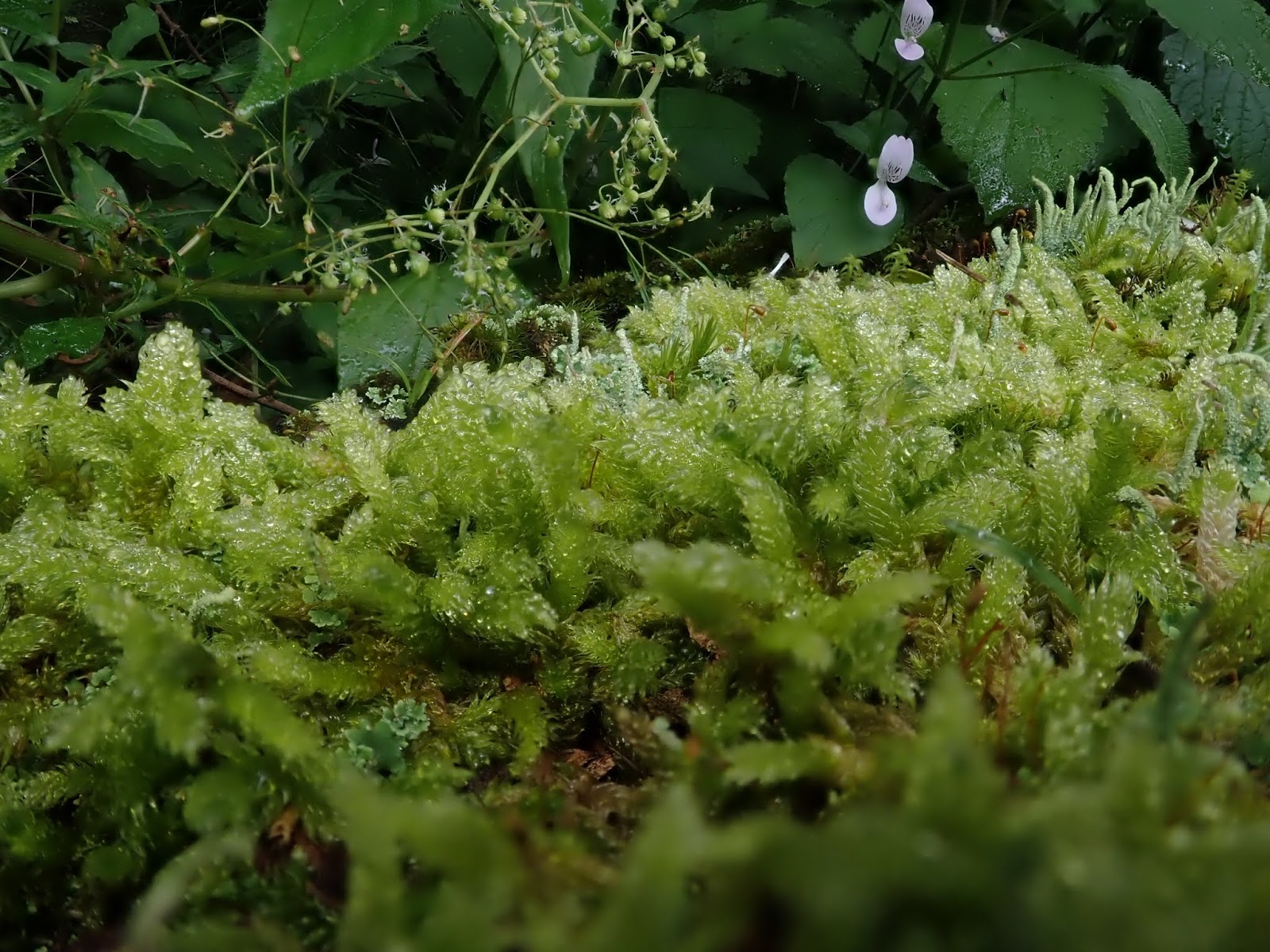
Also growing as epiphytes and lithophytes in our forests and forming extensive, soft, cushioned mats is the primitive fern-like Forest Spikemoss, Selaginella kraussiana. Origionally from Africa, these plants are now cosmopolitan and are regarded as greenhouse weeds in many countries and is a declared weed in New Zealand.


Still in the forests, search the moss and lichen covered branches and you may find this minute lichen, Usnea pulvinate, a very close relative to the eerie Old Man's Beard lichens that hang from trees up in the mist belt.


That's it for March. The days are getting shorter and the morning have cooled down a lot as we enter autumn. Come visit when you can, we look forward to it!

Tuesday, 5 March 2019

February 2019

FEBRUARY 2019


With a final total of 244mm of rain for January and then a further 122mm for February, the Estate is looking lush and green. The place is full of life, with me having sightings of some special birds this last month, including Ground Woodpecker, Orange Ground Thrush, Yellow-throated Woodland Warbler,Starred Robin and Blue-mantled Crested Flycatcher, amongst others. Game viewing has also been very productive due to the fresh, green growth after the fire. A ten kilometer hike in the mountains is almost definitely going to net you Eland, Mountain Reedbuck, Vaal Rhebok, Klipspringer, Common Duiker and Baboons. Below is a gallery of some of the wildlife I have encountered over the last month:


Two years back I found this tiny, strange looking flower in a spongy seepline above Little Joker Mine in the southern section of the Estate. I did not manage to identify it and placed it in my unsolved file on my laptop. A year or so later the laptop crashed and I lost a bit of information, including my Unsolved file, and then, by pure luck, I stumbled onto the identity of the flower while reading over some notes on ecology in the grasslands. I was excited but now I needed new photographs of the plant for my files. I returned to the area last February and did not find the plant, I think because it was too dry. This February I returned to the area on a hike with the Harwoods from Bulldozer Creek and, Hallelujah, there were plenty of them! It's a Corkscrew Plant, Genlisea hispidula, from the Lentibulariaceae, the Bladderwort Family. It is a carnivorous plant that lives in the water in marshes. It has two distinctive types of leaves, normal club-shaped leaves at the base of the plant that photosynthesize, and then special modified leaves below the surface that fulfill the function roots would normally. These specially modified leaves also have hollow, cylindrical spiral segments with backward facing hairs that trap microorganisms, like protozoans, and extract nutrients from them! 


In mid summer, the ubiquitous Brown-veined White butterfly, Belenois aurota, needs little introduction. This is because they are everywhere, all generally moving in a north easterly direction. The migration is not well understood but it starts in the south east of the country and moves north east right over the southern African landmass, picking up more and more individuals as they go, laying their eggs on their chosen host plants and feasting on high energy nectar while pollinating millions and millions of flowers en route. They then fly off shore into the Indian ocean and perish there...…


More common in the lowveld bushveld than the mountain grasslands, the Yellow Pansy, Precis hierta, is still a common site in mid summer on the Estate. The males of the species establish rather vague territories in open grassland, hoping to attract as many females as possible.


This is the closely related Blue Pansy, Precis oenone, which is also commonly seen on the Estate in Mid summer. The males also establish territories, but well-defined ones, that they vigorously defend against other males. These territories are situated on the tippy tops of hills.


This is the African Leopard butterfly, Phalanta phalantha aethiopica, not as commonly seen as the above species but very noticeable.


I was very excited to find this Amethyst Fruit Chafer beetle, Leucocelis amethystine, enjoying the nectar on a beautiful pink Asterid flower that I had not yet seen on the Estate. Mmmnnm! Where had I seen this flower before? Then it struck me! A Pompom Weed, Campuloclinium macrocephalum, an ornamental originating in North America! I immediately removed the plant with its woody rootstock, which was not very large. The Agricultural Research Coucil is quoted as stating that this plant "is rapidly becoming the most serious threat to the conservation of grasslands in South Africa!". This has become a serious pest in the Witwatersrand and I will stay on guard and make sure it doesn't happen here.


The spectacular but short-lived, aromatic flower of the Cape Gardenia, Rothmannia capensis, photographed from the small stunted individual that grows on the cliff by K15. The cliffs between Kingfisher Lodge and K15 and the between K15 and K22 are full of these small, shapely trees from the Coffee family but this is the only one reachable. The hard-skinned, edible fruits are round and larger than a ping pong ball but smaller than a tennis ball and not very nice tasting. Baboons and monkeys love them, though, and usually pick them from the tree before they ripen properly. If they do manage to ripen and fall to the floor, they are quickly gobbled up by Bushpig, Bushbuck and Common Duiker.


Often when hiking through the grasslands, one may encounter small blobs of frothy spittle clinging to the smaller branches of bushes or grass stalks. If you feel around inside this froth, you will expose a small insect which is the nymph of a Spittle Bug or Frog Hopper, from the Cercopidae family of bugs. This little nymph attaches itself to the stem with its proboscis and proceeds to suck the plant juices so copiously that, after filtering out the nutrients, it mixes the waste water with air and a waxy glandular secretion to make it froth and cover it's whole body. This spittle protects the nymph from the elements and potential predators. The adult looks like a tiny frog and has the ability to jump huge distances, hence the common name, Froghopper.


This beautiful specimen of a Silver Vlei Spider, Leucauge sp. (Metidae), waits patiently for an unsuspecting flying insect to get snared in it's web after an early afternoon shower.


During mid to late summer, the grasslands become spotted with the bright pink flowers of the Watsonia pulchra. 


A close relative of the Watsonia above is the much smaller, and therefore less noticeable Gladiolus elliotii. This year it is flowering like crazy ujp in the high altitude grasslands. Perhaps stimulated by the recent grass fires?


The endemic Transvaal Dwarf Chameleon, Bradypodion transvaalensis, is the only species of chameleon found in this area. Males and females both establish overlapping territories which the male defends more vigorously than the female. When defending his territory, the males rarely fight because a very colourful display involving postures is usually enough to drive away rivals. The males also achieves these bright colours (not shown) when courting a female.


Mid summer is also a great time to adventure in the African temperate forests on the Estate. All the rarely seen birds I mentioned at the beginning of this blog, except the Ground Woodpecker, are found in this biome. Keep reading to see some other treasures of the forests...
The Earthstar Fungus, Geastrum saccatum, is a puffball mushroom with a difference. The thread-like mycelium of the fungus body spread through the leaf litter on the forest floor and begin the process of decomposition. The fruiting body (mushroom) then begins to develop just below the surface of the leaf litter. Unlike other puffballs, this one has two dermal layers and when the body is developed, the formation of Calcium oxalate crystals on the inner side of the outer dermis stretches the surface, forcing it to split and invert. This motion clears the leaves lying on top of the fruiting body, exposing it. At this stage, if you squish the puffball, a puff of spores, like dust, is ejected from the valve on top. 


Another fungus to look out for in the forest is the Jelly Brain Fungus, Tremella mesenterica. This very well named fruiting body is slimy and almost transparent when it has expanded after the rains. Before it is moist enough, the fruiting body is shrunken, dark and woody. In the jelly state, it is said to be quite tasty in stews!


The fruiting body of the Golden Bracket, Phellines gilvus, also swells with moisture to form brackets with beautiful colours. These fungus, however, can dessicate and survive over winter till the next rainy season when it will swell again after sufficient rainfall.


Look carefully enough on the forest floor and you may find a small colony of Granny-bonnet Orchids, Disperis fanninae. Like a bunch of clansmen hiding in the shadows...


The beautiful Streptocarpus cyaneus adorns the floors and walls of the forest gorges from Christmas till the end of February.


The much rarer and endemic Streptocarpus wilmsii found as epiphytes on forest tree branches, or as lithophytes growing on the rocks on the forest floor. This plant is only found in this area so many botanists come in search of it for their lifer lists!


Whilst on a forest walk with Joel from Morrin Pools, we encountered many of the above goodies and also this cutest
  little gastropod! Fully stretched, the little blighter didn't even reach 15mm. His/er little shell was not even 5mm in diameter. I am in the process of attempting to identify it. When this happens, I'll let you know... 


Well that's it for February. A short but exciting month. It seems like there is still lots of rain to come. Maybe lots of rain at the end of summer and during autumn like last year. At least this season we had decent rainfall in springtime and during the growing season. We hope to see you soon!


Wednesday, 30 January 2019

ENTER A NEW YEAR

JANUARY 2019


The new year is here and summer is in full swing with 186mm rain recorded at the Central area in January, so far. Everything is green and everything is growing.

I read a really interesting article in PlantLife SA (volume 46:3 December 2018) regarding the relationship between flowers and pollinators. Now, the more specific the pollinator is for the plant, the more chance the flower's pollen will reach another flower of the same species and therefore be productive. In other words, if a yellow daisy, of which there are many species, attaches it's pollen to a common Honey Bee who is attracted to all yellow flowers, the chances are not so good that the Bee will fly to another daisy of the same species without visiting many other yellow flowers on the way, minimizing the chances for that pollen to be deposited on the correct flower species. But if a flower is designed to accommodate a very limited amount of specialized pollinating insects by, for example, storing the nectar (which the insect is attracted to for food) at the end of a long spur (as is the case with many orchids), then only insects with long enough mouthparts that are able to reach the nectar will visit the flower and collect pollen on it's body to transfer to the next flower of the same design (read species).

This article involved two plant species found here at Finsbury and their associated insect pollinators. These plants form the Milkweed Family (Apocynaceae), Pachycarpus campanulatus and P. concolor are so intricately designed that only a very few pollinators can reach their nectar, the food they are seeking. These are the Spider-hunting wasps of the Pompilidae family and the Chafer beetle, Atrichelaphinis tigrina, respectively.

Pachycarpus flowers are noticeable because it is difficult to identify the flowering parts when comparing them to other flowers. The male and female whorls are fused into a structure called the gynostegium which form the central pillar of the flower. Radiating out from these are the grooved corona lobes. So the female parts are now inside the gynostegium and the male parts form pairs of flattened, hardened structures, forming the sides of gynostegium, termed "guide rails". Beneath the slit in the guide rails are stored the pollinaria, two sacks of pollen attached by a thread, resembling a minute saddle. 

The nectar is produced and stored in the corona lobes which are designed to allow only suitable pollinators to reach it, and then only awkwardly! While the insect is manipulating it's body to reach this yummy nectar, one of it's legs invariable get caught in the flaired groove of one of the opposing corona lobes where it gets caught. The insect then panics and struggles to free its limb which slides up the groove of the lobe and is forced into the slit in the guide rail. The insect then pulls the leg out of the guide rail, and in doing so, the limb slides past the pollinaria and snags the joining membrane so that, when the leg is finally freed, it has the pair of pollinaria attached to it.

The insect now has to approach another flower and experience the same trauma of it's limb getting caught in the flayed groove of the corona lobes. As it enters the guide rail, the opening is too small to allow the pollinaria sacks in so, through frantic tugging, the joining membrane breaks and the pollinaria remain behind in the lobes as the limb enters the guide rails once again. From here they grow through the pillar wall and pollination is complete!


Fairy-bell Pachycarpus, P. campanulatus, showing the flayed corona lobes (cream colour) radiating out from the central pillar (green) with the guide rails (brown) attached to the sides.

A poor shot of a Spider-hunting wasp (they move too fast!) from the Pompilidae, the specific pollinator of the above Fairy-bell Pachycarpus.


A beautiful Pachycarpus concolor. This species utilizes a species of Chafer beetle for pollination. The beetle gets a leg caught in the flayed part of the corona lobe and, as it panics and struggles to free it's leg, the leg slides up the groove and enters the guide rail, where it snags a pair of pollinaria on it's way to freedom.


The Chafer beetle, Atrichelaphinis tigrine, responsible for pollinating Pachycarpus concolor above. This one was photographed on the flower head of a Xysmalobium, also in the Milkweed family, high up near Mount Prospect.

I have managed to capture many other exciting things while working in this incredible environment over the last month. Here are some of them:


An endemic Spotted Dwarf Gecko, Lygodactylus ocellatus, helping me control the ants on my stoep. Well designed hunting machines: all toes, except the rudimentary inner toe, are equipped with a retractable claw and adhesive scansor pads. The tail also has modified adhesive scales at the tip, allowing it to act as a fifth foot! When this 40mm long reptile is not inhabiting human establishments, it (if it is male) establishes a territory, a large boulder, into which it allows females and juveniles. Once mated, the females lay two hard-shelled eggs in a communal nest together with the other females under a nearby rock. Their main food is ants and termites (note the silly ant approaching his back leg).


A mating pair of Swamp Bluet Damselflies, Africallagma glaucum, photographed on the island in K33. DBI 1 (refer previous blog). The blue male transfers his sperm from his primary genitalia, towards the end of his abdomen, to his secondary genitalia, a special sperm storage pouch just behind his thorax. He then clasps the drab female behind her head with claspers on the end of his abdomen. She then twists her abdomen forward under her and locks it onto his second genitalia, forming a heart shape with their bodies, where sperm transfer is completed. The male then guards the female as she flies over the surface of the water, dipping her "tail" as she deposits the eggs singly into the water where they sink to the bottom. The egg hatches into a carnivorous nymph who sheds as it grows. Once the final instar is reached, the nymph crawls up a vertical stem in the water and emerges into the dry air. It forces it's way out of it's final nymphal casing and stretches out into an adult. It spends the next few weeks of adulthood voraciously feeding on other flying insects and seeking out mating opportunities.


This S/he was slowly on it's way along the cycle path between Loop road and the KLF road. S/he is an Achatina fulica, Giant Land Snail. You will mostly know them as the huge long dead snail shells that you may have encountered on the Estate. This is because the living ones bury themselves in soil or thick tufts during the day and only emerge in the night or on rainy days like this one was. I call it a S/he because, like all snails, they are hermaphrodites, meaning each individual has testes and ovaries, and when they mate they usually transfer sperm to each other's ovaries. Sperm is stored for up to two years (there's no rush anywhere here!) and they lay batches of up to 200 eggs six times a year. In bad times, though, they can remain sealed in their shells, underground, aestivating for 3 years. In a survival situation for us, the snail is a delicacy, escargot, bon apetit!


Wow! How's this one? Caught on the underside of a Pyjama flower, Colchium melanthoides, right near the summit of Mount Anderson, this Small Crab Spider, Thomisus sp. was enjoying her meal before I exposed her. I identified her to the genus by the large tubercles on which her eyes are imbedded, fer-eaky! These spiders are special because they can slowly change colour, like a chameleon, to the colour of the flower they have chosen as their ambush site. Once settled amongst the flowering parts where the attractive nectar is, they lie in wait, camouflaged, until an unsuspecting pollinator comes along, whence they will snatch them up with those oversized front legs!. They have powerful venom and will subdue a much larger insect like a Bee in a few seconds. They then suck the juices from their victims and discard the empty exoskeletons.  


This is a lovely, small (only 50mm) frog that I remember fondly from the Lowveld. Fondly because of the melodic bubble-popping boip call that they loudly emit. It is a Bubbling Kassina, Kassina senegalensis, that I have heard rarely from the manager's house area since being here at Finsbury. I visited Ian and Johnny at Finsbury House recently and while we were enjoying a drink and a chat on the verandah, this frog started calling. They told me that it had called loudly from a spot just outside the porch, every afternoon while they were there. I followed it's sound and managed to find it hiding in the garden bed, under a thick bush. He posed nicely for the photos. He is a male who starts calling, quite far from the water, in the afternoon. After no response from a female, who is attracted to the call, he moves closer to the water, all the time calling out with his distinctive call, the single-syllabled boip that is repeated only a few times a minute. By the time he reaches the water he has, hopefully, attracted a female with his song. If so, they will pair in amplexus and sink to the bottom of the pond while she lays batches off eggs that adhere to the muddy bottom and vegetation. The tadpoles are easily recognizable with their brightly reddish fins. They are voracious plant eaters. 

I hiked to the summit of Mount Anderson quite frequently in the last month or so, and while I have always encountered special flowers up there, on my last trip I found a treasure trove of five fine orchid species! Here they are with their SANBI Red Data status:

Disa amoena, a near endemic with four colour forms ONLY found in our area. Red Data status: Vulnerable.

Schizochilus cecilii ssp. transvaalensis, tiny and delicate. Red Data status: Least Concern.

Disa stachyoides, common but captivating. Red Data status: Least Concern.

The recently described, ONLY from this summit, Disa sterkeriana, mind-blowingly beautiful! Red Data status: Critically Endangered!

Satyrium longicauda, Common in grassland in Mpumalanga and KZN. Red Data status: Least Concern.


February begins and the rains keep coming. Just had another heavy rainfall this afternoon that interrupted this blog. With the rains comes life! We are a water catchment reserve here at Finsbury, with exceptional fly-fishing opportunities right now. Come and enjoy it!