Tuesday, 14 May 2019

April 2019

APRIL 2019


The end of April ushers in our short Autumn which traditionally means that the rains will come to an end for the season. The last four years have seen suitable annual rainfall figures but the rains have fallen at the wrong time with it starting in mid-summer and raining into the winter period. This is sufficient for the water table but is unsuitable for vegetative growth as a large chunk of the growing season has been dry. This season we have had 788mm which is substantially less than our mean average of around 950mm but we have had rain fall every month of spring and summer which is during prime growing time. This, together with the large fire of August, has promoted lush growth this season. It sure is still warm enough for lots of life to be thriving and reaching their quotas in time for winter. Here are some of the goodies that have been spotted this month:


The Common Morning Glory, Ipomoea purpurea.  Originating in the tropical and subtropical areas of the Americas it has spread around the entire planet in warmer areas for it's ornamental properties. First recorded in the Durban area in 1830, this and the following three photos illustrate four different colour forms I encountered this month in the small area between Finsbury House and K9.
In tropical and sub-tropical climes it establishes itself as a perennial and can become a serious pest in gardens and cultivated fields. But in areas where frost occurs, like here, the plant establishes itself as an annual and cannot grow very big so it does not become a pest. 
The most famous of all the representatives of the Morning Glory genus is the Ipomoea batatas, the Sweet Potato, also originating in the tropical Americas, whose flowers resemble these in size and structure but are more bland in colouration like the two indigenous species I have so far encountered here on the Estate.  
The seeds of this plant contain a powerful hallucinogen and therefore even a small number present in maize grain causes the crop to be down-graded, affecting the price of the crop.


A close up of the female in a mating pair of Crane flies from the Tipulidae family of flies. Because she emerges from her pupa already bloated with eggs, the distended abdomen of this individual indicates her sex. Since the adult only lives for a mere two weeks, the female must find a mate as soon after emerging from her pupa as possible. After mating, she lays her eggs in very dark, moist places where the larvae, called Leatherjackets, burrow into the substrate and consume living or dead vegetable matter. These Leatherjackets are serious pests to certain agricultural crops but were made known to the layman in 1935 when thousands of Leatherjackets were removed from the wicket of Lord's Cricket Ground in London resulting in bare patches that introduced an unaccustomed spin for most of the season!


Most insect larvae eat a very different food type to the adults of the same species. This reduces competition for food amongst the same species and puts different generations in different environments. Not so with this Ladybird from the Coccinellidae family of beetles. This beetle finds a large colony of Aphids (pictured) or Scale insects, both the worst enemy of the avid gardener, and deposits her eggs in amongst the colony. She then proceeds to stuff herself with the sap-sucking insects (pictured) and when her larvae hatch from their eggs, they also voraciously consume the aphids. Truly a gardener's best friend! But they were released as a biological control organism in the US as early as 1916 and they are now the pest, out-competing the local insects and establishing themselves as the most widespread Ladybird in the US today.


Although most trees are bearing fruit by autumn time, these beautifully inscripted pea-flowers adorn the Grassland Hook-leaf Pea, Otholobium wilmsii, at the moment. This attractive little tree is not common but can be found in forest fringes at high altitudes.


Considering the lush growing season and the fact that there was still plenty moisture in the soil, we decided to burn our first Patch Mosaic burn block in the south west of the Estate. With a patch mosaic burning policy we divide the Estate into much smaller blocks than was traditional. We then burn alternating blocks in successive years during the rainy season when lightning is common, simulating natural lightning fires. Because the fire is cool, resulting from moisture and green growth, the fire will not burn areas that do not have sufficient moribund (dead vegetable material). This will reduce the risks that fires pose and reduce the labour required for normal burning because the fire will not burn easily into more recently burned adjacent blocks, containing it safely. 


With only two small blocks remaining on the Estate that require a conventional fire, we will begin our patch mosaic project next summer. This will reduce run-off into the weirs; create evenly spread grazing for the animals; reduce the labour required for fire work; put an end to the huge, uncontrollable fires experienced in the past; and benefit the grassland ecosystems immensely. In the picture above, you can see a storm gathering over the fire. Needless to say, the fire was extinguished before it finished burning the block.


The Golden-spotted Sylph, Metisella metis, is a common Skipper found on the Estate throughout the year. The golden spots adorn the butterfly like jewellery, as in the mythical Metis, the original spouse of Zeus. The larvae feed on various grass species. 


In my February blog, I posted a picture and a little information of a Spittle Bug from the Cercopidae family of bugs. That was the nymph feeding off the copious amounts of plant sap, filtering it to extract the nutrients and excreting the waste as foam spittle to protect it from the elements and its enemies. This is the adult, called a Froghopper because it is squat like a frog, and it can jump like a frog although it springs more like a flea. 


We decided we wanted to offer the young 'uns something more exciting to keep them occupied this Easter break. So I compiled a workbook outlining a basic mountain survival course. We had bookings for 11 kids to attend but by the time Easter weekend arrived, there were only two left to enjoy (or not!) it. They were Joel (foreground), a visitor at Morrin Pools and his school buddy, Christian. The course covers mind control; dangers one may encounter in these mountains and how to avoid them; and orientation in the day and night. One of the biggest dangers one could face here is lightning strike and soon after we set off on the adventure, a lightning storm hit us from the south which was not in the forecast for the day! we had to descend into a gorge quickly and after waiting out the storm, we ascended again (you can see the haze of the storm heading north on the left of the picture). Talk about a practical course!


This is a panorama shot from the tippy top of the summit of Mount Anderson, facing west. It was full moon, so we wanted to see the moon rise while the sun set but you can see the clouds rolling up over the watershed on the left from the Sabie Valley, so the moon-rise was not so visible but we did have a spectacular sunset. note the guys are wrapped in space blankets because at this stage, the wind chill was getting to our bones...


The following morning, as the sun rises and the shadow reaches our camp, Christian walks through the soaked grass to join us sunning ourselves after a cold, wet night under the stars. The course was not very structured because it was the first time but it will improve next time. Get the kids ready! I will do a course for your kids anytime if you give me notice. 


If you are exploring the dark, afrotemperate forests on the Estate and you see a flash of colour pass by low to the ground, it may be a Dry-leaf Commodore butterfly, Precis tugela tugela. If you want a better look at it, follow it with your eyes and carefully mark the spot where it lands....


Because if you don't mark it carefully, you may never find the butterfly although it is right under your nose! when it lands it closes its wings and the undersides look just like a dead leaf, even differing from individual to individual! I had this one in my sights and I was still unsure if I had the right thing even when I was less than a meter away.


The Banded Garden Spider, Argiope sp., is a large brightly coloured web-living spider that is found in grasslands and areas with low vegetation all over the world.The spider spins a large but flimsy orb web about a meter above the ground and then waits for prey upside-down in its centre. Usually, close to this central area on the web, the observer will notice a zig-zag pattern of silk called a stabilimentum. There are many theories to the function of this zig-zag of silk, from reflecting UV light to attract insects, to making the web visible to larger mammals so they don't walk through it. But as its name suggests, it may just be there to stabilise the particularly flimsy web.


This beautiful Leopard was spotted, by the Moores from Rock Solid, on the other side of the Klipdrif stream in the bottleneck of South Valley at the end of April. After explaining its location to me, I rushed over there and it was still lying in the same place described to me but it was dark by that time so I didn't get as good a look. Nick said it was a large male leopard and, looking at the photo, I agreed, thinking he was the new big guy on the block. But after comparing the spot pattern on the bib and elsewhere, it appears to be the big female the Beaumonts from Cochybundu spotted and photographed nearby some time back. It looks like she has a whole Reedbuck in her tummy... 
As we enter the month of May, so do we change seasons and already one can feel the change in temperature and notice the shortening of the days. The water levels are still nice and high and the fishing is great so bring yourselves to the mountains as soon as you can.

To all who knew Doctor Mack Rogan, our sincerest condolences. Dear Mack, I'm going to miss you terribly. RIP.


Thursday, 28 March 2019

March 2019

MARCH 2019


There we go! March is already finished! It seems like the rain might also be, with only 76mm falling this month. Although we have had less, this season, it has fortunately fallen during the growing season, not, like the last few years, from mid summer to autumn. So this, together with the effects of August's run-away fire has made the Estate as green and lush as can be, even though the river levels are quite low for this time of the year.

And in the green and lush, life abounds! Below are some fun and interesting things I stumbled upon while working in this special environment:


The cosmopolitan Spotted Maize Beetle, Astylus atromaculatus, is a common site as they gather in groups on all flowers, eating pollen, socializing and mating. Afterwards, eggs are laid in clusters under leaf litter and the larvae burrow into the topsoil and eat decaying vegetation. Strangely, they also enjoy eating germinating maize seeds, which makes them a pest to maize farmers the world over. This individual must have thought he'd died and gone to heaven, landing on a platter of pollen in the form of the flower head of an Umbrella flower, Helichrysum umbraculigerum.


This Garden Locust nymph (no wings yet), Acanthacris ruficornis, is enjoying a meal of Red-hot Poker. It will grow up to be a large, elegant grasshopper but not this season since it is already the end of March. This individual is probably a second or third generation nymph this season so it will have to try to survive the cold winter, making it amongst the first from next season to lay eggs (if it's a female) after the first rains. Most adults will be laying large eggs in loosely turned soil now, where the eggs will over-winter and hatch in spring. The adult resembles the less colourful Brown Locust but has more powerful legs which can inflict a wound on any handler.


Oh I love this! I've always pointed out how the flower of the Northern Shellflower, Bowkeria cymosa, resembles a toad's mouth and if you gently squeeze the flower on the two ends, the mouth opens and closes. Well, on this tree, most the flowers have a pair of unopened buds above the flower which from the front and the side make them look like eyes. A real frog-like cartoon character! But besides being happy flowers, they also produce a protein-rich oil which is rather sought after by oil collecting bees of the Rediviva genus from the Melittidae family of bees. These bees mix the oil with pollen and stuff it into subterranean chambers they have constructed, in which they lay an egg per chamber. This protein-rich food is there for the larvae when they hatch.


The other day I landed up walking quite some distance in the grasslands and I stumbled upon 9 species of orchid. March is definitely a good time to go orchid hunting! This one, a Granny Bonnet Orchid, Disperis renibractea, was part of a colony growing close to Little Joker mine. It also produces a high protein oil that is gathered by their sole pollinators, oil-collecting bees, as referred to above.


This Common Fungus-growing termite, Odontotermes badius, is a winged-alate and the potential queen of a future colony. After rains the workers of a colony expose themselves while they open the hatches to their tunnels and urge hundreds or thousands of specially bred male and female winged reproductives (winged-alates) to embark on their maiden flight and go establish new colonies! This maiden flight is fraught with danger as the termites are a special source of protein for anything that is not vegetarian. In fact, I have watched Blue Waxbills and fire finches gobbling them down before and these birds are seed eaters! I encountered this princess as she landed near the helipad at the central area She promptly shrugged off her wings and then raised her abdomen to the sky, emitting a pheromone into the air which, if sensed by a male, will cause him to hone in on the source, land beside the her, shrug off his wings and run behind her, in tandem, until she finds a suitable spot for them to start digging. They will dig a chamber under the hard soil, mate and she will lay eggs which they will tend together. After hatching, these will be the first workers of a new colony. The specific name, badius, refers to the fact that these are the termites that like to eat the wood in our houses! 


...and right then this romantic story was shattered! The area was streaming with Pugnacious Ants, Anoplolepis custodiens, and it was only a matter of time before the termite princess was discovered. You will know these ants if you have fly-fished, in the heat of the day, at K9 from the eastern side on those flat rocks at the water's edge. The Pugnacious Ants scramble up your legs and the more you agitate, the more frenzied they become! Biting, they will devour anything they can over-power. I remember once releasing a small, 25cm long sand snake  in the vicinity of these ants. I landed up having to rescue the snake and remove the ants as they were beginning to over-power it. The specific name of this ant, custodiens, refers to their habit of tending Scale insects on their plant hosts. The Scale, a bug from the Hemiptera, colonise a plant host plant and begin to suck up it's juices. They secrete a sweet honeydew while they feed, attracting the ants who relish the secretion, swarm over the colony of Scales and attack any enemy of the Scales that may arrive, therefore being the custodians of the Scale insects!  


Look at those funky eyes. I found this Wahlberg's Velvet Gecko, Homopholis wahlbergi, at Kingfisher Lodge (Unit 6) while doing a bit of chain sawing. They are active in the night and the day, foraging for insects big and small, even large millipedes. Apart from having scansors on the underside of their feet that allow them to find purchase on almost any substrate, geckos differ from other lizards in not having eyelids (like snakes). Unlike snakes, though, they clean the eye scale with their broad tongues, like windscreen wipers. They also store calcium in special glands in their necks which allows them to lay hard-shelled eggs, unlike most other reptiles. They lays two eggs in a communal nest together with other females' eggs although no parental care is given after that.


I initially thought this was a baby millipede but have since learned that it is an adult Flat-backed or Keeled millipede from the Polydesmida order. This little chap was around a half an inch long and is a full grown adult who, by the looks of the pale carapace, has recently moulted. Although the normal millipede we see is very common, the order that this one belongs to is the biggest in the millipede class but they are all small and easily escape notice. They do, however, have a special defense in the form of Hydrogen Cyanide which they excrete from their carapaces that will repel most predators, even the notorious Pugnacious Ant.


A Spider Dung Beetle, Sisyphus sp., gathering dung from an Eland-with-the-runs' pat. In greek mythology, Sisyphus was the king of Ephyra. Because of his self-aggrandizing nature and his deceitfulness he was punished by the gods to roll a boulder up a hill. Each time he was almost at the top, the boulder would roll down again and he would have to try again. For eternity. These beetles roll their balls for a much better reason: Males and females meet on a fresh pat of dung and enjoy a feast of it while they get to know each other. The newly paired couple will then mold a ball of dung and roll it away to a suitable spot where it will be buried about 5cm deep and a single egg laid within. Later, the larva will hatch and consume the ball from within, pupate in the empty shell and emerge as an adult the following season. Interestingly, these are also the only dung beetles regularly encountered on large carnivore droppings.


I have posted a photo of one of these caterpillars on a previous blog and still have not found out to which lepidopteran it belongs. It is just difficult to ignore the psychedelic colour scheme. 


I encountered large patches of these beautiful Pink Strawflowers, Helichrysum adenocarpum, also near Little Joker Koppie, giving an electric flash of colour to the high altitude grasslands! Aside from the disc florets losing some of their lustre, the flower remains firm and colourful for months, even years, after it has been picked, making it a fovourite in dry-flower arrangements. While I was approaching this particular patch of flowers for a photograph, a young Oribi ram stood up from amongst them and bounded off, giving a show of it's stotting pronk. Spectacular!


This splendidly-coloured Foam Grasshopper, Taphronota sp., feeds on the leaves and stems of the numerous small, woody plants found in our grasslands. As I have mentioned in a previous blog concerning the Koppie Foam Grasshopper from the same family, Pyrgomorphidae, the nymph feeds on Milkweed plants and retains the poison from the plant within its body.
If molested, a toxic foam bubbles out from the warty thoracic shield which can be fatal to enemies as big as dogs. Look but don't touch. 


The Elegant Witchweed, Striga elegans, is a tiny little plant that stands less that 10cm tall and so, even though the flower is a bright red colour, is easy to miss in the grasslands. It is a hemi-parasite that attaches itself to the roots of a grass plant and extracts its mineral and water requirements from its host. It does have small, scale-like leaves that photosynthesise and provide the plant with energy.


Although it initially looks like a worm, this tiny, endemic snake with its metallic scales is only about 3mm thick and 130 mm long. It's a burrowing snake that burrows itself into the subterranean passages constructed by termites, its sole food source. Once inside the termite colony, the snake secretes a pheromone that placates the soldier termites who then refrain from attacking the intruding snake as it devours the worker termites. Clever, huh? Although it only has a single lung like more modern snakes, its pelvic bones hint at its primitive roots. This individual was found for me by James Mackenzie from Pebble Creek (unit 25) while him and his brother, Andrew were slaving away (community service) between K9 and Finsbury house removing Stinkblaar weeds. 


One of the butterflies fluttering around this month was the Spotted Sailor, Neptis saclava. Sailors are forest butterflies and have a characteristic floating flight, occasionally flapping its wings three to four meters above ground then settling with wins half open. The larvae feed off plants from the Euphorbiaceae and Fabaceae families, both well represented on the Estate. 


Another common butterfly encountered during the month of March, is the Bush Beauty, Paralethe dendrophilus. Very difficult to photograph with its wings open because they settle with closed wings but I finally managed to get off a shot. this species is different from its close cousin, the Mountain Beauty, by its strict habitat preference of moist temperate forest while the latter prefers open, mountainous grassland. Commonly seen feeding on fermenting fruits, the Bush Beauty has not been recorded feeding from flowers.


Once you enter the dark, temperate forests on the Estate you will notice many types of plants growing as epiphytes (on tree branches and trunks) and lithophytes (on rocks). These strange-looking, fleshy lithophytes are from the Pepper family and lacking an English name, the Peperomia retusa, stands less than 60mm tall. The little black balls attached to the flowering stems are the seeds and if you scrape them off into your hand, pop them into your mouth and chew them with your molars you will experience a sharp, strong black pepper taste, like from the grinder!


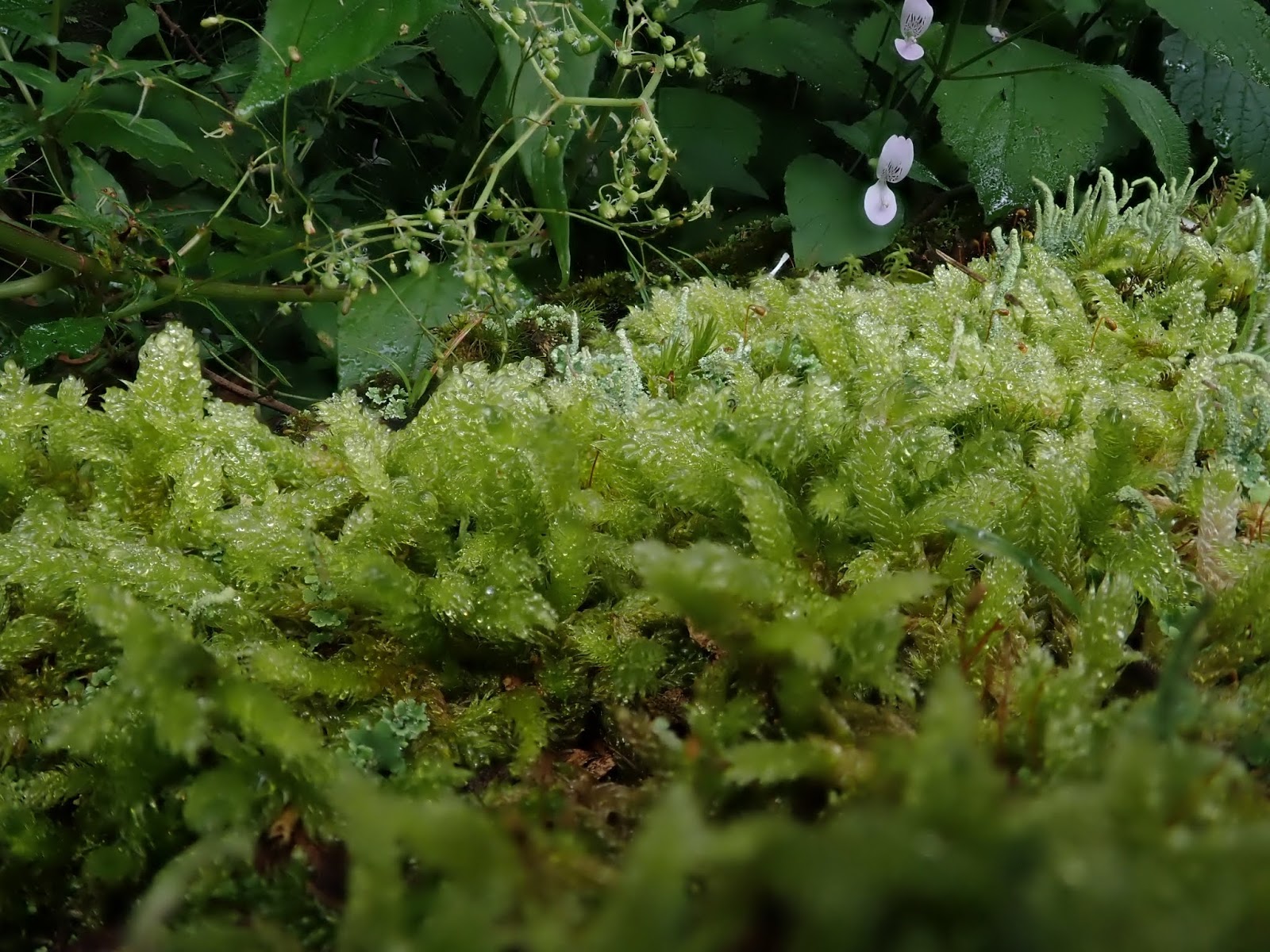
Also growing as epiphytes and lithophytes in our forests and forming extensive, soft, cushioned mats is the primitive fern-like Forest Spikemoss, Selaginella kraussiana. Origionally from Africa, these plants are now cosmopolitan and are regarded as greenhouse weeds in many countries and is a declared weed in New Zealand.


Still in the forests, search the moss and lichen covered branches and you may find this minute lichen, Usnea pulvinate, a very close relative to the eerie Old Man's Beard lichens that hang from trees up in the mist belt.


That's it for March. The days are getting shorter and the morning have cooled down a lot as we enter autumn. Come visit when you can, we look forward to it!

Tuesday, 5 March 2019

February 2019

FEBRUARY 2019


With a final total of 244mm of rain for January and then a further 122mm for February, the Estate is looking lush and green. The place is full of life, with me having sightings of some special birds this last month, including Ground Woodpecker, Orange Ground Thrush, Yellow-throated Woodland Warbler,Starred Robin and Blue-mantled Crested Flycatcher, amongst others. Game viewing has also been very productive due to the fresh, green growth after the fire. A ten kilometer hike in the mountains is almost definitely going to net you Eland, Mountain Reedbuck, Vaal Rhebok, Klipspringer, Common Duiker and Baboons. Below is a gallery of some of the wildlife I have encountered over the last month:


Two years back I found this tiny, strange looking flower in a spongy seepline above Little Joker Mine in the southern section of the Estate. I did not manage to identify it and placed it in my unsolved file on my laptop. A year or so later the laptop crashed and I lost a bit of information, including my Unsolved file, and then, by pure luck, I stumbled onto the identity of the flower while reading over some notes on ecology in the grasslands. I was excited but now I needed new photographs of the plant for my files. I returned to the area last February and did not find the plant, I think because it was too dry. This February I returned to the area on a hike with the Harwoods from Bulldozer Creek and, Hallelujah, there were plenty of them! It's a Corkscrew Plant, Genlisea hispidula, from the Lentibulariaceae, the Bladderwort Family. It is a carnivorous plant that lives in the water in marshes. It has two distinctive types of leaves, normal club-shaped leaves at the base of the plant that photosynthesize, and then special modified leaves below the surface that fulfill the function roots would normally. These specially modified leaves also have hollow, cylindrical spiral segments with backward facing hairs that trap microorganisms, like protozoans, and extract nutrients from them! 


In mid summer, the ubiquitous Brown-veined White butterfly, Belenois aurota, needs little introduction. This is because they are everywhere, all generally moving in a north easterly direction. The migration is not well understood but it starts in the south east of the country and moves north east right over the southern African landmass, picking up more and more individuals as they go, laying their eggs on their chosen host plants and feasting on high energy nectar while pollinating millions and millions of flowers en route. They then fly off shore into the Indian ocean and perish there...…


More common in the lowveld bushveld than the mountain grasslands, the Yellow Pansy, Precis hierta, is still a common site in mid summer on the Estate. The males of the species establish rather vague territories in open grassland, hoping to attract as many females as possible.


This is the closely related Blue Pansy, Precis oenone, which is also commonly seen on the Estate in Mid summer. The males also establish territories, but well-defined ones, that they vigorously defend against other males. These territories are situated on the tippy tops of hills.


This is the African Leopard butterfly, Phalanta phalantha aethiopica, not as commonly seen as the above species but very noticeable.


I was very excited to find this Amethyst Fruit Chafer beetle, Leucocelis amethystine, enjoying the nectar on a beautiful pink Asterid flower that I had not yet seen on the Estate. Mmmnnm! Where had I seen this flower before? Then it struck me! A Pompom Weed, Campuloclinium macrocephalum, an ornamental originating in North America! I immediately removed the plant with its woody rootstock, which was not very large. The Agricultural Research Coucil is quoted as stating that this plant "is rapidly becoming the most serious threat to the conservation of grasslands in South Africa!". This has become a serious pest in the Witwatersrand and I will stay on guard and make sure it doesn't happen here.


The spectacular but short-lived, aromatic flower of the Cape Gardenia, Rothmannia capensis, photographed from the small stunted individual that grows on the cliff by K15. The cliffs between Kingfisher Lodge and K15 and the between K15 and K22 are full of these small, shapely trees from the Coffee family but this is the only one reachable. The hard-skinned, edible fruits are round and larger than a ping pong ball but smaller than a tennis ball and not very nice tasting. Baboons and monkeys love them, though, and usually pick them from the tree before they ripen properly. If they do manage to ripen and fall to the floor, they are quickly gobbled up by Bushpig, Bushbuck and Common Duiker.


Often when hiking through the grasslands, one may encounter small blobs of frothy spittle clinging to the smaller branches of bushes or grass stalks. If you feel around inside this froth, you will expose a small insect which is the nymph of a Spittle Bug or Frog Hopper, from the Cercopidae family of bugs. This little nymph attaches itself to the stem with its proboscis and proceeds to suck the plant juices so copiously that, after filtering out the nutrients, it mixes the waste water with air and a waxy glandular secretion to make it froth and cover it's whole body. This spittle protects the nymph from the elements and potential predators. The adult looks like a tiny frog and has the ability to jump huge distances, hence the common name, Froghopper.


This beautiful specimen of a Silver Vlei Spider, Leucauge sp. (Metidae), waits patiently for an unsuspecting flying insect to get snared in it's web after an early afternoon shower.


During mid to late summer, the grasslands become spotted with the bright pink flowers of the Watsonia pulchra. 


A close relative of the Watsonia above is the much smaller, and therefore less noticeable Gladiolus elliotii. This year it is flowering like crazy ujp in the high altitude grasslands. Perhaps stimulated by the recent grass fires?


The endemic Transvaal Dwarf Chameleon, Bradypodion transvaalensis, is the only species of chameleon found in this area. Males and females both establish overlapping territories which the male defends more vigorously than the female. When defending his territory, the males rarely fight because a very colourful display involving postures is usually enough to drive away rivals. The males also achieves these bright colours (not shown) when courting a female.


Mid summer is also a great time to adventure in the African temperate forests on the Estate. All the rarely seen birds I mentioned at the beginning of this blog, except the Ground Woodpecker, are found in this biome. Keep reading to see some other treasures of the forests...
The Earthstar Fungus, Geastrum saccatum, is a puffball mushroom with a difference. The thread-like mycelium of the fungus body spread through the leaf litter on the forest floor and begin the process of decomposition. The fruiting body (mushroom) then begins to develop just below the surface of the leaf litter. Unlike other puffballs, this one has two dermal layers and when the body is developed, the formation of Calcium oxalate crystals on the inner side of the outer dermis stretches the surface, forcing it to split and invert. This motion clears the leaves lying on top of the fruiting body, exposing it. At this stage, if you squish the puffball, a puff of spores, like dust, is ejected from the valve on top. 


Another fungus to look out for in the forest is the Jelly Brain Fungus, Tremella mesenterica. This very well named fruiting body is slimy and almost transparent when it has expanded after the rains. Before it is moist enough, the fruiting body is shrunken, dark and woody. In the jelly state, it is said to be quite tasty in stews!


The fruiting body of the Golden Bracket, Phellines gilvus, also swells with moisture to form brackets with beautiful colours. These fungus, however, can dessicate and survive over winter till the next rainy season when it will swell again after sufficient rainfall.


Look carefully enough on the forest floor and you may find a small colony of Granny-bonnet Orchids, Disperis fanninae. Like a bunch of clansmen hiding in the shadows...


The beautiful Streptocarpus cyaneus adorns the floors and walls of the forest gorges from Christmas till the end of February.


The much rarer and endemic Streptocarpus wilmsii found as epiphytes on forest tree branches, or as lithophytes growing on the rocks on the forest floor. This plant is only found in this area so many botanists come in search of it for their lifer lists!


Whilst on a forest walk with Joel from Morrin Pools, we encountered many of the above goodies and also this cutest
  little gastropod! Fully stretched, the little blighter didn't even reach 15mm. His/er little shell was not even 5mm in diameter. I am in the process of attempting to identify it. When this happens, I'll let you know... 


Well that's it for February. A short but exciting month. It seems like there is still lots of rain to come. Maybe lots of rain at the end of summer and during autumn like last year. At least this season we had decent rainfall in springtime and during the growing season. We hope to see you soon!