Wednesday, 2 October 2019

September 2019

SEPTEMBER 2019


September, spring month, has come and gone. Like last September, I was hoping to get some spring rains but, alas, it was not to be. We had a few cold fronts come through but they were not moist enough to bring rain although those in the latter part of the month were very cold (down to 4 degrees centigrade!) due to snowfall further south on the Drakensberg range. The photo above was taken facing north from the Miner's Cottage during one of those cold fronts and, as you can see, it is very dry and everything that grows is waiting in anticipation for the first rains. I've had more than one of Finsbury's old timers tell me that they have never seen the river levels quite so low as they currently are, although the fishing has still been pretty good.

Anyway, even though I was away for almost half of the month, I still managed to see and experience a whole bunch of interesting wildlife. Below is a gallery of some of it:


One of the very first trees to flower in the springtime is also one of the most common trees on the Estate, the Ouhout (Oldwood), Leucosidea sericea from the Rose family. Although the Rose family is a large one, it is not well represented in Southern Africa with this species, the African Almond, Prunus africana, three species of Rice Bush, Cliffortia spp and a few indigenous Brambles, Rubus spp the only indigenous representatives on the Estate. We do, though, have at least ten species of exotic Rosids present on the Estate, some harmful and being removed and some naturalised. Two notable naturalised exotics are flowering now, the beautiful pink blossoms of the Peach, Prunus persica, dotted all over the riparian areas of the Estate, and the lovely white blossoms of the Apple tree, Malus pulima, found at the parking spot for M3 near Morrin Pools (Unit 14). The Ouhout is an encroaching species, which means that, although it is indigenous, it will dominate areas that have been disturbed in the past, in our case through mining or alien plant removal. In pristine mesic grasslands they still occur but in much smaller numbers. In these areas they have historically been used as an indicator species: the spots along the mountain streams in which they occur are optimum habitat for the release of Rainbow Trout, Oncorhynchus mykiss!    


I have been rather lucky with my spider sightings in the last year or so with the discovery of a new species almost every month. This is a common and widespread species, the Wolf Spider, Lycosa sp, and although it is strictly only active during the night, it is easy to find by it's brightly reflecting eyes in torch light. These spiders are hunters and do not use silk and web to catch their prey but instead roam the countryside in search of arthropod prey on which they pounce and subdue with their venom. They are easy to identify because they have three rows of eyes: a lower row of four smaller eyes, above that a row of two large eyes and above that, another row of two large eyes. Another identification aid is the fact that the female carries her egg sack with her while she is out hunting. When the spiderlings hatch, they remain on their mother's back until at least after their first moult, very much like scorpions do.


Sticking to arachnids, this is a photo of a Red Spider Mite of the Tetranychidae in the subclass Acari (Ticks and Mites). The picture is of poor quality because the mite has had to have been magnified many times just to get a look at it. With it's legs outstretched it still does not reach two thirds of a millimeter! Although so tiny, this mite is an enormous pest on plants as is sucks the contents of individual plant cells dry, mainly because of its breeding habits where a female, sexually mature at only five days old, lays up to twenty eggs per day for her lifespan of about a month. They are also very difficult to find on plants because of their small size and the fact that they reside on the underside of the plant's leaves. One giveaway is the presence of silk on the plant that is spun by the mite to protect itself from predators and the elements.


This is an underwater shot of two different species of Mayfly nymphs in a fast flowing stream originating from Goudkoppies. They are easily identifiable due to the three hair-like filaments protruding from the rear of the abdomen and the seven pairs of gills sticking out the sides of the abdomen. They belong to one of the most primitive insect orders, the Ephemeroptera which means "winged for but a day". The nymphs (above) may take up to two years to mature but once the adult emerges from the water it will only live from a few hours to a few days, depending on the species, with its only function to find a suitable mate. Even though these insects are small and unnoticeable, they should be well known to the Finsbury folk as they are the primary insect imitated by artificial flies used by fly fishermen. The nymph is imitated with wet flies and the adult is imitated with dry flies


The beautiful but tiny little flowers of the Clumpy Strawflower, Helichrysum caespititium, which grow in the form of little mats lying flat on the ground in shallow soils. They occur all around the office area on the Estate, particularly around the helipad and the rain gauge, and also atop the highest peaks where the soil is shallow and rocky. This little plant was found to be useful in medicine as a anti-microbial agent at the turn of the century when a new phloroglucinol was isolated from the species. A phloroglucinol is an organic compound that is used in the synthesis of pharmaceuticals and explosives. This was an important discovery since the cytotoxicity of contemporary antimicrobial drugs was a huge problem, and H. caespititium offered a solution. If you google the genus you will find endless information of the traditional and scientific uses of the plants. The genus consists of almost 250 species in Southern Africa, with the majority in the Fynbos biome and 19 species, so far, here on the Estate, with at least ten more to identify. Many species are particularly suitable for dry flower arrangements and are commonly known as Everlastings, Paper Flowers or Strawflowers. 


I visited Mike and Angela from Lone Tree Cottage (Unit 3) one evening to glean as much information as I could on the grasses found on the Estate, Angela's specialty. Besides having a ball, I also encountered some of their local fauna. This one is a Silver-striped Hawk Moth, Hippotion celerio, from the Sphingidae. Hawk moths are rather special lepidopterans from their sleek beauty to their speed to their pollinating specialities. They are among the fastest of insects with flying speeds up to 18 km/h and they are one of only four nectar feeders that evolved the ability to hover before a flower. The others are Hummingbirds, some bats and Hoverflies. Also, rolled up beneath their chins, they have a long probiscid (the Hummingbird Hawk moth's is almost 30 cm long!) used to suck nectar from flowers. In the early evening when a Hawk moth is preparing to forage, it will begin vibrating it's wings to warm up it's muscles. Then it will fly out into the evening and locate flowers mainly by scent. About 30% of Southern Africa's Orchids rely on moths to pollinate them. Orchids are specialists in securing very specific pollinators through their intricate flower design. Many orchids have very long spurs protruding from the back of the flower with nectaries right at the end of the spur. Only Hawk moth species with probiscids long enough will normally be able to reach this energy rich food source and so complete pollination more acurately as soon as it flies to the next flower, which will most often be of the same species. Clever, huh?


This was another one the fauna we encountered at Lone Tree Cottage that night. It is a Wahlberg's Velvet Gecko and it featured in my blog in March this year. That one I stumbled upon outdoors at Kingfisher Lodge (Unit 6) and this one is almost always indoors. Look at the colour difference, this one is much paler! Besides being spectacularly beautiful, this chap certainly is the biggest danger to that Hawk moth that I photographed just prior to this. His strategy is to lie in wait near the artificial light and ambush insects attracted to the light, which are mostly moths!


Another insect that is frequently attracted to artificial light is the Red Driver Ant, Dorylus helvolus. The one pictured above is the male who flies about at night in search of the scent of a colony. He looks more like a wasp than an ant and if you pick one up, it bends it's abdomen towards your fingers as if it is going to sting you. But never fear, there is no stinger! The colony, however, is filled with females only and they look like normal ants with big jaws...and stingers! The colonies normally consist of a couple of hundred thousand minor and major workers and soldiers but they can become huge, especially in central and east Africa, where they can consist of up to 50 million individuals! In places where the colonies become so big there will be certain times in the year when there is simply not enough food for them so they become nomadic and move through the bush in huge columns overpowering and consuming everything in their path. Even small vertebrates and immobilised large ones too. The first and only time I ever saw a marauding colony was a few weeks ago in the coastal forests of Kosi Bay, northern Kwa-Zulu Natal. Some Masaai in Kenya even guide these marauding colonies through their villages where they devour all pests from cockroaches to rats! The east Africans even use the soldiers' jaws as emergency sutures on open wounds: they hold the wound together, pick up an ant and force her to bite on each side of the wound, then break her body off. This is repeated along the length of the wound and the jaws remain attached and seal the wound like sutures. Anyway, once the male finds a colony he lands among them where they immediately rip his wings off and carry him back to a queen in the nest. 


What a great shot of a Brown Hyaena, Hyaena brunnea, taken by the new camera trap up on the junction of Loop road and the Cycle path, and at 08h00 in the morning! Although associated with more arid areas, this scavenging carnivore can survive in a wide variety of habitats. Although they scavenge alone mostly, they live in extended families where the previous offspring stay with Mom for a few generations, helping to raise the next offspring and the next. Males are more prone to leave the clan and the bigger and more successful of them roam around huge areas as rogues. The females in the clan do not mate with clan males, since they are all related, they only mate with these rogue males who are welcomed by all clan members during female oestrus cycles. Unlike their larger spotted cousins, Brown Hyaena do very little hunting of their own and if they do, it is for small mammals and other vertebrates, otherwise they are strict scavengers.


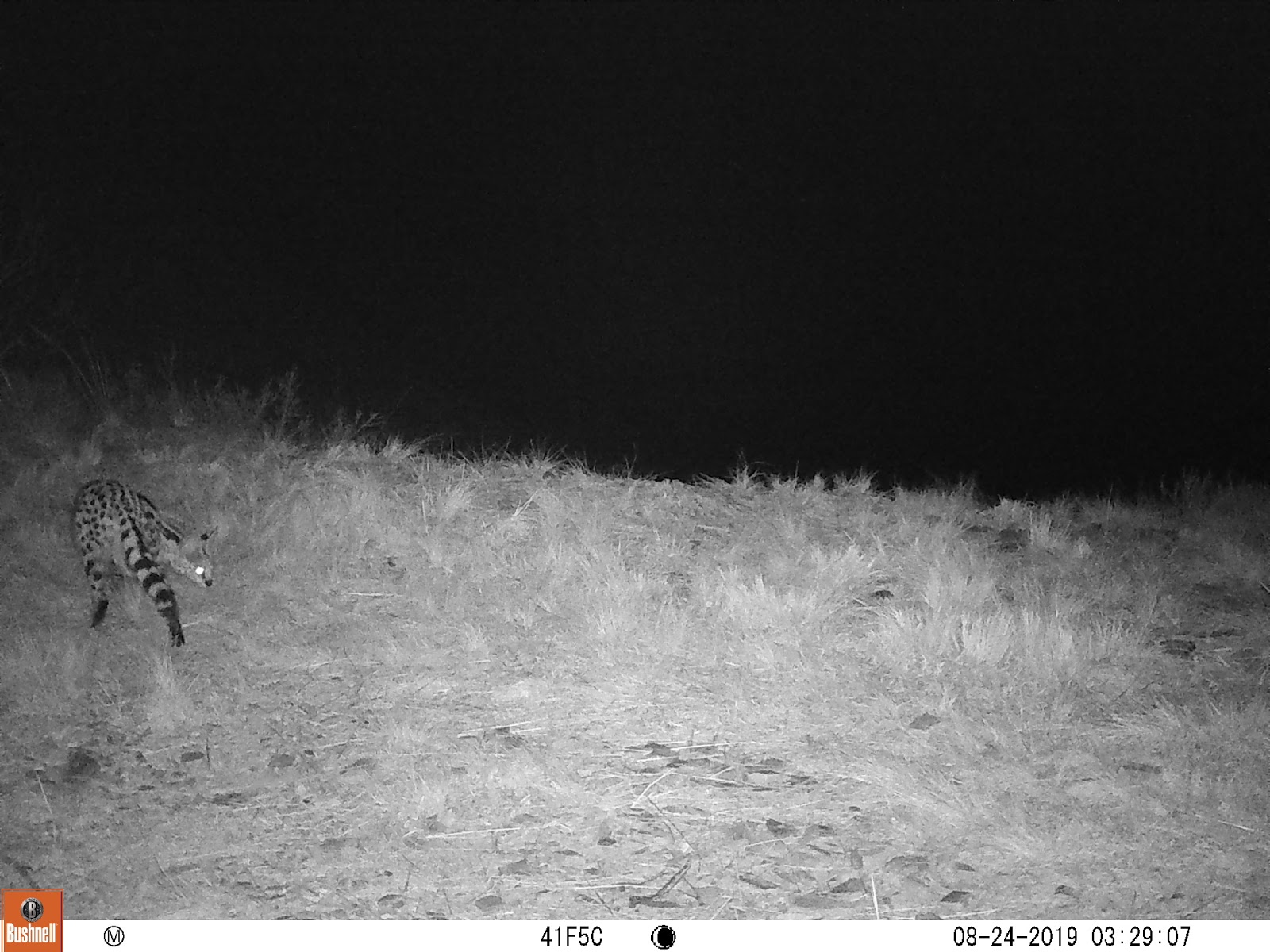
Another carnivore caught on the same camera trap last month, a Serval, Leptailurus serval. The grasslands of the Estate are optimal habitat for this solitary hunter of rodents. Upon hearing a rodent busy in the grass, usually from four or more meters away, the Serval will stand dead still until it pin-points the rodents position with those huge ears. Once it is sure of its prey's position, the spotted cat will launch itself into the air, up to two meters up and as far as four meters, and land directly on top of it's victim!


But what made these camera trap sightings so special is the time/date stamp. This Rooikat, Caracal caracal, appeared on the scene, in the same place, less than one and a half hours after the Serval, also sniffing around. Much more powerfully built than the Serval, the Caracal prefers a more wooded habitat than our grasslands and subsequently is much rarer than the Serval here on the Estate. The Caracal targets much larger prey items too, up to the size of a Common Duiker, which it can hoist into a tree just like a Leopard. So that's three special carnivores photographed by the camera trap up on Loop road in less than three weeks. Groovy!


Graeme Naylor from Cochy-Bondhu (Unit 1), a lover of orchids and all else natural, showed me an epiphyte orchid growing on the trunks of forest trees close to the Majubane waterfall. I told him I would keep an eye on them and photograph the flowers when they bloom. Well, Graeme, is it not beautiful? It is a Polystachya ottoniana orchid and all the other flowers were still just buds while this one had just opened by the last day of the month.


That's it for this month. Let us hope that October is the month that we get decent rainfall so that the water levels can increase and all this life that is on hold, will burst forth. We look forward to your visit...

Tuesday, 3 September 2019

August 2019

AUGUST 2019


The intense cold of July dissipated nicely this month although we still have had a bunch of really cold mornings. We had a few cold fronts that came with clouds and one that even threatened rain. It seems that spring wants to arrive sooner than usual this year as you will see in the next few photos. Below are shots of interesting goodies that I have seen and experienced in the month of August:


A pair of Raucous Toads, Amietophrynus rangeri, performing amplexus just beneath the surface of the water in the beautiful pond outside Finsbury House (Unit 23). Both the english and afrikaans name, which is "Lawaaiskurvepadda", are very descriptive! The afrikaans "Lawaai" means to "let loose", particularly with sound. The raucous cacophony started a little earlier than usual  this year at the normally peaceful Finsbury House. And so we were drawn to the water's edge to see what all the noise was about and found a frenzy of activity in the grass there.  Note how the female has her nictitating membranes or "third eyelids" partially opened while the male has his closed, protecting the eye.   


The best way to distinguish between a male and female frog is to look under the chin. The male has a gular sack which can inflate to massive proportions to amplify sounds. The female, like whose chin you can see in the previous picture, has no gular sack so she cannot produce the loud noises of the male. When ready to mate, the males will approach the water and space themselves in and around it's edges. They begin calling and the louder individuals get more mating opportunities because the females are attracted to the louder calls. Once a much bigger female finds a male, they enter the water and begin the mating process that is called "amplexus". During amplexus, the male mounts the female and his sperm runs down a ridge on her back and fertilises the eggs as they are excreted in their thick jelly strings. This is an underwater shot of the egg strings tangled in the grass at the water's edge soon to hatch in to tadpoles.


A real spring-time scene, isn't it? It's big, beautiful Citrus Swallowtail butterfly, Papilio demodocus, sucking the sweet nectar from one of those Gnidias I talked about in my last blog. The butterfly's common name is derived from the fact that it's larval foodplants are all from the citrus family (Rutaceae). Here, on the estate, this includes the impressive Cape Chestnut (Calodendron capense), the stinky Perdepis (Clausena anisata) and the thorny Forest Knobwood (Zanthoxylum dayvi), all forest trees. The larvae or caterpillars hatch on the foodplant and enjoy great camouflage as they stuff their mouths because they resemble bird droppings, at least for their first four instars. The final instar is not as well camouflaged but it does have an organ on it's prothorax called an osmeterium. When threatened, the caterpillar fills this organ with fluid and it unravels resembling a bright red snake's forked tongue and emits a foul odour, keeping predators at bay. 


This tiny Olive Lesser Thick-tail scorpion, Uroplectes olivaceus, is only 35mm long. it is very common here on the estate but is rarely seen because of it's size and nocturnal habits. They spend the daylight hours hidden beneath stones and rocks and emerge at night to actively hunt their insect prey. Most prey items are crushed by the pincers before the scorpion begins feeding but larger items are also subdued by the neurotoxic venom injected by the stinger at the tip of the powerful tail. Once subdued, the scorpion bites off pieces of  insect and lets this dissolve into a liquid together with digestive juices in a chamber outside the mouth. Only once liquified does it swallow it's meal. Scorpions have a bad name but of the 1750 species known only 25 are dangerous to man. In fact, in South Africa only 2 species are dangerous and they are the Transvaal Thick-tail. Parabuthus transvaalicus, which is less so but common in the Lowveld, and the Granulated Thick-tail which is the most dangerous and inhabits the more arid regions of Southern Africa. This little chap is harmless but its sting packs a punch in the pain department!


The beautiful flower of the Dolomite Sage, Salvia dolomitica, from the Mint family (Lamiaceae). The upper lip of the corolla arches over the pollinator as it settles on the flat lower lip with it's guide marks to the nectar. The Dolomite Sage is very particular where it grows and is endemic to Mpumalanga and Limpopo only between 1200 and 1900 masl and only on dolomite outcrops. This one is situated at the top of the driveway to Solitude (Unit 5) and they are also easy to find around the Bag End gate on the entrance road in Rivendell.


Our local Bushbuck ram around the central area is a rather handsome one. This photo was taken from my living room where I see him regularly and if I move slowly I can get even closer to him. The Bushbuck, Tragelaphus sylvaticus, is common in the wooded valleys of the estate and is certainly the antelope most commonly seen by flyfishers. The female is a lighter brown, much smaller, has no horns and is most often seen together with a youngster. They are the only solitary antelope in South Africa that are not territorial. Instead, both sexes establish home ranges (that are not vigorously defended) of about 5 hectares in size that overlap each others'. These common areas are used for socialising and for males to show their dominance over other males. This is done rather peacefully and they rarely fight over females in oestrus. I did once, though, hear a crashing sound above me on the slopes while I was in the Steenkamps Valley east of Rock Solid (Unit 22). When I investigated, I saw two large Bushbuck rams fighting violently. With their horns locked together, they tumbled a good 30 meters down this steep slope before they righted themselves. They only broke it up when they saw me. Although relatively peaceful towards each other, Bushbuck are well known to be very aggressive towards other species, dominating waterholes during droughts and killing gun dogs belonging to hunters. I have heard that a hunter or two have also been victim to the buck's aggression.


A great underwater shot of a quick moving and alert Damselfly nymph at the bottom of the plunge pool by Fern Tree crossing high above Solitude (Unit 5). I featured a Damselfly adult, the Mountain Malachite, in my May blog for reference. With specialised appendages at the tip of her abdomen, the female Damselfly cuts a slit into tender green stems of vegetation overhanging the water and then deposits a single egg into it, a procedure she repeats many times. Once the egg hatches, the nymph drops into the water where it is an aggressive hunter of Mayfly nymphs and other arthropods. The three paddles at the end of it's abdomen are tracheal gills that aid in breathing in it's watery environment. Folded invisibly under it's chin is it's "mask" or foldable, elongated lower lip that can shoot out and grasp it's prey and then fold back, bringing it's prey to it's mouth. When it is fully grown, it will crawl out of the water up the stem of a plant and attach itself there. The nymphal skin then cracks up the middle and the adult emerges.


A bright red blooming inflorescence of a Woolly Bottlebrush, Greyia radlkoferi, growing in the gorge at the first crossing on the Miner's Cottage road. Among the first of our trees to flower in the springtime, the flash of colour is awesome after a long, dry winter. Two species occur on the estate and they are very similar and difficult to differentiate from afar. Up close, though, the Woolly Bottlebrush's flowers are less dense on the inflorescence and the petiole is more fleshy and it clasps the stem while the Transvaal Bottlebrush, G. sutherlandii, has a more compact infloresence and the woody petiole's don't clasp the stem. Whatever the difference, the Sunbirds are happy. If you sit by a blooming Bottlbrush tree for two minutes you will get to see at least one Sunbird visiting the flowers for the sweet nectar. Also, from afar, the Bottlebrush is often mistaken for a Coral Tree, Erythrina lysistemon, but the latter do not occur on the estate. I did see one flowering near the road, down the slope about halfway up Klipspringer hill in Rivendell. 


A Jumping Spider from the Salticidae family, the largest of all spider families with more than 6000 species worldwide, perches atop a stone to search out potential prey. An amazing creature with four pairs of eyes that give it 360 degree vision and hydraulically charged legs that enable it to jump relatively massive distances. The two large front eyes are like telescopic lenses and they can see in four colours, our three plus the ultraviolet. Because their eyes are less than a millimeter apart, they cannot judge distance like we can so they judge distance accurately by focus-shifting instead, remarkable! With these abilities the Jumping Spider does not need silk to help capture prey. But every time before it jumps, the spider attaches a safety line to the substrate so that it can recover if it fails. They also use silk to construct little pup tents that they rest in during bad weather and in the night time. 


I busted this little guy stuffing his face with the petals of a beautiful Mountain Iris, Moraea moggii, although he maintains his innocence. I think not. His proximity to the scene of the crime (top left of photo), guilty look and the give-away petal pulp around his mouth confirm my suspicions...


This is an Acraead butterfly that I still have to try to identify. Unfortunately I did not get a look at the top side of the wings. But here it sucks the nectar from a Gazania krebsiana blooming on the road to the Miner's Cottage. Spring time is upon us!


I will be enjoying the climate and  many other opportunities offered to me in Kosi Bay for the first fortnight of September. When I return Spring will here in full! See you then.

Monday, 12 August 2019

July 2019

JULY 2019


July has come and gone and, although we did have a couple of cold snaps where the temperature at seven am was minus three, it was pretty mild. Almost all July's days were typically blue-sky sunny days like the one above of Mount Anderson viewed from the top of the waterfall near the Miner's Cottage (note the cottage in the bottom left of the picture). I have spent a lot of time in the area where the picture was taken during the month with my team moving in to eradicate the Pine plantations on the road to the Cottage. Exposed life is at it's minimum during this time but I still managed to photograph a bunch of interesting goodies:


Walk the mid to high altitude grasslands in the middle of winter and you will be forced to notice the small bush with yellow flowers dotting the landscape. They are Gnidia canoargentea from the Thymelaeaceae, a family of mostly poisonous plants with floral tubes with sepals attached, represented on the Estate by at least three species of Gnidia, the Mountain Gonna, Passerina montana, and the showy Pom Pom  Tree, Dais cotinifolia. The more common, summer blooming Gifbossie, G. caffra, is poisonous to livestock and well-known to local farmers. Of the 150 species of Gnidia, more than half are endemic to Southern Africa. 


Can you see it? Mostly just the eyes! I'm sure most of you know the Crab Spider, Aniphops of the Selenopidae, from their habit of lying flat on your bedroom wall and running sideways, like a crab, when frightened. In the wild, they are found on and among rocks, under which they take refuge when not active. Unlike the Aranea, who represent more than half of spider species and spend their active and resting time in or around their silken webs, the other group of spiders, the Megalomorphs, of which this is a member, roam freely and hunt for food like a leopard would, sneaking up to and pouncing on it's prey. With a modus operandi like this, concealment is of utmost importance and this little chap has it just right!


This skull and horns are the remains of an Eland who succumbed in the high altitude grasslands near Goudkoppies some time ago. Hollow-horned ruminants, which include all antelope type ruminants from a buffalo, bison, musk-ox to a goat, duiker and a steenbok, form the Bovidae family of ungulates (Mammals that walk on their tippy-toes). What differentiates them from the moose, elk and deer-like ungulates of the Cervidae, the other family in the group (Ruminantia) mostly from the northern climes, is the fact that the bovid's horns are solid bone attached to the skull with a keratinous sheath enveloping them, whereas the Cervids who grow horns (called antlers), grow them for a season then shed them afterwards. The keratin that makes up the horn sheath of the bovids, is made up of the same substance that makes up our hair and fingernails and there are only a few animals that can digest this hard type of protein and they are all insects or smaller organisms, eg: fishmoths, clothes moths and some protazoans and bacterium. In this case, the female Horn Moth, Cetratophaga vastella from the Tineidae, lays her eggs on the horns of a dead bovid and on hatching, the larvae burrow into the keratin and devour the horn sheath. The caterpillars construct tunnel-like cocoons from silk, strengthened with faecal pellets and collectively, these cocoons hang off the horns resembling dirty dreadlocks! Once the pupal stage is complete, a small, pale, slender moth with a pom-pom head emerges. Once all the keratin is consumed, we are left with bleached skull with horns like in the old western movies! 


Brrr! We certainly have had some chilly mornings during the month of July with the mercury showing minus three degrees on at least three occasions. Andries Maphanga, our New Holland tractor operator alerted me to these beautiful grass-blade popsickles at the base of the splashing water tank at Vakatsha (unit 9). 


This Cormocephalus centipede from the Scolopendridae was exposed and disturbed by me when clearing rocks up near Goudkoppies. I always feel guilty when accidentally exposing myriapods (centipedes and millipedes) in the dry season because they are very primitive and cannot retain moisture. Insects, being more advanced, have evolved a waxy substance covering the cuticle that helps retain moisture, allowing them to be exposed during dry times. Myriapods, however, need to make sure they are protected from water loss during these times by hiding in damp and shady areas under rocks and beneath vegetation. If a centipede can manage this consistently they may live to the ripe old age of ten years or more! They are predators, unlike millipedes, and use their antennae to search out any suitable invertebrate prey and when located, it will subdue it's victim with a bite from it's pincer-like "forcipules", forelegs modified into hypodermic stabbing tubes. These forcipules contain venom glands and believe me, a bite from one is as bad as a sting from a scorpion. No human deaths have been recorded from a bite from a centipede although those allergic to bee stings should take precautions against these critters as well. Because of their secretive lifestyle and nocturnal habits, centipedes are not often encountered but this is deceiving because, after spiders, they are the most common invertebrate predator in most terrestrial habitats. So common, in fact, that a vertebrate predator in the form of a snake, the Cape Centipede Eater, Aparallactus capensis, has evolved to prey exclusively on centipedes. These snakes are rather common on the Estate 


In my June blog I mentioned a bunch of succulents that can be encountered during the colder winter months. This was one of them, a Crassula swaziensis. They are pretty common throughout  the Estate at all altitudes in exposed, rocky situations. They are extremely popular garden plants for their hardiness, beauty and ease of propagation from cuttings. The leaves, which form rosettes, are bright green when moisture is abundant and become dark maroon during dry times.


An old abandoned nest of a Drakensberg Prinia, Prinia hypoxantha, pointed out to me by Dennis Jooste of Coch Y Bundhu (unit 1) and situated on the small island in K32. About 130 species of South African bird construct ball-shaped nests but the situation (in rank bush just over a meter above the ground beside water), the knitted construction (as opposed to woven) and the dimensions of the nest suggest it belongs to the Prinia. These little birds are monogamous (male and female stay together for life) and construct the nest together, share incubation duties and both collect food for the chicks, a real team effort. Many small birds that construct ball-shaped nests, particularly waxbills and sunbirds, build their nests in close proximity to the papery nests of social wasps referred to in my previous blog. These aggressive wasp neighbours aid in keeping predators away from the bird's nest. This is understood to be a commensal relationship which means it is one-sided as the bird benefits while the wasp is not positively or negatively affected. But when I handled the nest to confirm it's dimensions, a "foundress" Umbrella Paper Wasp (see June blog) and a couple of  her helpers emerged and flew away. I obviously disturbed them while they were over-wintering within the safety of the abandoned bird's nest. Maybe the relationship between the bird and the wasp is not entirely commensal. Maybe it is sometimes mutual as both parties benefit from the labour of the other, the bird benefiting when the wasp scares a predator away and the wasp benefiting with a safe refuge to over-winter. I did not find the remains of a wasp nest nearby but the scene is many months old...


The dainty corpse of the small Grass Jewel Blue butterfly, Freyeria trochylus, floating in M18, the water's surface tension not allowing it to sink. Before finding himself in this situation, the common male Grass Jewel vigorously defended a territory by perching on an exposed twig or grass stem and attacking and chasing away all other male Grass Jewels that entered the area. while females were herded within the territory until they were mated with. The females then searched out the larval food plant, Indigofera sp. (and in the lowveld, the beautiful String 'o Stars, Heliotropium stuedneri), and laid an egg on it so that the larva would have a ready food supply upon hatching. Lying on it's back with head turned, all I needed to see was it's tongue lolling out!


Another beautiful flower blooming in the winter time is the Starry Strawflower, Helichrysum spiralepis, found in medium to high altitude grasslands throughout the Estate.The small bushes are attractive both when the flower is budding with it's dark maroon buds (R) and once it has opened it's pale lemon flowers (L).


A minature geranium, Pelargonium dispar, showing different stages of leaf development. The green leaves in the rear are new leaves emerging while the beautifully coloured leaf is an old one on the way out. Also visible are a few that are dead already The striking flower is that of a typical Pelargonium and can be found in and around forest fringes in late summer and autumn. This small individual is completing it's first year of growth and will flower for the first time at the end of this approaching summer.


While having lunch one day high up on the Rock Kestrel Trail, I looked down to see this caterpillar spinning a web of supportive strands of silk to house it's pupa (chrysalis) in the corner of a broken rock. After hatching on it's larval food plant, the ravenous new larva of the butterfly first consumes it's egg shells before getting tucked in to the food plant. When it has eaten until it's skin is so stretched that it may burst, the caterpillar will shed it's skin and emerge with a looser skin and a bigger head and the first thing it does as it enters it's second instar is eat the discarded skin of it's previous instar, a great recycler!. This process is repeated until the end of it's fifth and final instar when it will leave it's host plant and find a suitable spot to enter it's pupal stage. This is where the above caterpillar finds itself in the photo. Once at has secured itself sufficiently, it's skin will harden and the caterpillar begins the pupal process where it's body liquidises and reforms into an adult butterfly that will emerge, mate and repeat the process. I think this is the caterpillar of one of the Whites from the Pieridae. 


In my April blog, I posted a photo of a Ladybird beetle eating an aphid and spoke about how important they are as predators of aphids. Above is a photo I took of an winged aphid, probably a rare male that hatched at the end of autumn. I say rare because it is the only time we get to see the male as he searches for batches of eggs to fertilise. During the spring and summer months, the female, after reaching maturity within a week of hatching from her egg, will bare two to four young parthenogenetically (meaning as clones without fertilisation by a male) per day! Thank goodness for the Ladybird beetle and the Lacewing larvae (Check the May blog) because , without predation, the number of parthenogenetic offspring from one adult female and her offspring will be around 210 to the power of 15 in only one year! That is an unimaginable number!! Only at the end of the season do they bare male offspring. In fact, many species of Aphid in the world do not ever produce males and breed only parthenogenetically. On the day that I photographed this individual they were everywhere, getting tangled in my hair and beard and getting into my ears. Bring on the predators!


Many of you would have noticed a breeding herd of Greater Kudu, Tragelaphus strepsiceros, hanging around the central area since the fire almost a year ago. These two youngsters, photographed by the water tanks for Otter's Rest (unit 10) and Elsmere (unit 11), are two of four that were born on the Estate during the summer. Kudus certainly occur here although usually only for short periods of time before moving back to the more wooded habitat found in Nooitgedacht and Rivendel and sometimes big bulls stay here more permanently. But this is the first time that I have noticed them, as a breeding herd, spend so much time here. I think this is because of their habitat shrinking in our neighbouring farms due to the fences that have been erected in Rivendel over the last few years. I don't think the situation is critical because if they were too stressed about it they wouldn't breed so prolifically. And it is certainly great to have them here. Welcome!


The days are lengthening and warming up as winter fades and spring approaches. And as you can see, no matter what time of year you come there is always a lot of life here. Come and indulge. See you then... 

Friday, 5 July 2019

June 2019

JUNE 2019


June has come and gone and the days are already getting longer.The grasslands have dried out as you can see from the above landscape shot featuring Mount Anderson as seen from the extreme north east of the Estate. There's plenty of beautiful dry season flowers blooming, especially the succulents. The aloes are blooming fiercely this season and I have had trouble driving these country roads because my eyes have been on the aloes and not the road, and at 90km/h it can be hazardous to say the least! I won't make it this year but I love to visit Berg-en-Dal camp at this time because it is filled with aloes of multiple species, with myriad sunbirds flittering in a frenzie all about. 

We have winter and summer flowering Aloes here on the Estate and the species currently blooming are featured below together with a bunch of other interesting wildlife I have encountered during my work here in the month of June... 


A bunch of Cliff Aloe, Aloe arborescens (arborescens = tree-like), growing in its typical habitat in the Lower Majubane valley (Note the Majubane waterfall in the distance behind them). This common aloe occurs all the way from the cape peninsula around the eastern mountainous side of the continent up into Malawi. It is probably the most cultivated aloe worldwide as an ornamental and it certainly is easy to propagate from cuttings or truncheons. They also grow happily in the shade and if you hike to the Steenkamps waterfalls, just beyond the rope balustrade, look north and you will see the south-facing slope before you is festooned with these plants. And they only receive decent sunlight in the very middle of summer! In the Orient, these aloes are commonly grown in gardens and widely used as a convenient first aid remedy for burns and abrasions, by applying the jelly found inside the broken leaves to the wound. Also very soothing for sunburn.


Although the spotted aloes are very difficult to distinguish from each other, I think these are Aloe affinis (affinis refering to its close affinity with other spotted aloes) also with the Majubane waterfall in the distance. They only occur within 1200 and 2000 meters above sea level and in between northern Swaziland in the south, Mariepskop in the north, Graskop in the east and Lydenburg in the west. The most proud specimen stands 20-30 meters east of Patrick's gate on the right side of the road as you enter Highland Run.


This spotted aloe, Aloe longibracteata, is the easiest to identify because of its elongated floral bracts (hence the specific name). Otherwise it differs from the previous species by its smaller stature and the flower stalks habit of branching lower down. 


Ha! Look at the long blonde bangs hanging over this little orb-weaver's eyes. She is a Hairy Field Spider, Neoscona hirta, and she's only 5mm long when crouched like this. Once she reached adulthood, she remained in the same web and is waiting for a male to find her. When he does, he spins a small little triangular web on the ground and deposits a little sack of sperm onto it, turns around and picks this up with his pedipalps (arm-like appendages). He then gingerly approaches the females web and tugs on the strands. She naturally responds as if this movement is a prey item snagged in her web so he drops down on a drag-line to prevent becoming a meal. He repeats this process until she realises that it is a male and not prey. He then approaches her and deposits the sperm pack in her genitalia and beats a speedy retreat lest he overstay his welcome and does become her prey. She can store this sperm for the whole season using only what is required to fertilise her eggs and saving some for later use on another batch of eggs. She produces an egg-sack in which she deposits her eggs and guards them until they hatch and reach their 3rd or 4th instar. Once ready, the minute spiderlings climb to the highest point of their mother's web, unfurl a strand of silk and drift off into the wind and into the unknown like a lost balloon. This process is known as ballooning and it is how spiders disperse from their mother's nest. Many perish because they land up in unsuitable habitats but those that survive, often do so very far from their birth place. David Attenborough has even collected ballooning spiderlings, alive and healthy, many kilometers above the earth's surface in the upper layers of the stratosphere!


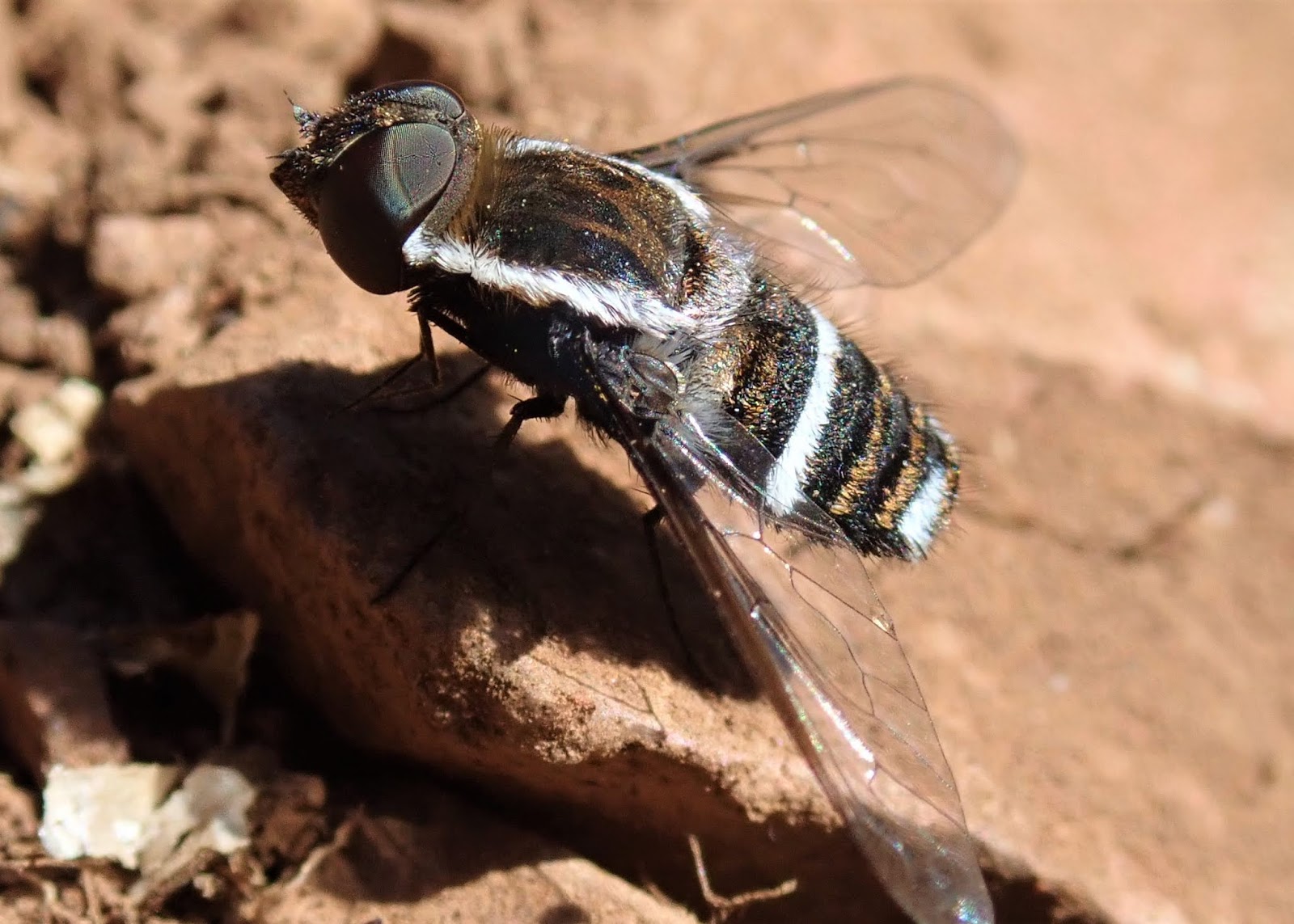
Another beautifully hairy chap. A Bee Fly from the family Bombyliidae in the Diptera order (flies). They are powerful fliers and excellent at hovering. They get all their nutritional requirements from pollen and they will hover over a flower and gather it without landing. The gravid female will seek out the entrance to a tunnel that houses the eggs and stored food of  the solitary bee or tsetse fly that is it's host and lay a solitary egg there. When the grub, fat and legless, emerges from it's egg, it burrows into these chambers and eats the stored food and the larvae of it's host. Locusts are a host to some species of Bee Fly and the larvae will do the same to the subterranean nest of these pests, making them a "good fly". 


This velvety Eucalyptus Weevil, Gonipterus sp., with it's metallic golden eyes, was trying to overwinter in the dried inflorescence of a Phymaspermum daisy on the Rock Kestrel Trail before I rudely interrupted it. Weevils belong to one of the largest of all insect families but are all easy to identify with their cute look of long (some very long) snout with antennae in front of it's eyes. Touch any species and they will immediately sham death by falling onto their sides with their legs outstretched and remain like that for some time, looking quite dead. Many species are economically important as they are pests on specific crops. This is an exotic species, brought here from Australia together with it's host plant: Bluegum (Eucalyptus) trees. It was thought to be one species, Gonipterus scutellatus, but is now one of ten in the "scutellatus" complex and is still to be formally described. And yes, I wrapped it back up in it's cosy overwintering inflorescence.


Another exotic, this fruit capsule of a Jimsonweed, Datura stramonium, is drying out and in so doing splits open and peels it's sides backwards, exposing the 500 odd little black seeds within. Any movement of the plant, either by wind or animal, scatter the seeds about. I remember my generation calling them the afrikaans name of MALPITTE when I was at school, referring to the hallucinogenic properties of the seeds that make a person mad. All parts of the plant contain dangerous amounts of the tropane alkaloids atropine, hyoscyamine and scopolamine, classified as deleriants. The reason it is not utilised in modern times is because the risk of overdose is high, but in older times it was used by the locals in central america to help them commute with their ancestral spirits. The dormant seeds can be buried and still germinate when exposed many decades later and fire also initiates germination. This was realised in the Kliprots valley this past season after the fire of last August when they just sprouted up everywhere, causing me and my team to stop what we were doing and concentrate on removing these plants before they produced seed. The plants are annuals meaning that they die after producing their seeds, so they are geared to growing quickly and I have found that if a plant is uprooted with small undeveloped fruits, the fruits will still develop, draining all the nutrients from the dying plant. This meant that once small fruits were visible, they had to be harvested from the plant before the plant was uprooted. Over a period of about six weeks we filled 46 fish feed bags with these fruits and with about 1000 fruits per bag and 500 seeds per fruit, we are looking at about 23 million seeds that were removed from the area between K33 south to W6.


A Common Dotted Border butterfly sucking up the sweet nectar of a Wild Aster, Felicia filifolia. These small, hardy shrubs are filled with copious amounts of gay mauve daisies that brighten up the drab winter grasslands. They are particularly common on the rocky, shallow soils around Elsmere on the Spekboom stream. Anne has also successfully planted a few individuals outside the office, behind Simon's quarters, and they are flowering even more profusely than their wild cousins!  


After the aloes, the honey-suckle flowers of the Tree Fuchsia, Halleria lucida, are also an important food source for our sunbirds and sugarbirds. Found in the riparian areas, in the Afro-temperate forests and on exposed rocky situations at high altitudes on the Estate, the Tree Fuchsia is one of our more common trees. The tree is unusual in that it's flowers, then edible but untasty fruits are produced directly from the stem, not from the tips of it's branches like most flowering trees. Fig trees do this too, like our Red-leaved Figs, Ficus ingens, and the Stamvrug, Englerophytum magaliesmontanum, which is not found on the Estate but is plentiful on Klipspringer hill in Rivendell farm on the entrance road. This is a very popular garden plant as it attracts sunbirds to it's flowers and many other birds to it's juicy fruit and it's shiny green leaves are attractive against it's dark, fissured bark.


Another succulent is the Kalachoe rotundifolia, found in the shade in steep rocky situations throughout the Estate. This little crassula grows easily from seed and cuttings and blooms for a long period of time, making it popular as a garden plant as well. Other crassulas that are flowering now to look for on the Estate are the Kalanchoe thyrsiiflora, Cotyledon orbiculata (Also planted by Anne, alongside the Felicia filifolia bushes behind Simon's room) and Crassula swaziensis.


Last year in my winter blog (June and July 2018) I posted a picture and a caption of a Cross-marked Sand Snake, Psammophis crucifer,. It is a blotchy and boldly marked snake that pursues it's prey of lizards and other cold-blooded vertebrates. This month I encountered two individuals of the much rarer plain phase, one where we chop fire wood at the central area and this one that James Mackenzie from Pebble Creek caught at K9. The rarer plain form is found around the Arnot area south west of us and the more common, boldy marked form is found here and south of us. Looks like we are lucky here to have both versions of this active, day-time snake.


This Twin Vapourer moth, Bracharoa quadripunctata, was photographed while resting in the thickets at SPK12. The combed antennae identify this individual as a male, while the females have simple antennae (This is so with all moths). When the female moth is ready to mate she releases and advertisement pheromone chemical into the air and a male, as far away as 100 meters, can detect as little as a nanogram (one billionth of a gram!) of this pheromone with these combed antennae. He will then turn in that direction and fly until he finds the next and the next in a zig-zag  until he finds the female, whence they mate. On the extreme, the male moths of the Silkworm, Bombyx mori, can detect a females advertisement pheromone up to 4,5 kilometers away! 


An Umbrella Paper Wasp, Polistes sp. Vespidae, warms up in the sun. In early spring, an over-wintered female, called a "foundress", begins constructing a nest from chewed vegetation material that dries like paper once it has formed (hence the common name). The nest consists of a pliable petiole that attaches multiple hexagonal cells, each surrounded by a potential six neighbours, to the inner branch of a tree or the eaves of your roof. A single egg is laid in each cell by the foundress and guarded by her until they hatch into immobile larvae with voracious appetites that she has to satisfy with pieces of caterpillar until they enter their pupal stage. The adults that emerge from these pupae are all worker females who are completely subordinate to the foundress and their task is to collect food and protect the next brood. The final brood of the season contains males and females who disperse and find mates. The mated females over-winter to become the next generation of foundresses. What I find amazing about such a simple creature is that when she goes in search of caterpillars for her brood, she actually tracks them down by flying low to the ground in search of caterpillar droppings which are not hidden away like the caterpillars themselves. Once she finds these droppings, she flies upwards into the foliage and searches for the hidden caterpillar responsible for the droppings....busted! 


That's all for this month. The temperature has really been very mild this winter but the temperature has plummeted these first days of July so I suspect it will be cold this month. But there is lots of fire wood so come down and cuddle around the fire during the cold and play in the sun during our beautiful sunny, blue-skied days. See you soon!