Thursday, 16 January 2020

December 2019

DECEMBER 2019


It was a jolly season to behold! The temperamental weather featured lots of lightning and dry thunderstorms but it let up enough for everyone to have a great time. It also finally, towards the end of the month, produced 132mm of rainfall which is not too much less than our 164mm average for the last decade. The estate is magnificently green and lush now, with many flowers blooming like the Scarlet River Lilies in the picture above, taken along the high altitude stream above Troutkloof waterfall on the new Zebra hiking trail. With all the outdoor activities happening on the estate over the month, much was seen, from leopard spotted by the Mackenzie's from Pebble Creek to a pair of Oribi spotted several times by the Stewarts and Greens from Jackpot Cottage. Below are some of the many goodies that I got to see over this last month of the decade:


I had to start with this Thread-waisted wasp that I spoke about in last month's blog. You will notice that the bright orange band around the first two segments of her abdomen, from the waist, has faded to almost black and she has a strange protrusion from between her third and fourth abdominal segments and another just before the last one. As mentioned before, wasps are mostly parasitic and their activities make good script for horror movies but it doesn't stop there. In this case the wasp has been stylopised, which means that she is a victim of a horrible parasite from the Stylopidae, a family of insects quite closely related to flies in the order Strepsiptera, The two protrusions from the abdomen of the wasp are either adult female stylopids who spend their entire adult lives protruding from the abdomen of their hosts, or male stylopid pupas, that once pupated, will emerge and fly off in search of a female. They do not kill the host but weaken it and make it sterile. When the female stylopid is receptive, she emits a scent pheromone that will hopefully be picked up by a male, which resembles a house fly slightly, but with branched antennae and clubbed forewings as opposed to a fly's clubbed hind wings. The male lives very briefly, less than six hours, so he may not dilly dally as he searches out these pheromones. Once he finds the female, he must mate with her through an opening on the anterior part extruding from the host, and then he will promptly die. Her young hatch within her, within the host, and eat their mother out from the inside!. These first instar larvae have legs and scramble out of her anterior section and run around in search of new hosts. Once a host is found, the larva attach themselves and secrete a compound that softens the host's cuticle so that the larva can burrow inside it's host's abdomen where they will feed and grow and then pupate, Once the pupal stage is complete, the male flies off and the female remains in her pupal shell for her entire life. 


While descending from Goudkoppies on the new Zebra Trail with a group of hikers, we came across this Red-banded Blister Beetle, Actenodia curtula, from the Meloidae. The bright red and black warning colouration and its slow-moving habits let us know that it is harmful or poisonous and the common name alerts us to the blisters that form on your skin if you fool around with one. The chemical that it contains and secretes through its leg joints when harassed is called Cantharadin, which in very small quantities is the major ingredient of "Spanish Fly", the age old aphrodisiac, but otherwise has been used by traditional apothecaries as a virulent poison for aeons. I remember once when a good friend of mine, while visiting me in the bush, squashed one under the fabric of his jeans. The blisters that formed were so big that we had to cut his jeans. I also remember that we accidentally burst a blister and new ones formed on his skin as the fluid ran over it! We landed up rushing him to the hospital.


This little round, flat-faced frog is called a Plaintive Rain Frog, Breviceps verrucosus, and it is a new species for my Finsbury list, next to the more common Mozambican Rain Frog. Male Rain frogs begin to call from the entrance to their subterranean nest when the humidity in the air increases. Like other frogs, the females respond and are attracted by the call. When she arrives at his nest, the male mounts the female by excreting a sticky fluid from his chest and pasting his little round body to the back of the much larger female and amplexus takes place. A dozen plus large eggs are laid in the nest and on top of that, she lays water-filled sterile eggs that help to keep the real eggs moist. The tadpoles hatch within a larger, water-filled egg and develop there instead of in a body of water like other frogs and they then hatch as froglings. The Afrikaans name for these frogs is "Blaas-op" which means to inflate. If one tries to pull one of these little frogs out of its hole, it will inflate its body so it looks like a little balloon and this makes it impossible to extract it from the nest.


I took this photo because I wanted one of a Click Beetle from the Elateridae. Click beetles are usually very drably coloured so I was excited to see one with aposmetic colouration, which is a bright colour pattern that advertises that the organism is harmful or poisonous. I unfortunately could not find out why this particular species is aposmetic but it must be because it contains some type of toxin. Because Click Beetles are so long and cylindrical, if they turn over, it is unlikely that they will be able to right themselves so they have a ridge on the edge of the thorax that comes into contact with the abdomen,and if they bend their bodies so that the abdomen catches the ridge and then suddenly let go, their bodies spring up into the air with a loud click and they land upright. But what is even more spectacular in the photo is the colours of the flower that the beetle is on. The flower is an Oxygonum dregeanum from the Polygonaceae and when viewed close up like this, the special colours can be appreciated: Powder blue anthers with a sprinkle of silver pollen, bright yellow stigmas set on shiny white petals with a soft blue tinge and pink underparts. Spectacular! 


Although I am crazy about birds, I don't usually mention them in my blogs because my camera is not designed for bird photography. But this little brown job allowed me to come so close that the photo came out. This is one of the three common little brown jobs that we get on the estate that look very similar. When hiking in the grasslands, particularly on rocky slopes, there is a ubiquitous plaintive whistle that can almost always be heard coming from this little bird. It is a Wailing Cisticola, Cisticola lais. The subspecies monticola (above) is the plainest of them all which makes it even more difficult to tell apart from the other common Cisticola in the estate, the Lazy Cisticola, C. aberrans, which prefers the rank bush along the rivers but also spends time on rocky slopes. The only way to tell these two cisticolas apart without hearing the sound is by the slight streaking on the back of the Wailing Cisticola (see above) as opposed to the Lazy Cisticola's plain back. The Lazy Cisticola also  likes to cock it's tail like that of a  Prinia. But then we get the Drakensberg Prinia, Prinia hypoxantha, that also enjoys a similar habitat! The easiest way to discern the Lazy Cisticola and the Drakensberg Prinia is the presence of streaking on the breast of the Prinia compared to the plain breast of the Cisticolas. Then there is a third species of Cisticola that occurs on short grasslands but it is relatively easy to distinguish from the others by the clicking sounds in the call and the wing-snapping when it flies. It is called a Wing-snapping Cisticola, C. ayresii. The Moores were with me when we identified this species and Nick (being British) loved the Afrikaans name which has a lovely ring to it: Kleinste Klop Kloppie.


This crazy, psychedelic bug is pretty horrifying as it sucks the juices from a worker termite. Some time ago I posted a bit on an Assasin bug that feeds exclusively on millipedes, well this one, from the Harpactorinae (not to be confused with the Harpactirinae subfamily of tarantula spiders featured in the last blog) subfamily of the Reduviidae family of bugs, is more catholic in its diet and sucks the juices from anything that it can subdue. The victim is a Nasute Harvester Termite and instead of jaws, it has an elongated, hypodermic "nose" through which it excretes a poisonous fluid as a defense against predators. In this case, you can see a drop of this fluid hanging at the end of its "nose" which has not stopped this predator! 


A very special flower, Zantedeschia albomaculata albomaculata, a Speckled Calla (see the speckled leaves in the background) was flowering this month. I have always pointed out a small colony residing on a ledge on the cliff above SPK12 to those who were interested and I have come across one or two other individuals on the estate over the years. This year, though, I saw at least five individuals flowering alongside the road in Steenkamp's Valley, particularly between Grilse Cottage and Rock Solid. Maybe it is the lack of rain? That's the only big difference between this season and the others since I have been here but it would be odd, since they usually grow in marshy situations...


Now this is quite a spectacular bloom, is it not? It is the flowering umbel of a Brunsvigia radulosa and it can't be missed because it stands up to a meter off the ground. I found this one while camping with the Moore's at the base of the summit of Mount Anderson after an afternoon shower. Like the previous flower, the Speckled Calla, I have seen two of these flowering in the Steenkamp's Valley, close to Bulldozer Creek, for the first time since I have been here.


A close up of the head and thorax of an Emperor Moth from the Saturniidae shows the feathery antennae of the male (the female has simple antennae). Lepidopteran (butterflies and moths) antennae are amazing appendages that are used for navigation in migratory butterflies; plant identification in those who require specific species for development of their young like the Monarch butterfly featured in the Jolly Season blog of 2018; flight stability and recovery in Hawk moths and others; and detection of females in most moths like the one above. The surface of the segmented antenna is covered in olfactory scales, pits or hairs that bind to free-floating molecules like pheromones, water vapour and scent particles. This male Emperor moth can detect a female, through her pheromones, from up to 2 kilometers away!


On my way to the Miner's Cottage recently, I saw a bachelor herd of Greater Kudu, Tragelaphus strepsiceras, on the grassy slopes above the road. Once they reach their fourth year, young Kudu bulls leave the natal herd and join up with a bunch of other bulls in the same predicament and form a bachelor herd, where they avoid the females and with them the aggressive attentions of large dominant, solitary bulls, and where they still enjoy the security benefits of being in a herd. They establish a dominance within this group and stay together for around two years until the lure of females becomes too much and they feel confident enough to go out there on their own and face the hazards of being a dominant male. In the Kruger Park, six year old, dominant Kudu bulls rarely survive past their seventh year due to predation. Being in a herd provides many eyes and ears to detect danger and when it happens, only one of the group will be killed, giving everybody a fair chance. Over here on the estate, a large male leopard is pretty much the only predator that will down a dominant, breeding bull. But a female leopard will still go for these young guns. 


A Spotted Bush Snake, Philothamnus semivariegatus, brought to me by James Mackenzie from Pebble Creek. I featured some of our green snakes in the October blog but did not mention this one because the spotting (which is very mild in this individual) makes it easier to identify. Unlike many snakes, the Spotted Bush Snake is not territorial and is known to travel relatively vast areas in search of food, which is almost exclusively roosting Geckos, although they will also take Chameleons and Tree Frogs. They are also very nervous snakes and are quick to disappear when disturbed. This nervousness also makes them unsuitable as pets as they very rarely feed in captivity, and even though snakes can live a long time without food, a captive snake will die soon enough.


The spectacular fresh bloom of the Common Sugarbush, Protea caffra, dusted all over the slopes of the estate, driving the sunbirds and sugarbirds crazy. As I have mentioned before, these pale flowers are atypical of this species, with the normal flower colour being a light red. In our area, though, this is the "normal" colour and I have , so far, only found two individuals with red flowers.


A big old Giant Dung Beetle, Heliocopris hamadryas. Of the 53 species that occur, 47 are found in Africa with the remainder in Asia. Generally, Dung Beetles are relatively easy to identify because they have flattened, spatulate forelegs and snouts, enabling them to easily mold a blob of fresh dung into a perfect ball. All species of Heliocopris specialise in Elephant and Rhinoceros dung and have mostly become locally extinct together with these pachyderms in unprotected areas. This is the only species that has been able to adjust to smaller herbivore dung like that of cattle and, in this case, Eland and perhaps White-tailed Gnu. This individual is also recognizable as a female because the males have large protrusions from their faces which lead to their common name of Rhino Beetle.


I left the best for last: A Drakensberg Crag Lizard, Pseudocordylus melanotus, that actually allowed Nick Moore and I to sneak within two meters of it! These lizards are around 400mm long including the tail with the females being less colourful and slightly bigger. They excavate scrapes beneath large boulders into which they retreat at the first sign of danger. Males advertise their dominance by occupying a large boulder and making themselves visible to potential rivals with the dark colouration mixed with bright orange a very effective camouflage, from above, on rocks covered by Fire-dot lichens. The gravid females are ovoviviparous, which means that their eggs hatch within their bodies and the young are born alive. 


Well that's it for the year. No, that's it for the decade! 2020 sounds like a sci-fi movie to me and makes me wonder where all the time has gone. We look forward to seeing you all many times this year in these beautiful mountains!


Thursday, 5 December 2019

November 2019

NOVEMBER 2019


Still very dry! We only had 84mm rainfall on the estate for the month of November. And 90% of it fell in just two days. There has been a lot of threatening with clouds and distant thunder as you can see from the above photo of Mount Anderson taken from the west. But, the grass has sucked all that rain up and is thriving and getting greener every day. There has also been some very hot days where 32 degrees has been reached (the lowveld has been averaging in the mid forties!) and all the little creepy crawlies have come alive as you'll see after the next photo...

First though, the month got off to a splendid start when the Springboks won the world cup. The estate was pretty quiet that weekend with only 4 houses being used. The members and guests from three of them were more than enough to celebrate that magnificent victory in the office turned party house!Go Bokke!


Now from rugby to Cricket... In my previous blog I spoke about how some frogs' calls can be quite complex, well the chirping of crickets, like the Field Cricket from the Gryllidae above, have been studied in Europe far more intensely than frogs' calls. Crickets appear to also have quite a vocabulary, with difference chirps for aggression, male beckoning female and male courting female. Also, their chirp rates' frequency fluctuates with temperature fluctuations and this is so reliable that the relationship between chirp rate and temperature is known as Dolbear's Law. Applying this law to the common american cricket, the Snowy Tree Cricket, we would be able to work out the ambient temperature, in fahrenheit, by adding 40 to the number of times the cricket chirps within the time-span of 14 seconds! Even more bizarre: There is a species of parasitic  tachnid fly with auditory organs that is attracted to the chirp of the above cricket, Once it detects the cricket it lays an egg on it and the maggot hatches and proceeds to consume the cricket from within. Since this was discovered in 1975, entomologists have discovered a few species of cricket on some Hawaiian islands that, although endowed with auditory organs and sound production organs, have evolved the ability to find females using more menial methods and do not chirp at all, to avoid attracting the fly! 


In the last blog I showed you a fly mopping up the pollen on a Hypoxis rigidula with abnormally light, lemon-yellow petals. Well ,it seems these flowers are a food source for a whole array of animals. Here, we have two caterpillars munching away at the (normal coloured) petals like there was no tomorrow! The Hypoxis is also very useful to us humans: The plant was recently described as a "Wonder Herb" and corms of the plant are now sold over the counter in health shops. The corms contain a compound called Hypoxiside, which converts to rooperol when it enters the human gut. Rooperol is a biologically active compound that balances the immune system and preparations of this are being used, in primary health care, to boost the immune systems of patients with HIV/AIDS.


This striking beetle is called a Skunk Longhorn because it expels a foul smell when it is harassed. This, and the beetle in the following photograph both belong to the Cerambycidae family and are collectively known as Long-horned Borer Beetles. This common name refers, firstly to the characteristically long antennae, and secondly to the fact that the females of these beetles use their ovipositors to drill into either wood, stems or roots and lay their egg batches therein. The female of this species lays her large batches of eggs in the wood of dead or dying trees, When the larvae hatch, they are voracious cannibals that consume their siblings until the survivors are so far apart that they are no longer a threat to each other. This boost of protein starts them gnawing away at the wood on which they feed. They avoid encountering their surviving siblings' tunnels as they create their own tunnels with the aid of vibration sensing organs, called chordotonal organs, that run along the sides of their fat white bodies. As they grow bigger, so their tunnels become wider but because wood is such a nutrient poor food source, it takes a few years for the grub to reach full size. At full size, they tunnel as close to the surface as they can and pupate there. 


This Long-horned Borer Beetle is called a Pondo Pondo Longhorn, Ceroplesis thunbergii, and it has a similar life history as the previous species. Once the pupal stage is complete, the adult chews its way to the surface of the wood or bark with well developed jaws and uses these to feed on nectar, pollen, leaves or stems of herbaceous plants. If you pick up any species of Long-horned Borer Beetles, you can watch as it rubs the base of its thorax against the rough edge of the elytra and produce a rather feeble sound. Since beetles have no auditory organs and the sound is not particularly frightening, it is uncertain why they would have evolved this ability. No species has been observed using this ability to communicate with others of its species and if there is a link between the ability to produce sounds and the vibration sensing organs in the larvae, then it still has to be discovered.


Forest Num Nums, Carissa bispinosa. zambesiensis, are flowering now which makes it easy to distinguish them by the white blooms in the gloom  of the afro-temperate forests on the estate. The small, bright red berry of this little tree from the poisonous Mikweed family is edible and tasty to boot, even though it contains a milky latex. This tree grows easily from seed and the dark, glossy green leaves, scented jasmine-like flowers and attractive berries, make it an ideal shade-loving ornamental. They are also armed with stout two-pronged spines and if planted in a row a meter apart, they will create an almost impenetrable barrier hedge. 


A close up of a Bark Spider, Caerostris sp. These spiders span a stout line up to 2 meters apart between two anchors and hang there large orb web from there in the night time. When morning arrives the spider dismantles the web, leaving only the initial stout line behind, and then retreats to a nearby branch where it huddles down for the day, looking just like a piece of bark. Now, the literature says that the spider eats the silk of the web when dismantling it so as not to waste the protein, a fact I always found hard to swallow because the webs are enormous compared to the spider. Well, when my daughter visited me a year and a half ago from the US, we were enjoying a walk, with flashlights, around the perimeter of  Shingwedzi camp in the Kruger Park after 10pm.. It was very windy and we encountered a Bark Spider waiting to snag prey on its huge web. I told her the story of it eating the web. She was also skeptical and then as if on cue, perhaps the light and the wind together were too much but the spider promptly began eating its web at a great speed! In less than 2 minutes the entire web, except for the stout line, was gone! I wish we had thought to film it with our phones but we were too stunned to think about it! 


When you walk down the footpaths of the estate, along the rivers or not, there is often a slim wasp that flies from the path before you at ankle height and settles again further along the path. Then takes off  again as you approach and moves further on and settles until you approach and the moves further on and.... This is it, Ammophila ferrugineipes from the Sphecidae family of Thread-waisted Wasps. These solitary wasps dig a hole into the hard ground (of the pathway) and construct a small chamber at the end, only a few centimeters below the ground. Once complete, she memorises the location of the hole and goes off in search of caterpillars which she attacks and paralyses with her sting. She then returns to the hole with her victim, flying cumbersomely (not a real word but descriptive) if it is small enough and dragging it if it is too big, and pulls the still-living worm down into the chamber. The worm was about 10cm away from the hole when the photo was taken. After she has deposited a suitable amount of worms into the chamber, she covers the hole up and expertly camouflages it by sprinkling sand on top. She even picked up the stone in the foreground in the picture, and placed it on top of the covered hole. The wasp then leaves and has nothing further to do with its offspring. After incubation, the maggot hatches from the egg and proceeds to eat the worms who are still fresh because they are still alive! Once the great meal is complete and the maggot is at full size, it pupates and emerges as an adult afterwards. 


This large wasp resembles the previous Thread-waisted Wasp with it's narrow waist but it rather belongs to the social Paper Wasp family, Vespidae. In my June blog I spoke about the beautiful Umbrella Paper Wasp and how the Foundress constructs a nest and has helpers help her raise her young. Well, even though this much bigger wasps looks like the previous solitary wasp it is also a Paper Wasp but tends to be less afraid of human presence so their nests are frequently found under the eaves of houses. I'm sure all the members from the estate have encountered them at their houses here, particularly those from Otter's Rest because we have to remove a whole bunch of nests from there every year. These wasps, unlike the Thread-waisted Wasps, feed their young in the nest pretty much like birds do.


This delightful little furry flower goes by the name of Doll's Powder Puff, Cyanotis speciosa, and it only stands 4-5 centimeters off the ground. It can be found throughout the estate but particularly in shallow soils in rocky situations in medium to high altitude grasslands. The fact that it thrives in full sun, in shallow soils, it reproduces vegetatively as well as by seed and it can withstand drought and flood make it an ideal plant for a Green Roof. In a green roof situation it requires little maintenance as well. If you go to even higher altitudes you may find it's rarer close cousin C.lapidosa, (also excellent for a green roof) which has got beautiful mauve flowers.


This Common Slug-eater, Duberria lutrix, was very reluctant to come out of the debris that it had burrowed into after I disturbed it while clearing the area for my carport. The thick scales on its snout enable it to burrow into surprisingly hard surfaces. This being this harmless snake's only defense except to roll up into a neat ball with its head inside the roll. As its common name suggests, the snake feeds exclusively on slugs and snails who are easily tracked down by the slimy trails they leave behind. it swallows slugs whole while it expertly de-shells snails by forcing the snail body into its mouth while pushing its snout between the snail and its shell. Those who have raised and fed these snakes say that it is very comical to watch the snake's mouth bubble after eating snails.


A small herd of Cape Buffaloes escaped from the Origstad Nature Reserve earlier in the month and I eagerly assisted by checking south and west of the reserve, in the Haartebees Vlakte, for any signs of them. I didn't find any buffalo but I did find a rocky "rainforest", like on the escarpment near the town of Graskop. In this mystical forest, besides the biggest Yellowwood that I have seen in the area, I found a Bottlebrush tree. I have always had such difficulty telling the two species we get here, the Transvaal Bottlebrush (Greyia sutherlandii) and the Woolly Bottlebrush (G.radlkoferi), apart, with the flower of the former being more cylindrical and the flower of the latter being more round. And the leaves of the former being glabrous and the leaves of the latter being hairy, with different individuals have hairier and smoother leaves etcetera etcetera. Coincidently, on the Plant Specialist Group outing I attended last month, I mentioned this difficulty to John Burrows, a well known botanist. He told me that the leaves of the Transvaal one are sticky at the bottom and shiny smooth, I won't get it wrong when I see it, he said. Well, he was right, of course. This one had the clearly cylindrical flowers of the Transvaal Bottlebrush and the leaves were sticky at the bottom and shiny (see insert). This puts my doubts to rest and I can now confidently say that I have NOT yet encountered a specimen of Transvaal Bottlebrush on the estate, only its close cousin, the Woolly Bottlebrush, Greyia radlkoferi. The other one can and should occur here and I will be more alert from now that I finally know the difference.


A Van Son's Thick-toed Gekko hatchling, Pachydactylus vansonii, found right up on the Goudkoppies plains. This 45mm long individual must have recently hatched, together with its single sibling, in the vicinity (The mother lays only 2 hard-shelled eggs). The adult is also boldly marked but with a very different pattern. Strange, though, because everywhere I have looked mentions that this is a lowveld gekko, not found in temperate areas except when transported there by humans (accidentally or not) and associated with houses. There's certainly no houses close to the Goudkoppies plains and it gets really cold up there but clearly they exist there and are breeding there. 


Wow, this moth looks a lot like a butterfly, especially an African Monarch like its name Monarch Looper (Cartaletis libyssa) would suggest. The second part of its common name, Looper, refers to the caterpillar who has less pairs of legs than your average caterpillar, leaving it with legs at the front of its body and at the back of its body. So when it moves, it reaches out and grabs the substrate with its front legs then lifts its back legs and the rest of its body up and brings it forward to the front legs. Then it lets go with the front legs and reaches out for its next foothold further along the substrate and repeats the process, giving it a looping gait. We commonly call them Inchworms which I think is more correct because all worms that do this belong to the Geometridae family of moths, which means: To measure the earth.


A spectacular Stemmed Clivia, Clivia caulescens. I know of a few members who love this plant but seldom get a chance to get here in November when they are flowering to see colonies of them in the forested gorges. This year they were out in force and the deeper part of the Upper Majubane was festooned with them. I had planned to go with Malcolm, the manager of MTPA's Emoyeni, to Clivia gorge beyond the Steenkamp's waterfalls this month but it was cancelled at the last moment. This gorge is apparently crowded with these plants so it must be quite a eye full during the flowering time. Perhaps next year.


I finally have got to see a Baboon Spider specimen on the estate. Unfortunately I cannot seem to find which species it is but it belongs in the subfamily Harpactrinae (Southern Baboon Spiders) in the Tarantula family. I have always known that they occur here because their burrows are easily recognisable but they are not easily coaxed out of it like their lowveld counterparts. Unlike most spiders, these are active hunters who do not rely on silk to catch their prey but instead actively hunt and ambush their prey in the night. The only time they use silk is to line their burrows and some species cover the entrance to their burrow to waterproof it. this individual was taking advantage of the lights around the office at night while it hunted the insects attracted by them, 


Finally, a rather depressing photograph of the larger of the Steenkamp's waterfalls taken a fortnight ago. It is reduced to almost a trickle as we enter mid summer with barely any rainfall. We had two heavy rainfalls in the latter part of the month but it fell so quickly and violently that all it did was cause a mini-flood and the water levels only rose for a few days, then dropped back down again. There is hope, though, because as I write this we have enjoyed 60mm of rain in 2 days (recorded as December rainfall) and it has been perfect rainfall: soft and continuous, allowing full absorption. Suddenly everything is looking greener, much greener than when I started this blog.

That's all for November. It is already time for the Silly Season again so we are preparing for a busy estate. Some very exciting news: Don has veiwed a small troop of Samango Monkeys in the Steenkamp's gorge. They have obviously migrated over the watershed from the Sabie valley side and it's great to have them here. let's hope they stay and become residents. I have gone searching but have so far come out empty handed. They are quiet, shy and retiring unlike their cousins so are difficult to spot. Keep a look out and try to snap a photo for me if you spot them to put into my files. 

See you soon!


Friday, 8 November 2019

October 2019

OCTOBER 2019


October, the month when rains traditionally arrive, has been hot and dry. All the plants are rearing to grow but the clouds remain light and rain still seems far away with the water levels dropping to all time lows. The above picture shows the thirsty grasslands surrounding Mount Anderson as seen from the south west, from Emoyeni above Bulldozer Creek. It may have been dry, but I got to see a whole bunch of interesting goodies while working this month:


Poised to spring away or defend itself with the sharp spines attached to extremely powerful hind legs, a Garden Locust, Acanthracis ruficornis, watches me as I approach it. Although it is called a locust, that word that rightfully conjures up images of massive swarms, only about a dozen of the 10 000 odd species of locusts or grasshoppers in the family Acriddidae actually swarm like that. There are two species, one a sub-species of the swarms of biblical times, and another, the Brown Locust that looks very much like the one above, that swarm in South Africa but only do so after a few seasons of continuous high rainfall. There's even a Red Locust response team with a dedicated helicopter based in Pretoria. We should rather be putting all these resources into harvesting the locusts when they swarm because the locusts themselves are a better source of protein than the crops they destroy! anyway, I digress, this is a solitary species and, after mating, the female drills a hole into the ground with the tip of her abdomen, lays a batch of 30 - 50 eggs and then covers them with a foamy liquid that hardens and protects them. She covers the egg sack up and, if it is late in summer, the eggs will over-winter and only hatch when it warms up and the rains arrive the following season. Otherwise they will hatch in about a fortnight and tiny little hoppers will emerge and begin to devour the grasses around them. These will continue to grow and molt until the sixth and final instar when it's wings are fully grown and functional.


Is it a bee? Nope. It is  a fly that mimics a bee, which offers a certain amount of protection. The quickest way to tell them apart is the very obvious single pair of wings in the flies as apposed to a double pair of wings in all other flying insects. These Hover Flies from the Syrphidae family are not attracted to the flowers for the nectar, instead they are there to mop up the pollen grains and, although they eat the pollen, some grains still adhere to them and they still pollinate other individual flowers as they get to them. Like Ladybird beetles, these flies also lay their eggs on plants that are infested by aphids, and the slow-moving, slug-like larvae hatch and eat these plant pests by the hundreds, so, over-all, the Syrphid fly is a gardener's friend. This individual has chosen the little yellow flower of a Three-leaved Clover, Oxalis corniculata, as its meal.


This Common River Frog, Amietia quecketti, was resting on a half submerged rock in a small plunge pool in the high altitude grasslands near Goudkoppies and s/he let me get really close. I type "s/he" because it is not possible to tell the sex by simply looking at a frog. Once a frog has been caught and is in-hand, the best way to tell the sexes apart is to look at the underside of their chin and, if there is a gular sack visible, then it is a male. A gular sack is the loose skin that expands into a massive bubble/bubbles when the frog is croaking. So then, the males are the ones that croak, and the females are the ones that are attracted by the croaking. The croaks are usually rhythmic and repetitive except for with a very limited amount of species. The only two species that I have noticed that don't have a rhythmic, repetitive croak are the Foam Nest Frog from the Lowveld and this one, the Common River frog. Their calls are soft and contain many elements like croaks, chirrs and squeaks all jumbled together. Although male frogs are the ones that do the croaking, both sexes are able to emit distress calls and a release call. The distress call is a scream that is emitted when the frog is being attacked by a predator. The release call is a soft squeak that is emitted by an individual when a male frog attaches himself to the wrong sex or species in moments of amorous mayhem in crowded areas. Both the above calls are emitted by all frog species but they have to open their mouths do do it, unlike when males croak. After a bit of digging, I found that the Common River Frog has 7 distinct call note types that range from advertisement calls aimed at females, to calls resembling a roll call aimed at established neighbouring males (used to weed out imposters), to calls aimed at both sexes giving particulars about ones size and fitness, and then a few recognition calls. So when you listen to the sweet cadence of the River Frog, know that they are having quite an in-depth conversation.


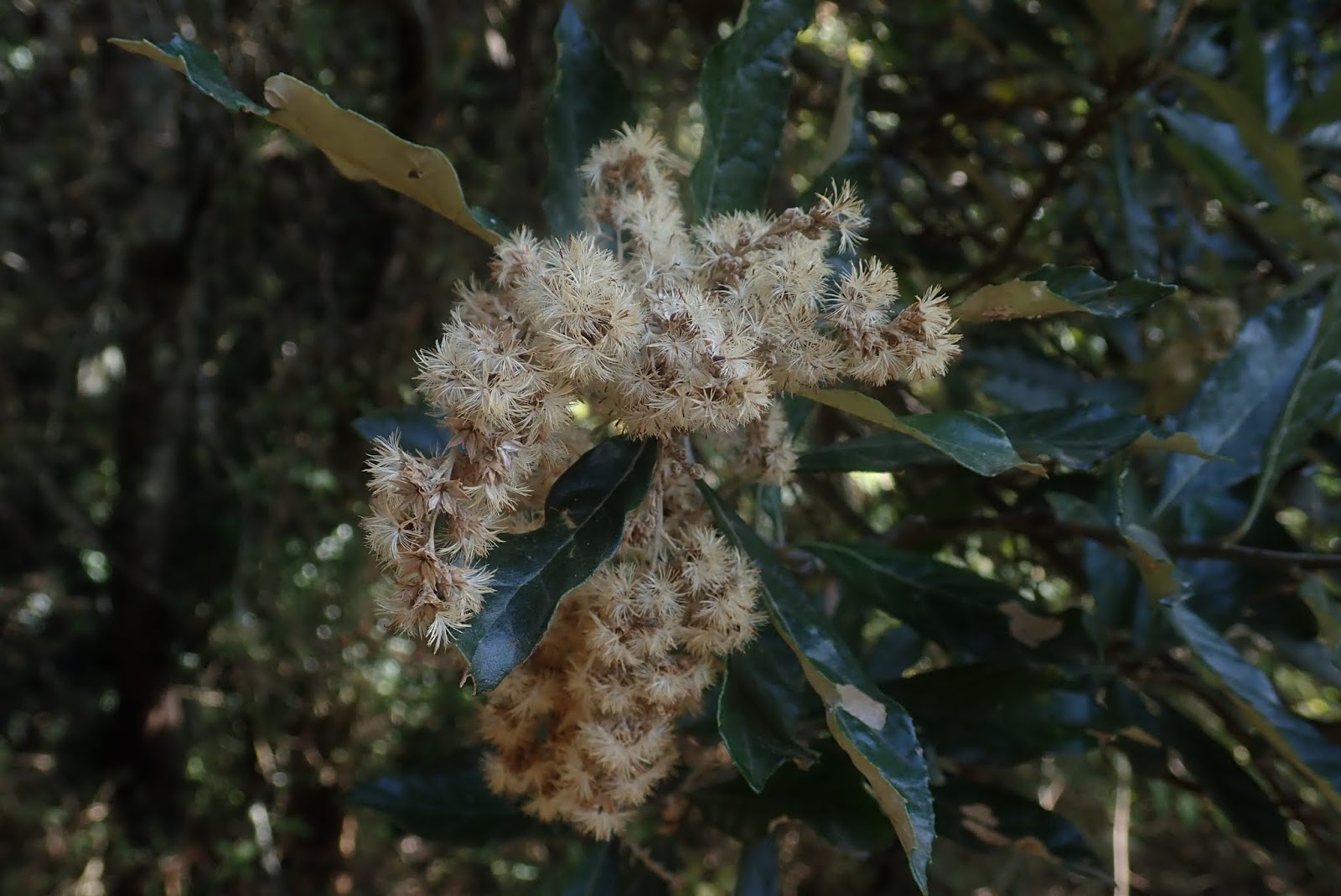
The leaves and drying flowers of a Forest Silver Oak, Brachylaena transvaalensis, a large forest tree that has somehow gone unnoticed by me for many years until the copious flowers caught my attention this month. What a grand tree! With a beautiful, thick and shapely trunk and hard, slightly wavy leaves, glossy green above and white and felty below. The flowers are produced in large axillary and terminal panicles and are made up of ray florets typical of the Daisy family. The strong, fine-grained wood was extensively used for implement handles and fence poles and aqueous extracts have been found to have anti-bacterial properties. Large forest trees are difficult to learn because everything but the trunk is out of reach. I was lucky to find this one beside a steep slope so I could reach the leaves and flowers to identify it. 


A very busy butterfly that is extremely difficult to approach, a Pirate, Caterocroptera cloanthe, is on the wing during October and can often be seen fluttering to and fro over the paths near the weirs, sometimes aggressively approaching people too. They fly fast and low and males spend most their time defending their small territories, otherwise you can find them sucking the sap from a wounded tree, or the juices from a rotten carcass or, better yet, courting a female. The bright flash you saw could well be this.


Isn't that just stunning, the flower tubes of the Ifafa Lily, Cyrtanthus stenanthus, on the vast, dry high altitude plains of Goudkoppies. This small, but common Amaryllis is easily overlooked in the grasslands because of it's size. The scientific name means "curved flower, narrow flower".


This drab, elongated moth is also easily overlooked, even if you're looking for it. This is because of its habit of holding its camouflaged, elongated body parallel with the  grass stalks and folding its antennae backwards. They are looked for, you know. In some European countries, like Germany, the are used, together with certain butterfly species, to test the potential toxicity of newly developed GMO crops. Here, being in the grasslands, they are one of the most abundant of our moth species and occur in a bunch of colour variations (all earthy) but all have the same body and wing shape. They lay their eggs on the base of a grass plant and the larvae, after hatching, burrow into the ground and feed on roots.


Although I have seen the notorious Rinkhals, Hemachatus haemachatus, twice in the time I have been here, both sightings were so brief that I could not even get a photograph before they disappeared. The Mackenzies from Pebble Creek have shown me a great video of an encounter they had and photos of a more recent encounter too, but alas, I still do not have a photo for my files. But the other day, up on the Goudkoppies plains, I came across this perfectly preserved sloughed snake skin that I immediately identified as belonging to a large male Rhinkals. Immediately as their skins are certainly the easiest to identify because the scales on the underside and of the head are smooth (like any shiny snake) and the dorsal scales are keeled (like adders that are not shiny), check the insert. Other snakes are mostly either one or the other. I could tell it belonged to a large male because the skin measured 120 plus centimeters long, which is maximum size for a rhinkals, and the tail was over 20 centimeters long, so I would not be able to fit 6 tail lengths into the snakes full length. Females have shorter tails so I would have been able to fit more that 6 of them to the full body length (general rule for sexing snakes). Although the rhinkals resembles the cobra, it is even further from a cobra than a Black Mamba is. The most notable difference between a rhinkals and a cobra are the keeled scales, as mentioned above; the fact that rhinkals' have no solid teeth whereas cobras do; and the fact that a cobra is viviparous, meaning it lays eggs, while a rhinkals is ovoviviparous, meaning that the eggs hatch just prior to birthing, within the mother's body, so that live young are born. Well, that was almost as good, for me, as seeing a living specimen but still, one day... 


I was attracted to this Hypoxis rigidula by the light lemon yellow colour of its petals, as apposed to the dark, richer yellow normally present in these beautiful flowers. While checking it out a common fly, Musca sp., settled on the petals and started mopping up the pollen grains from on and around the filaments, just like I noticed with the Hover Fly above. Makes an interesting photo, though.  


A handsome big male Grey Rhebuck, Pelea capreolus, triggered the camera trap on Loop road just before I went to collect the card and replace the batteries on the last day of the month. These common buck are endemic to South Africa and only occur in regions with large mountains.They live in a harem system where a dominant male establishes a territory, that he maintains by means of scent markings and vocalisations, in which he allows only his ewes and their offspring. He alone mates with his ewes from February to April and they give birth to a single lamb after a gestation of 8,5 months around the end of the year. They co-exist with the similar sized Mountain Reedbuck on the Estate but do not compete because they are browsers (eat woody plants) while the reedbuck are grazers (eat grass). Bizarrely, though, they have been known to kill reedbuck with those sharp horns of theirs, on occasion. 


This is a picture taken at the same place at the end of August of a handsome big male Mountain Reedbuck, Redunca fulvorufula, easily confused with the previous species, mainly because they are similar size, shape and colour and the fact that they congregate in similar herd compositions. The males are easy to distinguish because the reedbuck (above) have curved horns while the rhebuck (previous species) have sharp, straight horns. The females are more difficult to distinguish apart because they do not have horns. The easiest way to tell them apart is when they run away, which is inevitable once they know they have been spotted: The Grey Rhebuck (previous species) always holds out a bright, white pom-pom tail when it is running, whereas the Mountain Reedbuck (above) only unfurls its broad, flat white tail momentarily, as it begins to run away, then quickly folding it back again as it runs off. The Mountain Reedbuck does not have a particular breeding season like the rhebuck, and the reedbuck is a grazer of grass, with a specialised digestive system so that it can handle even the lowest grade grasses in the dry season. Both species are common on the Estate but one normally has to hike up into the grasslands to find them.


The housekeeper at Coch-Y-bunddhu (unit 1), Maggie Mashabane called me on the radio in distress because there was a large green snake in the laundry room. I responded and this is what I found behind the washing machine. It is a Western Natal Green Snake, Philothamnus natalensis occidentalis, and it was angry, with its throat puffed out in the photograph because I had just hauled it out of the laundry room. It did actually bite the index finger tip that was holding the camera and nearly made me drop the thing! Fortunately they are not venomous. The advantage about catching it is that I got photographs of all parts of its body that I thought I would need to identify it because there are 3 species of green snake on the estate that are difficult to tell apart. Well, as you can see from the long scientific name, I got this one right down to subspecies level because of the following:
This individual had keeled (remember from the rhinkals?) belly scales up to but not onto the tail like the natalensis subspecies, while the Green Water Snake has smooth belly scales. The keeled belly scales (inverted compared to rhinkals and adders) help it to find purchase while climbing, which they do more than the water snake; this individual had only a single temporal scale where the ear would be while the Eastern Natal Green Snake (natalensis subspecies), which also occurs here, has two. All species are associated with water and the main prey item is frogs and toads although anything of suitable size will be captured.


Some workers were clearing the thickets between the office and my house when they exposed a rabbit's nest. The nest contained two little rabbit kittens with their eyes still closed. There has always been some confusion as to which species occurs here, with some saying we had the Jameson's Red Rock Rabbit and others saying we had the Natal red rock Rabbit. Well, it seems like the taxon has been revised and what we get here is the Hewitt's Red Rock Hare, Pronolagus saundersiae. So the common name is named after Hewitt, the guy that described this as a subspecies of another species in 1961, and the specific name is named after the person, Saunders, who collected the skulls that Hewitt used, all very confusing! Anyway, when these little bunnies grow up they will become one of the solitary, night active grass grazers that we encounter on the roads in our headlamps. The story has a happy ending, I think, because the kittens had disappeared by the following day which means that Mom probably moved them to a new nest. 


These tiny yellow worker ants scramble to move the pupae of workers and soldiers to safety after I lifted the rock they were living under. I have been clearing rocks off the new hiking trail that I am cutting up on Goudkoppies and this disruption exposes many little creepy-crawlies, unfortunately for them. The ants in the picture only measure 2 mm in length and they are the workers of the Yellow Fire Ant, Solenopsis punctaticeps, in the Myrmecinae sub-family. They have powerful stingers and these, together with their multitudes in numbers helps them to subdue prey items much larger than themselves. In fact, the venom contained in their stingers is called  solenopsin and it is composed of alkaloids derived from  Piperidine which can cause an allergic reaction in some people, resulting in anaphalaxis, resulting, if untreated, in death! Beware the FIRE ANT! 


Another victim of my rock lifting activities was this recently sloughed Highveld Lesser Thick-tail Scorpion, Uroplectes triangulifer. This tiny little scorpion is the second species of Uroplectes I have found on the Estate. This individual's skin is still shiny and tender after it has climbed out of its previous skin that had become a bit too tight fitting for comfort. The pair of comb-like appendages (visible on the upside-down skin) are called pectines, and they are sensory organs that pick up minute vibrations in the substrate. When two scorpions come together they communicate via vibrations which are picked up by the others pectines etc. When a mating pair meet and they are satisfied with each other after communicating as above, then the male will clasp the female and begin to shuffle her around while he searches for a suitable place to deposit his spermataphore. Once this is completed, he drags her over it and she absorbs it. They release and go their separate ways and after a minimum of 3 months the female gives birth to 8 to 10 tiny scorplings that attach themselves to her back until they have molted for the first time.   


The daintiest marsh-dwelling plant around. A Utricularia arenaria that I found in the small marshes up close to Troutkloof waterfall. In February this year I posted about a strange little marsh dweller that I struggled so to get into my files. Well, this is another member of that fascinating family, Lentibulariaceae, whose members use modified, underground leaves to sift through marshy waters and extract bacterians and protozoans  as food, essentially making them carnivorous plants. The little flower, with the spur, only measures 5mm long.


As I write this there is a gathering of clouds and I hope it is a omen of what is to come. Rain, rain, please come and visit... You also need to come and visit. Enjoy the mountains and the fresh air.