Friday, 9 October 2020

SEPTEMBER 2020

SEPTEMBER 2020

September showed a lot of promise when it comes to rainfall by hosting the first rains of the season on the first day of the month! Okay, it was only 6mm of rain but it was still wet. Unfortunately there was only a further 2mm for the remainder of the month but it was overcast for a lot of the time, providing us with some spectacular skies like the photo above that was taken from the helipad facing north east. Being spring month, there was a lot of wildlife activity as everything seemed to be waiting in anticipation for the life-giving rains to arrive proper. Below is a gallery of some of those things that I managed to capture on this little camera of mine:

I was enjoying an afternoon walk with Roger Nicholson and his guests from Kliprots Creek (unit 24) when someone found this Donkey-faced Weevil hiding out inside a Saint John's Wort flower. Very appropriate it's name is, since it really does have a dufus sort of donkey face. It even has chewing mouthparts at the end of that long nose just like an ass. The snouted weevils or true weevils belong to an enormous family of beetles called the Curculionidae and although the members of this family look rather similar, their diets and behaviours are extremely diverse. Generally though, their defense, once molested, is to simply fall over sideways with legs outstretched and to play dead. The elytra, which are the hard shields on the back that cover the wings of other beetles, are fused together in snouted weevils, leaving them unable to fly but to provide them with an almost indestructible exoskeleton. In fact, even when they are trodden on by large mammals they are usually just pressed into the ground and not crushed, leaving an indentation in the ground after they move on. This suits them because most of them are very specific about their food plants and they choose the same plants as larvae (fat white grubs) and as adults. This means that they don't need to move very far in their lives and so they can be, and are, rather sloth-like. I suspect the Donkey-faced Weevils, Bronchus sp., have a similar lifestyle to their close relatives from the Chrysolopus genus and so would share a similar life cycle where the female weevil bores a hole for each egg into the stem at the base of her chosen host plant. Once the eggs hatch, the larvae burrow down into the roots of the plant and feed there until they are ready to pupate. They pupate beneath the soil beside the host plant and emerge as adults who dig themselves out of the ground and proceed to climb the host tree closest to them, slowly. This lifestyle where all stages feed on the same plant make weevils a great pest to man in many parts of the world but also make suitable candidates as bio-control agents. Depends on which side of the fence you sit...


Now, this Jewel Beetle from the Bupestridae, a different family of beetles, has a remarkably similar life cycle to the Donkey Face above: the female lays eggs in the soil close to the roots of a plant and the grub-like larvae burrow into the roots; once developed the larvae pupate beneath the soil and later emerge as adults; the adults eat foliage, stems or flowers of plants as well but Jewel Beetles are not as particular as the Donkey Face. But where the Donkey Face is slow and cumbersome, the Jewel Beetle is a jack in the box! She's quick to take flight and loves being active during the hottest time of the day. If you look closely you will see that she is also adorned with bright, iridescent colouring, hence the name Jewel Beetle. In fact, this species, Lampetis amourotica, is pretty bland compared to most of the family, who have blasts of rainbow-coloured iridescence covering their elytra, not just parts of the underside like this one. The iridescent colours that reflect off these animals change as you change the direction at which you look at them, like the rainbow colours that change on a compact disk as you move it around in your hand. Now, most insects that are brightly coloured use this aposmetic colouration (bright, bold colouration) as a warning to potential predators that they are either poisonous to eat or dangerous to molest. Or they are mimics of such but this limits population numbers of the mimic to less than a quarter of the model population, otherwise predators will not take the warning seriously any longer. Bright iridescent colouring, however, appears to have the opposite effect: it provides camouflage! Researchers at the University of Bristol filled hundreds of iridescent empty cases (exoskeletons) of Jewel Beetles with mealworms and also hundreds of cases painted with solid colours. They pinned these to trees in a nature reserve and left them for a few days. When they collected these cases they found that the huge majority of surviving mealworms were in the iridescent cases. It seems that the iridescence is difficult for a moving predator to recognise or pin-point. The diversity of the insect world is certainly extreme, that's for sure!


This little camera of mine is unsuitable for bird photography but sometimes I manage to get so close to a bird that I can snap off a poor shot. Like this Black-shouldered Kite, Elanus caeruleus, that allowed me to approach within meters on my motorcycle just beyond the driveway to Elsmere (unit 11) on the Spekboom River. The scalloping on the grey feathers, the slight tawny wash and the lack of a red eye indicate that this is a juvenile and the lack of even a yellow eye suggest that it only left the nest a month or less ago. I'm sure it is this inexperience that allowed me to get so close. Since the first clutch of eggs laid by the female is usually around March and it takes three months to get the chicks to disperse and look after themselves, it appears that this must be offspring of the third clutch of a local breeding pair. With females breeding within their first year of life, this fecundity, and the species' tendency to nomadism, the species is well adapted to respond to sporadic rodent population explosions. Black-shouldered Kites are most commonly seen perched on telephone poles or hovering over grasslands in search of their main food items, small rodents. Still-hunting from a  perch allows the bird to save a lot of energy but only provides them with a 10-20% successful strike rate while hovering, although using double the amount of energy, allows them to exploit areas far from perches and provides them with a 20-35% success rate. Although almost always seen alone, Black-shouldered kites roost in gatherings of a dozen or so individuals in large trees or reedbeds during the night.


If you go back and check my blog of September 2019, you will see a photo I posted of a Mayfly nymph under the water and gave a blurb on how they take up to two years to mature and emerge from the water as adults and how those adults, like the one from the Callibaetes genus shown above, live for a few hours to a few days only. In fact, the name of the insect order, Ephemeroptera, means "winged for but a day." They have degenerative mouthparts so they cannot eat. Even their digestive tract is filled with air to provide buoyancy, not to process food. I also mentioned that this is the insect, as larvae and adult, that flyfishermen model their flies on. What I did not mention is that the Mayfly is the only type of insect that moults as an adult, albeit only once: So when the adult emerges from the water, it is actually only a subimago, or to the angling folk, a Dun. Once these "duns" have emerged from the water they fly to a perch and rest while they escape their final moulted skin and become true imagos, or "spinners" in fisherman terms. These stages of their lives are synchronised, so when the imagos fly above the water performing their mating dance, they do so together with multitudes of others and this is known as a "hatch" to anglers. When a female is ready to mate, she flies into this cloud of performing males and is immediately grabbed by a male and held while he mates with her for a few seconds in the air before he departs and abruptly dies. She then rests while her eggs develop before she drops them into the water and dies too.


These soft, wispy flowers are common in the low-lying dry grasses on the estate at this time of the year. They are called Yellow Tulp Moraea pallida, and they resemble the Iris's of the northern hemisphere and although they are in the same family, that's as close as they get. The biggest difference is that the Moraea have corms, and as such are bulbous plants which evolved to withstand fires in the great grassland savannas of the southern hemisphere, while the Iris's in the north have rhizomatic roots. The resemblance to the Iris's comes from the double sets of three petals underneath a set of three petals above them. The lower petals usually have bright colours on the inner tip to act as a nectar guide to potential pollinators although in this species, the nectar guide is only slightly darker yellow. The Yellow Tulp, together with the Blue Tulp, Moraea polystachya, are the plants most responsible for livestock poisoning in South Africa. Their habit of growing in amongst grasses with long leaves resembling those of grasses make it easy for young and inexperienced livestock to eat them together with the grass and the cardiac glycosides present in the plant can lead to posterior paresis in cattle within a twelve to twenty four hours of consumption and death soon afterwards. It has been found that the concentrations of these glycosides in the plant is very variable and these concentrations are highest in plants occurring in the Mpumalanga grasslands in the north east of the plants' distribution, and lowest in the Western Cape at its most southern distribution. Fortunately it has also been found that the toxicity of the glycosides can be neutralised successfully, in almost all cases, with the timeous introduction of activated charcoal treatment. Of course, we don't have to worry about this because indigenous grass-eaters, those that occur here on the estate, because they evolved together with the plant, have inherently learned of the plants' toxicity and therefore do not consume them. We can simply enjoy their beauty!  


I was climbing the gorge on our boundary with Mount Anderson Ranch, high up above Kliprots Creek recently and, in the darkest shadows of the forest, I found this large, scary looking spider half in and half out of the water. The eye pattern tells me that it is in the Pisauridae family which would be Nursery Web Spiders and their allies (see blog from March this year for a Nursery Web Spider) like Fishing Spiders. This spider was standing at the edge of a well vegetated pool with most of its body resting on top of the water. I am waiting for confirmation but I think it is from the Dolomedes genus. These spiders wait at the edge of the pool and feel for vibrations in the water. Very much like a web-bound spider feels its web for vibrations when a victim is ensnared in it. When a vibration is felt, from a tadpole or Mayfly larva just beneath the surface, or an insect is caught up in the water, the spider runs across the surface, relying on surface tension of the water to keep it dry, and hooks the victim with the claws at the end of its front legs like a fisherman would a fish. The spider then drags its prey to the waters edge and immobilises it with it's powerful venom before tucking in. The short, velvety hairs that cover the spiders body keep it dry and if a predator, like a bird, snake or Pompilid wasp (see blog of March 2020) approaches, the spider dives beneath the water surface and escapes while these hairs trap a layer of air around the spider's body, enabling it to continue breathing. This buoyant layer of air forces the spider to cling to the bottom of the pond until the danger has passed or else it will pop up to the surface like a cork. When it does surface it is completely dry! 


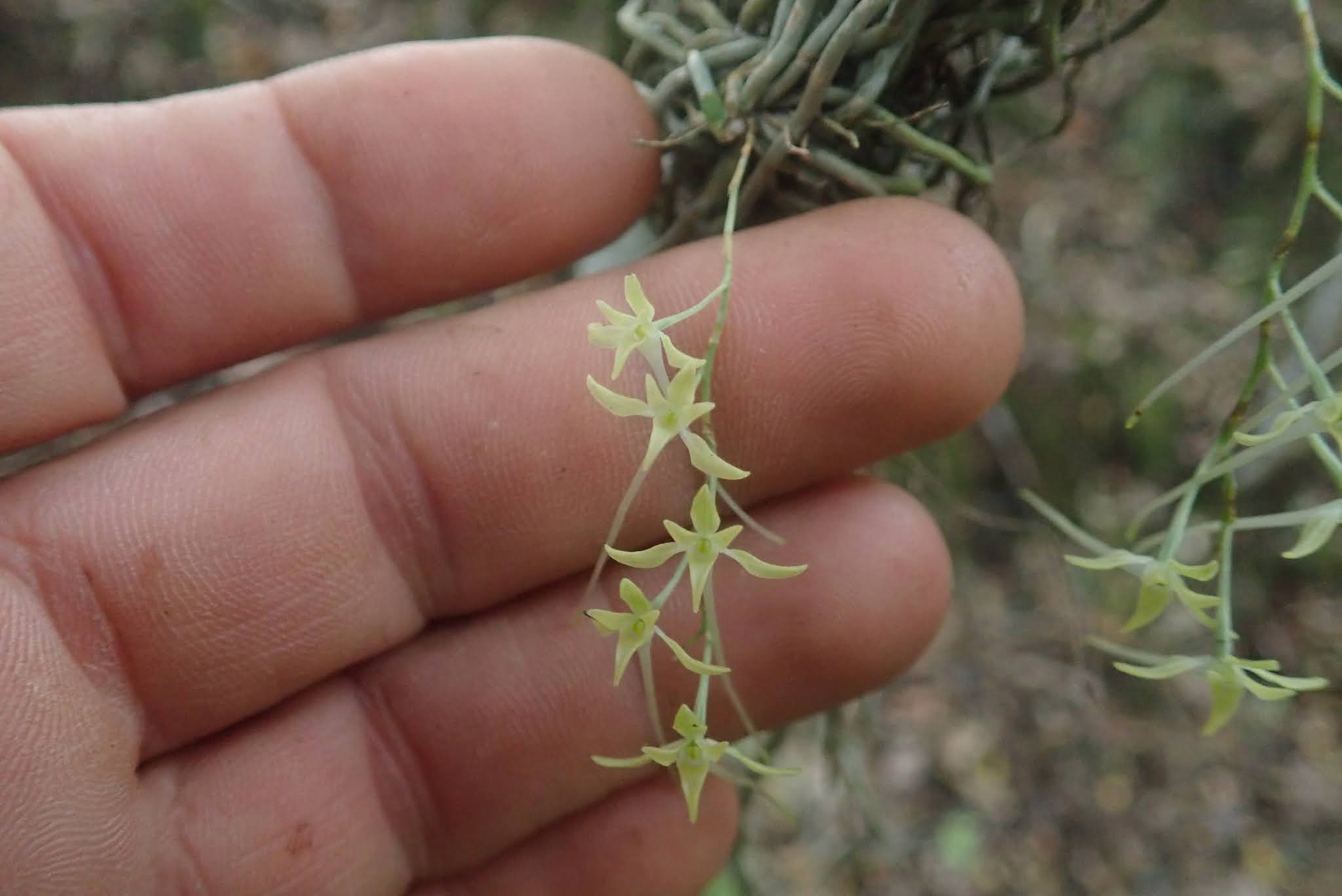
Aaaargh! I was so excited when I found this that I did scream! Have you ever seen such delicate flowers before? This is a Mystacidium gracile, an epiphytic (air plant) orchid that I have been hunting for, in the forests, in September and October, every year for quite a few years now - and voila - here it is! It is not actually that rare but it is a tiny bundle of roots, with one or no leaves, attached loosely to branches and is very difficult to spot. The specific name, gracile, means "attractively slender or thin" which it certainly is. The extremely long spurs that hang off the back of the flowers have the nectar at the bottom end of them and this design only allows Hawk Moths with long enough proboscis's to access them and, in doing so, collect pollen on its face and hopefully move on to another plant to enable pollination. Made my month, it did.


This is a frenzy of Copper-tailed Blowflies, Chrysomya chloropyga, feeding on, and laying eggs in the carcass of a bushbuck found up on the Kliprots river. Even though they are actually rather beautiful, they are inherently regarded with revulsion by us because they are serious spreaders of disease in human communities. Because this African fly is synanthropic (meaning it associates with humans), it, together with some close relatives, has invaded the rest of the tropical and subtropical world thanks to globalisation, spreading pathogens that cause diarrhea and bacterias like E.coli, Salmonella and Shigella in developing countries. The female stores sperm donated by males which enables her to rush off to the nearest carcass or open latrine and immediately lay eggs without having to find a mate first. Together with her multitude of friends, she lays between 50 and 200 eggs (per fly!) on a carcass and before you know it, the carcass is a writhing mass of maggots! If the carcass is too small for the masses of maggots, they will turn on each other and an orgy of cannibalism will ensue! In fact, even if a maggot is injured and leaks haemolymph (insect blood), his brethren will eat him! But there are some positive sides to this ghastly story: the maggots are used in wound therapy where they are introduced into a necrotic wound where they consume all the rotting flesh and leave the healthy flesh untouched; and they are useful in forensic entomology where a pathologist can determine the post-mortem interval and determine the time of death of a murder victim.


Right at the very beginning of spring-time one gets to see beautiful pink blossoms scattered around the Spekboom valley and at places on the Kliprots. These are exotic Peach trees (Prunus persica), remnants of the times when Finsbury House (unit 23) was a farm dwelling with a peach orchard between it and K9. There's also an ancient, gnarled Pear tree (Pyrus sp) beside the Picnic spot in the Spekboom valley and it looks very similar to the blooming tree above. But we have our own, indigenous blossom tree that explodes into bloom at the beginning of spring-time and it is the Wild Pear, Dombeya rotundifolia, pictured above. Even though the Wild Pear resembles the exotic Pear, they come from different families: the Pear and the Peach both belong in the Rose family and our Wild Pear belongs in the Hibiscus family. They can be found throughout the estate on rocky slopes but are most noticeable on the slopes above the mountain hatchery (near Morrin Pools) and above SPK1 up towards Spioenkop. Now, this a magical tree for the garden because it is very fast growing; it has a beautiful, kindergarten tree shape; it attracts butterflies; it is frost resistant, drought resistant and it makes a spectacular display in the early spring with its showy flowers that bloom before the leaves come out! And that's not all... It makes an excellent bonsai specimen with corky bark forming and leaves reducing within two to three years of care. It is also beneficial in wilder zones being drought resistant, fire resistant (leading to the Afrikaans name Dikbas) and good browsing for mammals. Wow! What a tree. Why do we even have exotics in our gardens when we have indigenous beauties like this? 


Deep in one of the gorges feeding the Klipdrif stream in Hidden valley, resides this large, bulbous bracket fungi call Chicken-of-the-woods, Laetiporus sp., upon the dead trunk of a huge, but dead, forest tree. The common name is derived from the fact that it is edible and tastes a bit like chicken but with a texture very much like chicken (when they are both cooked). This individual has hardened with age so it was unsuitable but, if the fungus body exudes a watery liquid then it should be harvested and cooked in a creamy garlic sauce. In fact, it can substituted for chicken in any chicken dish and leftovers can even be frozen. It is considered a delicacy in Germany and North America and is cultivated there. I only just discovered this so I will diarise it and make sure I return to harvest it next year as the fruiting bodies apparently appear, in the same place, year after year until the tree collapses. The fungus normally attacks dead hardwood trees but may sometimes be a mild parasite when it attacks the hardwood exposed by a wound on a living tree. The Chicken-of-the-woods is the Guinness world record holder as the heaviest mushroom at 45kg in 1990. 


Found me a Wahlenberg's Velvet Gekko, Homopholis wahlenbergii, hiding in a deep crevice between two flat slabs of rock up on Goudkoppies plains recently. Pretty high up for a gecko that is quite synanthropic (my new word!). Anyway, I never put enough effort into really understanding how geckos apparently attach themselves to even smooth surfaces, until quite recently, and it is actually quite mind-blowing. Fundamentally, they use the same technique as glues and epoxies do to adhere to surfaces but, I thought to myself, how do they become sticky when they want to stick to the surface, then suddenly unsticky when they want to lift their foot off the surface? Well, it helps to understand how things stick together: when two surfaces are pressed together, even smooth surfaces, a very small area of the surfaces are actually touching each other because, no matter how smooth they appear, they are rough at a microscopic level. So what glues do is fill the air spaces between the areas that are touching each other to the point that Van Der Waal's force takes effect. You would think "well, why doesn't stuff stick if you put water between them instead of glue?". Good question. The thing is: you get dry sticky; and you get wet sticky; and nothing in between. And dry will not stick to wet, for long, and wet will not stick to dry, for long. Anyway, Van Der Waal's force is (deep breath): when the surface area of the surface to be adhered to is covered enough (all those microscopic spaces of air are filled in) by the surface wanting to do the adhering, that the molecules' electrons, in such close contact with each other, begin to interact with each other, changing orbit, and becoming electromagnetically attracted to each other instead of repelling each other as usual. With geckos then (see insert in photo), apart from having retractile claws to hang from edges, the bottoms of their bulbous toes are ridged like the soles of boots and those ridges are covers in stiff, minute hairs called setae (about 14 000 per underfoot) and the tip of each seta splits into about a thousand nano-width bristles. So when it touches the substrate, these microscopic bristles reach into all the irregularities of the surface of the substrate and Van Der Waal's force takes effect and the foot grips tight. It has now been discovered that a gecko can change direction of these setae in milli-millisecinds so that forces are pushed into different directions so as to stop the Van Der Waal's force and then be able to unstick its foot from the surface enabling it to run, jump and change direction, even upside-down! Fa-sci-nating!   


These strange, closed flowers are called Lighted Matches Mistletoe, Tapinanthus rubromarginatus, and we found them appearing to be attached to the branches of a Common Sugarbush, Protea caffra. On closer inspection, one would notice that they are actually attached to their own branches that seamlessly attach themselves to the branches of the Sugarbush, the host tree. The strange flowers of this hemi-parasite (not full or holoparasite since it does have leaves that provide some sugars to itself through photosynthesis) are attractive to sunbirds who probe the flower with their long bill until the flower pops open and slaps the sunbird on the forehead with the pistil and anthers and so deposits pollen there. The bird then pollinates the flower it visits next when the same thing happens. This mistletoe only parasitises three species of Proteacea and they all occur here on the estate: Silver Sugarbush, Common Sugarbush and Willow Beechwood. The fruits of the mistletoe are small, sweet, red berries filled with seeds in a sticky jelly and birds love them. After the bird has eaten the berry, its beak will be soiled with this sticky jelly with seeds in it and the bird will wipe its beak off on a branch of another tree to clean it. The seeds adhere to the branch and when they germinate, their roots, called haustoria, graft themselves onto the branch and penetrate the vascular system of the host tree and begin to extract nutrients or water. And so the cycle continues....


That's it for September. What a lekker month it was. Now for October when we will hopefully have decent rainfall and jolly times. The flowers are starting to bloom and remember, if you are at the estate and you want to see them, let me know on the radio and I will gladly lead you on a hike in search of all these beautiful and amazing things. See you soon.

Monday, 7 September 2020

AUGUST 2020

 AUGUST 2020


August, that dry, windy month that drags us from the winter into spring, is always busy at the estate because of the school break, and this month was no different. A lot of folk got out there and did some hiking with quite a few families undertaking the new Zebra trail that traverses the Goudkoppies plains high above the Miner's Cottage, offering spectacular, albeit hazy at this time of the year, views over Hidden and Kliprots valleys. 

The end of August also marks the end of the rain cycle where we arrive at our final rainfall figure for the season past. I collected rainfall data from around the area and came to the conclusion that rainfall is locally erratic in these mountains. The official Mean Annual Precipitation (MAP) for the Lydenburg Montane Grasslands, of which we are part, varies from 660mm to 1180mm. That's some variation for a relatively small area. The lowest figure I received locally was Rivendell, west of us, with a MAP of 563mm, and the highest is Long Tom, south of us, with a MAP of 1067mm. North of us, the Rattray property reports a MAP of 676mm and ours is 894mm. Lydenburg towns MAP is 758mm. Rather variable I thought.

So I decided, just for interest's sake, to measure the rainfall from five different points on the estate for this past season (2019/20). The most northern point was the rain gauge at Pebble Creek (Unit 25). Then on the east, the point was Rock Solid (Unit 22). The south was Rainbow Rivers (Unit 17) and the west was the entrance boom where Patrick Mokoena stays and diligently guards us. The central area, in the opening between the Helipad and the manager's house is our central point and the point where our rainfall has traditionally been measured from. 


As you can see from the map, the five points are not really representative of the north, east, south , west and centre of the estate but they are, at least, representative of the estate. Following is a list with the recordings from these five locations on Finsbury Estate, an area of just under 3200 hectares:

1) North, Pebble Creek: 835mm

2) East, Rock Solid: 784mm

3) South, Rainbow Rivers: 637mm

4) West, Entrance boom: 719mm

5) Centre, Office: 704mm

Mean Seasonal Precipitation: 736mm

The seasonal figure, normally only measured from the Office area, is raised by almost five percent. And the north east of the estate recorded eighteen percent more rainfall than that recorded in the central area. There is a variation of more than twenty eight percent of the annual rainfall figure, normally taken on the estate, in an area of just below 3200 hectares. This certainly is erratic and will make a noticeable difference in moribund (in this case dry grass) build up across the estate and therefore the intensity of fires and planned burns. This will also affect the regrowth of alien plants and therefore my plans for follow-up operations. 

So we have modified (thanks Nick) the rainfall input spreadsheet on this site to accommodate all five of these points on the estate and we will continue to monitor rainfall at all of them.

Below is some other interesting fauna and flora that I encountered during the month of August:


The long, tubular flower of the Brown Jaybee, Jamesbrittenia burkeana, Allows only long-probiscid insects to access the nectar although some beetles have been known to chew through the base of the trumpet to access the nectar, bypassing the pollination process. This is a new species to add to our Finsbury plant list and I found it on the grassy slopes beside the gorge that runs from just north of M27 up toward Potato Seed Production. A scruffy bush reaching about a meter tall, the plants flower prolifically and are amenable to containers, making them suitable for outdoor pot plants in full sun. This species, together with two further identifications this month, bring our total number of Finsbury plants so far recorded on our list to 682 species! Closing in on that 700 milestone...


During my follow-up work and site inspections I have tried to explore as many gorges as possible to try and find more of the Elephant Foot vines (see blog posted on July 7), of which I have found five individuals to date (three males and two females). While exploring the gorge that runs from just below the sundowner spot in Hidden valley up to Mount Anderson with the Twiggs' from The Crofts (Unit 19), we came across these tiny, brightly coloured mushrooms attached to a rotting log. They are called Green Elfcup mushrooms, Chlorociboria aeruginascens, and, as you can see in the photograph, the mycelium also stains the wood a blue-green colour. The fungus is cosmopolitan, occurring throughout the world, and mostly attacks dead hardwoods, and when it occurs on oak, the wood is called Green Oak and has been used ornamentally in panneling as far back as the 16th century in Italy. It was also later used in Tunbridgeware in Kent in the 19th century and in parquetry (Wooden tiled flooring) since.


You've gotta love these names! Sticking to fungi, this is a forest of fungi called Lipstick Powderhorn, Cladonia macilenta, because of the bright red smooching lips at the ends of the stalks! The red tips are actually the apothecia which produce and distribute the spores used in reproduction. I found this in a moist, shaded area on the southern slopes of Mount Formosa in our neighbouring Emoyeni. This fungus is also cosmopolitan and occurs commonly on all the continents and has been found to produce a metabolite called biruloquinone which is a substance that effectively prevents neurodegeneration in Alzheimer's disease. Because of this breakthrough, a mass liquid culture system for the production of biruloquinone has been established in South Korea. The fungus is also rich in carbohydrates and it's close relative, Cladonia rangifera, grows in such abundance in the arctic that it is the staple pasture for Reindeer, Moose ,Caribou and Musk Oxen in the winter time where these animals access it by digging holes into the snow!


Many of you have mentioned to me that the Warthog population has increased dramatically over the last decade and I have certainly noticed it myself in the seven plus years that I have been here. I know that in fenced properties where Warthog predators have been removed, their populations explode and they become a pest that can be damaging to the environment, particularly in the dry season when they mostly dig for roots, tubers and corms. All our neighbours have also noticed this increase in population except for Cornel at Whiskey Creek to our south. He has not yet seen a warthog on his property. So I decided to set up a meeting with a grassland ecologist from the Mpumalanga Tourism and Parks Agency (MTPA) and a few of our neighbours' managers. We met at the MTPA offices at the hatchery in Lydenburg only for Frik Bronkhorst, the ecologist, to inform us that, as far as he was aware, warthog are indigenous to this area and were shot out, to the extent that they became locally extinct, probably during the second gold rush from 1930 onwards. This is because warthogs are asymptomatic carriers of the virus that causes African Swine Fever and this virus, although harmless to it's hosts the warthog, bushpig and soft ticks (which are the vectors), it is lethal to domestic pigs. After researching as much as I could on their natural distribution, it appears that they certainly should occur here all the way up to 2000 meters above sea level and I have not seen them much higher than that. Anyway, Frik and Trent, manager of the Rattray property are going to try to get some students involved to try and ascertain if the warthogs are pressuring the environment in an unsustainable way. What I initially thought was a potential problem actually turns out to be a great success story of warthogs reestablishing their population, by themselves, in an area where they were previously shot out. Pretty darn cool! (The photo was taken by our camera trap situated at K24)


This very, very ugly fly belongs to the Gonia genus in the Tachinidae family of flies. This huge family contains more than eight thousand species so far described and many more to come but one thing they all have in common, is that they are protelean parasites. These are insects that  begin life as parasites within the bodies of other arthropods and kill the host to enable them to emerge as free living adults. Most Tachinid females have a long, coiled uterus that enables the egg to be well-developed by the time it is laid on the body of the host. The egg then hatches quickly and the maggot burrows into the victim's body. The Gonia females, though, lay large numbers of their minute eggs on the food plant of the intended host and are ingested while the host, perhaps a fat worm, guzzles its leafy meal. Once inside its host, the maggot allows it to survive normally, albeit in poor shape, as it feeds on tissue within the host and avoids the important organs until it is ready to pupate. Then it will eat the organs and kill its host, pupate within the shrivelled cocoon that its host has become and later emerge as an adult fly. Now that is the stuff of horror shows!


A close-up of the numerous tiny, mauve and white flowers that make up the showy inflorescences adorning the Sagewood trees, Buddleja salviifolia, that have been in full bloom for the entire month. This colourful show helps us realise how common these small, scruffy trees are in the estate riparian areas and forest fringes. This is a good thing because their leaves are nutritious and enjoyed by the many browsing antelope we have here. The pleasantly fragrant little flowers, which are tubular with hairs between the tubes and the lobes, are also attractive to bees and butterflies, its pollinators, which in turn attract birds. This fact, together with the fact that the plant is quick-growing, drought-resistant and easily hedged, make it a popular subject in indigenous nurseries. To top it off, I was told that the leaves, boiled while still green, produce a tasty herbal tea and so I tried it and the result was a very pleasant, smooth and tasty tea!  


As I reluctantly emerged from my warm, cozy house on one of the colder mornings during the month, I looked down to see a whole bunch of Pugnacious ants, Anoplolepis custodiens (see blogs March 2019 and April 25 2020)  ), lying in a group, on the pathway, as if dead. I returned a short while later and noticed that one appeared to move slightly. I touched it gently and it stood up and began to groom itself. I touched another and the same thing happened. After a while others began coming to life on their own. Within fifteen minutes they were all up and running around with their usual haste. This is what happens to ectothermic (cold-blooded animals) when the ambient temperature moves above or below their operating temperature. Us endotherms (warm-blooded animals, can operate in any temperature because our metabolism keeps our bodies at a relatively stable temperature. The disadvantage of this is that we need to eat a lot more than cold-blooded animals. Now regarding these ants, in their subterranean nests, when it is colder, the workers tending the eggs, move the eggs and pupae two or more times a day to parts of the nest that are warmer at that time and the ants move to the warmer parts as well. Clearly these ants were caught outside the nest when the temperature dropped below their operating temperature and they simply collapsed until it warmed up again. Not something you see every day although I did, once, find a small Brown Water Snake on a path when it was very cold early in the morning and it was also unable to move until it warmed up, like these ants.


This stunning daisy lighting up the high altitude grasslands far above the Steenkamp's waterfalls is a reminder that day-length has increased to the point that triggers many plants into their growing phase. Spring-time is on the way! This is a Gerbera ambigua and it is one of three species that occur on the estate with a fourth and more famous species, Gerbera jamesonii, or Barbeton Daisy, occurring in our neighbouring Rivendel and the Lydenburg bushveld biome. The genus is named after the German botanist Traugott Gerber (1710-43) who was a friend of Swede Carl Linnaeus (1707-78), who devised the taxonomic system that we use today to classify living things. Towards the end of the nineteenth century Gerbera x hybrida was created by crossing the barberton daisy and the green-leaved daisy, G. viridifolia (which is found on the estate), and this is from where the thousands of cultivars come today. Gerbera is the fifth most used cut flower in the world, after rose, chrysanthemum, carnation and tulip. 


A Chorister Robin-chat, Cossypha dichroa, in a very relaxed pose while perching on the parking poles next to the hatchery. He/she is one half of our local pair that call the office area home. In the latter half of August and beyond, the male asserted the presence, and dominance, of the pair in loud, whistling song from the thickets between the offices and the museum. The powerful whistling song is a jumble of notes but is often interrupted by whistles that mimic other birds or animals. I have heard one mimic a Fish Eagle. The pair bond is powerful and they remain together for life and while the female builds the nest and incubates the eggs, the male assist in raising the chicks thereafter. They are usually secretive, confined to the thickets which makes the call rather eerie but this pair have really habituated around people that they will perch out in the open like this.  


Winter coming to an end means more chance of spotting snakes. Bumped this little Berg Adder, Bitis atropos (see blogs from 9 Jan 2017 and May 2019), on the KLF road high above Hidden valley and got down really close to it. It lay there, dead still, until I got within a foot of it. Then the tongue began to dart in and out of its closed mouth. It was trying to pick up particles of my scent on its forked tongue, which it then inserts into a double-lobed gland, the vomeronasal gland, in the roof of its mouth. This olfactory gland then analyses the scent particle. The advantage of having a forked tongue is that it helps the snake pin-point the direction the scent is coming from. If it spreads the tips apart, more particles will occupy the tip on the side in the direction from which the scent originates, than on the other. This is particularly important to adders because they strike and envenomate their prey and allow the victim to run off. Once the snake has waited long enough for the venom to immobilse the prey item, it will begin to track the victim down by scent, for which it uses its forked tongue.  


Louise Twiggs, the nature artist, has painted a beautiful watercolour of a Mount Anderson Everlasting, Helichrysum summo-montanum, and donated it to the estate. It is displayed in the office. That individual plant that she painted was one of only two plants that I had encountered on or near the estate right up until this month. I visited that plant multiple times each year during the winter, which is when they bloom, and never found any of its flowers fully open. This month, while on a hike through Emoyeni property with the Moore's from Rock Solid (Unit 22), we discovered a whole group of these plants and some had flowers that were fully open - a first for me! The plants prefer to grow on sheer cliffs so it took some time and a little risk to finally get my photograph of the open flowers. What makes the plant so special here for us is that it is regarded as a narrow endemic, meaning that it is only found here, in an eight kilometer radius between Mount Anderson and Mount Formosa, in the entire world. Even the scientific name is beautiful, it means: "The golden sun on the mountain top!" 


As I mentioned at the beginning of this blog, I have been trying to explore as many gorges as possible, hoping to find more Elephant's Foot vines. This is the gorge that runs from Bulldozer Creek up to Little Joker Koppie and it is quite spectacular. Fraser Moore from Rock Solid and I decided we would attempt to reach the very top without having to exit the gorge. I struggle to understand why I though I didn't need wet /dry clothes and shoes. It sure was fun. But, phew, did we get wet!


Spring time has arrived and with it will be all the birds, flowers and babies! 

Thursday, 6 August 2020

JULY 2020

JULY 2020


With the relaxation of some of the restrictions put in place to control the Corona virus, we have seen many members on the Estate during the month of July. July, traditionally a cold, windy month, was no different this year but still produced spectacular white grassland scenery like the above shot facing north from the southern part of the Rock Kestrel trail. And probably the most inactive month of the year concerning wildlife, I still managed to encounter a prolific array of interesting and exciting stuff. Below is a gallery of some of these:


Brrr. It has been a very cold July with some mornings so thick with frost that it looked like snow covering the ground. I found these beautiful ice structures beside the crossing into Hidden Valley from the Kliprots road. I think the curvy structures are formed when the spray from the water tumbling over the rocks freezes and builds up on itself like an ice stalagmite in a cave that is formed by freezing water vapour. If you can help with how and why these structures, which reach up to 10 centimeters high, are formed, then leave a comment at the end of the blog and let me know your thoughts. However and whyever they are formed, I'm sure all can agree that it has to be very cold (for us spoiled South Africans)!


During the month of May, I posted a blog highlighting the succulents one can encounter on the Estate. One of these succulents and certainly one of my favourites is the Bonsai Crassula, Crassula sarcocaulis. Since then, while high up above Rock Solid (unit 22) on the slopes at the base of Mount Prospect's peak, I found this spectacular rockery garden of them. Like epiphytes (air plants), as they are here, they are not growing in any soil but decomposing plant material and mosses on the rock surface. This also explains why they are all leaning as they have less anchorage to stabilise themselves against the strong winds experienced up there  Quite a treasure!


I stumbled upon this delightful little milkweed plant called Starred  Little Crowns, Brachystelma stellatum, high up on the rocks above Knife-edge Ridge in the very north-eastern portion of the Estate quite a while back, but only managed to identify it recently. It is an exciting addition to our plant list because it is classified as RARE in the National Red List of South African Plants. This is defined as a plant that
"meets at least one of four South African criteria for rarity, but is not exposed to any direct or plausible potential threat and does not qualify for a category of threat according to one of the five IUCN criteria. The four criteria are as follows:
  • Restricted range: Extent of Occurrence (EOO) <500 km2, OR

  • Habitat specialist: Species is restricted to a specialized microhabitat so that it has a very small Area of Occupancy (AOO), typically smaller than 20 km2, OR

  • Low densities of individuals: Species always occurs as single individuals or very small subpopulations (typically fewer than 50 mature individuals) scattered over a wide area, OR

  • Small global population: Less than 10 000 mature individuals."

In the Red List, they don't specify how many of and which of these criteria are met but I'm sure this species meets three of these criteria because: it is only found from Origstad Nature Reserve to Steenkampsberg and Long Tom; has low density of individuals (I only found three plants, very close together, in the whole area); and has probably represented by a small global population being endemic to such a small area on the planet. Fortunately, the populations are regarded as stable thanks to their habitat preference of high altitude rocky situations where development is unlikely to take place. The only threat I can think of is afforestation for timber production and that will never happen thanks to places like Finsbury Estate


Wow! This is the tenth species of ant I have so far identified on the Estate and five of them are from the same genus of Sugar ants (Southern Africa) or Carpenter ants (northern hemisphere). This is a Pale Yellow Sugar ant, Camponotus importunus, and this soldier was exposed when I accidentally shifted a boulder and exposed the secret entrances to its nest. They are scavengers of plant and animal material and the older workers emerge at night and search for food to scavenge (younger workers are put to work within the nest looking after the queen, cleaning passageways or tending larvae and pupae and only venture outside once experienced enough). They are very much attracted to sugars, syrups and honeys and if any of these are found (or any other scavengable material) the worker will take the shortest route back to the nest, leaving a scent trail of pheromones behind for the workers they are about to summon to follow back to the food source. These ants also frequently have multiple queens in a single nest who repel each other and reside as far from the others as possible within the nest. 


This is a carton nest, rather common but usually concealed amongst foliage in bushes and trees, constructed by a very different kind of ant, Cocktail ants, Crematogaster sp. The nests are constructed from pieces of chewed plant material mixed with saliva and is surprisingly strong. These are very aggressive carnivorous ants that search, in larger groups, for insect victims during the day. Once a victim is located, the locater runs around in a frenzy depositing excitable pheromones on the ground that attract others and they lift their abdomens forward above their heads (hence cocktail ants) and inject venom into the victim until it is subdued. The ants then carry the victim spread-eagled, to spread the weight evenly, back to the nest in a tree or bush. The ants have arolium which are pad-like lobes projecting between their tarsal claws. These arolium are critical in helping the ants to get the prey items to their nests high up in bushes and trees. The colonies, unlike the Sugar ants above, contain only a single queen but often have mature workers with functioning ovaries who sometimes lay eggs. These eggs are then eaten by the queen but if the queen dies, these workers can continue the colony for a limited time.


My team and I were working on the Pine along the northern parts of the Zebra trail when we encountered this Common Mole-rat, Cryptomys hottentotus.A very exciting encounter because they spend their time under the ground and the only sign of them we usually see are the little mounds of loose sand after they have cleared it from their subterranean tunnels. Although their eyes are extremely small and their eyesight very poor, this chap still saw us and when it did, it immediately lifted it's head and began grunting (pretty loudly!) and snapping those massive incisors together. Made me think of a miniature Hippopotamus! I wanted to pick it up to deposit it where I could photograph it easier but realised that it uses those incisors (unlike the Moles from the northern hemisphere that use their forelegs) to bite through the rocky soil when searching for food or building underground tunnels and rooms. Indeed, I found out afterwards that their skulls are specially adapted to house extra large muscles to enable this... good thing I didn't let it bite me... could've lost part of a finger. I did pick it up with my shirt and it immediately spun around within its skin to face me which I also learned later it was capable of to enable it to move around in its limited space underground (Honey Badgers can also move around within their skin). Another physiological feature of this subterranean mammal is that its incisors are exposed even when it's mouth is closed and its cheeks sealed which stops it getting a mouthful of soil while digging its tunnels. The social structure is also abnormal and is the genesis of eusociality: They live within a system where only one dominant male and one dominant female breed while the rest of the colony support them. The rest of the colony is usually made up of older offspring helping to raise their newer siblings (like in Porcupines and Jackals and many bird species - it is called an extended family) but immigrants are also accepted into the colony and depending on their experience and attitude will become casual workers or breeders while blood youngsters will be workers. Workers work about 20% harder than casual workers in the colony. The nest is made up of a system of permanent, maintained tunnels and chambers used for food storage and resting. They radiate out from this nest in tunnels to find food which is the roots, bulbs, corms of a wide variety of plants. They can even drag shallow-root plants through the ground into their tunnels and feed on the leaves and stems! Smaller food items are eaten in situ and larger items are carried to storage chambers and stored for later consumption. One colony studied in the Western Cape had a network of tunnels exceeding a kilometer in length! I guess the mole-rat I found must be an individual that has left his/her colony in search of another in which it hopes to be accepted as an immigrant.    


Another exciting discovery that took a long time to identify is the Northern Vampirecup, Cytinus visseri, which I photographed in May but only recently identified. This plant is a rare fully-fledged parasite that produces no chlorophyll at all (which is required for photosynthesis) and so relies on other plants, particularly Helichrysum reflexum of the Daisy family, for survival. That Helichrysum, which according to the literature is the only host to this plant, is a dense rounded bush of about a meter cubed which usually conceals the parasite although this individual was exposed. So it was unlikely that that was the  plant it was parasitising. The one green leaf visible in the photo resembles those of a plant in the Carrot family. Of course, if I had known I would have recorded the nearby plants but alas... Anyway H. reflexum does occur here on the Estate at high altitudes amongst rocks and it has a beautiful, rounded shape with copious amounts of pretty paper flowers. The parasite also produces no aerial vegetative structures and the only parts seen above ground are the maroon flowers which are enclosed in their petals. The petals have hinges, though, that enable the petals to fold right down at ground level exposing the flowers that contain copious amounts of sweet nectar (+30% sugar!). The plants are dioecious (male and female flowers occur on separate plants) and the exposed flower in the photograph is a male. The pollinating of the plant is also quite rare: The plant produces a scent (plasticy and yeasty to humans - not so attractive!) that is extremely attractive to small mammals like the Striped Field mouse, the Pygmy mouse, a Dormouse and the Short-snouted Elephant Shrew. These small mammals tend the flowers at night by folding the petals down and lapping up the sweet nectar and at the same time collecting pollen on their faces to deposit on the next flower and complete the cycle of pollination. This is the ONLY dioecious plant, in existence, that is pollinated by mammals! There was a study conducted between 2002 and 2006 at Mauchsberg in the Sterkspruit Nature Reserve, where the largest know population of the plant is found, close by near Long Tom where these and many other interesting facts were established about the plant and its pollinators.  


This is a photograph of a rather scraggly small tree right beside the front patio of the Miner's Cottage. But the Tree Fuschia, Halleria lucida, can grow into a handsome specimen in the right conditions. In fact, it is highly regarded as a garden subject because it is, without doubt, one of the best indigenous trees to plant when attracting birds is the motivation. Myriad Sunbird species, White-eyes, Thrushes, Robins, Pigeons, Fly-catchers, Turacos, Mousebirds and Barbets are regularly attracted when the tree is carrying flowers or fruits, which is almost all year round. In nature, they occur in stunted form on exposed rocky outcrops, on forest fringes as small trees and as large, imposing trees in evergreen forests. It also grows in disturbed places like mine diggings on the Estate. The bird-attracting, nectar-filled tubular honey suckle-like flowers are mostly concealed as they grow from the old wood of the tree. More reasons why it is a sought after garden subject is that it is easily propagated from seed, cuttings and truncheons and it is tough, frost resistant and a quick grower that thrives under varied conditions. It also usually flowers already in its second year of growth. 


Often while on a hike, somebody picks up a perfectly cubed piece of stone or points out one still embedded in a sandstone or mudstone boulder, that we call a Devil's Dice. When not in cubed form and excavated from underground and when still shiny it is called Fool's Gold because it is often mistaken for gold. The cubes we find are crystallised Pyrite ((1xFe) + (2xS) = FeS2) with a skin of Limonite where the Sulfate molecules are replaced by Oxygen and Hydrogen because of its exposure to the air. A single cell unit in the crystallised form of Pyrite is made up of 14 iron molecules and 28 sulfur molecules bonded together with an iron molecule in each corner and one in the center of each face of the cube, surrounded by sulfur molecules. A one centimeter cubed piece of crystallised Pyrite contains 1 to the power of 23 cell units, making it extremely dense. To give an idea of the enormity of that number: 1 to the power of 12 is equal to 1 trillion! As its name suggests, Pyrite, when struck with a piece of iron, creates sparks and in the 16th and 17th centuries was used in wheellock firearms to create the spark necessary for the gun to fire. In those days it was also stacked and the water leached from it boiled with iron to produce ferrous sulfate, used as a dye fixative in the textile industry and as a constituent of ink. Today it is used in medicine, horticulture, gold refining, the construction of modern dry-cell batteries and more. I ground down the face of a dice with our grinder and successfully exposed the shiny, metallic lustre of the Pyrite beneath the Limonite layer but did not manage to get it to spark when I struck it with a piece of steel. The Devil's Dice I used was small and quite awkward to hold so maybe that is why it didn't spark. 


Even though the month of July falls in the dead of winter, one can still find many striking species of flower in bloom. Like this beautiful Dicliptera clinopoda from the Acanthus family that I notice flowering each year from only one place on the Estate (although commonly found hiding among the scrub on the access road in Rivendell farm) between the wooden step bridge that crosses between SPK 7 and SPK 8 and Otter's Rest (unit 10) on the Spekboom River.


And finally, another striking flower blooming in the middle of winter, a Crimson Balloon Pea, Lessertia frutescens, After pollination, the striking, flattened pea flowers develop into a puffed-up balloon within which the seeds reside. This large bush was photographed on the river path along the Majubane river between Morrin Pools (unit 14) and M3 about 10 meters off  the western side of the path. Hard to miss in the drab winter colours...


What an exciting month for me, eh? That is such a special feature we have here on the Estate: the fact that there is always something amazing going on out there in our mountainous piece of heaven! If you stumble upon anything interesting, or anything you want to know about, photograph it and send it to me at jimmy@finsbury.co.za and I will try to identify it for you and if it is something interesting, I will incorporate it into one of my monthly blogs. So long!