Wednesday, 13 January 2021

NOVEMBER and DECEMBER 2020

 NOVEMBER and DECEMBER 2020


The jolly season is over and, unfortunately, it wasn't as jolly as usual, thanks to this pesky virus that has our world under siege! Also, I have neglected my blogs so I will combine November and December with this bumper issue:

The long-term weather forecast said that we should expect high rainfall in the first half of summer because Southern Africa's climate was to be influenced by a La Nina event (the opposite of El Nino) until the end of the year. Well, they couldn't have been more wrong! November had a measly 50mm (10 year average = 134mm) rainfall over seven days of rain, while December showed an improvement of 106mm (10 year average = 160mm) over eight days of rainfall. Anyway, the grasslands are still looking lush like you can see from the above photo of Hidden Valley, taken from the highest point above that valley on the Rock Kestrel Trail.

It's not even the jolly season that I enjoy so much over these two months but the abundance of life. I encountered so many things weird and wonderful over the last two months and I did manage to capture some of those moments with my little camera. Some of those you will find below...


It is amazing that once one is made aware of something, one tends to encounter it much more regularly. In October, I attended one of the very few outings this year with the Mpumalanga Plant Specialist Group up on Little Joker Koppie and the surrounds. Some of the members introduced me to a small, high altitude, low-growing bush that belongs in the Milkweed family that was not yet flowering. They showed me a picture of the tiny, hairy, hanging flowers. I was eager to see them because they looked delightful in the photo. Well, not even a month had passed and I stumbled upon one of these bushes far from Little Joker, up on Goudkoppies, that was flowering early. And the flowers are even more beautiful than they appeared in the book. I never thought that brown and black flowers would be so attractive. The bush has no common name but it is known as Anisotoma pedunculatus, and it is not particularly rare, just very easily overlooked. 


I encountered this tiny little male, inch-long, Sailing Bluet, Azuragrion nigridorsum, damselfly perched on the rank bush beside K33. Damselflies are much smaller and daintier than their robust cousins, the Dragonflies, but this damselfly is even small for a damselfly. Besides size, Damselflies perch with wings more folded than Dragonflies do, otherwise they resemble each other. Female damselflies spend most of their time far away from water and only approach water when they intend to breed. Males, on the other hand, spend all their time at the water's edge where they establish and vigorously defend territories, hoping that when a female comes to the water, she will come to his little spot. If she does, he will attempt to keep her within his territory while he courts her and ultimately mates with her. Once she is ready to lay eggs, she approaches a thin, tender, green stem of a plant that overhangs the water and cuts into it with the pair of slender saws that she has on the end of her abdomen. She then lays one egg within this slit and moves forward a little on the stem and repeats the process until she has laid about 40 eggs. This is very different to the laying habits of a Dragonfly who flies over the water and dips her tail into the water, in flight, and lays one egg per dip that sinks to the bottom. Anyway, once the nymph damselfly hatches, it drops into the water to begin it's amphibious stage of life which you can read about in my blog of August 2019. A unique behaviour of the Sailing Bluet, and where it gets it's common name from, is it's habit of landing on the water, often in groups, using the surface tension to avoid sinking, and sailing around, using it's closed wings as a sail. It is not known why they take part in this behaviour but it is diagnostic of the species.  


I encountered this very relaxed Night Adder, Causus rhomeatus, near Patrick's gate in the cool of the morning soon after sunrise. Usually a fast-moving, alert snake, this individual had it's body flattened against the substrate so as to expose as much of the surface area to the sun as possible. In this relaxed pose, it allowed me to approach much closer, without a reaction, than I have ever been to one of these lively snakes. The Night Adder confines most of it's activities to the darkness of night but, oddly, has the rounded pupils present in snakes that are active during the day (nocturnal snakes have cat-like pupils). Another rather unique feature of the snake is that it has enormous venom glands with a massive yield. Adders all have large venom glands but they still remain on the head-side of the neck, giving the head that diamond shape while the night adder's stretch along a quarter the length of the body. This venom is rather mild towards warm-blooded animals but deadly to amphibians, the snake's preferred food.


I found this beautiful Golden-scruffy Collybia, Cyptotrama asprata, growing from a fallen log in the darkness of the forest in Hidden Valley. Quite an enigma for taxonomists since it has undergone 28 name changes and placed in 14 genera since it's discovery in 1847! What we know as the mushroom is actually only the fruiting body of the fungus that appears when conditions are right. The gills (white in this case) produce spores (like primitive seeds) which drop out the bottom of the mushroom and are dispersed by the wind. The main body of the fungus is in the form of thin, interconnected threads called mycelium that grow into a net-like structure that forms a tangle within the substrate, in this case the log, and absorbs nutrients as it decomposes. These mycelium can cover quite an area when growing beneath the soil and, in fact, the largest living organism on the planet is a massive fungus growing beneath the soil and parasitising nutrients from tree roots in the Malheur National Park in Oregon, USA. The fungus, called Armillaria ostoyae, covers an area of 965 hectares (1350 soccer fields) and is estimated to be well over 2500 years old.


This Trailing Ice Plant, Delosperma cooperi, seems very comfortable growing from a crack in the wall at Rock Solid (unit 22). They are common on the estate and normally grow on cliff faces, providing a splash of purple with their multiple, long-lasting flowers. A popular garden subject, the plant can creep over rockeries and cover quite an area, and when in bloom, one can see why it's other common English name is Purple Carpet. The leaves and stems contain DMT and other hallucinogens and were fermented by the Khoi Khoi into a potent wine called "Khadi". I look more longingly to these glorious flowers since this darn alcohol ban...


This a handsome (in a nineties sort of way) Tussock moth, Euproctis sp., from the Lymantriinae. The name "Tussock" comes from the tufts of loosely attached, poisonous hairs present on the caterpillar. These poisonous hairs are even incorporated into the cocoon to further protect the pupa. Another characteristic of the sub-family is the presence of tympanal organs: hearing organs that resemble a membrane stretched over a round rim that picks up the vibration of sound waves. This a used as a defense against bats, who use echolocation to locate prey. Normally, when a bat is foraging, it releases loud pulses of sound that bounce back off of objects. The bat analyses these echoes and determines if the object is potential prey or not. If it is, say, a moth, the bat will home in towards the moth and begin to increase the frequency of the pulses so as to be more accurate as it approaches. Tussock moths can hear the bats and as soon as it hears a bat begin to increase the frequency of its pulses, the moth closes its wings and falls to the ground to avoid the incoming danger. Even more amazing is that there is a tiger moth, and probably more Lymantriids, that have extra organs, called "tymbals" that produce clicks like those produced from a pop can. If you depress a pop can, it makes a click and as you release it it makes another click. Well, these moths can produce up to 4500 clicks per second and when they hear a bat lock on to them and start approaching, the moth begins clicking with alternating frequency like a siren. This confuses the bat and so the bat breaks off the attack. Wow! How's that for an arms race? 


I noticed, for the first time, large, beautiful blossoms on that old, gnarled tree in front of the Steenkamp's ruins at the entrance to Bulldozer Creek (unit 21). These flowers helped me to finally identify the old tree as a European Crab Apple, Malus sylvestris. The old tree was probably planted between 1930 and 1940 making it 80 to 90 years old with the literature saying that they live up to 100 years old, meaning this tree is close to it's maximum attainable age. In it's natural range in Europe and China, this hardwood tree is never common and, because it requires lots of light, is usually only found on forest edges. The cultivated Apple fruit tree. Malus x domestica, is believed to be an ancient hybrid between this Malus sylvesrtis and Malus pumila, a wild apple tree species of which we have a single large individual growing at the parking of M3 which flowers and fruits prolifically every year. All apple species need to be cross pollinated to produce fruit and because this Crab Apple has such a long flowering time, it is often the species that is chosen to grow amongst an orchard of cultivated apples to help pollination. The seeds of the Crab Apple contain hydrogen cyanide and therefore should be discarded or swallowed whole. The small, tart fruit is suitable for cooking but is used mostly for it's high pectin content, a natural gelling agent used to thicken foods and particularly jams.


I found a huge baboon spider burrow in the grasslands where the path exits from the gorge towards the end of the Olinia waterfall walk in Hidden Valley. On closer inspection, I noticed a whole bunch of rather large spiderlings resting near the entrance to the burrow. After teasing the silk with the soft stalk of a grass plant, Mommy spider came up to make sure her little ones were okay! Once the male baboon spider reaches maturity, which only happens on the sixth year of some species, his lifestyle changes completely and he leaves his burrow to become a nomad with only one mission: to find a female, using pheromones released by the female when on the prowl. Once he discovers the burrow of a female, he transfers sperm from the genital opening on the underside of his abdomen onto his pedipalps and then begins to rhythmically tap on the burrows entrance. After she emerges and he finishes his little mating dance, he jams the mating spurs on his forelegs between her massive jaws so that she cannot bite him while he transfers the sperm from his pedipalps to her genitals. He then departs in search of more females. This behaviour by him is very dangerous and males therefore have a distinctly shorter lifespan than the females who can live for more than 25 years. The female constructs a waterproof, silken sack in the furthest depths of her burrow and lays her eggs within it. She tends the eggs and the spiderlings once they have hatched and this is the stage the spiders in the photograph have reached. Once the spiderlings have developed enough, they simply walk away from their mothers nest and construct their own burrow nearby, creating sort of colonies in certain areas. This is very different to the majority of spiders, spiders in the Araneomorph infraorder, who stand at the highest point of their mother's web and release a length of silk and allow the wind to blow them away, far from their mother, in a process called ballooning. 


I found a rock up on the mist-belt covered in dear-tongue ferns, mosses and a rather alien-looking, white, branching lichen called Elegant Fringe Lichen, Heterodermia leucomelos. This is a fruiticose lichen which forms loose tufts about 100mm across. The grey-white thallus is heavily branched and these branches are lined with stiff black whiskers up to 5mm long, which is characteristic of the species. As is the case with most lichens, this species is cosmopolitan but is rare and declining in most of the world where it is now protected. It is a lichen that prefers moist environments and is always associated with bryophytes (mosses) as it uses them for anchorage.


This day-flying lepidopteran, a Gold-spotted Sylph, Metisella metis, is sort of a mix between a moth and a butterfly. Notably lacking the comb-like antennae of moths and the club-tipped antennae of butterflies, the Gold-spotted Sylph has antennae hooked back like a crochet hook. It also has small wings relative to it's body size, like moths, although the rest of it seems butterfly-ish. Anyway, genetic studies put it as belonging to the superfamily Papilionoidea, in which butterflies are placed. It is a common butterfly and despite the bold golden splotches on it's wings, it's small size renders it inconspicuous.


Over the past few years I have introduced to you, via these blogs, a few species of grasshopper from the Pyrgomorphidae family. These, the Foam grasshopper (March 2019 blog) and the Koppie Foam grasshopper (March 2018 blog) retain the cardiac glycosides from their caterpillar's diet of the poisonous milkweed plants, in their bodies, after they have pupated, which renders them highly toxic. Both species have been the cause of death for domestic dogs. Well, this is a Green Stinkweed locust, Phymateus leprosus, and it also exudes a toxic foam when molested. This toxin, however, is even more potent than the others and more than one human death is attributed to it. 


This grey, mouldy mess that I found covering small patches of the lawn around my house may look like a fungus, but it is not. It is called Ashen Slime Mould, Physarum cinereum. When it comes to classifying living things, the highest level of classification is the Kingdom. For example, animals belong to the kingdom Animalia which includes earthworms, spiders, insects, amphibians, reptiles, mammals, birds etcetera; plants to the kingdom Plantae; mushrooms to the kingdom Fungi and slime moulds belong to the kingdom Protozoa, together with Amoeba proteus, the amoeba you studied in biology class at school; Plasmodium falciparum, the protozoan that gives us cerebral malaria and many others. So when not fruiting, the slime mould moves through it's moist environment engulfing bacteria, other protozoa, fungal spores and other non-living organic material in an amoeboid manner as it's food. Once they are ready to reproduce, they convert into the spore-bearing structures like in the photo above. 


This lovely photograph was taken by Fraser Moore from Rock Solid (unit 22) in the recently burned area just south of the staff village. It is a lone African Wattled Lapwing, Vanellus senagallus, and it was probably hoping to hook up with a mate while visiting this area that is attractive to this species. Recently burned veld makes it easier for the Lapwing to find the grasshoppers, beetles, caterpillars, crickets and termites that it feeds on. This is the time when a monogamous bond forms between a male and a female. They would then fly to a pre-used breeding ground, usually in wet grasslands where the male establishes a territory of between 3 and 6 hectares and prepares a few scrapes in the ground, in the complete open,  with his breast. The female then chooses which one of these scrapes she likes best and they both line the scrape with pebbles, grass, roots and animal droppings. The female then lays 4 cryptic eggs in the nest and the couple share incubation duties. If a raptor flies over the birds duck down onto the ground and freeze. likewise if ground dwelling predators are in view. But if something approaches the nest, the incubator sneaks off the nest and joins its mate and, together, they mob the visitor until it changes direction away from the nest.


A stunning Long-horned bee from the tribe Eucerini preparing to collect some pollen and or nectar from atop a Senecio flower. These bees dig tunnels in the ground and construct cells out of chewed vegetation and mud in series within these tunnels. Each cell is stuffed with pollen and nectar and a single egg is laid, after which the bee seals it and constructs the next one in front of it. After hatching, the larvae, resembling fat, white grubs, devour the sugar and vegetable meal provided by mom and then pupate in the cell.


Unlike the Elegant Fringe Lichen featured earlier, this fruiticose lichen prefers to grow on trees and also prefers a drier habitat. It is called Bushy-beard Lichen, Usnea strigosa, and it is closely related to the familiar Old Man's Beard that hangs down so beautifully from tree branches in the mist-belt. The smooth discs are the apothecium, which are concave surfaces made up of tightly interwoven hyphae (the strands that form the three-dimensional net that is the mycelium of the fungi). These apothecia contain millions of asci, which are the spore-producing cells of the fungus. They are designed so that when it rains, drops may hit the apothecium which splashes the spores into the surrounding environment.   


Now, I know that the colour scheme of Berg Adders, Bitis atropos, is variable. But over a ten day period during December, I encountered four different colour forms of the snake! This one was relaxing, in the open, beside my house and it is the typical colour form of a Berg Adder..


This one, a colour form that is as common as the above form, was tucked up against the cliff wall that leads up to Potato Seed Production in the Majubane Valley...


This one, encountered near the Troutkloof waterfall on the Zebra trail, was a blotchy brown colour that I have never seen before...


...and this one, a plain grey-brown colour phase, was encountered on the Kestrel trail. pretty much where the opening photograph for this blog was taken. I have also never seen this colour phase before.


That's all, folks! So far, January seems to be a good month for rainfall at the estate but I will let you know about that in my next blog. This virus is still getting worse so please all regard the rules: wear a mask, social distance...

Monday, 16 November 2020

OCTOBER 2020

 OCTOBER 2020


October certainly started off with a bang with 36mm of rain falling on the first two days and another 80mm falling over the following week. It was definitely enough to get everything growing nicely but, unfortunately, there was no further rainfall during the rest of the month. But the lifting of the more stringent Covid-19 restrictions seemed like a floodgate being opened and so we had lots of visitors which means I enjoyed leading many mountain and gorge walks. Although we do enjoy large animal sightings on these hikes, it is not always the norm. But this month I got to see quite a lot: like a distant sighting of a leopard while walking with Sue Band and friends from Finsbury House (unit 23) high up near the Troutkloof waterfall; or being approached and then by-passed by a herd of around fifty Blesbuck, Damaliscus dorcas phillipsi, pictured above, near the summit of Mount Anderson with Paige and friends from Rod's Rest (unit 7). I have described a few of the other interesting things I saw and did during the month below:


I encountered this spiny, squat little lizard up in Flavida plains on the Miner's cottage road in the heat of the day. It initially attempted to hide away from me but when I exposed it, it approached and looked straight up at me like this. It is a Ground Agama, Agama aculeata, and I thought it was rather cute. But I may not have approached it so closely with my little camera if I had read what I read after taking the picture: that they are aggressive for their size and very willing to bite with sharp teeth that project from the outside of their jaws, like with Chameleons, Iguanas and Bearded Dragons, within whose suborder they reside taxonomically. Fortunately though, it didn't jump up and attack my face. Another feature these lizards share with their chameleon cousins is that they are able to change colour. Not to blend into their environment like a chameleon since their habitat is quite consistent and so their fixed cryptic colouration certainly suffices. But they will darken when needing more heat and lighten when needing to cool down and also the males can attain bright colouration, particularly around the neck and head, during the breeding season to help advertise himself to potential mates. The best example that all who visit the Kruger Park will know, is the Bloukopkoggelmander that bobs its bright blue head up and down on his territorial tree. The male Ground Agama's head also turns blue, albeit not as brightly as the Bloukopkoggelmander, and he establishes a ground-based territory and advertises by bobbing his colourful head from atop a large stone or boulder in a prominent spot within it. Since it is well into the breeding season I would surmise that the above individual is either a female, or a juvenile male who both remain cryptic at this time. 


This massive Twig Wilter Bug, Anoplocnemis curvipes, was perched atop a grass stem beside Loop road just after the first heavy rains of the month. Remember, all true bugs (Hemiptera order of insects) have sucking mouthparts which are used to suck juices from their vegetable or animal prey, and this bugs powerful mouthparts can be seen tucked beneath its chin. It inserts this sucking apparatus into a young twig of its chosen plant and injects an enzyme which liquifies the plants' cells so the bug can suck them up. Most vegetarian bugs like Aphids (blogs of July 2019 and January 2020) or Spittle bugs (blogs of February 2019 and April 2019) don't have to liquify their food first because they insert their probiscids into the phloem, the vascular tunnels that transport sugars and minerals around the plant, and suck up the fluids therein, This allows them to suck up large quantities of juices that they can filter and use as protection as in the Spittle bugs, or food for body guards as in the Aphids. The Twig Wilter bugs' use of enzymes to liquify the plants cells provide it with less juices but more nutrition. This injection of enzymes also causes the young twig of the plant to immediately wilt, giving the bug its common name. Once the female lays her eggs in a row, within the stems of the chosen plant, she hangs around nearby and protects the site. After the nymphs have hatched, she still remains nearby to protect them with the strong-smelling, toxic fluid that she can emit from the gland just in front of where the rear leg attaches to the body (surrounded by reddish skin in the photo). Oddly, of all the literature I scraped together on this bug, which was quite a lot, there was always mention of the enlarged back legs but never a reason given for it being swollen like that. 


I'm touching the new shoots of this Cascade Asparagus, Asparagus ramosissimus, that occurs commonly in our forested gorges. The fresh tips of these shoots, or spears, are edible like the cultivated species but a lot smaller. The roots are also a good source of nourishment and were always included in the lists of edible plant matter in our survival courses back in the lowveld. But this species' habit of its quickly growing, heavily branched, up to three meter long trailing branches cascading over the edges of rocks in the gorges make it a grand garden rockery subject for shaded spots. It is truly beautiful in that setting and easy to grow from seed.


This is the tiniest of the Sugar Ants, a Hairy Sugar ant, Camponotus niveosetosus, at six or seven millimeters long, upon a lichen-encrusted boulder up on the grassland flats of Goudkoppies. These are among the most widespread South African sugar ant and also the ant most commonly associated with butterflies of the Lycaenidae family (see the Lydenburg Copper in the January 2020 blog for an idea of the butterfly larvae life cycle; and also see 'Some small animals' blog from 19 November 2018) and the care and upbringing of their caterpillars by ants (Myrmecophily). Caterpillars with thick, leathery integument so the bite and handling by ants does not affect them. Caterpillars that don't inherently wriggle when molested so that they don't excite the ants. Now it's the honeydew that the caterpillar produces from the seventh segment of its body that initially attracts the ant. But, as discussed above, the caterpillars chew plant material, they don't suck the juices from the vascular system so they cannot produce copious amounts of this 'honeydew' like aphids and spittle bugs do. The caterpillar's main objective, though, is just to get the ants near them so that they will be able to pick up the 'ant' pheromones that the caterpillar is releasing from small epidermal glands dotted over much of its body. These pheromones, produced by the caterpillar, are the same as the pheromones the ants produce to tell other ants to stay calm! Clever eh? In fact, the caterpillars have a pair of tubercles on their eighth segment that appear to have an olfactory function that prevents the ants from over-utelising the honeydew producing gland. Crazy.


I posted a blog in November 2017 called "A Successful Burn" and it was all about the very hot management fire that we burned to help rid the very north eastern block of the estate of woody plants, including large seed-bearing Pines. In that blog I explained why a hot fire was necessary and in further blogs (April 2019 and February 2020) I have explained the advantages of the Patch Mosaic burning plan that we have adopted at Finsbury. This is when we burn more smaller blocks each year in the wet season to simulate lightning fires. That very north eastern block that we burned hot has had three years to regrow and therefore this season was the right time to burn again. But since it was previously infested with large seed-bearing Pine trees, the majority of the seedbank in the block has germinated, resulting in swarms of new Pine saplings invading the same block again. This means that another hot fire was necessary so I planned on burning it, again, after the first significant rains of the season. Well, that happened at the beginning of the month and, once again, a successful hot burn was completed. In the picture above, you will notice Andries Maphanga, one of our senior field workers, igniting the fire from the bottom of the hill and behind him, the huge flames rapidly consuming the green field of Pine on the slope. The old tree skeletons in the picture are the remains of the larger Pines that were destroyed in the previous burn. We are winning the war against alien invasive plants here in Finsbury and although fire is only one of the weapons that we are using, it is a very powerful one against Pine. Another successful controlled burn... 


I remember a few years ago, Fraser Moore from Rock Solid (unit 22) gave me a photo of a Spotted Harlequin Snake, Homoroselaps lacteus, that he had encountered on one of his very long hikes up into the mountains. Having never worked in the grassland biome before coming to Finsbury, I had only ever seen pictures of the snake before and was quite jealous of the young man. Finally, while on a walk along the Zebra trail during the month, I saw a flash of colour from my peripheral. After some searching I finally came across the most colourful snake I have ever seen, a Spotted Harlequin snake. And the photograph does not do it justice. It is a highly glossy, fast-moving and vigorous snake whose erratic movements, combined with the bright, shiny, contrasting colours, confuse a potential predator, making it harder to pin-point and capture. This is the same sort of result a Zebra gets with its contrasting stripes and erratic movements when escaping predators. This endemic snake is venomous, has a very narrow gape and broad fangs in the front of its mouth with hardened scales on its snout. This design is adopted by snakes, like Burrowing Asps, that follow and catch other burrowing animals in small, confined areas. Very little is known about the venom but it appears to be very similar to that of its cousins, the Burrowing Asps, and therefore could be harmful to humans. Beware this beauty if you are a legless lizard, blind snake, thread snake or even termites and their larvae because you will always need to have one eye over your shoulder in those closed spaces you thought were safe!


This attractive flower belongs to a small tree or bush from the Mint family called Blue Cat's Whiskers, Rotheca myricoides. The tree is found on forest fringes and in riparian areas but is not common in either of those. There is an easy-to-find specimen at the lowest point of the dip in the path that runs from Solitude (unit 5) to its water tank. The plant was originally placed in the Clerodendron genus in the Verbenaceae family but, after molecular and genetic studies carried out in 1998, it was moved to the Rotheca genus in the Lamiaceae (mint family). Its habit of rapid growth combined with the attractive foliage make it a sought after garden subject but it is most suited as a large pot plant for a patio. It also responds well to pruning, which makes it very dense with copious amounts of bloom.


A beautiful mosaic of mosses carpet a south-facing (always shady) quartzite boulder at high altitude on Mount Formosa. The ropes are Running Clubmoss, Lycopodium clavatum, and the green bottom right is Haircap moss, Polytrichum sp; while the pale moss is a luxurious bog moss from the Sphagnum genus. The pale bog moss is a true moss which is non-vascular and whose roots act only as anchorage; the Haircap moss is also a true moss, but it has columns of enlarged cells that conduct water surrounded by smaller cells that pass nutrients around. Sort of like very primitive xylem and phloem. Its roots also act only as anchorage; then the Running clubmoss is also a very primitive plant that produces spores instead of seeds like the two previous species but it is vascular, with roots that absorb water and nutrients, and xylem and phloem that transport these throughout the plant. My blog of 25 April 2020 gives more on mosses and Haircap mosses but the pale bog moss is what excites me the most because it is quite rare in Africa and a great find. It is very common in the northern hemisphere, New Zealand and the south of South America where it plays a vital role in the creation of peat bogs because by storing large quantities of water, it prevents the decay of dead plant material. The moss contains two different types of cells: one containing chlorophyll which is used in the process of photosynthesis and the other as large, dead, structural cells that hold water up to twenty times the plants' weight. Sphagnum / bog / peat mosses are well known to gardeners because it is sold in nurseries to be used as a soil conditioner, increasing the soils capacity to store nutrients and water. It is also used as a natural wound dressing because of its absorption qualities and its acidity, which prevents bacterial and fungal growth. When I touched the moss, it felt so very soft and it was about fifteen centimeters deep! Very luxurious.


I explained how a foundress Umbrella Paper Wasp establishes her little colony in my blog of June 2019 but I learned something new when researching this similar species, Polistes fastidiotus: When the larvae, who are restricted to their hexagonal cells, see a nurse wasp arrive on the scene with chunks of yummy caterpillar, they bulge out from their cells while opening and closing their gaping mouths and some even scratch against the sides of their cells to create a noise, begging for the food like a bird chick would. What I found out is that the nurse wasp has a motivation to feed the larvae, and that is a clear, viscous liquid that leaks from the side of the larva's mouth when it is touched by the nurse, which is obviously to the taste of the nurses because they relish it. In fact, it has been found that, when a nurse wasp is not in attendance, other male and female wasps sometimes try to solicit this liquid gold and if the larva does not release some, the wasps can become aggressive and try to pull the larva from its receptacle and then suddenly shove it violently back until it emits some! 


For the past fortnight I have had a pair of these Lesser Striped Swallows, Cecropis abyssinica, visiting around my house for entire days at a time. If I open my sliding door they enter my lounge and sometimes come to a rest on my window sill while making quite a racket. I initially thought they were planning on building a nest under the eave of my patio but, either they are very careful and, even after all this time, they have still not decided, or they simply enjoy the insects around my house and have a nest elsewhere. When building a nest, they collect soft mud from the sides of puddles and mold it into a pellet in their mouths, fly to the nest site and add the pellet to their mud construction. The finished product, which takes two or three weeks plus to complete, is a sealed bowl with a long entrance tunnel, attached to the underside of a rock overhang or bridge or house's roof eave. The construction is undertaken by both sexes in their monogamous relationship and they begin to roost in the unfinished nest already when it is only half complete. The female lays an average of three eggs which are incubated solely by her while she is being fed by the male for two to three weeks. Both sexes spend 18 days feeding the rapidly growing chicks until they are fledged and taught to fly. They all roost together as a family for another month or so thereafter before the chicks depart and the breeding pair begin with their next brood. This happens two to three times a season and the breeding pair often return to the same nest year after year, either simply repairing the nest from last year, or breaking it up completely and building a new one where the old one was. 


This little colony of mushrooms are the fruiting bodies of a single fungus which contains a very powerful set of peroxidases that decompose both cellulose and lignin in hardwoods, causing white wood rot. Not common mushrooms, these Large-pored Funnel Caps, Polyporus arcularius, can be found on dead hardwood trunks and branches deep in our forested gorges. Most mushrooms that we are familiar with have gills on the underside of the cap that release the reproductive spores (same spores as in the primitive plants at the beginning of the blog) while these chaps have elongated pores which is noticeable in the photo. Medicinally, extracts of mycelial culture from these mushrooms showed antibacterial activity against Escherichia coli, Salmonella typhimurium and Staphylococcus aureus, all bacterium associated with severe food poisoning.


Another fungus, this time a bracket fungus called Turkey's Tail Mushroom, Trametes versicolor, is also found in our forested gorges, but more commonly than the above species. Although not edible to humans, this mushroom is very yummy to a bunch of insects like the caterpillars of the Fungus moth, Nemaxera sp, the maggots of the small, hunch-backed, forest-dwelling flies, Polyporivora picta, that form dancing clouds at dusk and dawn; and the Fungus Gnat, Mycetophila sp from overseas. Medicinally, though, Polysaccharide K and Polysaccharidepeptides can be obtained from the mycelium of the mushrooms. These extracts have been clinically used in cancer therapy, treating hepatitus, hyperlipidemia, chronic bronchitis and others since 1977 in China and Japan.  


Look at this stunning little forest of Lichens (see blogs The Jolly Season 2018, May 2019 and January 2020) residing together on a small branch on a dead tree high up in the mist belt above Kliprots valley. A five rand coin would easily cover the entire forest! There are three different species of lichens here, representing all the different lichen forms. The orange standing discs are the apothecia (spore-producing fruiting bodies) of the yellow, twiggy Teloschistes pulvinaris lichen which is a good example of a fruticose lichen. The grey pot with the pink porridge in it is an apothecia of the grey lichen called  Hypotrachyna, which is a good example foliose lichen. Then, finally, the circular, browny discs on the right of the picture are the apothecia of Lecanoria sp which is a good example of a crustose lichen. Looks like plants from Mars...  


That's it for October. Although the estate is looking lush and green, we could still do with a lot more rain and let's hope that November is the month for that. Can't wait to see you all here for the festive season. Have a great November.

Friday, 9 October 2020

SEPTEMBER 2020

SEPTEMBER 2020

September showed a lot of promise when it comes to rainfall by hosting the first rains of the season on the first day of the month! Okay, it was only 6mm of rain but it was still wet. Unfortunately there was only a further 2mm for the remainder of the month but it was overcast for a lot of the time, providing us with some spectacular skies like the photo above that was taken from the helipad facing north east. Being spring month, there was a lot of wildlife activity as everything seemed to be waiting in anticipation for the life-giving rains to arrive proper. Below is a gallery of some of those things that I managed to capture on this little camera of mine:

I was enjoying an afternoon walk with Roger Nicholson and his guests from Kliprots Creek (unit 24) when someone found this Donkey-faced Weevil hiding out inside a Saint John's Wort flower. Very appropriate it's name is, since it really does have a dufus sort of donkey face. It even has chewing mouthparts at the end of that long nose just like an ass. The snouted weevils or true weevils belong to an enormous family of beetles called the Curculionidae and although the members of this family look rather similar, their diets and behaviours are extremely diverse. Generally though, their defense, once molested, is to simply fall over sideways with legs outstretched and to play dead. The elytra, which are the hard shields on the back that cover the wings of other beetles, are fused together in snouted weevils, leaving them unable to fly but to provide them with an almost indestructible exoskeleton. In fact, even when they are trodden on by large mammals they are usually just pressed into the ground and not crushed, leaving an indentation in the ground after they move on. This suits them because most of them are very specific about their food plants and they choose the same plants as larvae (fat white grubs) and as adults. This means that they don't need to move very far in their lives and so they can be, and are, rather sloth-like. I suspect the Donkey-faced Weevils, Bronchus sp., have a similar lifestyle to their close relatives from the Chrysolopus genus and so would share a similar life cycle where the female weevil bores a hole for each egg into the stem at the base of her chosen host plant. Once the eggs hatch, the larvae burrow down into the roots of the plant and feed there until they are ready to pupate. They pupate beneath the soil beside the host plant and emerge as adults who dig themselves out of the ground and proceed to climb the host tree closest to them, slowly. This lifestyle where all stages feed on the same plant make weevils a great pest to man in many parts of the world but also make suitable candidates as bio-control agents. Depends on which side of the fence you sit...


Now, this Jewel Beetle from the Bupestridae, a different family of beetles, has a remarkably similar life cycle to the Donkey Face above: the female lays eggs in the soil close to the roots of a plant and the grub-like larvae burrow into the roots; once developed the larvae pupate beneath the soil and later emerge as adults; the adults eat foliage, stems or flowers of plants as well but Jewel Beetles are not as particular as the Donkey Face. But where the Donkey Face is slow and cumbersome, the Jewel Beetle is a jack in the box! She's quick to take flight and loves being active during the hottest time of the day. If you look closely you will see that she is also adorned with bright, iridescent colouring, hence the name Jewel Beetle. In fact, this species, Lampetis amourotica, is pretty bland compared to most of the family, who have blasts of rainbow-coloured iridescence covering their elytra, not just parts of the underside like this one. The iridescent colours that reflect off these animals change as you change the direction at which you look at them, like the rainbow colours that change on a compact disk as you move it around in your hand. Now, most insects that are brightly coloured use this aposmetic colouration (bright, bold colouration) as a warning to potential predators that they are either poisonous to eat or dangerous to molest. Or they are mimics of such but this limits population numbers of the mimic to less than a quarter of the model population, otherwise predators will not take the warning seriously any longer. Bright iridescent colouring, however, appears to have the opposite effect: it provides camouflage! Researchers at the University of Bristol filled hundreds of iridescent empty cases (exoskeletons) of Jewel Beetles with mealworms and also hundreds of cases painted with solid colours. They pinned these to trees in a nature reserve and left them for a few days. When they collected these cases they found that the huge majority of surviving mealworms were in the iridescent cases. It seems that the iridescence is difficult for a moving predator to recognise or pin-point. The diversity of the insect world is certainly extreme, that's for sure!


This little camera of mine is unsuitable for bird photography but sometimes I manage to get so close to a bird that I can snap off a poor shot. Like this Black-shouldered Kite, Elanus caeruleus, that allowed me to approach within meters on my motorcycle just beyond the driveway to Elsmere (unit 11) on the Spekboom River. The scalloping on the grey feathers, the slight tawny wash and the lack of a red eye indicate that this is a juvenile and the lack of even a yellow eye suggest that it only left the nest a month or less ago. I'm sure it is this inexperience that allowed me to get so close. Since the first clutch of eggs laid by the female is usually around March and it takes three months to get the chicks to disperse and look after themselves, it appears that this must be offspring of the third clutch of a local breeding pair. With females breeding within their first year of life, this fecundity, and the species' tendency to nomadism, the species is well adapted to respond to sporadic rodent population explosions. Black-shouldered Kites are most commonly seen perched on telephone poles or hovering over grasslands in search of their main food items, small rodents. Still-hunting from a  perch allows the bird to save a lot of energy but only provides them with a 10-20% successful strike rate while hovering, although using double the amount of energy, allows them to exploit areas far from perches and provides them with a 20-35% success rate. Although almost always seen alone, Black-shouldered kites roost in gatherings of a dozen or so individuals in large trees or reedbeds during the night.


If you go back and check my blog of September 2019, you will see a photo I posted of a Mayfly nymph under the water and gave a blurb on how they take up to two years to mature and emerge from the water as adults and how those adults, like the one from the Callibaetes genus shown above, live for a few hours to a few days only. In fact, the name of the insect order, Ephemeroptera, means "winged for but a day." They have degenerative mouthparts so they cannot eat. Even their digestive tract is filled with air to provide buoyancy, not to process food. I also mentioned that this is the insect, as larvae and adult, that flyfishermen model their flies on. What I did not mention is that the Mayfly is the only type of insect that moults as an adult, albeit only once: So when the adult emerges from the water, it is actually only a subimago, or to the angling folk, a Dun. Once these "duns" have emerged from the water they fly to a perch and rest while they escape their final moulted skin and become true imagos, or "spinners" in fisherman terms. These stages of their lives are synchronised, so when the imagos fly above the water performing their mating dance, they do so together with multitudes of others and this is known as a "hatch" to anglers. When a female is ready to mate, she flies into this cloud of performing males and is immediately grabbed by a male and held while he mates with her for a few seconds in the air before he departs and abruptly dies. She then rests while her eggs develop before she drops them into the water and dies too.


These soft, wispy flowers are common in the low-lying dry grasses on the estate at this time of the year. They are called Yellow Tulp Moraea pallida, and they resemble the Iris's of the northern hemisphere and although they are in the same family, that's as close as they get. The biggest difference is that the Moraea have corms, and as such are bulbous plants which evolved to withstand fires in the great grassland savannas of the southern hemisphere, while the Iris's in the north have rhizomatic roots. The resemblance to the Iris's comes from the double sets of three petals underneath a set of three petals above them. The lower petals usually have bright colours on the inner tip to act as a nectar guide to potential pollinators although in this species, the nectar guide is only slightly darker yellow. The Yellow Tulp, together with the Blue Tulp, Moraea polystachya, are the plants most responsible for livestock poisoning in South Africa. Their habit of growing in amongst grasses with long leaves resembling those of grasses make it easy for young and inexperienced livestock to eat them together with the grass and the cardiac glycosides present in the plant can lead to posterior paresis in cattle within a twelve to twenty four hours of consumption and death soon afterwards. It has been found that the concentrations of these glycosides in the plant is very variable and these concentrations are highest in plants occurring in the Mpumalanga grasslands in the north east of the plants' distribution, and lowest in the Western Cape at its most southern distribution. Fortunately it has also been found that the toxicity of the glycosides can be neutralised successfully, in almost all cases, with the timeous introduction of activated charcoal treatment. Of course, we don't have to worry about this because indigenous grass-eaters, those that occur here on the estate, because they evolved together with the plant, have inherently learned of the plants' toxicity and therefore do not consume them. We can simply enjoy their beauty!  


I was climbing the gorge on our boundary with Mount Anderson Ranch, high up above Kliprots Creek recently and, in the darkest shadows of the forest, I found this large, scary looking spider half in and half out of the water. The eye pattern tells me that it is in the Pisauridae family which would be Nursery Web Spiders and their allies (see blog from March this year for a Nursery Web Spider) like Fishing Spiders. This spider was standing at the edge of a well vegetated pool with most of its body resting on top of the water. I am waiting for confirmation but I think it is from the Dolomedes genus. These spiders wait at the edge of the pool and feel for vibrations in the water. Very much like a web-bound spider feels its web for vibrations when a victim is ensnared in it. When a vibration is felt, from a tadpole or Mayfly larva just beneath the surface, or an insect is caught up in the water, the spider runs across the surface, relying on surface tension of the water to keep it dry, and hooks the victim with the claws at the end of its front legs like a fisherman would a fish. The spider then drags its prey to the waters edge and immobilises it with it's powerful venom before tucking in. The short, velvety hairs that cover the spiders body keep it dry and if a predator, like a bird, snake or Pompilid wasp (see blog of March 2020) approaches, the spider dives beneath the water surface and escapes while these hairs trap a layer of air around the spider's body, enabling it to continue breathing. This buoyant layer of air forces the spider to cling to the bottom of the pond until the danger has passed or else it will pop up to the surface like a cork. When it does surface it is completely dry! 


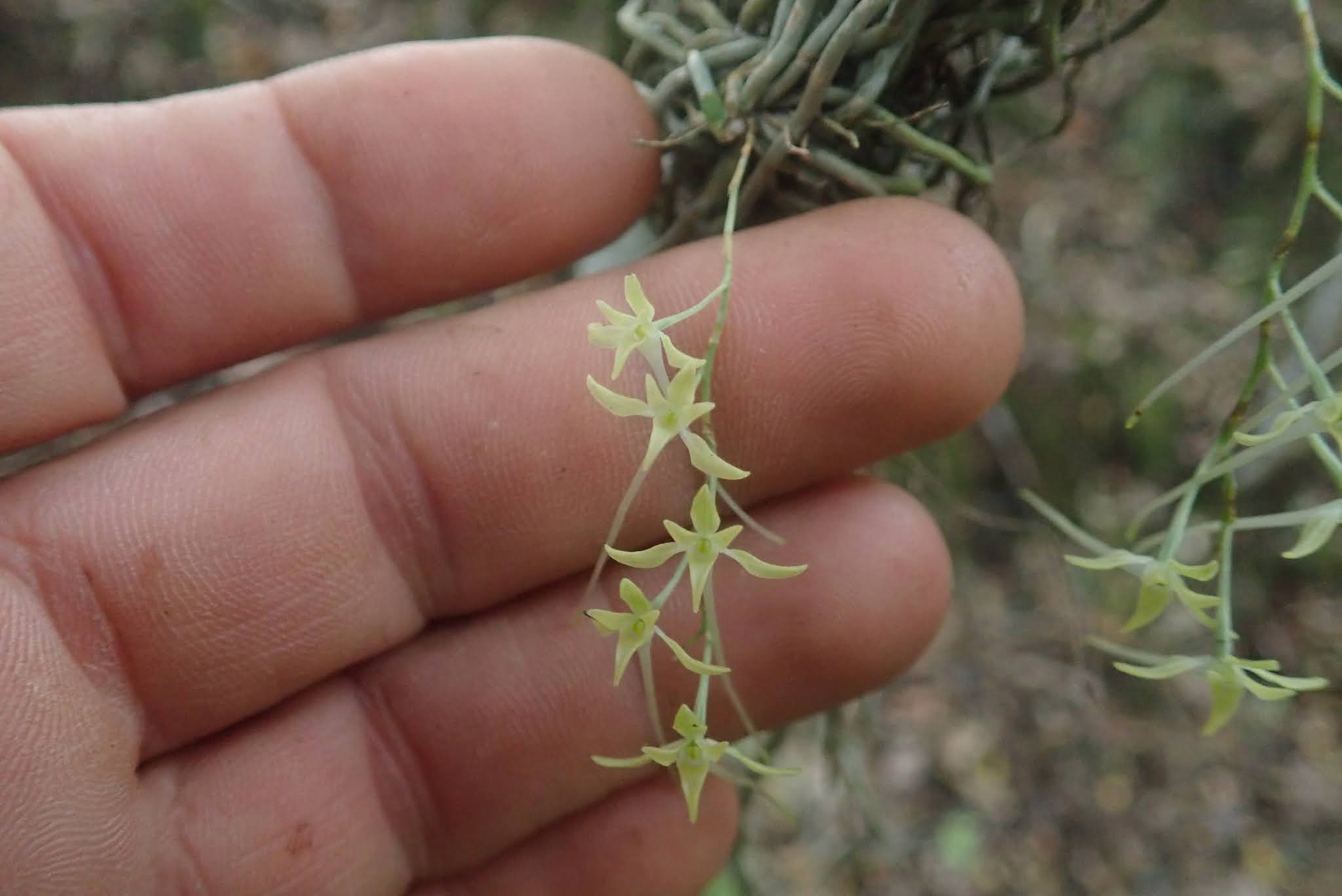
Aaaargh! I was so excited when I found this that I did scream! Have you ever seen such delicate flowers before? This is a Mystacidium gracile, an epiphytic (air plant) orchid that I have been hunting for, in the forests, in September and October, every year for quite a few years now - and voila - here it is! It is not actually that rare but it is a tiny bundle of roots, with one or no leaves, attached loosely to branches and is very difficult to spot. The specific name, gracile, means "attractively slender or thin" which it certainly is. The extremely long spurs that hang off the back of the flowers have the nectar at the bottom end of them and this design only allows Hawk Moths with long enough proboscis's to access them and, in doing so, collect pollen on its face and hopefully move on to another plant to enable pollination. Made my month, it did.


This is a frenzy of Copper-tailed Blowflies, Chrysomya chloropyga, feeding on, and laying eggs in the carcass of a bushbuck found up on the Kliprots river. Even though they are actually rather beautiful, they are inherently regarded with revulsion by us because they are serious spreaders of disease in human communities. Because this African fly is synanthropic (meaning it associates with humans), it, together with some close relatives, has invaded the rest of the tropical and subtropical world thanks to globalisation, spreading pathogens that cause diarrhea and bacterias like E.coli, Salmonella and Shigella in developing countries. The female stores sperm donated by males which enables her to rush off to the nearest carcass or open latrine and immediately lay eggs without having to find a mate first. Together with her multitude of friends, she lays between 50 and 200 eggs (per fly!) on a carcass and before you know it, the carcass is a writhing mass of maggots! If the carcass is too small for the masses of maggots, they will turn on each other and an orgy of cannibalism will ensue! In fact, even if a maggot is injured and leaks haemolymph (insect blood), his brethren will eat him! But there are some positive sides to this ghastly story: the maggots are used in wound therapy where they are introduced into a necrotic wound where they consume all the rotting flesh and leave the healthy flesh untouched; and they are useful in forensic entomology where a pathologist can determine the post-mortem interval and determine the time of death of a murder victim.


Right at the very beginning of spring-time one gets to see beautiful pink blossoms scattered around the Spekboom valley and at places on the Kliprots. These are exotic Peach trees (Prunus persica), remnants of the times when Finsbury House (unit 23) was a farm dwelling with a peach orchard between it and K9. There's also an ancient, gnarled Pear tree (Pyrus sp) beside the Picnic spot in the Spekboom valley and it looks very similar to the blooming tree above. But we have our own, indigenous blossom tree that explodes into bloom at the beginning of spring-time and it is the Wild Pear, Dombeya rotundifolia, pictured above. Even though the Wild Pear resembles the exotic Pear, they come from different families: the Pear and the Peach both belong in the Rose family and our Wild Pear belongs in the Hibiscus family. They can be found throughout the estate on rocky slopes but are most noticeable on the slopes above the mountain hatchery (near Morrin Pools) and above SPK1 up towards Spioenkop. Now, this a magical tree for the garden because it is very fast growing; it has a beautiful, kindergarten tree shape; it attracts butterflies; it is frost resistant, drought resistant and it makes a spectacular display in the early spring with its showy flowers that bloom before the leaves come out! And that's not all... It makes an excellent bonsai specimen with corky bark forming and leaves reducing within two to three years of care. It is also beneficial in wilder zones being drought resistant, fire resistant (leading to the Afrikaans name Dikbas) and good browsing for mammals. Wow! What a tree. Why do we even have exotics in our gardens when we have indigenous beauties like this? 


Deep in one of the gorges feeding the Klipdrif stream in Hidden valley, resides this large, bulbous bracket fungi call Chicken-of-the-woods, Laetiporus sp., upon the dead trunk of a huge, but dead, forest tree. The common name is derived from the fact that it is edible and tastes a bit like chicken but with a texture very much like chicken (when they are both cooked). This individual has hardened with age so it was unsuitable but, if the fungus body exudes a watery liquid then it should be harvested and cooked in a creamy garlic sauce. In fact, it can substituted for chicken in any chicken dish and leftovers can even be frozen. It is considered a delicacy in Germany and North America and is cultivated there. I only just discovered this so I will diarise it and make sure I return to harvest it next year as the fruiting bodies apparently appear, in the same place, year after year until the tree collapses. The fungus normally attacks dead hardwood trees but may sometimes be a mild parasite when it attacks the hardwood exposed by a wound on a living tree. The Chicken-of-the-woods is the Guinness world record holder as the heaviest mushroom at 45kg in 1990. 


Found me a Wahlenberg's Velvet Gekko, Homopholis wahlenbergii, hiding in a deep crevice between two flat slabs of rock up on Goudkoppies plains recently. Pretty high up for a gecko that is quite synanthropic (my new word!). Anyway, I never put enough effort into really understanding how geckos apparently attach themselves to even smooth surfaces, until quite recently, and it is actually quite mind-blowing. Fundamentally, they use the same technique as glues and epoxies do to adhere to surfaces but, I thought to myself, how do they become sticky when they want to stick to the surface, then suddenly unsticky when they want to lift their foot off the surface? Well, it helps to understand how things stick together: when two surfaces are pressed together, even smooth surfaces, a very small area of the surfaces are actually touching each other because, no matter how smooth they appear, they are rough at a microscopic level. So what glues do is fill the air spaces between the areas that are touching each other to the point that Van Der Waal's force takes effect. You would think "well, why doesn't stuff stick if you put water between them instead of glue?". Good question. The thing is: you get dry sticky; and you get wet sticky; and nothing in between. And dry will not stick to wet, for long, and wet will not stick to dry, for long. Anyway, Van Der Waal's force is (deep breath): when the surface area of the surface to be adhered to is covered enough (all those microscopic spaces of air are filled in) by the surface wanting to do the adhering, that the molecules' electrons, in such close contact with each other, begin to interact with each other, changing orbit, and becoming electromagnetically attracted to each other instead of repelling each other as usual. With geckos then (see insert in photo), apart from having retractile claws to hang from edges, the bottoms of their bulbous toes are ridged like the soles of boots and those ridges are covers in stiff, minute hairs called setae (about 14 000 per underfoot) and the tip of each seta splits into about a thousand nano-width bristles. So when it touches the substrate, these microscopic bristles reach into all the irregularities of the surface of the substrate and Van Der Waal's force takes effect and the foot grips tight. It has now been discovered that a gecko can change direction of these setae in milli-millisecinds so that forces are pushed into different directions so as to stop the Van Der Waal's force and then be able to unstick its foot from the surface enabling it to run, jump and change direction, even upside-down! Fa-sci-nating!   


These strange, closed flowers are called Lighted Matches Mistletoe, Tapinanthus rubromarginatus, and we found them appearing to be attached to the branches of a Common Sugarbush, Protea caffra. On closer inspection, one would notice that they are actually attached to their own branches that seamlessly attach themselves to the branches of the Sugarbush, the host tree. The strange flowers of this hemi-parasite (not full or holoparasite since it does have leaves that provide some sugars to itself through photosynthesis) are attractive to sunbirds who probe the flower with their long bill until the flower pops open and slaps the sunbird on the forehead with the pistil and anthers and so deposits pollen there. The bird then pollinates the flower it visits next when the same thing happens. This mistletoe only parasitises three species of Proteacea and they all occur here on the estate: Silver Sugarbush, Common Sugarbush and Willow Beechwood. The fruits of the mistletoe are small, sweet, red berries filled with seeds in a sticky jelly and birds love them. After the bird has eaten the berry, its beak will be soiled with this sticky jelly with seeds in it and the bird will wipe its beak off on a branch of another tree to clean it. The seeds adhere to the branch and when they germinate, their roots, called haustoria, graft themselves onto the branch and penetrate the vascular system of the host tree and begin to extract nutrients or water. And so the cycle continues....


That's it for September. What a lekker month it was. Now for October when we will hopefully have decent rainfall and jolly times. The flowers are starting to bloom and remember, if you are at the estate and you want to see them, let me know on the radio and I will gladly lead you on a hike in search of all these beautiful and amazing things. See you soon.