Wednesday, 2 February 2022

JANUARY 2022


 JANUARY 2022


The first month of 2022 was a beauty! Although there has not been very much rain, it has still been falling softly, leaving the rivers with a strong, crystal clear flow. The rainfall for the month varied between a low of 78mm for Gate 2, to a high of 191mm at Pebble Creek (unit 25). 132mm fell at the central area compared with an monthly average of 213mm since 2010. The season total for the office stands at 585mm, just over 300mm short of the average annual figure of around 900mm. Everything is so lush and green that the grass even looks tasty to a meat lover like me! The picture above illustrates this on the high altitude stream above Troutkloof waterfall on the Zebra trail. The banks are bursting with the huge leaves of River Pumpkin, the bright flash of Scarlet River Lilies and the pink shower of the pendulant flowers of Hairbells! I found a whole bunch of interesting wildlife this month and have highlighted some of them below:


While walking just below the cliffs of Goudkoppies I saw what looked like the fluffed panicle of a Natal Red Top grass plant, Melenis repens, but it appeared a bit too swollen so I approached for a closer look. It was not the panicle of Natal Red Top but a raceme of clusters of tiny, hairy Milkweed flowers that I had never seen before. I could not find anything like it in my books so I posted it on various social media sites and was finally contacted by a Dr. SP Bester, a milkweed specialist scientist (among other things) from SANBI (South African National Biodiversity Institute), who was rather excited about my find. He said it was possible that this could be a new species of Shield Tongue in the Aspidoglossum genus of the Milkweed family. He requested that I collect and press a specimen for him to study. I borrowed the relevant equipment from the local MTPA botanist, Tommy Steyn, and returned to the area, established a five thousand square meter quadrant around the individual that I had found, and began my search for more individuals. Fortunately, I managed to find a further five individuals in the quadrant so felt comfortable to dig up one of them to press and send to Pretoria. If ever one is to find a new species of plant, it will most likely be an insignificant plant like this one since all easily noticeable plants would have already been seen. But on closer inspection (inset), wow, what a beautiful little hairy flower! Now I wait...


This is another small, insignificant member of the Milkweed family: The Rosary Vine, Ceropegia linearis ssp. woodii, is not rare or endangered, it is just difficult to find because of its size and the fact that it grows in cracks in rock and cliff faces. In fact, globally, this species is the most cultivated of all the species of the genus and is known by a huge assortment of common names like Hanging Milkwort, String of Hearts and a few variations of that, Heart Vine, Jacob's Beard and many more! The trailing stems grow from a bulb between rock surfaces and at each node, a pair of leaves, flowers or even new bulbs can grow. The heart-shaped leaves are succulent and arranged neatly in pairs and if the plant resides in a spot that offers dappled shade, marbled or variegated (the leaves develop plain, dark green colouration in complete shade). The flowers (see inset) are extraordinary little traps and are similar throughout the genus. They have a swollen base and a long tube that has four lobes on top that join at the tip to form four windows (openings) that emit an odor that attracts its small fly pollinators. The fly enters the window to find maroon nectar guides that lead it down the tube into the swelling where the fused anthers and stigma reside with the nectar and pollinia (bags of pollen). The tube is lined with downward pointing hairs that allow the fly to enter the swollen base but not to exit it. This imprisons the fly for long enough to ensure that it snares the pollinia on one of its legs. There is sufficient nectar in the nectary to ensure the fly's comfortable survival until the downward pointing hairs wilt and allow the fly to exit its temporary prison and fly off to pollinate the next single use flower! Wow! What an elaborate design. After successful pollination, the ovary develops into a follicle. a double horn-shaped seed pod that splits horizontally and exposes many flat seeds with long hairs attached. The change in the moisture in the air around the seeds when the follicle splits, causes the hairs to begin to spread open to form a parachute for the seeds that are then dispersed by the wind. What a crazy little succulent! Ceropegia: keros = (greek) wax; pege = (greek) fountain, referring to the flower that resembles a wax fountain.


I captured this beautiful scene in the thick forests in the upper Majubane kloof, close to the waterfall. It is an old, rotting log covered in mosses and beautifully coloured yellow and maroon (?) Elf Cup mushrooms. Although these fungus fruiting bodies are most likely from the Cookeina genus in the Sarcoscyphaceae family of mushrooms, there are a few very similar genera in the family. I featured one of them in a blog in January last year and explained the function of the cup, which is to disperse the reproductive spores. I will repeat the process in more detail: The spores, for reproductive purposes, are formed on the shiny pink (or yellow) interior, or hymenium, of the apothecia (the cup) and when it rains the apothecia fills with water and the hymenium absorbs some of it, creating a hydrostatic pressure on this inner surface, and when it evaporates and dries out, this causes a negative vapour pressure resulting in the tissue popping outward and catapulting the spores into the environment. Another extraordinary dispersal technique. One cannot help but to fiddle with them because the resemble little rubber cups and, sure enough, they are rubbery. Also apparently edible so I picked off one of the small ones and took a nibble and it was tasteless but had a nice texture.


This incredible series of photographs were taken and sent to me, at my insistent request, by Dave De Vos from The Crofts (unit 19). They feature a pair of Malachite sunbirds, Nectarinia famosa, in and around their nest situated within the crown of a beautifully rounded Silver Sugarbush tree right beside the road between Tranquility (unit 15) and Jackpot cottage (unit 16). I remember him and Kenna Twiggs sitting in their Landrover for a few hours trying to get these shots. Well, it paid off! Here we see the male perched atop a Flame thorn tree, showing off his bright green breeding plumage and long streaming tail. During the non-breeding season he loses this plumage and resembles the more drab female, except he may still retain a few random metallic green feathers. We don't get to see him like that because they migrate locally to lower altitudes during the non-season.


This is the female perched atop a Silver Sugarbush, Protea roupelliae. This Protea obviously has superior quality, or much greater quantity nectar than the other Proteas of the area because both the Sunbird and the Guerney's Sugarbird greatly prefer this species and occur more frequently where this tree occurs. Interestingly, when they both find each other on the same tree, the Sugarbird dominates and chases the Sunbird away. Look carefully and you will see her long, almost transparent tongue protruding from the tip of her bill. This long, spaghetti tongue is what reaches the nectar. Malachite sunbirds are only seasonally monogamous, meaning a male and female hook up for a breeding season then part and perhaps hook up with another partner the following season. The pair then establish a territory spanning a hundred or so protea trees and, while the female constructs the nest, the male defends the this territory.


These are the two little chicks! They seem quite well advanced and fit quite snuggly in that soft domed-purse of a nest their mother built. If these chicks are successfully fledged their parents may use it again for a second generation of chicks. And even a third if it is a good season. And if the same male and female sunbird happen to hook up again next season, they may just use the same nest again, with the female strengthening the old nest with new material. She also, alone, incubated the eggs more than half of the time for two weeks before these two hatched and they remain in the nest for about three weeks before they are ready to learn to fly. This takes between one and two weeks and until then, they are herded back into the nest each night to sleep, like mom is tucking them in for the night.


Although less than ten percent of the adult sunbirds' diet consists of arthropods and other invertebrates, that is exclusively what the chicks are fed by the adults for rapid growth, here by the female. Perhaps a spider, taken from its web by the hovering sunbird, or an insect gleaned from its hiding place beneath a leaf. There are records of the adult sunbird regurgitating nectar for their chicks but this is disputed by some.


Here the male has fed the chick but the chick is plainly unimpressed by the quantity! At least he contributes a bit towards raising the chicks although its usually less than a third of the time. Again, he is showing us the sunbirds' long spaghetti tongue.

One last thing about sunbirds and their importance as pollinators: It is well known that tubular flowers in the red colour spectrum are attractive to sunbirds in general, making them the chosen pollinators for many plants. Plants on the estate like Aloes, Tree Fuschia, Red-hot Pokers, Wild Dagga and even the Clivias in our forests. These sunbirds, of all species, carry the pollen on their faces because it was deposited while they had their faces stuck into the flower opening so they could reach the nectar at the base of the long tube. Well, it was recently recognised that sunbirds, and particularly the Malachite sunbird, appears to be the preferred pollinator of the Torch orchid, Disa chrysostachysa. A tall (up to 1,2m) orchid with tiny golden orange flowers stacked tightly around a long spike inflorescense (chrysostachya = golden head of corn) that occurs west and south of us, as close as Dullstroom. Unlike the long tubular flowers usually preferred by sunbirds these orchids have tiny flowers with sweet nectar in swollen spurs with very narrow entrances that allow only the spaghetti tongue of the sunbird to access the nectar. The design of the orchid makes for a suitable perch for the bird and so it perches in one place while it probes each flower within its reach for the nectar. Paired pollinia (sacks of pollen common to all orchids) then adhere to the feet of the sunbird and get deposited on the following orchid flower without competition or pollen clogging (when other species' pollen is deposited on a different species of flower's female part and clog it up so it cannot accept any further pollen. A challenge for flowers that choose generalist pollinators) from other flower species.


This is a close-up of a female Wolf spider (Lycosidae family) as she squeezes herself into a gap between stones and rock to protect herself and her egg sack from my camera. I mention in a little feature in my blog of September 2019 that they are common night-time hunting spiders that are easy to find because their eyes reflect the light of a flashlight like an antelope's do. These well-developed eyes are similar to the eyes of a jumping spider, with a pair of larger ones on the front of its face, like a car's headlights. They do not spin a silken web and instead run freely at night in search of their prey which mostly consists of ground dwelling insects and other spiders. They also have three small recurved claws at the tips of their legs that they use for anchorage as they jump on the back of the prey animal who was either actively chased down and overcome or ambushed. Once anchored to the back of its prey, the spider rolls itself onto its back so that it is bear-hugging the unfortunate arthropod and then bites it and injects its powerful venom that quickly liquifies the insides of the prey. At first glance, the spider above may be mistaken for a Nursery-web spider from the Pisauridae family (blog of March 2020) because the spider is carrying her egg sack with her. There a a few important differences although they are closely related species' like the female Wolf spider carries her egg sack attached to her spinnerets by strong strands of silk while the Nursery web spider carries her egg sack with her mouth and chelicerae. Also although their eye patterns are similar, the Nursery web spider has similar sized eyes while the two "headlights" of the Wolf spider are clearly much larger than its other eyes (eight in all like almost all spiders). The female Wolf spider carries the egg sack with her, even defending it from predators like this one may have done because, if you look closely, you will see that she has lost two of her eight legs, both on the left side! Don't worry too much, they will grow back! Apparently, if the egg sack is detached from her, she will run around furiously searching for it until it is found. And when the spiderlings hatch, they will crowd up onto her abdomen and remain their, protected by her, until after their first moult when they will release a long strand of silk and balloon away, sometimes hundreds or even more kilometers away in the wind. If they fall off their mother's back before this, they will chase her until they can grab hold of her leg and scamper back up. If they don't succeed, they will be lost and die because, even though the mother shows great parental care for a spider, it only goes so far and she will not return to look for the lost spiderling. 


I have mentioned before that I really like plants that associate with cliffs, or cremnophytes, usually because they are quite unique like the only fig tree that occurs here, the Red-leaved fig (see my ancient blog of 1 September 2013) and the Rosary vine at the beginning of this blog among very many. This dwarf shrub, a Narrow-leaved Bride's-bush, Pavetta gracilifolia, a member of the Coffee family, was photographed on the cliff beside the big concrete and rock bump at the crossing at K15. This cliff just keeps on giving! There is a big Red-leaved fig residing nearby, the stunted Cape Gardenia and a climbing Grape among others. In fact, I even mention this little bush my blog (of March 2020) featuring the Cape Gardenia but I did not, at that stage, know which species it was. The Bride's bushes have an interesting feature although not restricted to the genus, but found in three genera of the coffee family: If you look carefully at the leaves, you will notice that they seem to possess little bumps in their smooth skin, like pimples. These are nodules that house bacteria from the Burkholdaria genus, a group of bacteria that cause infectious diseases like Glanders in horses and others and Melioidosis which kills about half of the one-hundred-and-sixty-five thousand people it infects annually. These bacteria, when associated with the leaf nodules, are species specific which means that one particular species of bacteria associates exclusively with one particular species of plant. The origin of the relationship appears to have been a single infection event in the evolution of the plant where, either it shared a parasitic or commensal relationship with the plant and has, over time, evolved into a mutual relationship with the host. It was initially assumed that the bacteria fixed nitrogen like the bacteria that live in specially designed nodules on the roots of legumes but after experimentation it could not be proved. Since the bacteria is present in the seed of the plant, scientists then boiled the seeds to remove the bacteria and found that plants that germinated from these seeds all turned out grossly deformed, suggesting that the bacteria produces growth hormones for the Bride's bush. The bacteria ensure they stay with the correct species of plant by attaching to the seeds and then, when the seeds germinate, they move to the growth nodes of the new plant. The leaves develop stomata (small pores used in respiration and transpiration) when they are just buds (unlike other plants whose stomata develop later on) and the bacteria, residing in a jelly-like substance produced by the plant, enters the leaf through these and develop the nodes from there as the leaf grows. Plants, being life forms that cannot move, have evolved the most complex relationships with animals that can move in order to manipulate them to do things that would otherwise require independent movement. These strategies are infinitely complex and I think scientist are just beginning to scratch the surface of these complexities which prove to us how interconnected everything is. 


This bracket fungus has got to be one of the easiest to identify when it is young and exudes this amber syrup. It is a Weeping Polypore, Pseudoinonotus dryadeus, and can be found growing in the darkest corners of our dense kloof forests. It usually occurs at the base of a broad-leaved tree trunk at a spot where the bark had been removed or damaged, maybe by a Porcupine or something similar. Once established, it causes white rot and it's mycelium (stringy tentacles) will penetrate the root crown of the tree, ultimately killing the tree. The root crown is the place where the vascular system of the roots, which is different from the vascular system of the rest of the tree, meet and connect. The Weeping Polypore, although appearing tasty, is not edible but also not poisonous.


Yummy yum! A most delicious looking and, might I add, tasty Raspberry from a White Bramble bush, Rubus rigidus, from the rose family that I found in rank bush near Rainbow Creek (unit 2). The raspberries we buy from the supermarket are mostly from cultivars of the species R. idaeus but many countries have their own species and cultivars. I have always thought that the fruit of the Asian Ceylon Rasberry, R. niveus, are the best tasting while our indigenous species had rather sour fruits. I was very pleasantly surprised when I tasted the fruit from this bush because it tasted as good as the Ceylon's but was even juicier! This made me happy because this is one of our indigenous species. I have so far identified seven species of bramble on the estate and, of those, four are indigenous and three are invasive aliens. After nine years of clearing alien invasive plants from Finsbury estate, we are finally at the stage of control where I could begin working on the brambles this month. This means I have had to teach my team to differentiate between the species so that they could remove the invasive ones and not harm our indigenous ones, something that is not commonly done when bramble are controlled and indigenous species are indiscriminately cleared together with the invasive species, denying many animals and birds (and humans) a nutritious indigenous fruit species. This is not so easy because, although two of the invasives are relatively easy to identify against our indigenous ones, one species. Rubus sp.X consists of many variations because it is a hybrid between the American Bramble and this one. My team is about halfway along the Kliprots river now and it seems that they are targeting the correct species.


Middle to late summer is the time for orchid hunting and this year has been no different. I have conducted a few hikes where we concentrated on finding orchids recently but the most successful this season, so far, must be the trip I took with the Harwoods and their orchid crazy guests from Bulldozer Creek in the middle of December. We drove all the way around on the Long Tom pass road, entered Emoyeni reserve through a gate opposite Hops Hollow Brewery and approached the summit of Mount Anderson as closely as we could and found only four species. But we did find the special one we were looking for, Disa staerkeriana, which only occurs on the summit of Mount Anderson and nowhere else on the planet (see blog of Sunday 19 February 2017). And another of the mere (I promised them eight species!) four species was a new one for my Finsbury orchid list. We then popped in to the Brewery for a huge burger and perhaps a beer or two and afterwards drove up to the aerials on top of the mountain beside the brewery, a fine orchid venue according to Duncan, the orchid crazy guest of the Harwoods. Was he right? Hell yes! We found a further eight species of orchid there including four (!) new species for me, one of which I found on a later hike up on Goudkoppies. Unfortunately, three of those cannot be added to my Finsbury list because they were not found here. We found twelve species of orchid that day! Anyway, the above orchid, a Lilac Split-lip orchid Schizochilus lilacinus, is one of the species I was hoping to find for the group but as I approached the spot where I had found them just a week prior, I saw they were no longer in bloom so not worth climbing the group up to. But these are special too because they, together with five species, so far that I know of, only occur in a very small range right here around Mount Anderson.


The beautiful, extremely showy flowers of the Wing-leafed Wooden Pear, Schrebera alata, blooming this month at the edges of our kloof forests and the thick riparian bush along some of our rivers. Not just showy but also pleasantly scented, especially in late afternoon and evening when it may attract moths as chosen pollinators in that segment of the day. They make great garden subjects because they are easy to grow and very fast growing too. They have these pretty flowers, attractive, glossy green leaves and the tree sports a nice shape. Plant a seed in spring-time and, voila!, in a month you will have a seedling, according to gardening literature. Protect the young trees from frost, though.


That's it for the month, and an exciting month it was since I also executed my first proper patch mosaic burns this last month. That is when I go out into the grasslands, with no staff, bend down with my lighter and put a flame to one point and then walk away and forget about it, simulating a lightning fire. Being so green at the moment, the fire will not burn unless the grasslands in question have enough moribund material, which is dry grass material from previous seasons that will ultimately smother the grass plant if not allowed to burn. The fire will inevitably burn out in the cool night or when it reaches areas with less moribund. A safe, easy burning policy that reduces fuel load and promotes biodiversity by simulating the natural fires that occurred in the grasslands before human intervention. There are a few patches now on the slopes from the valley bottom up to the Miner's cottage road and I have a few more planned for the month of February. Have a good one and, hopefully, see you soon.  


Thursday, 23 December 2021

CHRISTMAS 2021

 CHRISTMAS 2021


At the end of October, the rainfall for the month was lower than the ten year average but I described it as good, soft, absorbing rain which was good for the vegetation as it allowed seeds to germinate and protect the soil from erosion. Well, since the end of October we have had an average of 245mm rain fall in 21 rainy days. This is quite a bit lower than the ten year average of 322mm over November and December combined. But the rain that fell was still soft and absorbing, resulting in the aquifers filling up sufficiently to rise the river levels nicely in time for Christmas. The estate is green and lush as you can see from the photo above, taken from atop Goudkoppies towards Mount Anderson. The lush grasslands are pumping with life and below are a bunch of interesting and exciting things that I stumbled upon during the last two months:


A close-up of a Raucous Toad, Amietophrynus rangerii, trying to conceal himself amongst the grass and debris in open grassland far away from large bodies of water. The rough, warty skin combine with cryptic coloration to provide decent camouflage. Frogs and toads do not drink water. Instead they absorb water through their skin via osmosis but this also means that they need to remain moist because they lose water easily too. Being the second most common amphibian on the estate, after the Common River frog, Raucous toads move far away from their breeding sites to find enough arthropod food so they have the ability to store large amounts of water in their enlarged bladders and lymph sacs to keep them moist during these sorties. Even those huge, bulbous eyes seem to help camouflage the toad. Interestingly, they have powerful muscles attached to the rear of their eyes so they can retract them for protection. They also, quite comically, retract their eyes to help shove large prey items down their gullets, from the inside!


This large, discoteque-patterned caterpillar belongs to the adult Brown-striped Hawk moth, Basiothia shenki, which looks quite similar to the Hawk moth I displayed in October, although the caterpillars look miles apart. The adult moth, as previously mentioned, has a very long proboscis rolled-up, like an elephant's trunk, which is not really designed to reach your beer or wine during sundowners but to reach right to the end of a long spur or flower tube to reach the nectaries at the end thereof. In fact, this species' proboscis is exactly the right length, together with only one other species of moth, to reach the nectaries at the end of the long spur at the rear of the stunningly beautiful orchid, Satyrium longicauda which is quite common here on the estate in high altitude grasslands, particularly around Mount Anderson's summit. These lovely orchids are starting to flower now and will do for most of January too. I recently read an article where experiments were conducted to try to establish how these moths and the orchid's flowers, using protandry, work together to try to minimise self-pollination and maximise pollen export. Protandry is when the flower produces the male parts of the flower before the female parts The orchid has a row of flowers on the vertical inflorescence and the lower flowers open before the ones above them on said inflorescence. Protandry will ensure that, once all the flowers are open, the lower ones will be female and the upper, younger ones will be male. Amazingly, when the moths approach the orchid, they always visit the lower flowers first, depositing the pollen taken from the previous flower with the female while picking up more pollen from the males above to export to the next plant! If the moth visited the flowers the other way, self-pollination would increase (leading to poor seed production) and pollen export would decrease.


This is an apt-named Long-horned Fairy moth from the Ceromitia genus in the Adelidae family of moths. These crepuscular (active at dusk and dawn) moths also have rather long proboscis' and are important pollinators for flowers that open at dawn and dusk to avoid the competition that is present during the day. They are rather primitive and all moths more primitive than these still chew their food, unlike most modern lepidopterans. The long antennae are used by the males to detect pheromones produced by the short-antennaed females. How he successfully flies with those monstrous things is another miracle of nature :) 


It is quite hard to believe that all the insects, all five different looking ones in the two pictures above, are all the very same species, just in different stages of development! While walking in the Steenkamps' waterfalls path in the kloof forests last week, I noticed these strange creatures hanging from the underside of the leaves in a whole bunch of trees in one area. I took these photographs and collected a few pupae (the yellow-and-black chequered hanging things on the first photo), put them in an aired bottle and waited for the adults to emerge. The beetle in the bottom photo is the resulting adult! It is a Leaf beetle from the Garelucinae sub-family in the Chrysomelidae family of 35 000 described species and an estimated 60 000 species of plant-eating beetles! The larvae look similar to caterpillars from the Lepidoptera (moths and butterflies) as they munch the leaves of a tree except, like all beetle larvae, they just have legs at the very front of the long body, unlike lepidpterans whose legs run all the way down the long body or just the front end and the back end, like inchworms.


Can you spot the Cape Robin-chat as she incubates eggs in her nest? She has constructed it in a particularly thick, shrubby River Sage in the garden of Finsbury House (unit 23). A very common bird in our gardens, the Cape Robin-chat, Cossypha caffra, surely must be familiar to all who are reading this. The song, a ubiquitous sound in the garden, is almost always sang by the dominant male in a monogamous territorial pair while the female usually only sings if her mate has perished and she is on the lookout for a new partner. The pair will establish a tiny territory that they will aggressively defend against others of their species but, unlike many monogamous species, the male and female do not spend much time together. They forage separately and even roost separately in the night. The female builds the nest on her own, incubates the eggs and hatchlings on her own and initially feeds the newly hatched chicks on her own, with the male only chipping in to help once the hatchlings begin to grow. Also, unlike many monogamous birds, the Cape Robin-chat pair do not sing in duet to strengthen their bond. The diet is catholic although more emphasis is put on insects and other small arthropods than scavenging and fruit, although they are important for seed dispersal for most of our indigenous riverine trees here on the estate. These eggs hatched and the mother successfully fledged the chicks just over two weeks. The youngsters are now following their mother all over while she supports them and teaches them what they should and shouldn't eat. The Cape Robin-chat is one of the favourite victims of the brood parasite, the Red-chested Cuckoo, more commonly referred to as a Piet-my-vrou.


This beautiful caterpillar is that of a Lappet moth, Eutricha obscura, in the Lasiocampidae family of moths. It looks very similar to the Cape Lappet moth caterpillars which are normally found in large aggregations on the stems and trunks of trees that make them on of the more commonly observed caterpillars. The adult is a large brown moth with a wingspan of about 70mm. The long hairs on the caterpillar are poisonous and so one should avoid touching them. If you brush a part of your body against the caterpillar, the hairs break off into your skin and urticarial weals (hives) will form almost immediately, causing some discomfort. In more serious cases, the entire affected limb will swell and systemic reactions may result in vomiting and anaphylaxis. If you have brushed against one, the best way to remove the hairs is to cover the area with duct tape and then to peel it off, removing the poisonous hairs at the same time.


The other day, as I emerged onto the flatlands of Goudkoppies from the Troutkloof waterfall side of the Zebra trail, I was greeted by a most pleasant sighting: A Blue Crane, Grus paradisia, South Africa's national bird, foraging in the grasslands a mere thirty meters from me! Barely visible to the left of the rocks in the photo, the bird walked slowly away from me as it entered Mount Anderson Ranch property. I really could have gotten a photo when it was still much closer but I was enjoying the moment too much to have thought of it! I searched carefully for its mate and saw nothing, suggesting that this was a youngster who had not yet found a mate to team up with. Like many birds, they are monogamous but these large birds, males can reach five-and-a-half kilograms, become quite a charismatic pair. They are vociferous with their many different deep, guttural squawks which are loudly proclaimed in duet, with the male having the deeper voice. (So, unlike the eagles, the Crane male is larger than the female and he has a deeper voice) And aggressive too, mainly towards Wattled Crane near the nest which is something I have not observed. The Blue Cranes that we see here (I've now seen them on Goudkoppies, twice above the cliffs on our boundary with Potato Seed, and numerous times in the open plains of Haartebeesvlakte) more than likely roost, nest and congregate in the Steenkampsberg area between Dullstroom and Belfast, which is a very important breeding area for this threatened species. I have heard them calling and, I assure you, it is loud and unforgettable.


I was walking along the base of the cliffs below Goudkoppies, above the Miner's cottage and noticed many blooming Harveya huttonii, a parasitic plant that is only noticeable when in flower. These odd, pale plants belong to the Broomrape family (Orobanchaceae), which is a family of parasitic plants that attach themselves to the roots of the host plant: Orobos = legume (gr); anche = strangle (gr). Until recently, all the members of the family were holoparasitic like the plant above, which means that they cannot survive without their host plant. Recently, all the parasitic members of the Snapdragon family were transferred from there to the Broomrape family, which introduced the hemiparasites to the family. Hemiparasites are able to photosynthesise for themselves and can therefore survive without a host. The seeds from the above Harveya rest just below the ground and will not germinate until they receive a chemical signal from a host plant's roots. The signal from the potential host is not intended, they are merely plant root exudates that leach into the surrounding soil. Once the parasite's seed detects the chemical, it germinates and sends haustorial roots in the direction where the concentration of chemicals increase, therefore closer to the host plant. The host must be close enough for the parasites roots to reach it with their very limited energy supply. Once reached, the haustoria of the parasite attach themselves and tap into the xylem and/or phloem of the host and begin to grow. The parasitic plant, if dug up, just looks like a pale, swollen root, and only reveals itself when it blooms like the one pictured above.  


Funny. On my way to town recently, with our vehicles slipping and sliding down the access road toward the railway tracks as if they had a life of their own, I spotted a Speke's Hinged tortoise, Kinixys spekii, crossing the road from one of the plots to another. In fact, it was very close to the spot where I saw the chameleon on the power line (see blog of Finsbury Autumn Wildlife, February 2020). It is the very first tortoise I have seen near the estate since I got here almost nine years ago! The hinge the name refers to, is on the hind section of the shell so that the tortoise can close off the tail area by bringing the upper carapace (where the hinge is) down on to the plastron (the flat bottom of the shell). When other tortoises retract into their shells they pull their head in and cover it with the large, armoured front legs but cannot cover the tail section properly to keep some predators out. On more than one occasion, I have witnessed a Ground Hornbill (that massive predatory bird found in the lowveld) eating the flesh of a tortoise (Leopard tortoise on both occasions) from the gap between the carapace and plastron at the tail! The Hinged tortoise will be protected from that fate because of the hinge.


This is a Scaly Woodcap, Lentinus stupeus, one of the easier to identify mushrooms in our forests. Although the densly curved, hispid hair looks unappetising, the mushroom has a tough, chewy meat and a strong flavour when young and is much sought after by foragers.


Golden-spotted Sylph, Metisella metis. Metis was a Greek goddess and advisor to Zeus. She was of great use to him and he was wildly attracted to her although it was prophesised that if he lay with her, she would first bare a daughter of infinite wisdom, and then a powerful son. So powerful that he would ultimately overthrow Zeus. After lying with Metis, Zeus, in order to avoid the prophesy from occurring, convinced Metis to turn herself into a fly. When she did this, Zeus quickly swallowed her but it was too late. She was already carrying her daughter to be born Athena, who would be raised in Zeus' mind! Metus crafted weaponry and a shield for her daughter who used them to give Zeus headaches until Zeus ordered his head cut open to release Athena, who was made goddess of warfare wisdom and handicraft. Metis was very beautiful and was adorned in gold, just like this stunning little skipper butterfly.  


This was a stand-off between me and this Darkling beetle from the Psammodes genus, Tenebrionidae family. Tenebrio means "seeker of darkness" because the majority of members are found in dark places where they live long and move slowly, hence Darkling beetles. We, here in South Africa call them Tok Tokkies because of the way they tap their abdomens on the ground, making a soft tok tok tok sound to attract mates (see blog of January 2020 where the inset photo shows the male underside and the point that he taps with). Just look how well armoured the beetle is! It would take a lot to break through that shell. Most beetles lift their forewings, which are hardened as armour, and then spread their hind wings to enable them to fly. These beetles' armour is so thick that it would be unable to fly for the weight, so the forewings have fused and the hindwings disappered, leaving a slow-moving armoured car type beetle to wander the grasslands. In fact, after the beetle dies, their empty carapaces persist for months, hardy against the elements. 


Phew! I have been looking for some of these tiny mushrooms for many years now. They are Termitomyces microcarpus, mushrooms that are associated with termites and their nests. They are the result of an amazing farming culture that evolved in many termites well over three hundred million years ago (we only started farming twelve to thirteen thousand years ago!). Although termites can assimilate the dead vegetation that they collect as food, the nutritional quality of the food is not as high as is required the seer the many complex different castes that the termites require to have a fully functioning eusocial colony. So the termites gather up the dead vegetation and bring it into a group of chambers strategically positioned within the mound so that they remain at a relatively constant temperature with a consistently high moisture content. They pile the vegetation on top of itself until it forms a shape that is not unlike a human brain. Because the conditions are so favourable, Termitomyces microcarpus fungus grows on the vegetation, consuming it. The termites, when they require high quality food to raise special castes like reproductives or secondary / tertiary queens, harvest the fungus and feed it to the relevant larvae. The definition of farming! At this time of the year, the termites allow the fruiting bodies of the fungus to grow so that the fungus can reproduce. It is edible for us and, although they are small, they are plentiful. I harvested a bunch of them and enjoyed the taste when they were raw so much, that I had finished them by the time I returned home so could not cook them to taste. There is another common mushroom that occurs here on the estate that associates with termitaria. it is a Podaxis pistillaris and although it is associated with termite mounds in its range, it can survive without the termites and vice versa. The Podaxis fungus appears to grow from the faeces of the termites within the mound and there is no evidence that the termites eat the fungus or utilise it in any way. It seems like a comensal relationship where the mushroom benefits and the termite is not affected. In my blog of December 2016 I erroneously stated that the Podaxis was farmed by the termites. 


I found this daytime moth holding two old grasstalks together, in the wind, while it laid its eggs on them. It was quite a feat and I was surprised by the moth's strength! After much searching and deliberation, I discovered it is called an Equine Maiden, Thyretes hippotes, from the Erebidae family of moths. What was so surprising is that the distribution maps in my book and on the internet confine the species to the Fynbos biome in the extreme Western Cape, with the larva's food plant being a species of plant that does not occur here, although we have some close relatives. The admin folks from the insect forum on the internet that I belong to seemed quite excited by the find. That's another species for my moth list which is very, very far from home it seems!


Another animal that I have been on the lookout to photograph for the whole time I have been here, a Common Platanna, Xenopus laevis, found just outside my house during the recent persistent rains. Unlike most amphibians, the adult frogs rarely leave the water so they are very difficult to photograph. Or though they are endemic to Sub-Saharan Africa, they are very well known internationally, even to the layman because in the early nineteen thirties, it was discovered that if you inject a little bit of woman's urine into the back leg of the frog, by the next day it would have laid eggs if the woman was pregnant. It was a very accurate pregnancy test and was widely used until the late nineteen fifties. By this time the frog had been exported throughout the world, becoming the go to frog for all frog related experiments in laboratories world-wide. Because of this, the African Clawed frog (English name) has become an exotic pest in many countries. It is still the most used frog in laboratories and its cells are the source of Xenobots, man-made biological robots! Xenobots were created from frog stem cells in twenty twenty. They consist of skin cells and heart cells. Future applications could be to carry medicines around the body or to gather plastic microdots from the ocean into sizable solids that can be collected as an environmental remediation exercise. Google Xenobots, you'll be amazed. 


Wow, what a diverse bunch of goodies I got to see in the last two months! A lovely way to end the year. We here at Finsbury wish all those that celebrate Christmas a MERRY MERRY CHRISTMAS and a HAPPY NEW YEAR to all! See you in the new year... 2022!

Friday, 12 November 2021

OCTOBER 2021

 OCTOBER 2021


Well, October has certainly been a strange month weather-wise. We have had seven rainfall events during the month but only an average of 60mm has fallen. This is wonderful for the grasses as all the new seedlings can arise without being washed away, allowing them to establish themselves which, in turn, will minimise erosion when the big rains come. But it has not been all that wonderful for the anglers because the river levels are still critically low. The long forecast does suggest that we will be having an above average rainfall this season, so let's hope lots of rain is on the way. 

The only place in the whole country that claimed it was able to fix my little camera couldn't without needing to send it overseas! Can you believe? Anyway, I had them ship it back to me and I have replaced the lens glass myself, with the plastic from a cellular phone screen protector and although I will not take any more underwater photos, it seems to have worked because the photos are coming out clearly again. So below is a gallery of things I got to see this month past:


Well, this is the last underwater image I will take with my little camera. It is of Common River Frog's, Amieta quecketti, tadpole. River frog tadpoles usually take between nine and twelve months to develop to the stage where final metamorphosis begins, a drastic change of structure and organs which will allow it to leave the water as a frog. If there is a shortage of food or the surroundings are very cold, development could take up to two years. Once the very under-developed tadpole emerges from the egg, it immediately attaches itself to the bottom of the stream with the help of a sticky patch below its mouth, so as not to wash away with the stream current. External gills are immediately produced, allowing the creature to breath. Within a few days the spiracle, a slit on the left side of the body develops and a membrane encloses the external gills and they become internal gills over which water is pumped and expelled through the spiracle. Then the karatinised mouthparts develop with rows of teeth designed to scrape algae off rocks or bacteria and plant material from underwater stems, which is the main food of the tadpole. The eyes develop at the same time. By this stage the tadpole is free swimming and can begin to feed. After a few months, hind legs begin to grow from buds and forelegs begin to develop within the gill chamber, inside the tadpole. When the tadpole has developed fully and is ready to metamorphise, it stops feeding and hides away while the fore legs, already fully developed, erupt from the skin and internal organs develop, including lungs so that the tadpole has gills and lungs and can breathe through both, coming to the surface of the stream to breathe air. The mouthparts recede and widen, losing the keratinised teeth while the whole head changes shape. Finally, the tail is absorbed by a process called apoptosis, a controlled and rather complicated disintegration and absorption of the cells. The young Common River frog adult will now be able to leave the water for a terrestrial lifestyle. I don't know how long they live but it seems that they can live for surprisingly long. There are the following South African records: Cape Sand Frog 18 years; Red-legged Kassina 23 years; Common Platanna 30 years; and the Giant Bullfrog 35 years!    


In the last few months we have been priveledged to get numerous sightings of a juvenile Crowned Eagle, Africa's most powerful eagle, around the central and southern parts of the estate. I recently cleared some alien plants from the fringes of the forested gorge that runs in a southerly direction just opposite Grilse Cottage (unit 18), from the valley bottom up towards Little Joker koppie. About two thirds the way up the gorge I came upon a massive Cabbage tree, Cussonia spicata, like the one Lone Tree Cottage (unit 3) is named after, growing from a shelf in the side of the gorge slope, pictured above. The nest is most certainly that of a young pair of Crowned eagles and is very typical of their nests. The reason I say young is because Crowned eagles, well all eagles really, use the same nest over and over for their entire breeding lives unless the nest is destroyed or they are chased away by humans. They may rotate between two nest also, though. Each year they will add new sticks and branches to the nest so that it grows bigger and bigger. This particular nest appears as if it has only been used for one or two seasons so far so the pair was probably only formed a few years ago. About a year ago I watched a pair displaying and calling along the upper slopes and cliffs of Little Joker koppie and, after the female who is easily distinguished by being larger than the male, departed, the male swooped down on a small group of four Mountain Reedbuck and tried to catch one! But missed. The Reedbuck regathered nervously while the eagle circled overhead again and didn't seem to be aware that the threat came from above. That's what it seemed like, anyway. I am now sure that this pair is the same pair nesting in, what is now called Crowned Eagle gorge, just opposite Grilse Cottage in the Steenkamps valley. Incidentally, I have encountered what looks like an abandoned Verreaux's eagle (Black eagle) nest on the cliffs below Little Joker mine, above the gorge that runs the most east of the three gorges that spread out south from behind Bulldozer Creek (unit 21). Lovely to have a resident pair of Crowned eagles on the estate 


A few days ago, I went to inspect the raking of a tracer that we have cut along a part of the path of the Amphitheater hike, the ten plus kilometer hike that starts and ends in Hidden valley (South valley), for a burn we have planned. The clouds were quite low when I ascended in the morning, In fact, the heading photo for this blog was taken that morning during my ascent. By the time I had finished with the tracer, the clouds had lowered significantly and my vision was limited to only a few meters. I decided to test my directional capabilities and spiraled up to the summit of Mount Anderson, at a gentle trajectory, in the thick mist. Wow! It was eerily quiet and a Steppe Buzzard, I think, flew within a few meters of me, silently, and alighted on a nearby rock. A little further along, I noticed the silhouettes of two buck ,Reedbuck or Rhebok, staring silently at me. And then the raptor glided between us again. Gee, it was a spiritual experience, I tell you! Anyway, during this incredible experience, I did stumble upon a few flowers that I could not identify. This was one of them. I have since been able to identify it as a Shortstyle Uintjie, Morae brevistyla, an intricately designed Iris in the mists of the highest peak in the area. Interestingly, what separates our Moraea genus from the European Iris is the fact that European irises have a rootstock, while our Moraea have bulbs, a defense against the natural fires that have swept through the grasslands forever. Needless to say, fortunately, during my descent, I was able to intercept the path of the Rock Kestrel trail and get safely back to my motorcycle. What a gas!   


On that same lekker day, very close to where I found the very exciting Eucomis sonnetteana (see blog January 2020), I managed to photograph this tiny (3cm high flower and 3cm long leaf blade) Mokobulan African Hyacinth, Ledebouria mokobulanensis. The plant was discovered and described by Sandie Burrows, a well known and loved local botanist in 2008 and is decrared VU (vulnerable) in Red List. This is what they have to say: "This range-restricted endemic is known from three locations along the highest peaks of the Mpumalanga escarpment, amidst extensive forestry plantations. Potentially threatened at all three locations by mining, expanding forestry plantations and ... inappropriate fire management... This species is a range-restricted endemic. It is known only from 3 locations, growing on and around the high peaks of the Mokobolwane Mountain Range, in the Lydenburg Centre of Plant Endemism (Lötter et al. 2002), along the Mpumalanga escarpment in Mpumalanga, South Africa. The species occurs in short, high-altitude grassland, between 2 000–2 200 m altitude, and steep rocky slopes, usually amongst rocks and grass. At such high altitudes, the grasslands are bathed in mist on a regular basis, especially during the wet summers. Much of the precipitation is received as condensation from this mist." I had this hyacinth on my Finsbury plant list but had combined it with a, not so, similar looking species, Ledebouria cooperii, in my ignorance. This sort of thing is very exciting for me (:  


I like to try add a bird species to my blogs and, as you know, my camera is not suited to this sort of thing, and the lens was so terribly scratched at this time, so the picture is of poor quality (especially since it has been cropped). But this is my resident, extremely local, Cape Wagtail, Motacilla capensis. I was really not further than three meters from him/her when I took the photo. We've got to know each other, me him and her, and they have become very bold as they strut around, wagging their tales vigorously, while plucking unsuspecting arthropods from the depths of my lawn. I have never been able to find any literature explaining why they constantly wag their tails but the wagging does become more frantic when the bird is alarmed or anxious. The Cape Wagtail is monogamous and the breeding pair usually remain together for life. They defend a very large breeding territory, around twenty five square kilometers, from which they will evict any other adult wagtails of their species. They will then, together, construct four or five untidy cup-shaped eggs within this territory, either on the floor in rank bush, in the lower branches of a thick bush or even in a depression on a river bank, and finally choose their favourite from these in which to breed. Once the eggs are laid, both sexes perform incubation duties although the female usually spends the night in the nest while the male roosts nearby. Once hatched, all duties are again shared between the parents and the young are fully fledged in just over a fortnight. The parents will teach the young how to hunt and help feed them for about a month after that before they are evicted from the territory and the mating pair go at it again. They have an extremely long breeding season that lasts most of the year so one breeding pair can successfully raise up to six broods a year. Like a factory! Because they have taken to humans and their gardens, domestic cats are amongst their worst enemies. Other enemies include raptors and snakes. Another common enemy is the Red-chested Cuckoo, commonly known as a PIet-my-vrou, that finds the nest and lays its own egg within, forcing the Wagtails to raise chicks from a different species of bird. 


I have erected a pair of camera traps on the Zebra trail, just before you reach the Rock Pool (see Zebra Trail in your activities guide at the back of your house file) and have captured a bunch of mammals so far. Like leopard, klipspringer, mountain reedbuck, grey rhebok and regularly, an adult eland bull, (previously Taurotragus oryx), who is in his breeding condition where he becomes very much less sociable towards other bulls and cows uninterested in mating. Physically, he develops a tuft of black hair over his highly placed pre-orbital glands on his forehead which he rubs against any object standing still long enough so as to spread his personal scent as far and wide as possible, advertising his status to receptive females and potential male rivals. If two breeding males find themselves after the same receptive cow, they will not hesitate to fight, sparring and jostling with those short, compared to the cows', but sharp horns. No literature that I have consulted suggests that they will fight to the death, and I wouldn't believe it if it did, until I actually saw it myself a few years ago during one of our September game count operations with Trent, the manager of the Rattray's property next door. On this occasion, we saw, from the Rattray's game-drive vehicle, three eland in the distance up on the Goudkoppies flats. Two of the eland were large bulls and they were wrestling their horns while a cow observed. As we watched from a distance, one of the bulls turned around and walked off into a rocky thicket of trees and shrubs that formed an island in the open plains while the other bull and the cow ambled off together into the distance. When we approached the scene where they had battled, we noticed a large puddle of blood on the ground that had a trail into the thickets where the lone bull disappeared. We followed the blood trail on foot and found the lone bull, freshly dead on his side in the thickets with a fatal stab wound in his abdomen! Clearly they are prone to fight to the death over an oestrus cow, and so, with such high stakes, they must practice and this they do by sparring as youngsters and also by thrashing, when they fight a tree and usually win by breaking its branches or by felling it if it is small enough.


On the subject of camera traps, the Rivett-Carnac family at Pebble Creek (unit 25) have a camera trap set in one of our true wilderness areas, on the seldom used grass track (Loop road) that reaches the far northern portion of the estate. It was in the morning when condensation was high but it is clear that this leopard had just killed a Grey Rhebok ram and was busy dragging it out of peering eyes, But not the cameras'! It has been a month of many leopard sightings on the estate, starting with the sighting of an inquisitive young female lying on the Kliprots road near K12 by the O'Neill group from Lone Tree Cottage (unit 3). This inquisitive female was seen three or four more times by staff and visitors. Then a group from Whisky Creek (unit 8) got a thrilling sighting on foot of a large leopard on the Steenkamps river before Don, Anne and I got treated to multiple sightings of a pair of mating leopards who mated all night between our two houses! Don and Anne saw the pair just outside their pedestrian gate and I got to see the male twice, once from my bathroom window and once right outside my bedroom window. I went to sleep to the aggressive growling and spitting of these two mating leopards that night. Wow! In just over three months now, we can expect new cubs on the block.


Oh, it's so nice to have moisture again! The mosses, club mosses and hair mosses, the epiphytic ferns and lichens, like this Smooth Lungwort, Lobaria quercizans, have all absorbed the moisture that has been lingering over the estate, although not really turning into real rainfall. It has been very cloudy and misty, especially at higher altitudes and this is enough for these types of organisms. As mentioned many times in these articles, lichens consist of a symbiotic alliance between a fungus, that provides structural support and some minerals extracted from the anchor site, and an algae which provides the required sugars via photosynthesis. The orange-brown discs are the apotheca, the fruiting body. These apotheca are constructed of tightly interwoven hyphae (fungal strands that normally spread out from the body to access the substrate for food) with millions of asci, small discs that produce spores, the "eggs" of the fungus part of the lichen. These spores are spread when water splashes into the orange-brown disc and splash them away. The spores will have to meet up with the correct algae species before a new lichen will be formed.


I found this Cockscomb Fern, Schizaea pectinata, at the very top of a gorge, above Jackpot Cottage (unit16), where the gorge gives way to grassland. The head, which I am holding between my thumb and forefinger, is the reproductive part of the plant that releases the reproductive spores of the fern. This fern is rather common in the northern hemisphere but less so in the south. In South Africa it is common, together with another species, S tenella, in our fynbos biome in the Cape but much less common here in the summer rainfall areas. In fact, it is the first of the species that I have encountered on the estate so far. A new fern for our list. Groovy.


This is a photo of a Cape Hawk, Theretra capensis, one of those hawk moths with the long proboscis, rolled up under the chin here like an elephant's trunk, that sits on your beer can, or wine glass, and shares your sundowner with you. Quite common, this moth occurs from the point of the Cape all the way up through Kenya. The huge, smooth and fat caterpillar, bright blue-green with a tail horn, greedily eats the leaves of plants mainly from the grape family, the Northern Bushman's grape, Rhoicissus tridentata cunefolia, a creeping trifoliate plant that commonly grows on forest edges and rank bush is particularly favoured here on the estate.


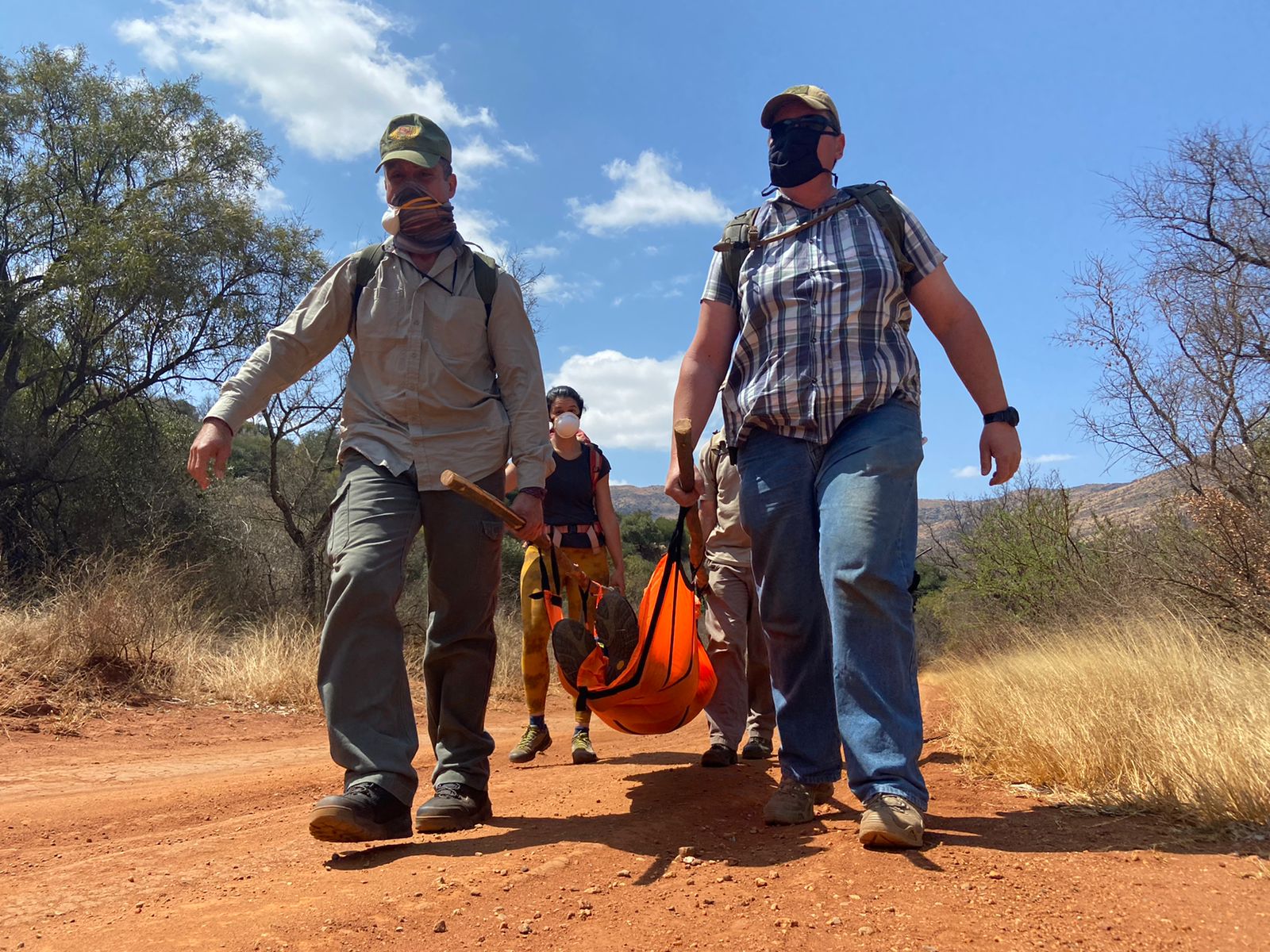
Luckily, we have had very few medical emergency situations on the estate but somebody does hurt themselves every now and again. As a past guide in the lowveld, I have had to complete my level I First Responder course quite a few times to remain validly licensed to guide. But one gets rusty quite quickly with the details of it all and so I mentioned this to the board and, Wammo! they sent me on a five day, level III Wilderness First Responder course, held in Bryanston and Magaliesberg. Wilderness is defined, in this sense, as an area where medical assistance is more than an hour away. So it is not just a matter of first aid but to keep the patient stable for a length of time. And so off I went on this course and found that, not only was I rusty, but a lot has changed. One must remember that first aid is an evolving art and is regularly modified as new information and experiences come to light. I particularly enjoyed this course because it dealt with situations that would more likely occur here at the estate and because of the practical element of the course that we practiced in the Magaliesberg range between Haartebeespoort dam and Rustenburg.


We covered all the usual topics like patient assessment but went into deeper detail with a primary and a secondary assessment, including a rapid trauma survey, vital signs and pain assessment and head to toe survey all to help establish a precise diagnosis of a patient in a far-away place. The advantage of this course is that we practiced these things in simulated exercises in a true wilderness area. We carried this "patient" for about a kilometer and had to then pass the make-shift stretcher, patient within, over a gate and proceed. Good practice, We also learned many other ways of carrying a person out of the wilderness.


We covered subjects like acute coronary syndromes like angina; respiratory emergencies including asthma and hyperventilation; bleeding, like abrasions, lacerations, contusions etcetera; fractures; burns including lightning strike injuries which is probably the biggest danger faced in an open grassland situation like that at the estate. We covered penetrating and blunt force trauma which, in the wilderness, could result from a fall here in the mountains. As a first for me, we covered the subject of diabetes in quite detail and then also all the allergic reactions that one may encounter in a wilderness area, including anaphylaxes. Importantly because it is such a real threat here, we covered thermoregulation including Hyper and hypothermia; drowning and high altitude emergencies like altitude sickness. We naturally covered spinal injuries and, pictured, is us practicing lifting a patient on to a spine board without moving their spine.


So there's the certificate. But please let me not have to use these skills.

That's it for October as summer approaches with the Christmas season just around the corner. Almost mid-November as I write this and the water levels are still very, very low. Here's to hoping for more rain to fall in the near future.