Thursday, 2 June 2022

AUTUMN 2022

 AUTUMN 2022


Autumn has come and gone and with it, the warmth! But even though the morning temperatures have dropped significantly, we still received 74mm rain over the office during the month of April and 75mm during May. Our average since 2010 during April is 61mm and the average for May is 13mm so we have had a great rainfall season all around! Our first rains for the season were in August and we have had good, absorbing rains ever since. In the last five or six years, the rains have only arrived well into the summer, around October and November, which excluded a lot of the growing time from rainfall. The bush here is lush and green and the aquifers are topped up nicely so the rivers are at a good level for this time of the year.

 What has probably been the most noticeable change during the Autumn time, though, are two species of plant that are flowering en masse. The first is the bright yellow Geelblombos, Phymaspermum acerosum, that grows in the valleys (note: I have told everybody that I couldn't find an English name for this plant. I now have. It's called "Grassveld Sheepsdaisy"). The second is the Wilms' Paperflower, Helichrysum wilmsii, which grows up in the grasslands. In the picture above you can see Mark and Theresa Cotterell and their pooch, Charlie the poodle, from Rainbow Rivers (unit 17) hiking into a field of these paperflowers on the Amphitheater hike above Hidden Valley. 

Although these paperflowers are very beautiful with the outer side of the petals (actually bracts) a deep maroon and the inner sides white, with these petals surrounding a bright yellow center, and all the flowers facing the same way as they follow the sun (like sunflowers), having fields of them dominating the grasslands is a sign of environmental stress. These are the woody plants that I was going on about in my last blog that, if they dominate, indicate that that area has not burned frequently enough which is, in turn, allowing woody plants like these to overtake the grasses in a grassland. This will ultimately kill the grasses and the absorptive quality of the grasslands will be compromised (see last blog), affecting the healthy flow of our rivers.

The burning projects that we have undertaken in the last few years have reformed lots of our grasslands but there are still some areas that are affected, as seen above. No worries though, I'm on it: I'm hoping, if we have nice spring rains next season like we had this season, to burn this area in spring with a hot fire so that it is nice and green by Christmas time, sans the everlastings. Well, the everlastings will still be there but, with a proper fire regime, will never dominate and choke the grasses out.


These fields of Wilms' Paperflowers are vast magnets for generalist pollinators like bees, beetles and butterflies who are attracted to the nectar and pollen produced. Here we see a Painted Lady butterfly, Vanessa cardui, sucking up nectar from one of these flowers. 

The Painted Lady butterfly is the most widespread butterfly in the world and occurs everywhere except Antarctica and South America. They also take part in massive migrations in Asia and North America. In the largest of these migrations, it takes six generations of the butterfly to migrate, in generational steps, using the sun for direction, from Tropical Africa right up to the Arctic, a fourteen thousand five hundred kilometer round trip. That's, like, almost two thousand five hundred kilometers per butterfly per generation!

Most butterfly species have a very limited amount of plant species that they use as host plants for their caterpillars to feed on and the gravid female butterfly finds these plants by recognising the unique volatile chemicals released by those particular plants and then lays her eggs on them. This ensures that the caterpillars are on the correct food plants when they hatch. This system ensures that there is less competition between species for food and therefore increases the survival rate of the offspring. The migratory habits of the Painted Lady make this strategy impossible to follow because very few plants are widespread enough to be available to the butterflies over the massive areas that they roam. There are more than three hundred species of plant that the caterpillars of the Painted Lady have been observed feeding on. The gravid female Painted Lady butterfly does not select particular plant species to lay her eggs on, she chooses the plants that have open flowers and nectar for the adults to feed on as the host plants, no matter which species they are.

This strategy negatively affects the survival rate of the caterpillars but these butterflies do not have a mating season and so breed throughout the year, laying batches of eggs over and over, ensuring that, at least, there is enough offspring to counter the massive mortality experienced by their caterpillars.    


While walking the Spekboom river footpaths recently, I noticed that the base of many tree trunks in the thick riparian bush on the north side, had two or three of these hollow exuviae, sloughed skins left by Cicada bugs once they emerged from their final nymph stage into their winged, adult stage.

Cicadas are best known to us by the loud, high-pitched, incessant buzzing sound that the males produce to attract the attention of a potential mate. The females hear this with with their tympanal organs which pick-up and analyse sounds, particularly the mating buzz of the males. The males also have these hearing organs but must disconnect them when calling because the sound he produces can reach, in some species, one hundred and twenty decibels (a gunshot is around 130db) and that would damage his own hearing.

If you manage to catch one of these bugs and turn it on its back, it is easy to distinguish between male and females: The female will have a sharp, scythe-like appendage (ovipositor) at the tip of her abdomen while the male will not. Instead, he will have two semi circular plates at the rear underside of his abdomen which cover his sound-producing organs. Both sexes' "ears" are situated here in the abdomen too. The sound-producing organ of the male are, in effect, two separate membranes supported by powerful muscles that vibrate and "pop" the membranes up and down, very much the same as you pressing the bottom of a tin in and out. Most of the remainder of the male's abdomen is hollow which helps amplify the sound. The hollow cavity in the males' abdomen also has folded membranes on each side that can be unfolded and re-folded to adjust the volume of the sound produced and when the bug calls it constantly adjusts the volume and this helps to create a ventriloquist type of scenario where it is difficult for predators (and curious human beings) to pin-point the insect.

Once the female responds to the mating call and mating is complete, she will cut a slit into the bark of a branch or twig and lay an egg within, repeating this process until she has laid all her eggs. After about six weeks, the nymphs hatch from the egg and drop onto the floor and immediately burrow into the ground with their powerful, folding forelimbs. They dig down until they encounter the roots of a plant and then create a little chamber in which they will reside while they puncture the root and the xylem within with their rigid proboscis and suck the juices out. The xylem is the vascular pathway that transports water and minerals from the roots to the rest of the plant.

These Cicada nymphs will reside underground, burrowing from root to root, until they are fully developed. Most species are referred to as "annual cicadas" and their nymphs will spend from two to nine years feeding like this underground before they are fully developed and ready to transform into an adult. But at least two species in North America (and more than likely in Africa too) are referred to as "periodic cicadas" and they synchronise their breeding and egg-laying activities so that the nymphs emerge thirteen and seventeen years later respectively en masse! This strategy is employed to increase the survival rate of the insect by flooding the "market" with youngsters so that, even with a high predation rate, the survival rate will be adequate for the species' survival. Also, it reduces the chances of a specialised predator from evolving because the long time frame between the emergence of the generations is longer than most insect will live, forcing them to find other prey species. 

Periodic cicadas or not, when the nymph emerges from underground, it climbs up the base of a tree trunk and secures itself there with it's powerful forelegs and rests. After a while, the skin on the back of the nymph splits open and the adult slowly emerges, wings and all. Adults retain productive mouthparts and, instead of feeding underground from the roots of a plant, they puncture the stem of the plant above ground, and suck the juices from there. The big rounded "nose", easily visible on the nymph and the adult, houses the pumping muscles that suck the fluids from the host plant. If one manages to find a bunch of these insects together on a branch of a tree, one can safely deduce that it comprises a mixed sex grouping at a feeding site.     


How cool is this relatively small Golden Baboon spider, Harpactira tigrina? It certainly is a large spider but they grow a lot bigger than this, big enough to fill my hand almost completely. And, as you can see, although they appear menacing, they are actually rather placid and tame quite easily, making them popular pets the world over. Unfortunately, this results in people collecting them from the wild which put natural populations under stress. Even making them locally extinct! 

Although Baboon spiders prefer subtropical and tropical climates, they are still quite common in our grasslands but are seldom encountered because they are active almost strictly at night-time only. The days are spent resting within the safe confines of a neatly constructed burrow that extends about thirty centimeters vertically underground with a sharp corner at the bottom that opens up into a small chamber. The whole affair is thickly lined with silk and, often, once the spider is in attendance, the circular burrow entrance is closed over with a silken barrier (See my blog dated November and December 2020 where you can see a huge female spider, with spiderlings, right at the entrance to her burrow). 

I encountered this chap in the open grasslands, in the daytime, far from any burrow. This leads me to deduce that it must be a sexually mature, wandering male, in search of the scent trail a mature, unmated female left behind her while out hunting in the nights before (see same blog for an explanation of his actions after he finds a scent trail). The lifespan of the male is very much shorter than that of the female (who lives to 25+ years!) because he spends so much time outside the safety of his burrow and is thus exposed to more predators.

The burrow is dug and modified over a period of many years as the spider grows and sheds skin. Once an adult and fully grown, the spider loses the ability to dig efficiently and so no longer modifies the burrow, mainly because she has reached full size. And so, if the burrow is exposed and damaged, the spider will be forced to abandon its home which puts it under significant risk because it is unable to construct a new home. In this case, it will usually build a roof of silk in a concealed spot and spend its resting time beneath this hammock-like web where it is exposed to more predation and fires and weather dangers than it otherwise would be.


I just had to add this photo to this publication! I arrived at K24 while it was still very early and the sun had not yet risen. Unbeknownst to me, I parked on the stem of a Wild Stockrose, Hibiscus canabinus, and off I went to complete my chores. When I returned to my bike a few hours later I noticed how the strangled flower still stubbornly opened up to fulfill it's function of attracting pollinators. I gingerly removed the front tyre from the neck of the plant and it immediately stood up proudly! See, even plants can be stubborn :)


This nasty looking critter is, well, just that: Nasty! This terrifying beetle is a Ground beetle from the Carabidae family of beetles. The main feature that separates beetles from other insects is the fact that the first pair of wings have hardened and serve as armour over the abdomen. The second pair of wings are folded up beneath these hardened wings and, when the beetle wants to fly, the hardened wings open up on hinges on the top of the abdomen, nearest the thorax, and the wings unfold and the beetle flies away with the rigid front pair of wings awkwardly folded open like this. Many species of beetles' first pair of wings, like this Ground beetle, have fused together and they have lost the second pair, rendering them flightless but extremely well armoured. 

Ground beetles have a pair of glands at the tip of the abdomen that store and then, when its life is in danger, mix and expel noxious gasses like formic acid which, in some species, has an audible "pop" as it explodes. Other species, like one I know from the Lowveld, squirt the formic acid, with precision, towards the attacker's face and eyes. The common Afrikaans name for this species is "Oogpister" for that reason. In fact, the newly hatched babies of the Bushveld Lizard look nothing like the cryptic coloured adult lizard. Instead they are black with two yellow spots on the side of their bodies and when they are molested, the lizard arches its back and walks slowly just like the Ground beetle it is mimicking and, hopefully, scares the attacker off. This is one of the very few examples of vertebrates mimicking an arthropod! 

Either this individual belongs to the few species that do not have this ability or this beetle was not upset or afraid enough to use this defense (the formic acid is expensive for the beetle to produce so it will only use it in extreme circumstances) because it remained quite relaxed in my clutches. The jaws, though, are something that needs to be avoided because they are quite capable of administering a painful bite. These jaws are used to grab and subdue their prey items as they run across the ground in search of anything they can overcome. A seriously well-armoured insect with massive jaws and a chemical defense system is not to be trifled with!


These are the leaves and fruit of a Narrow-leaved Sand-olive, Dodonaea viscosa ssp. angustifolia, very widespread with a tolerance of a wide variety of habitats from semi-arid deserts to forest fringes in high rainfall areas. They occur in tropical, sub-tropical and even temperate climes from South America, through Southern Asia and into Australia, New Zealand and the Pacific islands. Possibly the tree with the most common names because each country has its own name for it. Probably best known as a Hopbush, one of the Australian names that has been adopted by nurseries around the world. Hopbush comes from the fact that it was used instead of hops in the brewing of beer in Australia. The tree is resistant to salinity which has made it the preferred tree to plant to stabilise dunes. It is elasticky (not really a word) which affords it resistance to high winds, and it is thus used for windbreaks. It also has a tough, durable wood and has been the wood of choice for weapons, walking sticks and implements in all the countries it occupies. 

Although the tree is more like a large, shapeless bush, the shiny leaves, pretty little clusters of flowers and attractive fruit (the fruit in the picture is newly formed and will turn a shade of pink as it develops) make it a good garden subject. An easy place to find them on the estate is on the steep bank that leads down to the carport of Kingfisher Lodge (unit 6).  


In my blog of November 2019 I featured a little blurb on Bark spiders, Caerostris sp. There I mentioned how they spin a massive orb web in the evening and then dismantle it by eating it around dawn the next morning and then lay up against the bark of a tree during the day, almost invisible thanks to their camouflage. I also mentioned how my daughter and I witnessed a Bark spider eat its web in less than two minutes (it's a huge web!). In fact, it was dazzling because, I'm sure if I scrunched the web up in my hand and rolled the silk into a ball, the ball would be bigger than the spider, not just its stomach! If the spider did not do this, the web would simply be too expensive to build because it would have to build a new one everyday. This is because it would most certainly get damaged during the day because the web is usually spanned across a large open area and would be in many an animal's way during the day. 

Anyway, what is exceptional about this spider is that, although it is the same species as the spider I previously featured, this individual has a snow-white patch on the forepart of it's abdomen which would negate the effectiveness of it's camouflage in the habitat that the other one occurred but here, where I found this one, there was a ton of white lichens attached to the stems and trunks of the trees, making this spider's camouflage even more effective! Just goes to show how local conditions can affect the morphology of a species. 

In my blog of December 2019 I featured a photograph of a male Drakensberg Crag lizard with his mix of cryptic colouration and bright orange. They are endemic to these parts of the Drakensberg where there is an abundance of Firedot lichens (see blog of May 2019) attached to the rocks and boulders. The Firedot lichens are bright orange making the bright orange on the lizard an efficient camouflage! This spider goes one further: a single population of  spiders of a specific species is marked differently to the rest of the species because of it's immediate surroundings. Now that's adaption! 


This is a picture of a completely defoliated Common Sugarbush, Protea caffra, taken on the crest of a hill high above Pebble Creek (unit 25) and Kliprots Creek (unit 24). Since the beginning of the rainy season I have noticed that at least half of the Common Sugarbushes on the estate have been under severe stress. The leaves have been discoloured and the flowers were dying while they were still mere buds. I checked the entire property and noticed that the problem was occurring throughout the estate and was affecting from a third to a half of the population. But only the Common Sugarbush was affected, not the Silver Sugarbush which is just as widespread and lives together with the Common Sugarbush in our grasslands. I took photos of the infected leaves and flower buds and sent them off to some of my botanist friends at the Mpumalanga Plant Specialist Group and, fortunately, they responded that it looked merely like a fungal infection, possibly caused by the long, wet rainy season we have endured, and that I shouldn't worry but need to keep observing the situation. 

Now recently, all of those dead leaves have dropped off and brand new, bright red leaves are emerging (in Autumn!) on all the affected trees. This is good news because it means that the trees are still fine and it was just a single generation of leaves and flowers that may have been affected. We'll see next growing season if the sickness has gone or not.


As you can see by the date stamp, this photo was taken, by one of our camera traps, during the month of May six years ago. The reason I am publishing it is because just the other day I was a spectator to a severe battle between two male Natal Spurfowl, Pternistis natalensis, in my garden that persisted for some time and I did not manage to get a decent photograph because they were so very mobile! Afterwards I walked around the garden and found tufts of feathers all over the place! 

I went through my francolin photos and found this one which I think it is appropriate because the photo was taken extremely close to where my house is now. In fact, I think the house may be on top of the place that this photo was taken. If you look carefully at the photo, you will notice a large spur at the back of the bird's leg, just before it is covered by feathers. That feature distinguishes the bird as a male because the female does not have this spur as it is used exclusively as a weapon and the males are the ones that get into fights. This will mean that there is a good chance that the francolin, sorry, spurfowl, in the picture is the great great (many times removed) grandfather of one of the two spurfowls that were fighting so enthusiastically around my house. How cool is that?

Natal Spurfowl are monogamous and sedentary, meaning that the two males were more than likely fighting because of a territorial dispute. They groupings of Spurfowls and Francolins are called "coveys" and a covey of Natal Spurfowl consists of the mating pair and their offspring who remain strictly within this territory, with the youngsters dispersing when they are sufficiently confident to do so.. The female lays up to eight eggs in a shallow scrape on the floor, in thick bush, lined with only a few feathers and the eggs hatch within three weeks. The chicks are born altricial, which means their eyes are opened immediately and they can run around with their mothers as they hatch from the egg. They are so well developed at hatching that they can fly within ten days!

For the younger folks: We used to call all of these partridge-like birds Francolins but, even though they appear similar, they are now classified into different clades after genetic research. Generally, the Spurfowls tend to be bigger, live in denser environments and have harsh, crowing calls which they often emit from an exposed position (like a rooster from a perch). While the Francolins tend to be smaller, live in open environments and have whistling, melodic calls that are made from the ground. So in Finsbury then, we have Natal and Red-necked Spurfowls in the thickets mainly in the river valleys, and Red-winged and Grey-winged Francolins in the open grasslands


Meat product manufacturers use meat preservatives to prolong the onset of oxidation, enzyme reactions and microbial spoilage, and thus extend the shelf-life of their products. I'm sure we all remember the Listeriosis breakout a few years ago that killed many people who ate the infected meat products. 

Synthetic preservatives have been, and still are, used in meat production but there have recently been concerns over the potential carcinogenic threats these preservatives pose to the consumer. Also, it has been found that the microbe Listeria monocytogenes, amongst others, are resistant to these synthetic preservatives (hence the Listeriosis outbreak a few years ago). Even more worrying, adding these synthetic preservatives to meat products has resulted in the emergence of resistant strains of microbe that are difficult for the industry to manage, creating a need for natural, organic preservatives.

This tiny, delicate little flower is that of a Fever Woodsage bush, Teucrium trifidum, found here on the estate and widespread over Southern Africa. It is used widely in traditional medicine for its anti-microbial activities and, because there has been a recent demand for natural preservatives, scientists at the Govan Mbeki Research and development centre at the university of Fort Hare have tested it, in 2020, to determine its potential as a source for natural meat preservatives.

This was their conclusion: " The aqueous acetone, ethanol and methanol T. trifidum extracts contained condensed tannins, flavonids and phenolic compounds which showed significant free radical mopping capabilities. In addition, the extracts demonstrated anti-bacterial activity against gram-negative and gram-positive bacteria. The T. trifidum extracts can potentially be used as a natural source of antioxidant with antimicrobial components and can therefore be used as preservatives..."

Funny how we moved from natural to synthetic and now we are moving from synthetic back to natural. When will we learn?

Well, that's it folks! Autumn has now come and gone as we now enter w-w-winter, the big chill. See you next time!


Thursday, 14 April 2022

MARCH 2022

 MARCH 2022


Although the summer begins to wind down, the rainfall was still steady during March with 170mm falling over the office, a good 50mm higher than the annual average for March over the last twelve years. This rainfall figure brings the central part of Finsbury 20mm above the average annual rainfall figure of 900mm. The rivers, although flowing nicely, are not flowing strongly and that could be attributed to the fact that the catchment areas have seen significantly less rainfall than the office area. The north and east of the estate records around the 800mm mark while the southern part only records 676mm. The north, east and south are important because it is in the mountains there where lie the aquifers that feed our streams and so, although the rainy season has been very beneficial environmentally for the well-spaced and absorbing rains experienced, more rainfall is required in the mountains in these areas to adequately fill the aquifers so that our streams flow nicely during the upcoming dry months. These nice, well-spaced and absorbing rains have certainly caused the vegetation on the estate to flourish and the scenery is spectacular. Like, how spectacular is the display provided by a colony of Narrow-leaved Nerines beside the Majubane waterfall in the photograph above. Always special flowers blooming in the spray of this magnificent waterfall! Below is a bunch of interesting wildlife I encountered during the month:


After completing a rather grueling hike and returning to my bike in Hidden valley the other day, I lay down to take a refreshing drink of pure, chilled mountain water from the Klipdrif stream. I suddenly heard this loud thrumming sound approach me and when I got up, this African Hummingbird Hawkmoth, Macroglossum trochilus, gently approached my face and began drinking the sweat from my hairline! It was an almost spiritual experience with the soothing, deep thrumming sound in my ears and the wind from its wings cooling my face. It seemed so peaceful and trusting as it moved from my brow to the straps of my backpack which were also drenched in salty sweat. I removed the backpack and put it down on the grass and the Hawkmoth hovered over it as it drank away, allowing me to get this close-up shot. 

The main food for this insect is the sweet nectar produced by flowers but they will also enjoy a meal of the juices of a rotting corpse or fresh excrement where other nutrients are found. Or maybe the salt present in sweat. Being nectar feeders, they, with their long, straw-like proboscises, are perfect candidates as pollinators for plants with flowers designed to attract specialist pollinators. This specialist pollination strategy, as opposed to a generalist pollination strategy, is employed by some plants to minimise the chance of the stigma (female pollen receptor) being clogged by the pollen from other plant species, which would be introduced by generalist pollinators. The plants that choose this strategy have opted to produce flowers with a design that only allows pollinators with mouthparts the length of their corolla tube or longer to access the nectar, which lies at the bottom of the corolla tube. All pollinators with longer proboscis' than the corolla tube will still be able to access the nectar, but will not collect pollen from the stamen of the flower because they will not touch it with their body because it is too far away. So, when this Hummingbird Hawkmoth drinks pollen from a flower with a short corolla tube, it will not collect pollen. It will only collect pollen from a flower where the it's face touches the male parts of the flower, ensuring that the it only carries the pollen from a small range of flower species, even if it visits many other different flower species during feeding. This makes it the "specialist pollinator" that the flower is designed to attract, increasing the chances that the following flower where pollen is transferred, is the same species of flower. Certainly a gentle soul with an important job, this Hummingbird Hawkmoth.


This spectacular butterfly, a Green-striped Swallowtail, Princeps nireus, also has sucking mouthparts a similar length to the Hummingbird Hawkmoth but its inability to hover as efficiently as the Hawkmoth restricts the types of flowers whose nectar it can access because it needs a foothold. And you can see here, as it drinks nectar from the flowers of a Tropical Slugwort, that its body doesn't come close to the flower parts so will not pick up pollen except randomly on its feet. Not benefitting the slugwort at all. But the butterfly, although rather common here on the estate, is hard to get a good look at because it rarely sits still for a second! The flash of blue-green catches one's eye as it zips from one flower, hovering awkwardly and grappling with its legs while it quickly sucks up some nectar, to the next flower, flashing the brilliant green-blue (depends on the angle) stripes on its fluttering wings. Even when it flies in the shade, the contrast of it's pitch black body and the brilliant blue-green stripes on the upper wings shines in the darkness. Almost as if it is generating light. It almost is really, if you look at it from our perspective, because the colourful scales on the wings are flourescent. That means that, when they absorb light with very short wavelengths (Ultraviolet), a dark light that our eyes do not see, the scales reflect a light with a much longer wavelength, light that we can see! So yes, the scales on the butterfly's wing patterns are actually generating light for ours, and many predators' eyes to see. But the strobe effect and the erratic flight path of the butterfly make it a confusing quarry. In fact, almost the only time one gets to see this butterfly sitting relatively still is when it, usually in groups, sits on the floor sipping the fluids from excrement, carcasses and the like. But the wings still shiver franticly while it does this. 


Two years ago, right at the beginning of the original lockdown, I featured one of these truly alien-looking fungi, a Starfish Stinkhorn, Aseroe rubra, in one of my blogs but I must show you again. Initially, the mushroom looks like a puffball mushroom sitting amongst moist leaf litter and this has the descriptive name off the "egg". The egg then cracks open on the top and opens up, revealing a slimy interior out of which the stem grows and once it has reached about ten centimeters, the bright red tentacles open up to reveal a topping of dirty brown slime, called the gleba. The gleba is a slimy substance in which the spores are produced and it smells of dead meat which completes the picture of an open, rotting wound. A perfect attractant to bot flies and the like who spread the spores after they land on the mushroom and the slime adheres to their bodies. This was the very first indigenous mushroom described from Tasmania and was collected in 1792 and described in 1800. Soon after that, it was introduced to Europe and ultimately North America. It is believed that it was introduced to all the places where it now exists outside of Tasmania and Australia although Mycologists are not sure regarding Southern Africa because here it has been found far from human influence and bot flies have a limited range during their lifetimes. Aseroe comes from Greek for "disgusting juice" and rubra is latin for red so both common name, Starfish Stikhorn and the scientific name are very descriptive..   


This is probably the main factor that hooked me away from the lowveld bush to the mesic grasslands of the Mpumalanga escarpment: The incredibly beautiful flowers! Stumbling upon a brilliant flower, like this Sheathed Sword Lily, Gladiolus eckloniiI, in the rolling grasslands simply lightens up my day. Every time. Gladiolus is a genus with about two hundred and seventy species spread over Europe, the Middle East, Madagascar and Africa but its center of diversity is here in Southern Africa, particularly the Southwestern Cape, with one hundred and sixty six of those species (eleven species on Finsbury so far) occurring. These striking flowers whose sepals and petals are not distinguished from each other (called tepals), making them even more attractive, usually sport multiple flowers, in different stages of development, on an erect spike. The male parts of the individual flowers develop before the female parts in that flower and these individual flowers develop from the bottom of the spike upwards over a set time (this is called Protandry, refer the second article, featuring the plump caterpillar of a Hawkmoth, of my blog of Christmas 2021). This decreases the chances of self-pollination because the flower's chosen pollinators have a hereditary behavioral influence that makes them visit the bottom flowers on a spike first, before moving to the next flower above on the spike, searching for nectar. This insures that the bottom flower gets pollen deposited on it from the previous plant visited before the pollinator gathers the pollen from this plant's first flower and moves upward to the next flower on the spike that has not yet developed the female part. So the pollen now collected from the bottom flower, is not deposited on the female part of the flower above it because it has not developed yet. Instead the pollinator collects more pollen from the higher flowers (because the male parts have developed already) that it will carry to the following plant. Phew! Harder to explain then I thought. But, if you understood my rather shaky explanation, you'll see yet another example of the intricate and co-evolved relationships between flowering plants and their chosen pollinators. 


I took this photo of a small family group of Rock Hyrax, Procavia capensis, in the bottleneck that leads into Hidden Valley about a kilometer east of the Kliprots road. Most of the Hyrax colonies I have seen on the estate are small family groups like this one except for a large colony in the cliffs far behind and above Kliprots Creek (unit 24), and a large colony in the fallen rocks below the cliffs of Potato Seed Production, high above Rainbow Rivers (unit 17). They live in a harem system so the smaller family groups, like this one, consist of one large, dominant male (right of center), with one to seven related females and their offspring. The larger colonies consist of many of these harems, all living together but having limited contact with other harem groups in the colony. 

These pudgy, serious-looking animals belong to the Paenungulata clade in the Afrotheria superorder of mammals and were previously thought to be the closest relative to the elephant. They certainly are from the paenungulata clade, together with the elephants but more recent research has placed the Dugongs and Manatees (order Sirenia) as closest relative to elephants (order Proboscidea). They live in small territories, defended by the male, of less than a half a hectare, along cliff faces and fallen boulders. These territories are advertised with conveniently spaced latrines where all members defecate and by vocalisations from the dominant male. 

As herbivores, they have multi-chambered stomachs like ruminants, but they do not chew the cud so are not ruminants, to help them digest the hardy vegetation that is associated with this habitat. Other adaptions include four-toed front, flat-footed (plantigrade) feet and rear, three-toed feet that stand almost on tippy toes. The underside of the feet are made up of large, black pads that are constantly moistened by sweat glands. These adaptions help it move around and over the rocks with surprising agility.

The breeding season starts around now and the male becomes more grumpy and vocal while his testicles grow to twenty times their normal weight. He will mate with all the adult females that are ready to conceive in his harem and they will carry the litter, of around three pups, for a gestation of an astounding seven months! The extremely well-developed young are born in spring and are able to jump from rock to rock within a few days. Although they are weaned by three months, they already begin to eat vegetation before the first week of their lives are over.

Their rocky, exposed habitat is subjected to extreme temperatures and so much of the ninety-five percent of time they spend resting involves thermoregulation activities, like sunning themselves to heat up or retreating into crevices in rocks to cool down. Very much like cold-blooded reptiles. They are inactive during cold, wet days and sometimes active on warm moonlit nights and while they forage, they always have a few sentinels placed in strategic lookouts points to warn them of impending danger. Although they are the staple diet of Verreaux's Eagles, Leopards, Caracals and pythons are probably their worst enemies. They do, however, enjoy an average life expectancy of ten years in the wild.


I can't help featuring photos of these lovely, photogenic little spiders. Once again, a photo of a Crab spider, Thomisus sp.(see blogs of March 2018 and May 2020), but this time with its prey, a large, hairy fly of sorts. The spider sits atop an open flower, in this case an Umbrella Everlasting, and slowly, like a chameleon, changes to the same colour as the flower, becoming invisible to the unsuspecting nectar or pollen seeking insect that may come visit. As the insect alights on the flower, the spider grabs it with its powerful, over-sized forelegs and quickly bites it and injects a fast-acting venom that subdues the prey before it can struggle free. This Crab spider then moved to the underside of the flower so that it could lap up the juices of its prey without being seen... 


Oooh! Death lurks in the grass! It's definitely not typical to find a Brown Button spider, Latrodectus geometricus, walking on the grass because they are rather strictly web-bound. The only reason this one is, is because I moved it there from the typically untidy nest in the dark recesses of my patio bench and table while I was cleaning. They are normally a more brown colour with slight chevron markings on the sides of the abdomen and with the banding on the legs more pronounced. But this is a very old female and so, she the Brown Widow, is almost pitch black. I did get to see the give-away brilliant red and orange hour-glass shape on the dorsal part of her abdomen (as opposed to the hour-glass pattern on the ventral part in the Black Widow) but she was not prepared to show me for the photo. They normally reside in an untidy, three dimensional web in dark, still places which can be identified by the pale, spiky egg sacks (smooth in the Black Widow), about eight millimeters in diameter, entangled within. Because of their secretive and sedentary behavior, bites are almost never heard of. Thankfully because the venom is extremely potent and, although the same potency for the Black and the Brown Widow, the Black Widow is capable of injecting larger amounts than her Brown cousin. It is a neurotoxin that, if enough is injected, can cause a dangerous condition called lactrodectism, where the victim will experience intense pain around the bite; prickling skin and goosebumps; then hypertension (and a bunch of other hypers!); nausea and vomiting; abdominal pain and more. If left untreated, symptoms should subside by three days although fatigue, insomnia and general weakness may persist for months even. Scary. The Black Widow, L mactans, was always believed to be the most dangerous Southern African spider with this, the Brown Widow, a close second. But it is now believed that the Six-eyed Crab spider, Sicarius hahnii, is potentially the most dangerous spider in Southern Africa but there has never been a record of a bite on a human. If tests on rabbits are anything to go by, the cytotoxicity of the venom causes severe necrosis and the Hemotoxic element causes massive internal hemorrhaging, causing a rapid death! And I had the honour of seeing a whole bunch of these really rarely seen spiders, on my own, in a sandy cave, high up on the Mikberg mountain in the Damaraland desert, in Namibia, at the close of the last century. I knew that they were highly venomous and rare so I relished the experience. A pleasant memory. I took a bunch of photographs that I developed into slides which I must try and dig up.    


Finally, this is a photograph, taken on the Rock Kestrel trail, facing north east about two kilometers in, of the grasslands after a Patch Mosaic Burn (PMB) that I burned from the seventh to the ninth of March. I would like to try and briefly explain the function of grasslands in the greater scheme of things and the pros and cons of burning them. It is quite a long explanation but it is not possible to make it more concise, I'm afraid:  

Grasslands began to evolve in the middle to late Cretaceous between seventy and sixty million years ago but they only started to dominate as a biome a mere six million or so years ago. They have had a huge influence in natural ecosystems and are the main reason for the speciation of large grazers like antelope and deer in the last twenty five million years. In South Africa, the grassland biome, which covers almost twenty five percent of the land area, is the second largest, after the savanna biome, but is the biome under the most pressure from human activities. Thirty percent of the grassland biome is transformed irreversibly and another thirty percent is partially degraded and poorly managed. The remaining forty percent is in a relatively pristine state but is highly fragmented and only slightly over two percent of this is formally protected.   

Probably the biggest benefit high altitude grasslands play in environmental ecology is as water catchment areas. This is why we are part of the Mount Anderson Water Catchment Reserve. Let me explain why: Grasses are designed to be crowded together with other grasses and that is why the have lanceolate leaves that point upwards, a design that allows them to receive sufficient sunlight for photosynthesis in their crowded conditions. Another significant feature shared by grasses is that their leaves' growth point is at the base of the leaf or stem instead of on the apex of a stem (research intercalary meristems). So, if you cut a grass's leaf blade in half, it just continues growing from the base (like our hair) whereas if you cut a woody plant's leaf in half, the leaf dies. This means that grasses can flourish in extremely crowded conditions and also survive when grazed, mowed and burned. Woody plants cannot. 

These massive tracts of grasslands in high rainfall areas (like ours) act like a sponge and promote rainfall infiltration. In fact, in 2003, Reyer's and Tosh proclaimed that, on the plateau, "rainfall infiltration in grasslands is solely responsible for providing water to the entire Gauteng province". But the efficiency of this sponge is directly related to the condition of these grasslands. The grasslands' condition can be assessed by it's basal cover. The spaces between each plant (the bare ground) are measured by grassland ecologists and this measurement will give you the basal cover of that particular area. A poor basal cover is when there are large spaces between plants and a good basal cover will be when there are only small spaces between plants, allowing less run-off during the rains and thus, more absorption. Also, the design of the grass plant guides the water, during rain, straight to the bed of the plant, which actually forces the water into the ground instead of allowing it to run away. (this is very noticeable when you water your lawn, there is virtually no runoff until the ground is saturated). 

Now, grasslands have been burning regularly since they evolved into huge grasslands, long before humans had any influence on them. This is easy to understand when one looks at the massive species count of  other plants with underground storage devices (USOs) like bulbs and geoxylic suffrutices (underground trees) that coexist with the grasses in grasslands that have evolved those USOs as a defense against fires. These non-grass plants have a herbaceous growth form that can grow when conditions are good and can be destroyed by fire while not damaging the plant which is protected underground, just like grasses. 

Before human interference, fires were mostly started by lightning strikes but, unless it was during a dry thunder storm, which are not rare on the escarpment and plateau in South Africa, only a small area would burn before the rain extinguished it. But if it were started during a dry thunderstorm, even when the grasslands are green and moist, it would burn until either the fuel load was too small, or until the following rains fell. The roads and fire breaks that we construct, and our actions, stop these fires and so if they were not in the equation, a relatively rare natural fire would burn massive tracts of land before it was extinguished. Much more rarely, in the dry season, fires may have started by falling rocks causing sparks (there is a lot of pyrite in our grasslands) which could ignite the dry grass leaves, burning massive tracts of grasslands. When I talk about fuel load, I refer to moribund. During our cold winters, grasses pull their nutrients into their roots for storage until the next growing season and the grasses leaves dry out and die, unlike woody plants that drop their dead leaves, grasses' dead leaves remain attached to the plant and build up over successive growing seasons. The following season, new grass leaves emerge amongst the old dead leaves. If the grass plant is not burned every few years (three to four seasons in our area), the build up of these dead leaves, which are referred to as moribund, begins to smother the grassplant's neighbours by blocking out the sun for them and, ultimately, smothers itself. Once its neighbours have died, there will be a shaded patch of bare ground where they used to be and this is a nice habitat for woody plants' seeds to germinate, and so they will. 

As early as the nineteen fifties, ecologists realised that "mesic grasslands do not exist in equilibrium with their climate and could return to a forest state if fire was excluded from the system" (Acocks 1953) Now, as mentioned above, woody plants (dicotyledons) are a very important component of natural grasslands and will often outnumber, in a number of different species that are designed to co-exist with grasses, the grassplants in a healthy grassland but these species do not grow taller and shade the grasses. The encroachers, the taller woody plants that need to be controlled, are also a natural component of the grasslands but they should never dominate, and would never in the presence of fires. In a situation described at the end of the previous paragraph where patches of shaded, bare ground form, these encroachers will quickly grow taller than the grass plant (the leaves not inflorescence) and soon succeed in smothering those grass plants that smothered their neighbours originally! These woody plants will then dominate and the problem with that is that these woody plants usually have a main stem, or are multi-stemmed, which supports a canopy of leaves. So although it appears like the ground is fully covered by plant-life, there are large spaces of bare ground between each plant's stem/s (poor basal cover) and then when it rains, the water rushes down the slopes on the mostly bare ground, where it will erode the topsoil away and instead of being absorbed into the ground, will run into the rivers and away. Refer to the sixth article in my blog "Early Spring Time" (posted on 28 Sep 2021) for more on this.

Our mountains are mostly made up of porous sedimentary rock and so each mountain is an aquifer. When water is absorbed into the rock, it fills up and, because the water cannot run freely out of the rock due to friction against the rock granules, the rock acts as a storage unit (an aquifer) that slowly releases the water, by gravitational force, out of natural cracks and seeps (springs) which feed our rivers throughout the year, even during the dry season. So if the grasslands were compromised, there would be no absorption and so flash floods during the rainy season, and drought during the dry season with no flowing rivers. Devastating!

In the last few years, since I have been in charge of burning here on the estate, I have concentrated on removing the woody plants with hot block burns to try and get the grasslands in the correct condition for PMBs. PMBs are generally cool fires and so, if I cool burn an area that is being dominated by woody plants, the woody plants will not be killed and the fire would only remove the moribund which will be slightly beneficial to the woody plants and they will even increase, exacerbating the problem even further. 

Anyway, this year is the first year that I have executed proper PMBs. Meaning that I executed them on my own with no staff and only lit the fire at one or a few ignition spots (as in a lightning fire). I burned three small PMBs ( forty to sixty hectares each) in January which were extinguished on the same night by rainfall; a fifty hectare one around the rehabilitation area above and west of Cochy-Y-bunddhu (unit 1) and a sixty hectare one east, west and south of Pebble Creek (unit 25) in mid February which were also extinguished by evening rainfall (very good imitations of natural lightning fires); and then this two hundred and fifty hectare PMB, featured here, that burned for two-and-a-half days before I went up and extinguished it, easily by myself (the benefits of PMBs compared to block burns regarding staff and resources are obvious). 

I have gone up and inspected the burned areas from January and can already see areas where brand new grass plants have germinated in the open areas between the older established grass plants, effectively decreasing the basal area which will increase rainwater absorption and reduce sheetwash erosion in the following seasons.

This is as simple an explanation that I can conjure and the subject is a lot more complex but I hope it helps explain what I am doing to transform Finsbury grasslands into optimum high altitude grasslands. Besides the obvious benefits for biodiversity and the ecology of our grasslands, these activities will ultimately reduce topsoil run-off which will reduce silting up of our weirs, reduce resources and staff normally required to execute blockburns and firebreaks, and eliminate the unsightly firebreaks that used to mar the otherwise beautiful montane grasslands in which the estate nestles. If you are interested in this and get a chance while you are here, let me take you on a walk into the grasslands where I can explain this more practically... 

So long for now. Enjoy your autumn :)   


Monday, 14 March 2022

FEBRUARY 2022

 FEBRUARY 2022


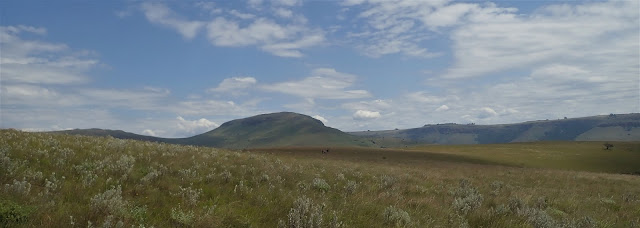
The shortest month of the year was very wet with thirteen days of rains and a whopping 165mm falling over the office. In the twelve years that the rainfall has been measured with data available on the Finsbury News website, it only rained more in February (288mm) in the 2016-17 season. Even last year February's Cyclone Eloise dropped less, albeit only 11mm, rain onto the estate. And after all of this, the rivers have generally remained nice and crystal clear. The rainfall was also very localised and erratic with that 165mm falling over the office and a mere 50mm rain falling over Rainbow Rivers (unit 17) in the south, 126mm falling over Pebble Creek in the north, 93mm falling over Rock Solid in the east and 68mm falling over Gate 2 in the west. This makes the average rainfall over the estate 100mm but the recorded measurements of the past 12 years have been what has fallen over the office. The above photograph of a lone Eland cow (in the centre in the distance) in the vast, open grasslands with Little Joker koppie in the background gives you an idea of how lush the grasslands are. Lots of rain means lots of life so below I have posted a bunch of interesting life that I encountered during the month.


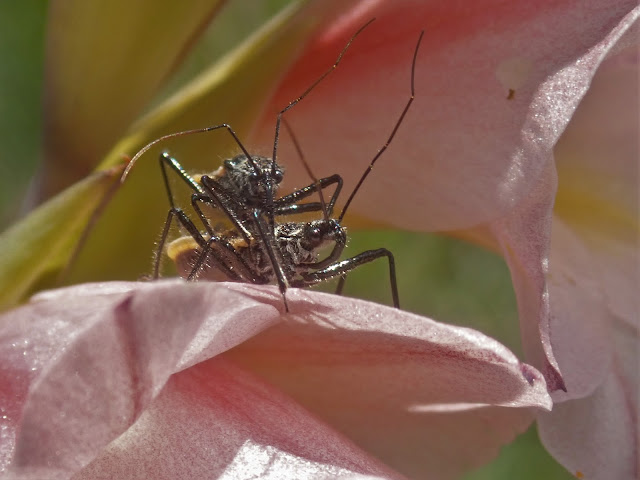
This is a pair of Assasin bugs from the Reduviidae family of true bugs, Hemiptera, preparing to mate. They have chosen the venue well - the soft, pleasantly scented petals of a Gladiolus flower! The female underneath is showing us her rostrum, the thick proboscis that she folds under her chin, which she uses to pierce her prey which she has ambushed. She then injects enzyme-filled saliva into her victim which liquifies its internal organs. She then sucks this up through that rostrum. I have touched on these insects before with a species that exclusively preys on millipedes (The jolly season 2018) and an individual I snapped while it sucked a termite dry (December 2019). Once the female has been mated with, she will deposit a clutch of eggs on the underside of a leaf or on the flat face of a tree trunk. The eggs will hatch to reveal a whole gang of Assasin bug nymphs that will hunt as a pack initially before becoming solitary. The nymphs resemble the adults although they are usually coloured differently and they do not have a pair of wings. The nymphs of many species excrete a sticky substance all over their bodies and then throw sand over themselves as a camouflage. This enables them to avoid detection by their victims as they lie in wait to ambush them. They acquire their wings and adulthood after their fourth molt and once this has occurred, they no longer excrete the sticky substance and so no longer camouflage themselves. Finally, The tip of that powerful rostrum fits neatly into a groove on the underside of the insect's body when not in use. If the insect is threatened, it can apparently produce a relatively loud sound that may frighten the enemy away. It produces the sound by rubbing the rostrum up and down along ridges within this groove. This is called stridulation and is the same method employed by grasshoppers etcetera to make their sounds, although they rub their legs up and down on ridges on the sides of their bodies.   


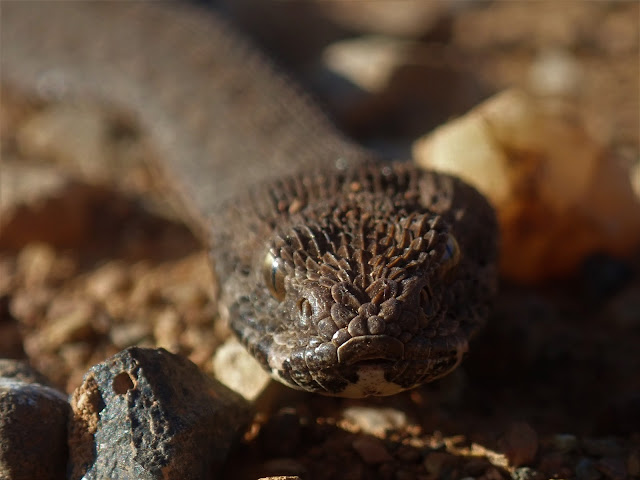
I can't help myself. I love these pugnacious little snakes, and so not too long goes by before I feature one of them on my blogs. In my blog of August 2020, I explained the function of the forked tongue, in May 2019 I did a feature on the unique venom of the snake and in my blog of November and December of 2020, I displayed photographs of four different colour forms of the snake that I have encountered on the estate. This chocolate one was so relaxed that she allowed me to approach within a few centimeters with my camera and she didn't even budge. I say she because this individual had a short tail, and that is the only way, without handling the snake, that one can identify the sex. When the female is ready to mate, usually in the early spring time, she will deposit a trail of pheromones on the floor behind her as she moves around. The pheromone scent persists for up to a week if the conditions are right, and if a male runs across this scent, he will immediately begin to follow the trail like a sniffer dog! If he encounters another male with the same intentions en route to the female, they will fight for dominance. Well, more like wrestle, and the victor will usually press the front of their bodies down on the head of the loser, subjugating it. The victor will then continue to track the female down. When he locates her, they will mate after a brief courtship and then immediately part ways. The female will store the sperm of the male beside her ovaries for up to seven years! Using a portion of it when required to ferilise the eggs in the ovary. The Berg adder is viviparous, which means that the young are developed within the womb of their mother instead of within an egg. And so the Berg adder female will give birth to eight to fifteen live young, quite large in fact, like about thirteen centimeters long per youngster, compared to the mother's length of between thirty and forty centimeters, towards the end of summer, and these youngsters immediately disperse and look after themselves. These little snakes feed on insects, like grasshoppers etcetera until they are large enough to pursue their usual prey of skinks and lizards from the rocky grasslands. The end of summer is on the way! 


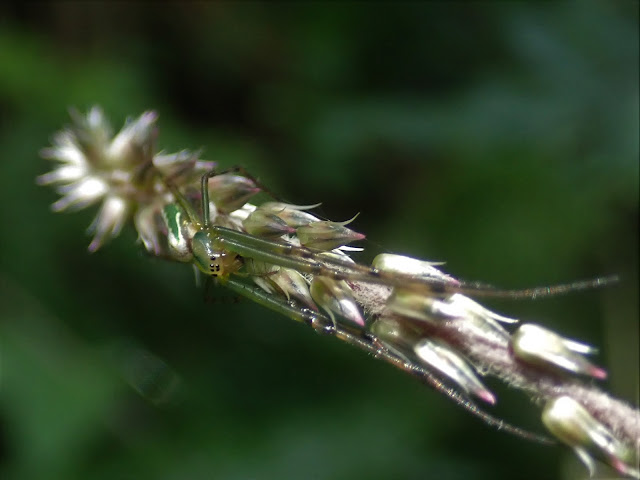
A Silver Vlei spider, Leucauge sp., Metidae family, stretched out in her "disappearing pose" on the inflorescence of an Amaranthus plant. These attractive spiders are certainly the most commonly encountered spiders in the dark, moist forests on the estate but are usually found hanging upside-down above the center of their orb-webs at thigh-height between ferns and trees. One cannot help destroying these webs as one navigates the forests because they are everywhere! When disturbed, then the spider retreats to nearby vegetation and adapts the stretch pose. The web is not constructed vertical to the ground like most orb weavers but at an angle of about sixty degrees, making them easy to identify. Again, it is up to the male to find the female and approach her on her web to mate with her. The black widow syndrome is very apparent with this species as the female almost always eats the male after they have mated! The main prey of the spider are small dipterans, particularly mosquitos, which are abundant in the moist, dark forests. Once the mozzie is caught up in the web, the spider approaches the prey and immediately begins to chew the body of the prey, breaking it up. It then vomits an enzyme onto the chewed pieces which begin to liquidise. Once liquidised, the spider sucks the fluid into its mouth by pumping the stomach muscles and tiny hairs around the mouth filter out the undigestable pieces that it discards afterwards, together with the crumpled shell of the victim. This pumping stomach action is also what spreads the nutrients around the body of the spider. Once enough has been consumed, and the spider feels its body growing, it will return to the middle of the web and hang there upside down again. But this time its skin will split down the middle and the spider will climb out of its smaller, older skin and leave it hanging there like an old piece of clothing. Certainly the biggest enemy to the Silver Vlei spider are Spider-hunting wasps from the Pompilidae family (see blog of March 2020), who will easily locate the spider as it rests in the middle of its web. 


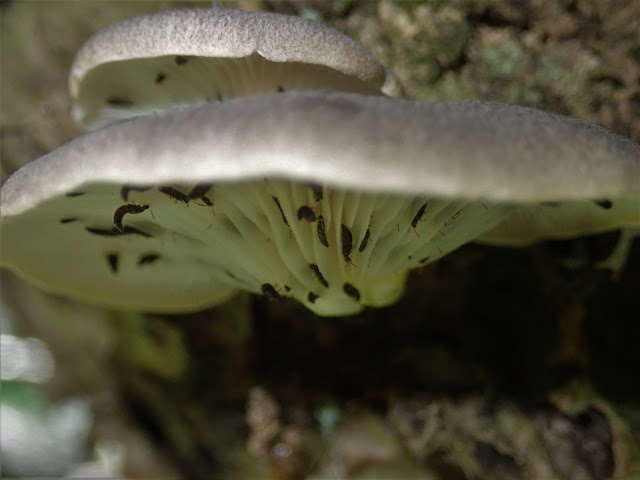
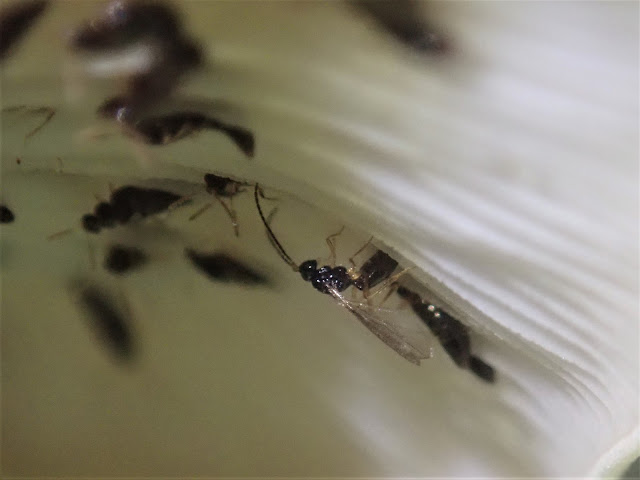
Still in the moist, dark forests of the estate, you may stumble upon a bracket fungi like these pictured above that look a lot like Oyster mushrooms (P. ostreatus). They are Pleurotus pulmonarius from the same genus as Oysters and are just as tasty too. In fact, in warmer areas these are the mushrooms that are cultivated and sold as Oyster mushrooms in the shops. Like the genuine article, the mycelium are grown in a petri dish and then transferred to a grain of sorts. Once established, they are then deposited onto a bale of straw or something similar where the mushrooms will develop en masse, ready to be harvested. Besides the fact that these mushrooms are very tasty, they are also filled with healing properties which was recently established with experiments on mice: They are found to have major analgesic properties which is used for pain management; they also have anti-inflammatory properties and also delay carcinogenesis, meaning that they could be used to fight cancer; they also have an antihyperglycemic effect, halting the progression of diabetes; and finally, powdered mushroom in water inhibits the release of histamine which means it could be used to treat hay fever! Wow! That's a lot of medicinal uses even if only effective on mice for now. When I looked from underneath to see the gill pattern, I noticed it was crowded with tiny Rove beetles which, although they all look very similar, belong to the largest extant family of any organisms, the Staphylinidae with around sixty three thousand species! Rove beetles are mostly predatory but I have since learned that there are a few species that specialise in collecting and eating spores, the minute "seeds" of fungi. They're easy to distinguish from other beetles by their long, pointed abdomen and very short elytra (the hardened pair of wings that cover and protect the flying wings when at rest against the body). The second pair, or flying wings are quite large and must fold up rather elaborately to fit beneath the tiny elytra, apparently like watching a sports car fold its roof into a small area in the boot...  


Now, when I looked closer, I also saw a tiny wasp clearly laying her egg/s (see by the bent posture) within some unfortunate victim who is not visible in the photo. I have discovered that the wasp is more than likely a, wait for it, koinobiont endoparasitic Alysiine braconid wasp. Jissis, that's a long name! It actually simply means that the wasp belongs to the Alysiinae subfamily in the Braconidae family and it is parasitic by injecting its egg into the body of its host and the egg hatches and the wasp larva eats the victim from inside, finally killing it! These wasps normally parasitise fly larvae (maggots) but I'm not sure what a fly larvae would be doing in the gills of a mushroom. I suspect the wasp is injecting its egg into the larvae of one of the rove beetles. Normally, the larvae of the wasp will eat the insides of its victim, careful not to harm it too much to avoid killing it too soon. Once the victim pupates, then the wasp larvae eats out the lethal organs and the victim dies, allowing the wasp larvae to pupate within the pupa of the victim and then, once developed, emerging as an adult! Quite a lot of action taking place in the gills of this mushroom.


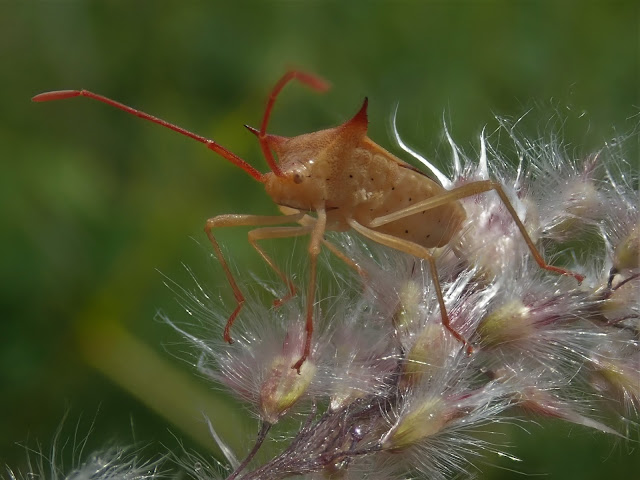
This is a Stinkbug, Cletus ochraceus, sitting on the beautiful silver-haired seeds as they develop on the inflorescence of Natal Red-top grass, Melenis repens. A glimpse of the rostrum (rigid proboscis) reveals that it is also a true bug, like the Assasin bugs above but these are the vegetarian version. The rostrum is used to pierce the stems of plants instead of the bodies of insects, and the juices of the plant are sucked out. The common name is derived from the fact that they possess glands that emit a revolting smell as a defense when harassed or handled.


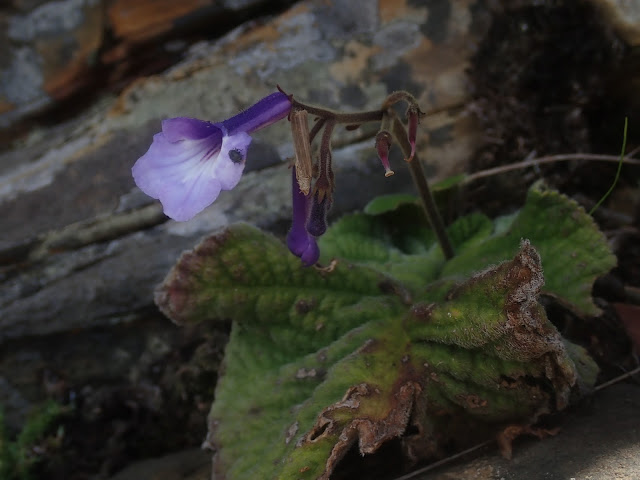
Streptocarpus hilburtianus growing from between the rocks on a cliff face. Streptos are special. They are commonly referred to as Nodding violets  or Cape Primrose and we have seven species here on the estate, so far discovered. Although some grow in very exposed places, they grow on or associate closely with rocks and shade. If you've seen the photograph on the cover of the lovely book, Finsbury Estate, Through The Lens, for sale in the office, you'll see how they can add splendid colour to the dark, shady gorges. Check my blogs from 7 February 2015; February 2019 and January 2021 for interesting facts about these plants. This one, though, is special because it only occurs here, at Long Tom and on the Steenkampsberg, the only point higher than Mount Anderson in Mpumalanga, and it only occurs at high altitudes (above 2000masl). It is listed as vulnerable (VU) on the South African plant Red List.


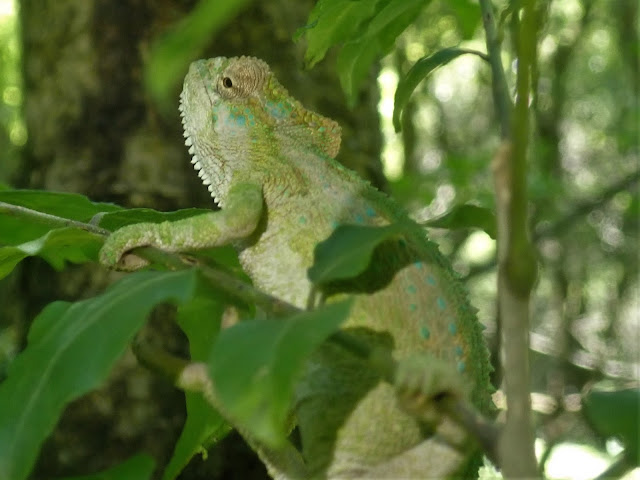
I went the whole of last year without seeing a Transvaal Dwarf Chameleon, Bradypodion transvaalense, and so I was delighted to find this one in the gorge that runs from the most northern point of Loop road up to Black Hawk Down crash site in Mount Anderson Ranch. Chameleons are quite unique lizards and are well known because of these unique traits, like being able to move their eyes independently and look at two different places at once. This enables them to search more thoroughly for potential prey and enemies. When it locates a prey item, like an insect, the chameleon will focus both eyes onto it and thus enjoy stereoscopic vision which allows it to accurately judge distances so that, when it has crept close enough, it can shoot out its long, sticky tongue which can reach twice its own body length, and latch onto the prey item and pull it back into its mouth. Another unique trait we all know so well is their ability to change their body colour. This they do for three reasons: one, to effectively camouflage themselves so that their prey and enemies find it harder to see them; two, and probably the most important reason, is they use colour changes to communicate their intentions to other chameleons. Bright colours dominate other chameleons who respond with dull colours etcetera; and thirdly, to help regulate body temperature. They will turn lighter shades if they want to cool down and darker shades if they want to absorb more heat and warm up. This one was very well camouflaged because I nearly squashed it with my hand when I was about to grasp a tree trunk for support and, fortunately, I saw it at the last moment.


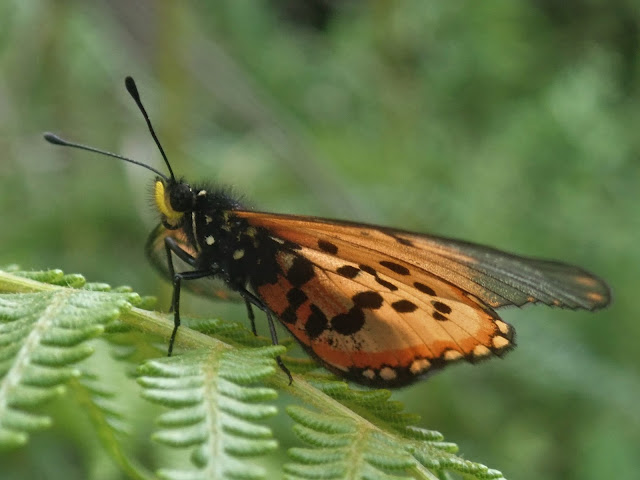
This is a close-up shot of a Wandering Donkey Acraea butterfly, Acraea neobule neobule, at rest on a Bracken fern frond. These butterflies are extremely laid back, and if you don't make very sudden moves, you can get right up to them. They also have a noticeably slow, floating flight as if they fear nothing in the world. They can feel like this because their bodies are covered in an extremely rubbery integument and also glands that release poisonous fluids. So if a young, inexperienced bird comes along and snaps the butterfly up in its beak, the butterfly secretes this poison and the bird immediately spits it out, and because of the rubbery integument, the butterfly continues on its merry way, unharmed. The bird, on the other hand, learns quickly that butterflies that look like that are not worth pursuing in the future!


I was walking the Zebra trail when I saw a spider run from the path in front of me, into a hole at the base of a grass clump and just disappear... I was, like, where did it go? Mmmnn, I bent down and investigated. I found that, after some unconservative digging, the arachnid had run into an apparent hole and swiftly closed a door over it. A trap door! I remember finding Trapdoor Wolf spiders in my time in the Lowveld and, once you knew what to look for, they were relatively easy to find. But this? There was no crease. Nothing. I have learned that this spider is actually an Ant spider from the Zodariidae family of spiders. They are daytime free-range hunting spiders that usually associate with ants, releasing pheromones so that the ants do not bother them. This one is from the Cydrela genus and is apparently one of the very few species that does not associate with ants and one of the only species to employ a trapdoor in their digs This is a free range spider that emerges from its burrow and actively hunts its prey, consumes it, and then retreats back into its burrow. Like a day-active Baboon spider but a lot smaller. And it is obviously a spider that is very rarely seen because it usually disappears into its invisible den in a flash when disturbed.    


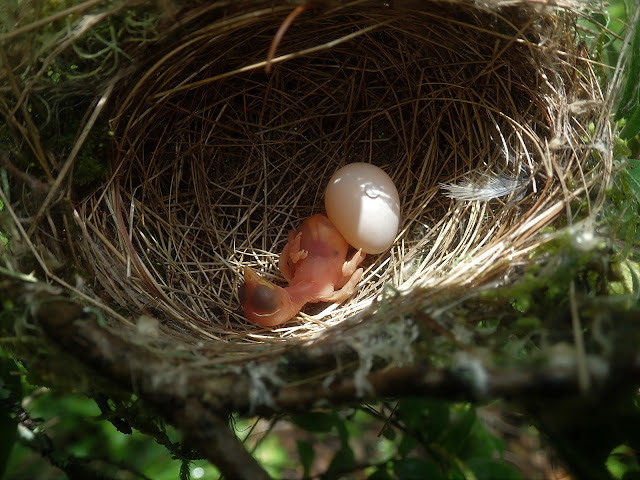
I was trying to climb from Olinia gorge onto the steep grasslands and, as I was pushing my way through the thick forest fringes, I startled a little Cape White Eye, Zosterops virens, from a nearby but well hidden nest. I looked down to see this little picture. A newly hatched chick just out of the egg squirming beside its still unhatched sibling. The little thing was not any bigger than my little pinky finger! According to the literature, which I have mentioned before in my blog of January 2021, their diminutive size results in only about fifty percent of hatchlings fledging because they fall prey to even smaller nest robbers like Common Fiscals, Fork-tailed Drongos, Southern Boubous and Olive Thrushes. And in that blog you will see that I could have captured that little fledgling as well, and if I was a hunter-gatherer, eaten it just like those common birds do. But many people, including me, have a soft spot for these lovely little birds because they can get very close to you while they are foraging through the bushes in the riparian areas of the estate. 


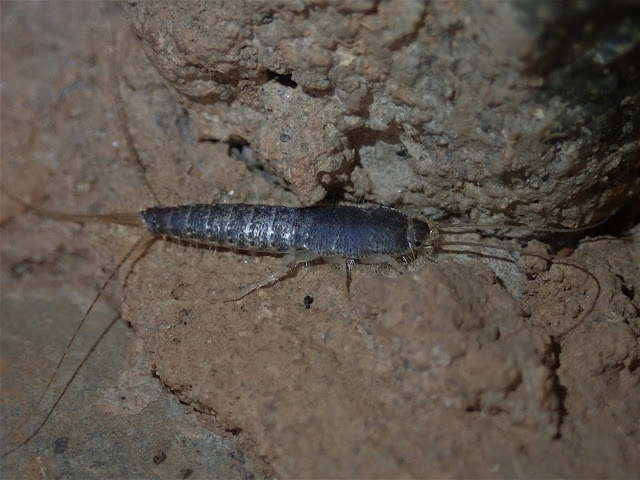
Finally, a photo of a Fishmoth, a very primitive, wingless insect that have the ability to consume and break down pure cellulose, which is the usually indigestible material that makes up the cell walls of plants. We all know them because they can eat the pages in our books if we don't look after them and, amazingly, do not require drinking water despite the dry diet they live on. They absorb all their water requirements directly from the water vapour present in the air.. They are so primitive that they do not have wings. Many insects do not have wings anymore but they evolved from winged ancestors and have lost their wings while Fishmoths, together with Springtails and a few others were around before wings evolved on insects, almost four hundred million years ago. In fact, they are so primitive that they do not have a definite larval / nymphal stage in their lives. They just hatch from the egg, resembling an adult and just grow up molting into an adult. Their common name is derived from the fact that they have long, fish-like bodies which are covered in minute silver scales, arranged much like those of a fish. The scales are rounded with delicate little patterns on them. In fact, in the old days, the scales were used to test the quality of microscope lenses. If you could make out the ornamental patterns with the microscope then it was regarded as a good quality one. 

That's it for February. I see that Easter is quite late this year, around the middle of April but March still has a public holiday so it will hopefully be busy here then. We look forward to seeing you all as we reach the end of the first quarter of the year.