Wednesday, 12 July 2023

AUTUMN 2023

 AUTUMN 2023


So, we had a wet summer, a dry summer's end and a very wet autumn. The photo above shows an early misty morning over the hatchery in May! Should be an awful lot drier. The autumn rainfall was 58mm at the office during April and 93mm in May. The average over the past thirteen seasons (since 2010) is 61mm for April and 13mm for May. Considering the averages, April was close to average, but May has been extraordinarily wet. This is because the weather phenomenon called La Nina ("little girl") has persisted later into the season than usual. This phenomenon is caused when the surface temperatures of the eastern part of the central Pacific Ocean, along the equator, are lower than normal, causing higher precipitation for as long as it lasts, which is usually up to five months every four or five years or so.

Unfortunately, the opposite weather phenomenon, El Nino ("little boy") is forecast for next season and so, if that happens, we can expect a season of very low rainfall.

Anyway, the grass in the valleys is still lush and green and the water levels are still okay even as we enter the cold winter months, brrrr! Actually, we have already had frost two or three times in the final fortnight of May so, if you plan on visiting, remember the warmies.

And so, a very pleasant autumn it was here on the estate. Below you can gander a few of the exciting things I found and experienced during the two months that have passed since I last published here.


Birdlife South Africa visited the Mount Anderson Water Catchment Reserve for a weekend in April to add data to the Southern African Bird Atlas project. Certainly not the best time of the season for birding because all the migrants would already have returned to their warmer destinations by this time, but, amazingly, the group managed to compile a list of 133 birds within two days! This figure is so high because they also explored the parts of the Lydenburg bushveld biome within the reserve's boundaries, which boasts many bushveld bird species, like those found in the Kruger Park, that do not occur here in the mesic and mist-belt grasslands of the estate. The consolidated list for Finsbury itself was 51 species, which is exceptional in our open biomes in only two outings!

Three species of Bushveld bird that were spotted on the very fringes of our boundary with the bushveld biome, that I have not seen on the estate before, include Blue Waxbill, Black-collared Barbet and Red-billed Quelea. Otherwise, exciting new species for our Finsbury bird list include Striped Pipit, White-fronted Bee-eater, Southern Double-collared Sunbird, Common Quail and Holub's Golden Weaver. The common yellow weaver found at the central area are, in fact, the Holub's, not the Cape Golden Weaver. I confirmed this by comparing the calls after I had learned they were spotted by this group. Also, the Southern Double-collared Sunbird could easily be overlooked with its close cousin, the Greater Double-collared sunbird a common sighting here on the estate.

Also, I will be adding a further three species to our list, last updated in twenty-twenty, that have been sighted since that update. These are Wood Owl, confirmed calling in the thickets in the Steenkamp's valley by the Dampiers and MacLartys from Kliprots Creek (unit 2) some time ago; European Nightjar as mentioned in one of my recent blogs; and a Lanner Falcon which I had a very clear sighting of, very recently, up on the Zebra trail. That's an extra ten species for our list, bringing it to 168 species so far recorded on the estate!


It's funny how, with even just the knowledge of the visit by the Birdlife folks, I began seeing birds that I had not seen before on the estate, just by being more vigilant about it, like the Lanner Falcon sighting just after they departed. A mere two days before the group visited, I noticed a pair of Bee-eaters perched on the powerlines above The Croft's (unit 19) on passing and just assumed they were a pair of overwintering European Bee-eaters that we so often encounter on the estate during the summer months. Then it dawned on me that they had white on their fronts so, the next time I drove past there, I kept my eyes open and, true as nungies, there they were again in the same area. This time perched on the exposed bank by The Crofts' entrance way. Definitely a pair of White-fronted Bee-eaters and very exciting.

Then, at the end of autumn, in the dying days of May, while passing by early in the morning, I noticed three of them emerge from a hole in the bank, about fifty or so meters from our entrance gate, within Highland Run. I stopped and investigated and found this hole (above) in the bank. The give-away is the double tracks on the floor of the hole, which is caused by the birds' feet as they shuffle to the entrance, crouched over.

Normally, White-fronted Bee-eaters nest in colonies, with each nest constructed and the brood cared for by an extended family consisting of the parents and a few of the previous season's offspring, neighbouring the following nest chamber etcetera etcetera, resulting in a number of nest holes in a single exposed vertical earthen bank. In this instance, however, it is clearly a single nest of a newlywed pair of birds that have started from scratch, or whose previous nest was perhaps disturbed. Being more of a savanna and woodland species, this is, I'm sure, on the very fringes of suitable habitat for these birds. This may be able to explain why, what we have here, is not a typical situation for the species.

A one meter long, 40mm diameter hole excavated in a vertical earthen bank has some distinct advantages as a nest sight. Most importantly, it is inaccessible to predators, making it an ideal place to raise young. Also, it is extremely well insulated, so temperatures within do not fluctuate excessively, helping to keep the chicks warm. In fact, these birds incubate their eggs less than other birds because of this.

The biggest disadvantage, however, is a lack of oxygen and a build-up of carbon dioxide and ammonia vapour within the nesting chamber. To alleviate this, the parents are required to visit the nest frequently, even without food, because the piston effect created by their coming and going pumps the gases out, and allows oxygen in.


Gotcha! Towards the end of autumn, the beautiful violet daisies of the Wild Aster (see blog Winter 2022 for more about the bush) begin to bloom en masse on the estate. This is obviously very attractive to the various insects that are attracted to the nectar within the flowers, and so, it stands to reason that this is a good time for predators to lie in wait on the daisies...

This is exactly what this Crab spider from the Thomisidae family did. The Crab spider is capable of changing its body colour, like a chameleon, to suit the colour of the flower it has decided to settle on. Once this happens, it becomes almost invisible to the pollinators that are attracted to the flower as it sits on the petals, with its powerful forelegs spread wide, waiting for them.

In this case, it was a beautiful Golden-spotted Sylph that alighted on the flower and BANG! The spider grabs it with those powerful legs and injects its potent venom into the victim before it can struggle free. Besides killing the victim, the venom also begins to liquify the insides of the victim so that once the spider chews through the tough skin, it can lap up the innards that leak out before discarding the empty carapace. This is an extremely messy process because spiders, being much more primitive than insects, have not yet acquired a bottom lip, so you can imagine the mess when trying to suck and shovel thick soup into a mouth without a bottom lip. What a mess.


Wow! What beautiful artwork is this chrysalis of an African Monarch caterpillar, as it went in, and butterfly when it emerges. I found it attached to the fat, juicy leaves of a Paddle plant, Kalanchoe thyrsiflora (see blog: Succulents of Finsbury Estate for more on this plant) I encountered on the highest point of the Rock Kestrel trail on a hike one day recently. See my blog "The Jolly Season 2018" to see the butterfly and the egg and learn about the poisons found within.

You will notice that I called this thing a chrysalis as opposed to a cocoon, and it was for a good reason. Both perform the same duty by enclosing and protecting the pupa from the elements while the body of the insect rearranges itself from a caterpillar into an adult butterfly. The difference is that a cocoon is constructed from silk produced by the caterpillar and woven into a cocoon, while a chrysalis is the final shed skin that is modified. So, the caterpillar uses silk strands to secure its body to the substrate then sheds its skin for the final time but, instead of discarding it, it retracts back into it and seals it off, allowing the hardened skin to become the pupa. 


A typical fairyland toadstool recognisable from the time of the smurfs and before! It is a Fly Agaric mushroom, Amanita muscaria, fully developed with a cap diameter of 150mm, growing from the fallen oak leaves carpeting parts of Morrin Pools during autumn and winter months. The characteristic white flakes sprinkled on the top are actually the remains of the protective skin, or universal veil, surrounding the young mushroom that was a much smaller round ball like an egg as it developed. 

The Fly Agaric gets its common name from the fact that it was powdered and mixed with milk to attract and kill flies, from as far back as the eleventh century in the central and north-eastern northern hemisphere. The ingredients, mainly muscimol and ibotenic acid, are responsible for the death of the flies, and the milk, the fly attractant. These two ingredients are also responsible for the hallucinogenic effects produced when ingested by shamans and their ilk in their quest to communicate with their ancestral spirits and gods in the mushroom's native areas in the north-central and north-eastern northern hemisphere, also, since the beginning of time.

Because of this, it is also the mushroom responsible for more than ninety percent of mushroom poisoning cases worldwide, although, if boiled sufficiently, it is quite edible and eaten as food in many northern cultures as well.

This mushroom has spread to all continents together with pine and birch trees, popular in timber plantations, as a mycorrhiza, a symbiont attached to the roots of those species. It is also a mycorrhiza that associates with Oak trees, hence it's presence at Morrin Pools. The mushroom in the photograph is the fruiting body of the fungus, and only develops above ground when the fungus wants to produce reproductive spores. The actual structure of the fungus is a three-dimensional network of thin strands or threads that that grow in the soil and colonise the cortical cells of the roots of the Oak tree. 

These threads, or properly, mycelia, have an enormous surface area as they occupy the soil surrounding the tree's roots and can, therefore, connect to the roots of suitable neighbouring trees too. So, in return for some of the sugars produced by the tree through the action of photosynthesis, the fungus will supply the tree with minerals and water that the tree cannot access alone. They can also enable the tree to send nutrients to a neighbouring tree, even if it a different species! This also enables the trees to "communicate" with each other by sending signals, via the myorrhiza, to neighbours when it is attacked by predators, like aphids, and the neighbouring trees can begin to produce compounds that taste bad to the predator, or even attract the enemy of the predator, parasitic wasps! 

The complexity of nature is only just beginning to be appreciated to us simple humans, isn't it?


The beautiful paper daisy flower of a Pink Everlasting, Helichrysum adenocarpum, that blooms in the autumn time in our high-altitude grasslands and rockeries. It is a plant belonging to the Asteraceae or Compositae (both accepted names for the Daisy Family), and, like all members of this enormous family, a single flower (as seen above) is, in fact, a composite of many flowers. In this case, the yellow portion of the flower is the capitulum, which is actually a disc with more than fifty tiny, but separate, flowers, each with their own male and female parts, crowded together. These tiny flowers are called disc florets. The "petals" are actually hard, papery bracts, arranged in several rows, that fold over the capitulum to protect the flowers when the flower is closed because the sun is not shining.

In a "normal" daisy, the yellow capitulum does actually have petals, but each petal is a single, separate flower called a ray floret, and these surround the disc florets to create a typical daisy flower.

Now, this is the largest family in South Africa, where the family is very well represented with many subfamilies and genera endemic to the region. They are used around the world for many things, from medicines, coffee substitutes, vegetable oil producers, food plants, insecticides and ornamentals. In South Africa, the best-known would be Sunflowers, the daisies of Namaqualand, the Cosmos that line our roads, irritating blackjacks, and, of course, the Barberton Daisy, which is the fifth most cultivated ornamental plant on the planet.


On a little promenade along my newly cut pathway (just to make it circular) from the Bushpig Alley path, just before entering the gorge between Pebble Creek (unit 25) and Kliprots Creek (unit 24), back around to the Kliprots road, we spend some time walking along the base of flat, rocky cliffs hosting many species of lichens. In fact, some of it even looks as if someone has spray-painted the rocks in some places, with different colour crustose lichens!

Anyway, while I was blabbering on about these lichens, one of the group members pointed to a spider hiding close to where my hand was. Embarrassingly, the spider had to actually be pointed out to me because it was so well camouflaged amongst the lichen that I still could not see it! When I did, I was really impressed with the spider's camouflage. Well done! Like a bark spider (refer blog Autumn 2022 for a bark spider with local comouflage variations), also in the Araneidae family, the hairy field spiders spin a beautiful radial orb-web in the late afternoon to early evening. After hopefully catching prey in the night, like mozziez and moths, and drinking it up, the spider deserts the web (unlike the bark spider that eats it) and retreats to its day resting spot, where it will be able to curl up and disappear for the day. 

Unfortunately, I haven't managed to properly identify it yet. It belongs to the genus Neoscona, which are commonly called hairy field spiders. Refer to my blog of February 2019 for the interesting life history of a hairy field spider, N. hirta, very closely related to this, although less than a third of the size, which I encountered on the estate. In fact, although the field spiders are extremely common where they are found, which is almost everywhere on the planet except Antarctica, there are only a hundred and thirty-odd species in the genus as of twenty-twenty-two, with seventeen occurring in South Africa.


Sometimes things take long to identify but, with the internet and all its specialised groups and clubs, and constant follow-ups, sooner or later a break-through occurs. Only once did I encounter the above species of flower, high up at the top of a gorge leading up the watershed towards our boundary with Komatiland Forestry, way beyond Pebble Creek, and I thought it was Lobelia erinus, a popular garden subject, although, besides a striking resemblance, the habitat and flower size were atypical of that species.

Okay, so recently the flower was finally properly identified by one of the specialists as a Long Tom One-eye, Monopsis kowynensis, from a genus very closely related to, and previously included in, the Lobelia genus, all in the Bell flower family (Campanulaceae). It's exciting because it is rather rare and only known from a few locations in the Long Tom mist belt and it is rated as VU (vulnerable) in the SANBI Red List. If any species is not rated as "Least Concern" on this Red List, like the above plant, then it enjoys protection as per South African law, further strengthening our status as a conservancy and ensuring mining does not return to our mountains. 

The specific name refers to a Bakwena chief, named Chief Kobeng Moxane, known as Chief Kowyn by the Voortrekkers, who was exiled, with his tribe, from the highveld during the tumultuous Southern African war or Mfecane, which started in the late eighteenth century and ended in the mid ninteenth century. He showed the Voortrekkers the natural migration path that led from the escarpment, one thousand meters down into the lowveld. This enabled them, and later the gold diggers (think Jock of the bushveld), to travel from the highveld to Delagoa bay (Maputo), creating an important trading route.

So far, on Finsbury estate, we have identified 33 plant, 2 butterfly, 12 bird and 11 mammal species that are of conservation concern because of their Red List status, making us an important conservation area. Pretty cool, eh?


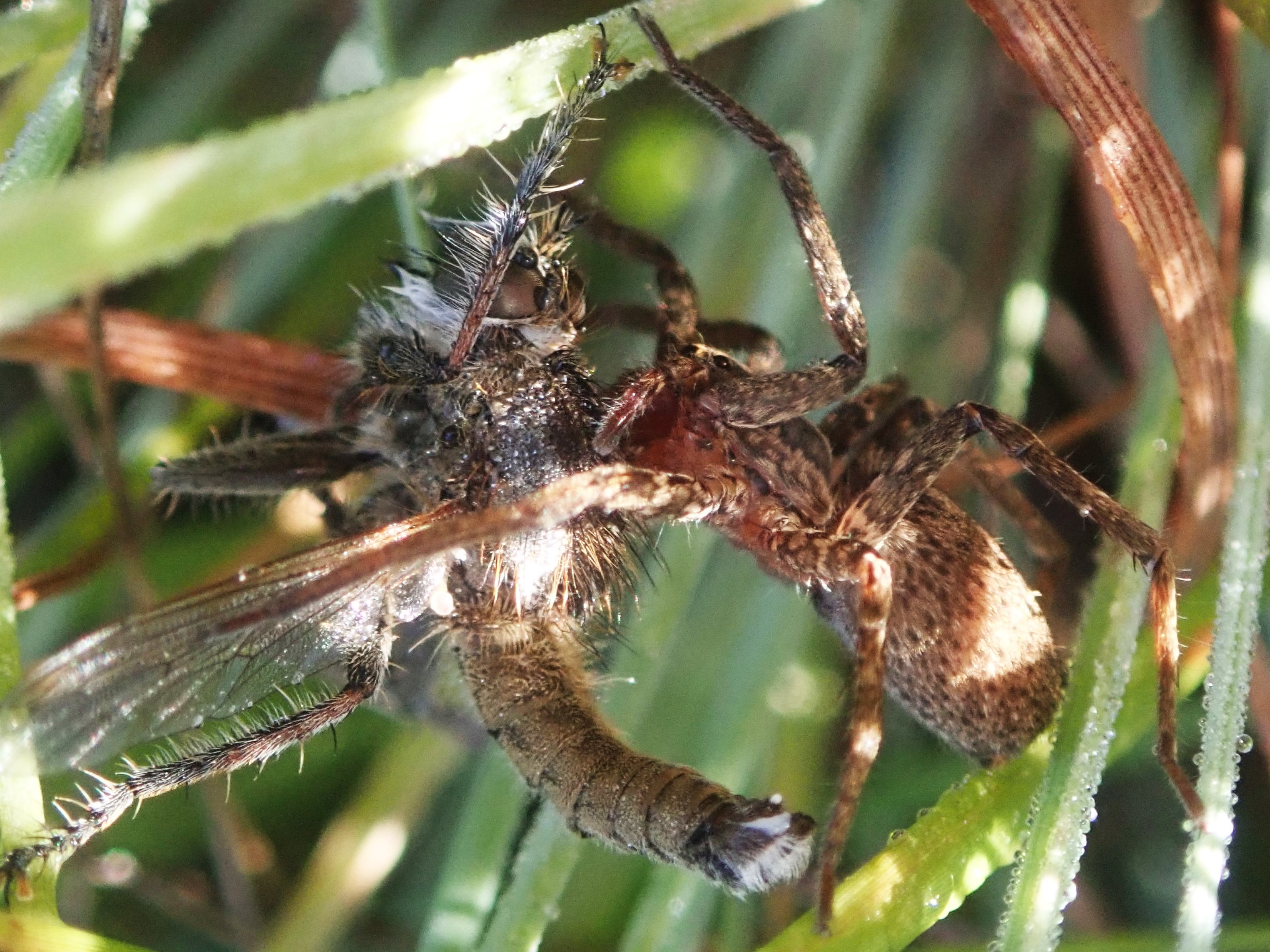
I have mentioned the badly named Robber Fly as one of my favourite insects. Badly named because they are supreme hunters and never scavenge and I love them because they kill irritating flies as they circle my face. Well, even such rapacious hunters become the hunted sometimes. I encountered this scene close to the Serenity sundowner spot (old site 26) at the end of the Hidden Valley Road. 

It was early morning and, judging by the dew covering the body of the Robber fly victim, the spider snuck up to a roosting Robber fly and attacked it from the rear. Although Robber flies prey on other flying invertebrates, morphologically, they are more than capable of killing and consuming a Wolf spider like this. So, this is a true case of eat or be eaten!


That's it for the autumn months this year. Winter has set in and it is getting colder each day. Let's see what the winter months bring...

PS: Now, there have been many leopard sightings in the last while and, although this is very exciting, it can also be a little worrying for some of you with little children and pooches. This trend of sightings has come and gone over the years, and the way Don has described it in his recent letter to members is the best way to put it. It does not mean there are more leopards than usual. We are privileged to be able to stay together with these magnificent animals within the ecosystem on the reserve, but we need to be aware of the potential hazards associated with them. A leopard will not attack an adult human unless under extreme circumstances. I have always maintained, correctly I believe, that there is more chance of an aeroplane landing on me than a leopard attacking me on this estate, even when walking on my own. But it is well-known that leopards like to prey on dogs, although not when accompanied by humans, and very young children may be at risk if they are alone. So just make sure someone is keeping an eye on the younger kids and dogs while you are on the estate and the chances of anything going wrong are close to zero. And enjoy the sightings...


Thursday, 13 April 2023

LATE SUMMER 2023

 LATE SUMMER


We have arrived at the end of summer, which is very noticeable by the earlier setting sun in the evenings, and later rising sun in the mornings. Still amazes me how quickly it tilts. We were prepared for cyclone Freddy to hit during February, but he moved north in the nick of time. We got more rain during the squall that hit the east on the ninth of February in the lead up to Freddy than from Freddy himself, but then it stopped. No more rain. Albeit February was a very very wet month with an average of 254mm falling on the estate. That's 254 liters of water poured onto every square meter of the entire property over the month! The average over the last thirteen years for the month is 117mm so Freddy sure did have an influence. Unfortunately, with that much water pouring down, much of it just runs off into the rivers and away, which is not really representative of the amount of water entering our aquifers.

In contrast, March was exceptionally dry. Cloudy and all, but no precipitation. A mere average of 34mm fell over the estate against a thirteen-year average of 110mm, resulting in the driest March since we started recording rainfall thirteen Years ago. April has been a bit wetter so far, with an average of 15mm falling so far, as of Thursday thirteenth. 

The grasslands are lush and green except for the patch burns that we have recently affected, which are greening up quickly. The fire around the north-west portion of the estate (around Kliprots Creek, unit 24) was a very healthy one, burning, slowly, over a few days before extinguishing itself. Ditto to the other patch mosaic burns we performed this season. The grasslands are getting stronger and healthier, preparing for what our changing climate has in store for us.

The opening photo of this episode was taken from above Steenkamp's waterfall (south), looking towards Goudkoppies (the flat piece right at the back on the right of the photo), showing the lush green grasslands that are only now beginning to get a bit pale as the season ends.

I have encountered many exciting things during this time, including regular sightings of a pair of Black eagles all over the estate, but mostly around the central area; nine antelope species spotted during an unbelievable hike; and very much more! Below are some of the living things I encountered during summer's end:


Talking of spotting lots of Black eagles... Went for a high-altitude hike with Helen Stewart from Jackpot cottage (unit 16) and her new family to the Troutkloof waterfall area. While we were walking, we got a distant sighting of this pair of Black eagles which always gains some ooohs and aaaahs. While returning down the rough roads from up there, we suddenly saw an eagle alight from the floor pretty close to the vehicle, and upon further inspection, got a great, but brief, sighting of the female (the bigger of the two) still feeding from a freshly killed Hewitt's Red Rock Hare carcass. She was nervous because of our close proximity, but was not prepared to leave her food behind, so she took it with her. This photo was snapped by Helen with her cellphone as the eagle alighted and flew off with the remainder of the hare.

This is very exciting for us because we are hoping that this pair of eagles are choosing a nesting spot within the estate, which means they will entertain us with plentiful sightings and experiences of their sheer majesty and presence! Normally, they have three to five nests in their territory, which in this area is about sixty square kilometers in size. If they are looking for an additional site on Finsbury, they will choose an inaccessible shelf on a vertical cliff face. Don has pointed out a tall cliff in the Hidden Valley amphitheater where he has seen them concentrate, so let us hope.   

We do currently have an active Crowned eagle's nest on the estate (see blog of October 2021), which is a special privilege, so I hope I'm not being too greedy....


Grasses are the most recently evolved group of plants and only began to dominate the land masses in the last five million years and less. I think the competition and the complexity of the insect-pollination system allowed a return to the wind-pollination system more feasible (the more primitive of the plants ie, conifers, and before them, the spore producing plants like ferns all used the wind), if sufficient numbers were achieved. And so, we have grasses: Flowering plants, stacked together tightly, without the need for the pretentious, and expensive, coloured petals, scents and nectar required to attract pollinators, grasses dominate by sheer numbers which are achieved through their meristems, the growing points, being at the base of the leaves, low down on the ground, so that, even if you throw fire, grazing, snow or frost at it, the plant can still grow unhindered. In fact, grasses in grasslands, prairies or steppes (different names for the same thing, really) have become so reliant on fire and grazing to minimise competition with other plants, that without them, they would regress back into shrubland and woodland. 

The photo above is of the flowering inflorescence of a Stab grass, Andropogon schirensis. a common grass on the estate. The photo clearly shows the plum-coloured filaments of the stamens (male). tube-like so as to release pollen grains into the wind, and then, especially near the base (in this photo, all flowers will have a female part), the pale, feather-like stigma (female) stretched out to collect pollen from others in the wind.


A beautiful close-up of a Transvaal Dwarf chameleon, Bradypodion transvaalense (= slow-foot from the Transvaal) as it tried to sneak past me unobserved in the thickets of the forest edge near Rainbow Rivers. Alas, it failed, and I managed to capture the subdued blue and yellow tinges on its scaly skin, meaning it was not yet stressed (they turn a contrasting bright and dark colour when stressed).

The Bradypodion genus contains no less than twenty species, and they all occur in Southern Africa only, meaning they are all endemic to our country and occur naturally nowhere else. Genetic studies are underway, and it seems the species count may even increase with some near endemics occurring in tiny, specialised areas, mostly along the escarpment, of which we are part.

Chameleons are a mostly an African affair, especially Madagascar, with only a few species outside in the Mediterranean, Asia and India, all near the African side. The most widespread, including in South Africa, is the Flap-necked chameleon, the one most of you will know from the Kruger Park and elsewhere, including the western properties in our reserve like Rivendell. This species, together with a desert specialised, ground-living species, the endemic Namaqua Chameleon, both belong in the Chamaeleo genus and dig holes in which to lay their eggs, which take about three months to incubate. The South African Dwarf chameleons, of which the Transvaal Dwarf chameleon is part, all belong to the Bradypodion genus and are viviparous, which means they give birth to live young, mostly after about a year's gestation.

I have had the joy of seeing newly hatched Flap-necked chameleons before in the Kruger Park but it would be a real treat to see little new-born dwarf chameleons here on the estate. They must be the tiniest little things, considering Mommy pops out up to seventeen little lizards, one after the other, when she gives birth!


I was riding my motorbike, in the night on the Majubane road just above Tranquility (unit 15), when I sighted this Nightjar on the road. I tried to approach it, with my flashlight focused on it and managed to get this rather poor shot before it alighted and flew away. I went home, thinking it must have been a Fiery-necked nightjar, the commonly encountered nightjar on the estate, when I identified it as a European nightjar, Caprimulgus europaeus by the plumage pattern. Check it out and let me know your response. I'm sure I'm right here!

Also, aeach species of nightjar is represented by multiple subspecies whose colouration and plumage pattern differs only slightly, so, phew, after much consultation, deliberation and frustration, flipping from page to page and back again, with the limited detail on the photos, I finally settled on the greyer Asian subspecies of European nightjar, Caprimulgus europaeus ssp. umwini.

The best way, of course, to identify the similarly looking nightjars, is to listen to their calls which are very specific. This cannot be done in this case because this nightjar is a palearctic breeding migrant, meaning it breeds in the palearctic region, in this case, in Iraq and Pakistan, and migrates to the southern hemisphere, in this case Southern Africa, to escape the harsh northern winters, after which it returns home to breed. So, it has no need to make any sounds down here because its calls are reserved for mating purposes only, and when here, they are taking a break from each other.


Recently, I encountered a Golden-eyed Lacewing larvae (below), and, after identifying it, I realised that, finally, I have a photograph of the life stages (excepting the pupa) of this Neuropteran from the Chrysopidae family, all taken on the estate. This is exciting because they are not so terribly common, or, at least, certainly not easy to find. The eggs (left) are attached to the end of a ten-millimeter-long silken stalk, which, in turn, is attached to a twig or the underside of a leaf. The larvae (below) are voracious predators with poor senses that hatch from the egg, moult in-situ and then embark on a feeding frenzy, where they walk around moving their heads side to side and, if they encounter any

creature that can be subdued by their massive pincer-like, hypodermic jaws, they will clasp the victim within these jaws, inject a cocktail of enzymes and suck up the liquesced innards that result. Even a sibling! It is surmised that this is the reason that the adult female deposits each egg on the tippy-top of a silken stalk: To keep the hatchlings further away from each other so they have less chance of coming in contact and eating one another. In fact, the digestive cocktail that they inject into their prey is so potent, that it will liquify the innards of a small, soft-bodied insect within two minutes of injection! They will then use silk to bind the remaining exoskeletons of their victims to their backs to help camouflage themselves from
                                                                                    
birds and other predators in preparation for their next hunting session. Once they have eaten their fill and are ready to pupate, they will spin a silken cocoon around themselves and begin their journey to an adult within a mere three weeks, unless this happens at the end of summer, like now, and they overwinter within the cocoon and emerge after the first rains in springtime. Once the adult has emerged (left), it will conceal itself until it's net-like wings harden, easily identifying it as a member of the Neuroptera (nerve-winged) together with Owlflies and Antlions. The adult feeds mainly on nectar and so is an important night-time pollinator to various plants. They also have tympanal organs, membrane-like ears that allows them to hear. This feature is mainly used in the mating songs (actually vibrations) males sing when trying to impress females so she will allow him to breed with her. One huge advantage of the ability to hear when you are a nocturnal flying insect, is that you may be able to pick up the ultrasounds emitted by bats, surely your worst enemy, when on the prowl, and take evasive action, like many moth species, by folding the wings and dropping to the floor. A Golden-eyed Lacewing adult does just that. Very clever! 


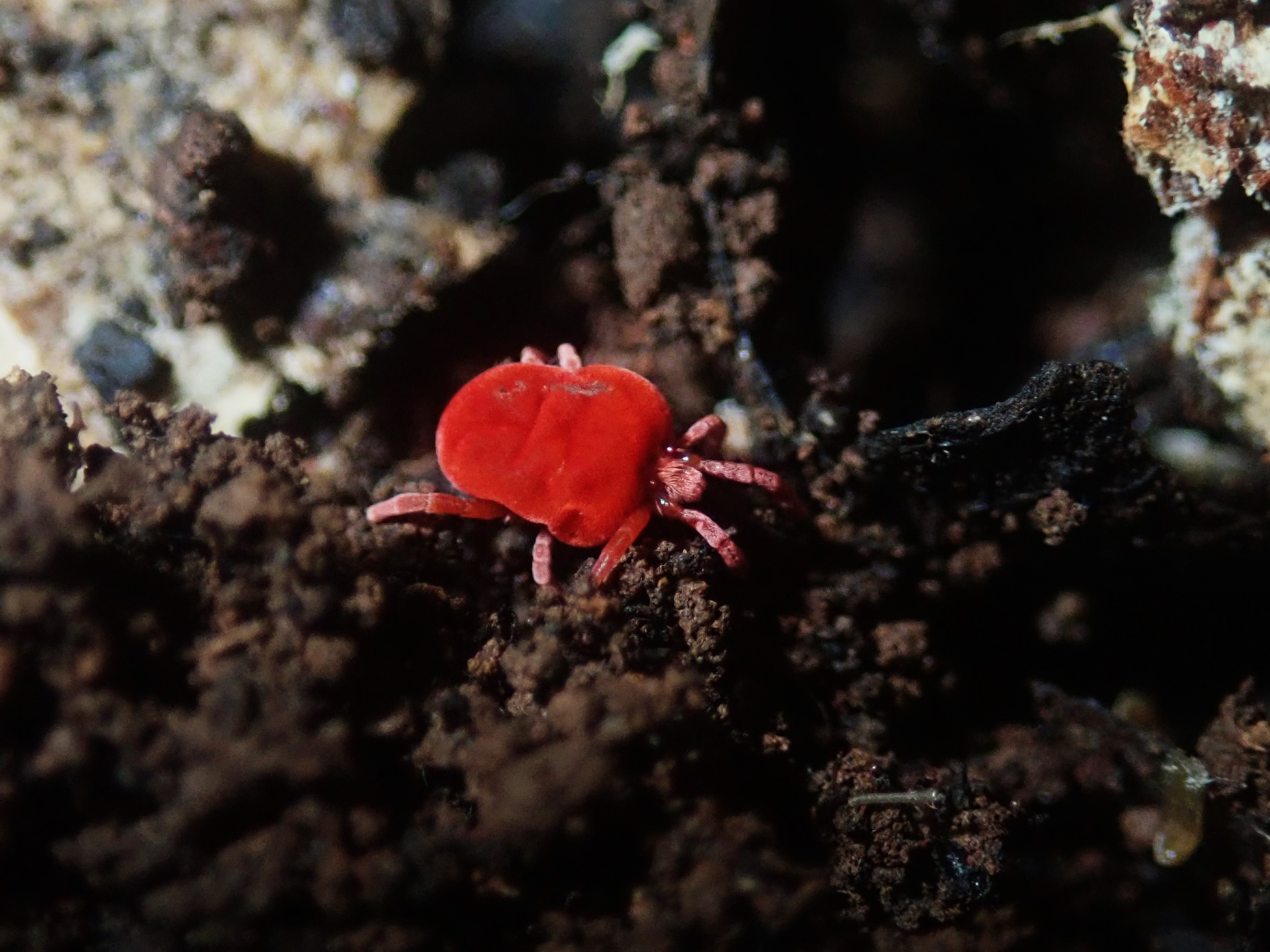
In my blog dated September 2019, I featured a rather poor photograph of a Red Spider mite. The quality of the photo being so poor, even with the special magnifying features on my camera, because the thing wouldn't stand still and it was just over a half-a-millimeter long! And that size, for a mite, is big. This one here, above, is a giant at three millimeters long. Even at that size, on the forest floor, in among the detritus, it sure was easy to spot this bright red Red Velvet Mite, I think from the Dinothrombium genus in the Trombidiidae family, the biggest of the mites.

I was lucky with this photo, because I took it before the thing got wind of me. Once it realised I was there (I've got to get the camera very close when the subject is so small), it wouldn't stand still, again like its tiny distant cousin from the blog I mentioned earlier. Fast and zippy. Anyway, when I was gathering information on these odd creatures, I discovered that a mite, less than a millimeter long, from southern California, holds the world record for the fastest animal! That is, the speed it runs relative to the size of its body. It achieved 322 body-lengths per second. To put that into perspective, a cheetah achieves 16 body-lengths per second; the fastest insect, a species of Tiger beetle from Australia, achieves 171 body-lengths per second, the previous record-holder before someone measured the mite's speed, using high-speed photography in a laboratory and in their natural habitat.

Mites are everywhere, all around us. They fill all the common niches, from decomposers to plant-eaters to predators to parasites and even cannibals! They live in all conditions from salt water to fresh water to forests to deserts to houses and even hospitals! They can do this without us noticing because of their tiny size. They are like an advanced mix between a tick and a spider, although they fit between the Solifuges (Red Romans / Kalahari Ferrari) and the Pseudoscorpions (see blog of March 2021 to learn about these also-amazing creatures). All of them: ticks; spiders; scorpions; harvestmen; solifuges; mites; pseudoscorpions and a few others, make up the Arachnida, a class of Arthropods.


This beautiful, lanky spider is a Dark Sheetwebber, Euphrosthenopsis pulchella, and belongs in the Nursery-web and water spider family, the Pisauridae. But, as there is always an exception to the rule, they are not wandering spiders like the Nursery-web spider, who resemble and behave very similarly to the common wolf spiders (blogs September 2019 and January 2022), who do not use a web to capture prey but instead wander around actively hunting their prey, and thus, the female carries her ball-like egg sac with her while the eggs incubate (the Wolf spider carries her egg sac by her spinnerets on her abdomen while the nursery-web spider carries hers with her jaws).

The Sheetwebber, by exception, builds a horizontal, sheet-like web like a Funnel-web spider (blog of February 2020) does, also with a tunnel-like retreat to escape danger. The eggs are laid and incubate within the retreat, so she doesn't have to carry them with her like her brethren. If an insect lands on, or walks on to her sheet-like web, she darts out of her tunnel and subdues the victim with a potent venom that those same brethren require, like most wandering spiders, because they don't use silk to help subdue their prey like web bound spiders.

I found this individual in the thickets between Solitude (unit 5) and the gorge that runs past it. Exciting because I have only once seen this spider before on the estate many years ago.


It is amazing. I didn't get to see a Baboon spider for my first seven years here at Finsbury and suddenly, in the last few years, I have had a whole bunch of sightings! Every sighting, of course, is thrilling because they are so large and yet so gentle (unless you are their prey). 

This is a large male Golden Baboon spider, Harpactira tigrina (see blog of Autumn 2022 and erratum thereafter). I say large because, as with most spiders, the female is much larger than the male, although in baboon spiders, the size difference is not that great, and this individual covers half my forearm! And I say male because he ran past me, away from one of my patch mosaic fires: If it was a female, she would have retreated into her silk-lined burrow, whereas males usually reside beneath a hammock of web in a nice, secluded spot, making it necessary for him to find refuge in amongst rocks during fires.


A stunning pair of Golden Waxcap mushroom, Hygrocybe chlorophana, fruiting bodies, growing from a rotting log, covered in soft mosses, on the forest floor near Steenkamps' waterfalls. It's sightings like this, coupled with the bright red Red Velvet Mite, and Knysna Turaco, that bring colour into the darkest depths of our Kloof forests. In fact, according to the literature, most Hygrocybes are brightly coloured, and indeed, I have found bright red ones in our forests too.

Golden waxcaps are associated with old, natural meadowlands in Europe called "Waxcap Grasslands", which are becoming more and more rare as we continue to alter our landscapes, making these mushrooms endangered in the northern hemisphere. In the southern hemisphere, they are associated with woodlands and forest.

The fruiting bodies are edible but not particularly tasty. Hygrocybe means "wet head", alluding to the fact that the cap is often slimy on top and, chlorophana is a bit of a misnomer because it actually means "pale green" and, as you can see, there is absolutely no pale green to be seen. Even the boffs mess up every now and again! 


As you traverse the estate, especially along the rivers in the valleys, during the late summer months, you will notice bunches of pinky-maroon decorations hanging from various bushes and trees. These are bunches of fruit (winged seeds) belonging to Rambling Dock, or Turkey Rhubarb, Rumex sagittatus.

Rambling Dock is a low to medium height scrambling creeper with soft, arrow- head shaped leaves (hence the specific epithet: sagittatus) that are delicious in soups and edible like a marogo / spinach. The flowers are numerous but tiny and insignificant. It's the three-winged fruit that is attractive, and this attribute that has taken the plant overseas where it has become a major pest species, especially in Australia, Tasmania and New Zealand. Yup, most of their pest plants come from South Africa, and most of our pest plants come from Australasia! Bluddy ozzies and kiwis!

In this case, the plant is creeping up and through Bracken Fern and Yellow Sheepsdaisy. The Sheepsdaisies which are now, as I write, just after Easter weekend, beginning to bloom en masse, filling the valleys with yellow!


When photographing animals, it is best to try and get the entire body in the photo, try not to cut anything off, unless you are looking for a portrait. Now, this Brownback Grass Katydid,  Tylopsis continua, if you zoom in, has the most beautiful candy-striped eyes, and, because of those super long antennae, I would have had to bring the camera much further back to fit the body in, and the eyes would have been invisible. So, I chopped the antennae by about a third just to fit the rest of the body into the frame. Those are long antennae, hence the common name for this family of orthopterans (crickets, grasshoppers), Long-horned grasshoppers. In North America, they are called Katydids, an onomatopoeia. I will use Katydid because it's a lot shorter. 

In the past, I have stated that the difference between a grasshopper and a Katydid is that a grasshopper eats vegetables (grass) and is active during the day; whereas the katydid is a predator and is active during the night. That is not entirely accurate because this species, with a few others, is actually an omnivore: eating mainly grass leaves and flower petals but has also been observed eating soft-bodied aphids and caterpillars.

Also, if you look really carefully, you will notice a fine slit on the front tibia. This is a closed tympanum, a membrane that detects sound, like our ears do. Male Katydids stridulate with their forewings, producing different frequencies of clicks. Besides being species specific, the frequency of their clicks is dependent on the ambient temperature. Frequency increases with temperature increase. It is so accurate that, in North America, they can accurately calculate ambient temperature by using the formula: number of clicks per fifteen seconds, plus thirty-seven, gives the temperature in Fahrenheit (X (clicks / sec) + 37 = T (F)).

The female Brownback grass katydid hears the males call and responds by approaching him. After mating, when she is ready to lay her eggs, she cuts a slit, with her blade-like ovipositor, in the leaf sheath on a grass stalk, in which she lays her eggs. After a few weeks (or after winter if they lay at the end of summer), tiny nymphs, that look similar to the adult, emerge from the grass stalk and begin their lives of eating, hiding and mating. 


Finally, at the end of the Rock Kestrel trail on Saturday during Easter weekend, not far from K9, I glimpsed this withered caterpillar resting on a mattress (?) resting on the inflorescence of on the top of a grass stalk. On closer inspection, I saw it was a dead caterpillar resting atop the cocoons of the parasitic wasps that had eaten the caterpillar out from the inside, then spun cocoons and some have clearly already pupated as their cocoons are empty.

The culprit is an Ichneumonid wasp (See blog of February 2020). The wasp uses its long, slender ovipositor (instead of a sting) to inject an egg into the victim, a caterpillar. Amazingly, in some species and more than likely this one too, the single egg "reads" the victims species, size, age and how long until it goes into its pupa, and then divides the egg the requisite number of times so that there is enough food for the number of eggs that are formed! That is simply incredible! Then these larvae do not kill the caterpillar, so that it can eat, albeit in poor condition because it is being slowly devoured from the inside, to continue nourishing the maggots within. By the time the maggots are ready to pupate, the caterpillar has died and they drill through its integument and spin their cocoon beneath it. More commonly, in some species, the cocoons stick out of the integument like quills on a porcupine.

There's more! There are some caterpillar species, who too regularly had fallen victim to these wasps in the distant past, that have evolved a pattern on their bodies that looks so very much like these cocoons sticking out, that the ichneumonid wasp avoids it, apparently convinced that the caterpillar has already been parasitised! Crumbs! It's crazy out there :)  


That's it for summer here at the estate. Already feeling the chill in the morning air. But we all know that the estate is as entertaining in the winter as it is in the summer. Remember, if I am available during your visit, I am more than happy to take you and your guests on doodles, walks or hikes. Just contact me at jimmy@finsbury.co.za. Or on the radio when you arrive here. See you then! 

PS. If you want to find the blogs I refer to in parenthesis, on the top left corner of the blogspot website, there is a search bar. Type in the blog name or the subject's name...

Wednesday, 1 February 2023

THE FESTIVE SEASON 2022-23

 THE FESTIVE SEASON 2022-23


The festive season was lots of fun but, alas, it's over :( The weather, in the first half of the season, was exciting, mostly wet and tempestuous with glorious hour-long breaks of sunshine pretty much every day. So, even though it rained regularly, it was still possible to get out and have fun between the wet spells. And so, in December it was wet, with an average of 243mm falling on the estate over seventeen rainy days in the month. The most falling on the eastern parts of the estate, with 318mm recorded from the gauge at Rock Solid (unit 22), and the least falling on the southern parts of the estate, with only 208mm falling over Patrick's gate in the west (only 4,94km west north-west away, as the crow flies). Conversely, January has been dry, with an average of 110mm falling over the estate in just six days of rainfall! It looks, though, we may be getting some good rains in February. Let's hope. 

As far as I am concerned, the rain, unlike last season, has been hard on the environment. When it has rained, it has rained hard, with leavy drops, and lots of them. This is a recipe for erosion and run-off, but it certainly is better than too little rain. As you can see by the photo above, taken from the Miner's cottage road, close to the second zebra trail sign (see the cottage on the left), the estate is lush and green. And everything is just growing like crazy. Wow, I love all the life! 


Like the US postal service boasts about rain or shine, most of the families that visited did not let the rain dampen their spirits and were out and about in spite of it. I bumped into one such family, coincidentally, at a similar place to where the photo I just spoke about was taken (this time the Miner's cottage is in the back-round just to the right of the family). The Joostes from Coch-Y-bunddhu (unit 1) were all over the estate during their time here. In fact, I saw more families and groups exploring the wilderness areas of the estate than I have ever seen before.


An East African Lowland Honey bee, Apis mellifera ssp. scutellata, searching the flower of a Ribwort Plantain for even more pollen, although it appears its pollen sacks are overflowing already. Even that common name is quite a tongue-twister, eh? Well, you see, the taxonomy of Honey bees has been very difficult to interpret, mainly because they have been domesticated for at least 2600 years and have, therefore, been interbred and inbred since then and now occur, in abundance, on all continents. 


It is believed that the Apis genus originated in southeastern Asia and the Philippines, and the A mellifera type species then spread into Africa. Thereafter, the desertification of the Middle East separated the species which isolated the African genome. This genome went on to adapt to two very different climes within the continent, the summer rainfall regions which occur throughout the continent and, of course, the winter rainfall region which only occurs on the very south-westerly tip of the continent. So, in South Africa we have two indigenous species of honey bee from the Apis genus: Apis mellifera scutellata and Apis mellifera capensis separated by climate.

In 1990, beekeepers moved a bunch of Cape Honey bees from the winter rainfall areas to the summer rainfall areas of South Africa, which swiftly became a big problem for the indigenous East African Lowland Honey bees, residents of the summer rainfall areas! A queen bee of a hive produces pheromones in her mandibular glands that control the behavior of her worker population. These pheromones recognise her as the queen; prevent the workers from attacking her; ensure she receives better quality food; and prevents workers from developing their ovaries and laying their own eggs (although, if this does happen, these eggs are usually weeded out of the cells by more closely related workers of the Queen anyway, and those that do hatch are males and are therefore evicted the following winter). 

Unfortunately, Cape Honey bee workers can enter the hive of an East African Lowland Honey bee colony, can develop her ovaries and lay haploid eggs, by parthenogenesis, which are female, in cells which are ACCEPTED by the young workers who tend the eggs and pupae. By doing this, the Cape Honey bee paratisises the East African Lowland Honey bees' colony. The new female Cape workers do not forage for food or anything else that benefits the colony, and so, as the population of Cape bees grows, the indigenous workers' population decreases and finally the hive collapses. The female Cape workers then move to other East African hives and the process repeats itself many-fold! 

A barrier separating the two subspecies was established 1993 and beekeepers are not allowed to take the Cape Honey bee across it. This has saved the beekeeping industry in South Africa. 


Shaggy Ink Cap, Coprinus comatus, found on the Hidden Valley road around Christmas time. This mushroom is a close relative of the Snowy Ink Cap mushroom that I featured in my previous blog. The specific name, comatus, is the latin term for "long hair" or "leafy" referring to the hair-like scales on the cap, also the reason for the common name: Shaggy. This mushroom also has a negative effect on individuals if they consume alcohol as in the previous species, although not as pronounced. The fact that the effects are not as acute and the fact that they taste really good has made these popular eating. But only if one eats the young, unopened individuals like the one on the right in the picture above. 

To recap: The "Inkcap" part of the name comes from the ability to extract a permanent, browny-black ink from the mushroom. Once the spores are produced in the gills, the gills begin to deliquesce into a black, gooey slime. That which drips to the floor, impregnates the floor with spores. The stink of the slime also attracts flies who transport the spores that stick to its legs and when the remaining slime dries, the spores flake off and are transported by wind to far-away places. For those that want to get the ink from the mushroom, simply place a few whole mushrooms into a glass jar and seal the jar for a couple of days until the jar contains a gooey black mess. Sieve the contents through a baking sieve and, Viola, what remains is a good quality ink, albeit a stinky ink! 

The tall individual here was quite a robust mushroom, standing more than 400mm tall. Upon closer inspection, the shaggy cap is actually quite beautiful, with many colours and a lovely texture. One of the prettier mushrooms I have seen on the estate.


A poor photo because of very poor light, but a remarkable creature! This is an Ant-mimicking Jumping spider, Myrmarachne formicaria, that I found on the patio of my house. The male apparently has the long chelicerae, as in the photo, but I cannot seem to find the reason for that adaption. Besides the long chelicerae and the huge, forward-facing 'headlight' eyes, the mimicry is superb! Experiments have proved that these jumping spiders are preyed upon four to five times less that a non-mimicking species, so that is obviously the reason for the mimicry. Ants bite, sting and are filled with formic acid and so are preyed on less than other insects in general. There is also speculation that the mimicry allows the spider to get much closer to insects, like scale insects (see "ants and aphids", blog of January 2020; and "Scale insects", blog of May & June 2021), which it then attacks and devours. There have been no reports of this being observed yet, though.

But looks are not enough. The spider also behaves like an ant: When running, it purposely runs on a windy trajectory that changes every ten or so body lengths, mimicking an ant that is following a pheromone trail left by another ant in the colony. Also, although it runs on eight legs, like a spider, and not six like an insect, it stops periodically and lifts its front legs off the ground and waives them around, just like an ant does with its long antennae. This was all noticeable as I followed this guy around my stoep. A really clever survival tactic. Amazing stuff!


This lovely, colourful photo, taken by Ally from Ally D Photography (guest of the Bands of Finsbury House (unit 23)) of an adult Malachite Kingfisher, Corythornis cristatus, on the left, feeding pieces of frog to his / her fledged offspring. The photo was taken at K13, a weir where these spectacular little birds are regularly spotted. After the Pied Kingfisher, these are the most common and abundant kingfisher found on bodies of fresh water. They do prefer slower-moving water than what we get here at Finsbury, which explains why we don't see them at every second weir, because, along slow-moving rivers, you will find a pair on every two-hundred-meter stretch! So, along rivers where populations are saturated, a monogamous pair of Malachite kingfishers establish a linear territory stretching about two-hundred meters along the river, with perching space on both sides.

After brief displays by both sexes, copulation occurs and then both sexes begin digging a narrow (about 40mm in diameter) hole into a vertical sand bank. The tunnel is dug to a depth of about a meter, at a slight incline, and then a fist-sized chamber is hollowed out at the end. The adults, stooped, fit snuggly along this tunnel when accessing the nest and the constant backwards and forwards shuffling creates parallel ruts along the floor of the tunnel, a characteristic feature of an active Malachite kingfisher's nest tunnel. Once completed, there is no extra comforts or bling added, the female lays two to four eggs on the floor of the chamber.

Both sexes incubate the eggs, and within two days they will hatch. The chicks are fed minnows, tadpoles, insects and their larvae and nymphs, pieces of frog, crab and lizard, for just over two weeks when, suddenly, a few days before fledging, the constant supply of food slows dramatically, and the chicks visibly lose weight. It is believed this weight-loss allows the chicks to negotiate the tunnel easier, as they prepare to fly for the first time. Once fledged, the chicks will remain with the parents, as is the situation in the above photo, while the parents teach them how to hunt and what to hunt. The chicks are then evicted from the territory and must fend for themselves.

Then the whole show starts again! Although, if the nest was built in a suitable spot and there were no problems, the pair will use the same nest over and over again, raising as much as four broods in a season. Even using the nest again in the following seasons. One problem, though, is they do not clean the nest of scraps, bones, or even faeces. In fact, it's so gross in there that, at the stage before fledging, there is usually a slimy, stinky ooze dripping out of the hole entrance (the reason for digging the tunnel at a slight incline)! 


This is a nice close-up shot of a Dancing Acraea butterfly, Hyalites eponina, waking up on its night-time perch. It's a small (wingspan less than 40mm), common butterfly found in riparian bush and on the edges of forests on the estate. In fact, it is ubiquitous throughout the eastern side of southern Africa in wooded habitats. The female, whose colouration is very variable, can be seen flying slowly, low to the ground as she searches for plants belonging to the Malvaceae (Hibiscus family), particularly Triumfetta and Hermannia species, so she can then lay a batch of eggs on the underside of the leaves. The larva, a prickly little worm, will devour the leaves on the host plant before it will anchor itself to the bush and enter its pupa stage. If this happens early enough in the season it will exit the pupa in the same season, or if later, then it will over-winter in the pupa stage.  


Goody Gumdrops! A new species for our list. This is a Purple Gorse, Muraltia flanaganii, and I found it in a rocky area on the high-altitude grasslands above Knife-edge Ridge, in the extreme north-east of the estate, while hiking over Christmas time. It is in the Milkwort family (Polygalaceae), in the same order as the Pea family, all with a familiar flower design. The plant was described by Harry Bolus (1834 - 1911), a very well-known botanist from the day. He was an accomplished businessman, a philanthropist, a botanist, and a botanical artist. In fact, to those orchid fanatics, he is very well known for the immense work he did on the orchid family.

Of the 115 different species from the Muraltia genus, this one and only four more occur outside of the Cape Floral Kingdom, making it a typical fynbos plant, hardy and able to survive in nutrient poor soils with erratic temperatures and rainfall. Its close cousin, M. heisteria, is a popular garden subject because of these attributes and, so, this one should be a good one too, outside of the winter-rainfall areas. Perfect for a rockery, the rounded shape of the bush, the attractive leaves and copious white, mauve and purple flowers make for a jolly sight.


The hairy caterpillar of the Mountain White-spot moth, Mesocelis monticola, feeding on the leaves of a low-lying plant in our high-altitude grasslands. This species is the only one in the genus (monotypic), which is placed in the Lasiocampidae family. Lasio (Gr)= Hairy; Campa (Gr)= caterpillar; Meso (GR)= middle; ocelis (Gr) = eye (referring to the eyespots in the middle of the wings); monticola (Gr) = to love mountains. Very descriptive!

Once the caterpillar has had its fill, it will spin a tough, papery cocoon on a twig of a tree or bush that serves as a food source for the caterpillars. After pupation, the male emerges from the cocoon as a drab, bulky, brownish moth with a white spot on each forewing. The female is apterus, meaning she has little stumps instead of wings and she cannot fly. She will remain in the cocoon and release her reproductive pheromones into the air and the male will, hopefully, pick these up and find her and impregnate her while she is in the cocoon. She will then emerge and lay her egg batch on the host plant and the cycle will repeat itself. 


This is very exciting! This is the first confirmed sighting and photograph of the super-elusive Natal Cascade frog, Hadromophryne natalensis, from the very primitive family of frogs, the Heleophrynidae, the Ghost Frogs. The photograph was taken by Don Robertson while he and Heidi Robertson (Rainbow Rivers unit 17) were hiking to the Steenkamps' waterfalls!

In this ancient linage, the frogs lack ribs and have no dentate upper jaws. They have thin, translucent belly skin, through which the muscles and organs can be seen, and it is believed that that is where its family name, Ghost Frogs, comes from. Another primitive trait is that they perform amplexus, which is when the males clasp the females during mating, the old inefficient way. In frogs and toads, fertilisation is external, so the female lays the eggs while the males fertilises them immediately as they emerge from her. The males of modern frogs clasp the female under the armpits whereas, the more primitive and inefficient method sees the male clasping the female around the waist (inguinal amplexus).

The entire family contains only two genera and six species, five of them, the Ghost frogs, endemic to the Eastern and Western Cape and one species, this Cascade frog, alone in its genus, is endemic to the Drakensberg escarpment. 

Now there are some problems that a frog may face when living in cold, fast-flowing streams high up in the mountains that these frogs have adapted to overcome: Among a few unique traits of the tadpoles' head is the presence of a large suction cup around the denticles that help it stick to the rocks while still feeding; the adults have expanded disks at the tips of fingers and toes for the same reason; they have fully webbed feet to fight the current better; flattened bodies to fit inside cracks in rocks; and the eggs, from one to two hundred per laying, have a sticky surface to stick on rocks after amplexus.

Although the adults are hard to find for most of the year besides late summer when they breed, the tadpoles are apparently easy to find because they are quite unique, they are also visible throughout the year because, the water being so cold, it takes two years to develop into a froglet. I have also read that the adults like to emerge during full moon time so I will endeavour to visit the Steenkamps' waterfalls during a full moon soon. Thanks Don and Heidi :)


When I was doing the electricity readings in December, I found fresh male leopard tracks coming from the northern parts of the estate all the way down to the southern areas. So, after I had photographed the meter at Rainbow Rivers (unit 17), the last meter to photograph, I was headed back, on my motorcycle, to the office when I saw a huge African Black eagle / Verreaux's eagle standing on the grassy slopes just above the Majubane road as it passes the entrance to Tranquility (unit 15). 

I rode past so as not to scare it away and parked a little further along the road. I unsaddled and snuck closer using the bank on the side of the road as cover. I got to about twelve or so meters from him and was about to expose myself to get a good close-up shot of it when my foot disturbed a mass of flies on the floor. I looked down and saw the innards of a medium-sized mammal, covered in said flies, on the side of the road by my feet. This unexpected movement alerted the eagle and I just managed to get a couple of shots off while it was flying away. What an enormous bird! It's like a hang-glider! 

Anyway, I climbed the bank and approached the spot where the eagle was and found the freshly cleaned skull of a young warthog. I pictured what an amazing sight it must have been to see a Black eagle take a young warthog. It must have been a noisy affair indeed! On the way back to the road I found the fresh tracks of the big male leopard that I had been seeing the whole morning, moving quickly from the carcass to the thick riverine bush of the little gorge where unit 15 gets its water from.

So, I deduced that the leopard killed the warthog early in the morning (after it was light of course) and was eating it, under the watchful eye of a perched Black eagle, when I approached on my motorcycle on the way to Jackpot Cottage from Morrin Pools. This chased the leopard into the thickets and, after I had passed by and the leopard did not return, the eagle moved in to scavenge the remains, which is when I rode back after taking photos of the meters at those two houses. What an exciting turn of events!


Another first! This is a photograph of a Stonefly from the Notonemauridae family in the primitive Plecoptera order and this is the first photo of any individual from that order to be added to our insect list. 

The first true insects appeared in the middle Devonian, about 390 million years ago. They were rather simple and had no wings and resembled the only slightly more advanced Silverfish / Fishmoths that we find in the cupboard eating our books. Then, about 320 million years ago, the first winged insect appeared on the scene. They were the common ancestors of Mayflies (order Ephemeroptera) and Dragonflies and Damselflies (order Odonata). Now this was obviously a great improvement for their survival and, because of this, almost all insects today have, or have had, wings. The only problem these insects have, is that the wings are unable to fold over their backs, making it difficult for them to squeeze into small spaces.

Then, less than 300 million years ago, the first insects with wings that could fold closed over their backs appeared on the scene and these are the ancestors of the Stoneflies like the one photographed. They could finally fold their wings over their backs and could occupy many more niches in the ecosystem. 


I have been compiling lists of all the living creatures, fungi, protists and plants as I have found, photographed and identified on the estate since I got here ten years ago. Protists are sitting at only two species; then fungi, including lichens, at more than seventy species; Plants are sitting at 836 species; and Animalia, which includes earthworms, snails, arachnids, other athropods, insects, birds and mammals, at 560 species. 

These lists all occupy my laptop and iNaturalist (see after this), and so I decided to remove the animals from this digital habitat and into the real world! In the photo, you see an A2 sized, leatherbound list of all the estate's animals, which will be updated periodically, in their taxonomical order with a thumbnail photo of each. All the photographs, except for most of the birds, and the odd other of which I only had very poor photos of, were taken by me on the estate.

I will put this list, together with a magnifying glass, in the Natural History part of the museum where it can be accessed by members and their guests.


A screengrab as an example of the layout of the Finsbury Animalia list. The columns start at Phyllum, then move to Subphyllum; Class; Order; English Order (in bold); Suborder; Family; English Family (in bold); Subfamily; Taxon (scientific name); Common name (in bold); then there is a thumbnail photo bordered in white for the white columns and green for the green ones; then body length, the current SANBI Red List status; and finally a column for photo credits. You can use the list to compare against animals you have encountered on the estate and that will help you identify it. Once you have the proper name, you can google it and find out more or enter it into the search bar on this blog site and it will show if or when I featured it on one of my blogs.


iNaturalist is a website you must visit if you are interested in the identification and recording of any species, from plants to animals etcetera. It is an international site with members in any and every country who post their observations (photos or sounds) and specialists and others help you to identify them. So please visit iNaturalist.com, open a free account and get started!


I have created a project on iNaturalist called "Finsbury Estate Biodiversity" and, once you have opened your account, you can search the projects for it. If you go into the project, you can become a member and contribute to the species that have been found here so far. So if you are hiking in the Finsbury mountains and you come across an animal, plant or fungus that you would like to identify, just take a picture and post it as an observation and I, or somebody else will help you. Simple and fun!

So that's it! Another fun festive season done with and another beautiful year ahead! Remember to ask me for our new digital map of the estate so I can send it to you to load onto your device so that you and your guests will never get lost on the estate, even on the longest hikes. And, of course, if you want a guided walk or hike, contact me at jimmy@finsbury.co.za and we can arrange it. See you then!