Wednesday, 11 April 2018

A month of diversity

MARCH 2018

The month of March was a rather busy one for me and my team. It is the end of the growing season which means there is a ton of new alien plant growth to contend with. The very dry spring we have had this year has resulted in the trees producing many more seeds than a wet spring would have them produce (remember this when you want your garden trees to flower more abundantly: give them less water during the growing time.). This is now the fourth year of dry springs in a row and I can see it when I see all the new Pine growth all over the Estate. The rains have certainly been coming later in the season in the last few years with us receiving 112mm in the month of March.

Anyway, this means that I have been busy up in the mountains a lot lately, which has exposed me to many exciting things: Lots of game and other goodies! To add to this, Easter was in March this year as well, so a lot of exciting activities took place too. Following, see a gallery of some of the things I managed to photograph:

An Ascalaphid Ant Lion, in the Proctarrelabis genus. The transparent, wavy wings and the hairy face of this Ant Lion adult make it appear like an apparition. The larvae of most Ant Lions are well known because they construct little pits in soft sand into which insect get trapped. The larvae, which hides under the sand at the bottom of the pit. throw sand, with their heads, at the insect as it tries to scramble up the loose sand on the sides of the pit. This helps the victim slide down to the bottom of the pit where the larvae grab s it with it's massive jaws and pulls it under the sand to devour it! This species, however, has a larvae that is free roaming and pounces on its victims just like a lion pouncing on it's prey. These insect are from the Neuroptera order, the same order as the Lacewings, the insects we mimic with the flies attached to our lines when fly fishing.


This is a wingless female Toad Grasshopper from the Pamphagidae family. These vegetarians rely on their superb camouflage to escape detection by predators. The males are smaller and winged and stridulate to attract a mate. The female, upon hearing the male's call, approaches him to mate, just like frogs do. Note the membrane on the side of her body that she uses to hear the male. The common name of Toad grasshopper does not refer to the fact that their mating system is similar but from the fact that some females from the family resemble toads with their fat, squat bodies.


Unlike the above species of Grasshopper, the Koppie Foam Grasshopper, Dictyophorus spumans, does not attempt to hide from it's predators. In fact, it is aposematic which means it is brightly coloured, indicating that it is not a tasty meal! This grasshopper feeds on the leaves of Milkweed plants, very poisonous plants from the Apocynaceae family. Once the leaves are consumed, the poisonous cardiac-glycosides from the plant are stored in the body of the grasshopper and if it is molested, the poison oozes like a foam from its' thorax (Note the yellow foam in the photo). The poison is potent and is known to kill dogs when eaten!


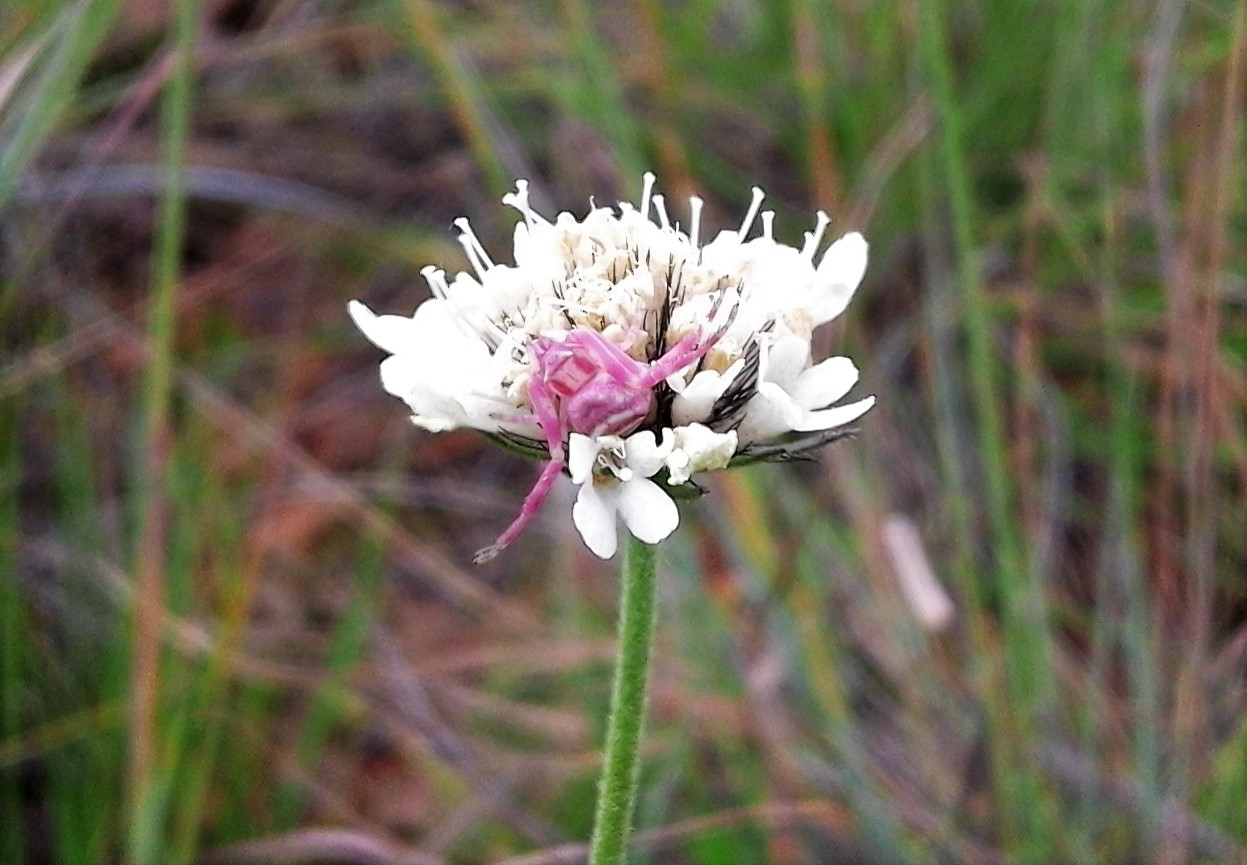
A beautiful Small Crab Spider, in shades of pink, prepares to blend with the Wild Scabious flower on which it is perched. The spider, from the Thomisidae family, has the ability to slowly change colour to the same shade as it's environment like a Chameleon! Once the spider is white like the flower, it disappears on it and waits for an unsuspecting pollinator to arrive on the flower, then, in a lightning flash, it grabs its prey and sucks it dry...


This is certainly a more benign creature but no less interesting! What you see is the mobile home of a Bagworm, from the Psichidae family, attached to her food plant, a maroon phase  White Stonecrop, Crassula virgata. The male bagworm is a typical flying moth with no mouthparts and a very short life-span in which to find a female and nothing else. The female is much longer lived and never leaves the bag that she constructs with silk and hardware that she collects from her surroundings. Once the male finds her, he manages to insert his long, extensible abdomen into the bag and fertilizes her, after which he promptly dies. The female continues eating while she lays up to 1500 eggs inside her bag until her body shrivels up and dies. The bag, attached to some substrate, protects the eggs till they hatch the following spring to allow the young to repeat the process.
 

A close up of a Fresh Water Crab, Potamonautidae, preparing to defend herself and her eggs which you can see are held closely to her body by her folded tail. The young arthropods complete all their larval stages within their eggs while kept safely beneath their mother and then the minute, fully formed young emerge and disperse.


A very young, and foolish, little Helmeted Guineafowl got left behind and confused when scattering from me although I did see it regain its family after I released it. This family consisted of a single male and female and their offspring. Very established flocks often lay communally in one nest with the most dominant female's eggs in the middle, giving rise to many more little chicks scurrying around!
 

Gee, this Fiery-necked Nightjar sure let me get close! You can clearly see the stiff bristle-like whiskers behind the small bill with a massive gape. It uses these bristles to feel insects, while in flight, so that it can snap its astonishingly wide mouth closed. The beautiful nocturnal call of this bird is a sound that is hard to forget and we often, in season hear them around the central area by the office. This one was near S4 on the Steenkamps.

Sue Harwood from Bulldozer Creek with a bunch of friends enjoying an amphitheater hike around the eastern edge of South Valley on a cloudy Sunday. We also visited a view point over the Haartebeesvlakte on the hike bringing it to about 13km in total.


We also enjoyed a traditional hike to the Brewery over the Easter weekend with a total of nine folks. We had all four seasons that day and just missed 26mm of rain which we could see falling over the office area as we were approaching the last leg of the hike. You know, the part when you can see the roof of the Brewery about 2km away and everybody's pace picks up for the last minute sprint.... 

It has been raining quite a lot in the past week since Easter and our seasons rainfall has risen from the high 500s to almost 700 mm. Late rains for sure. Enjoy this Autumn and see you in the mountains.

Friday, 16 February 2018

Visit by Mpumalanga Plant Specialist Group

VISIT BY THE MPUMALANGA PLANT SPECIALIST GROUP


Yesterday I decided to ascend to our work site at the base of Jackpot Koppie up a slope that I have not used before. I parked my bike at S12 on the Steenkamps river and headed South West up the very steep slope. At a point it became necessary to climb a cliff inside a little hammock of trees, and so I began to climb, struggling with the thorn branches of a Flame Thorn Acacia. I suddenly got a whiff of rotten meat and was immediately worried, considering my awkward situation, that I was intruding on a Leopard kill site. I cautiously ascended to a ledge and was gobsmacked at what awaited me in the shadows.....


For you maybe an anti-climax but for me, an event that I have been anticipating for four years!
It's a Stapelia gigantea, a carrion flower from the Milkweed Family that produces a pungent carrion smell to attract flies for pollination purposes, explaining the smell of rotten meat. I got so excited I nearly fell off the cliff! I have been lugging it up to the base of the cliffs bordering Potato Seed Production for the past four years (clearly at the wrong time of the year) to try get a photo of the flower. It feels as if the flower is made of rubber...spectacular!

This discovery marked the end of a four day journey with the Mpumalanga Plant Specialist Group, of which I am a member. The group consists of an array of botanists and passionists (like me) that move around the province and identify plants for the benefit of the hosting land owners.

Delia Oosthuizen, Barbara Turpin, Shane Burnes, Doug McMurtry and Troos Van Der Merwe inspecting a specimen of Schizocarphus nervosus in the newly burnt area off Loop road.

Doug and Shane enjoying lunch with Mount Anderson in the backround

They have helped me with our Finsbury plant list immensely by increasing the species count by thirty odd species so that our list now exceeds 550 species! Added to this, they collected samples for enough species that our list should exceed 600 species, which, considering elevation limitations amongst others, could be half of the total species count (considering that the species count for the Lydenburg and Long Tom centers of species diversity, of which we are part, includes just over 2260 species) in Finsbury. WOW!

Following is a gallery of flowering orchids we encountered in the last four days:

Corycium dracomontanum. Off the cycle path at about 1850 meters.

Cynorkis kassneriana.  In the Steenkamps waterfall gorge.

Disa amoena. On the new Kestrel Trail at about 1850 meters. VULNERABLE (SANBI red list)

Disa clavicornis. Just below the summit of Mount Anderson, 2260 meters. ENDANGERED (SANBI red list) 

Disa patula var. patula. On the new Kestrel Trail close to South Valley 1780 meters. I recently photographed a specimen of Disa patula var. transvaalensis which is an endemic.

Habenaria dives. At the base of Jackpot Koppie above Unit 16, 1850 meters.

Liparis bowkeri. In the Steenkamps waterfall gorge

Neobolusia tysonii. On the South Eastern slopes of Mount Anderson, 2000+ metres

Satyrium longicauda. All around the summit of Mount Anderson.

Schizochilus cecilii subsp. transvaalensis. Just below the summit of Mount Anderson, 2260 meters.
 
Jissis! My brain is full after their visit.

Till next time. We look forward to your visit.

Friday, 12 January 2018

New Rock Kestrel Trail


ROCK KESTREL TRAIL

Well folks, I have finally finished cutting the Rock kestrel hiking trail and it is quite challenging but boasts spectacular views of our beautiful piece of heaven. The trail itself is just 200m short of 10 kilometers and traverses from a new parking spot about half way up South Valley to a new parking spot just after the first corner on the access road to Rod's Rest (Unit 7), close to K9. The trail allows Finsbury members and visitors to explore some high altitude grasslands without a guide and without the chance of getting lost.


I have designed the trail along existing game paths so as to reduce the impact on the environment and have only cut virgin paths to join these animal paths together. I have also not removed the grass tufts from the path surface to combat erosion, although small mitre drains will be added to the steeper slopes.

The first leg of the trail is quite tough as you gain 350 odd meters of altitude within the first 2,5 kilometers of the trail. This section provides beautiful views of Olinia Gorge, a gorge hidden from the roads. The gorge is named after the Mountain Hard-Pear tree, Olinia emarginata, which dominates here and has been particularly notable this season as they have flowered more copiously than usual (see previous blog) - spectacular! Once the gorge is crested, your altitude will be the highest on the trail at around 2080 meters above sea level as you traverse the base of Mount Anderson. After just over 4 kms, the trail reaches River Lily Crossing, a perennial mountain stream that flows from Mount Anderson's artesian aquifer into Solitude Valley past Unit 5.

This small portion of the trail cuts through Emoyeni property so the path has not been cut here but, because it is a natural drinking place for animals, the path is well defined and cannot be lost. Another kilometer or so sees the trail pass by Chironia Spring arising from Mount Prospect's artesian aquifer. The spring is marked, in summer, by the presence of beautiful Chironia purpurascens flowers. This stream also flows into Solitude valley. Keep an eye out for ROCK KESTRELS during the trail between these two water points as I have seen a pair almost every time I have been there - giving rise to the trail's name. There are many rocky areas around the Chironia Spring and I have also regularly seen a family of three Klipspringers in the area.

The next few kilometers takes one through the vast, high altitude grasslands at the base of Mount Prospect where, one morning, I saw a breeding herd of more than 50 Eland! The trail then descends into the Kliprots Valley along a series of old mining paths.

To do the trail as mentioned above, one would need to get a lift to the parking at the start because the trail is not circular. The red track on the above picture map is the trail done in a circular route from the Central area, north up along the Kliprots, down the little path that runs from Unit 1 to South Valley, and then along South valley to the trail's starting point, then the trail and onto Central area again. This route was just short of 16kms, a really beautiful 16 kilometers! The trail, of course, can be traversed in any direction but starting from the South Valley side will keep the morning sun in your favour.

Finally, the trail meets up with Emoyeni's two-track close to River Lily Crossing. This is the two-track used by Emoyeni management and traverses the entire property all the way to the Hops Hollow Brewery on the Long Tom Pass. All of it traversable by mountain bike. Please remember, though, that permission is required from Emoyeni management to use these two-tracks.

The Kestrel Trail has already been completed by Roger Nicholson, from Kliprots Creek, on a mountain bike! So if you think you can... 


Tuesday, 9 January 2018

A great festive season!

A GREAT FESTIVE SEASON


Well, December has come and gone and it was jolly. We had a great crowd here and the weather played along too. Below is a little gallery of some of the stuff I encountered during the time:

James Mackenzie from Pebble Creek wearing a necklace of living snake. The snake is a Skaapsteker and it is at it's maximum size. This particular individual relaxed completely around James and even accepted a meal from him!

John and Jessie Green from Jackpot Cottage slaving away below Mount Prospect. Jessie had to work off seventy odd community service hours so I got her busy raking our new hiking path and destroying small Pine trees on some of the slopes. The hiking path is 10km long and runs from K9 up to the base of Mount Prospect and on to the base of Mount Anderson before dropping down into South Valley.

William Lotter sighted a small female leopard around K14. After alerting me to the sighting, I rushed out and managed to get her between K15 and K16. She is rather small but I did notice that she had milk so she must be a first time mother.

This is the rather complex egg sack of a Praying Mantid. Glands within the female mantid's body secrete a fluid that foams and hardens when in contact with the air. While hardening, the foamy fluid is shaped by the two cerci on the tip of her abdomen into around sixty separate compartments into which she lays one egg per compartment. Each compartment has a tube reaching to the outside with a one way valve on the end to stop anything entering the tube. After about a month after the eggs are laid, a baby mantid, tightly enclosed in a narrow membrane, wriggles itself up the tube and out the valve where it stops half way and begins pumping blood into its head which makes it expand and split the membrane so that the new baby can emerge and face the world. The "balloon" around the egg compartments protect the eggs from the elements and shock.

A Common fly rests upon a Bellflower from the Wahlenbergia genus.

The beautiful Mountain Hard-pear, Olinia emarginata. These trees have provided us with a spectacular display of their flowers this year! The smaller individual on the left is in full bloom while the larger, central one is still getting there.

The Dainty Sugar Bush, Protea parvula. This small protea's flowers creep along the ground in short grass, high altitude areas. Unlike other Proteas which have extra thick, corky bark to protect them from the regular fires in the grasslands, this little Protea has adopted another method, it has become a suffrutex, which is an "underground tree" with only leaves exposed to fires...

A Robber Fly from the family Asilidae. The common name is rather derogatory because it implies that the insect is a thief. Nothing can be further from the truth because this dipteran is in fact a voracious predator. On a hot day when I am being harassed by flies, I always smile when I hear the unique, powerful buzz of a Robber Fly as it enters the scene and perches nearby. Once it has locked onto it's victim, it will take off and catch the fly in mid air, usually right in front of my face! It will then land again and suck the juices from the fly so that one can actually see the fly's body crumple as it empties!

A first for me at Finsbury is a Sac Spider from the Clubionidae family. This is the spider that is responsible for the most spider bites that are referred to doctors! They are night time hunters and roam around in search of prey. If they are on your body while you are sleeping and you just move, they will bite! The puncture marks are wide apart (around 5 mm) which makes them easily identifiable. Necrosis soon sets in and the wound becomes large and painful and will get worse if not treated. There have been no human fatalities recorded from this species though.

I had Fraser Moore from Rock Solid helping me clear rocks out of the way so that I could cut the new hiking path. This moving of rocks exposed a lot of interesting goodies. One of them was this rare sighting of a Uroplectes olivaceus with a bunch of babies on her back. The image was difficult to acquire because of her nervousness and the fact that she is only 25mm long which makes the babies very, very small.

On one rather cold day I drove by a burrow on the edge of the Loop road. Being cold, the Warthogs decided to remain in their burrow for the day and when I drove past, the sound of the vehicle was too unnerving for the mother Warthog and she darted out and away after throwing large chunks of mud at me. I had enough time to get my phone ready for when the little ones followed...


Wednesday, 15 November 2017

Spring-time gallery

SPRING-TIME GALLERY


Spring has come and gone here in the mountains and during that time, unfortunately, there has been less rain than there should have been. I was going through the rainfall data in the archives and it seems that Finsbury experiences a four to five year dry cycle alternating with a four or five year wet cycle. This would be the fourth year of a dry cycle. We had more rain last year than our average but that was only because of the Dineo weather pattern, otherwise the rainfall would have been below the annual average. We still have had around 150mm so far and that is enough to get a lot kick started.

Following is a brief gallery of some of the things I have encountered in the field in the last few weeks...


Murray Beaumont's fit friends on the summit of Mount Anderson
The flower of an Eland's Bean, Elephanthorrhiza elaphantina. The enormous roots suggested in the proper name are not actually the roots but the underground stems and trunk. Yes, it is a suffrutex, an underground tree with just the twigs and leaves protruding above the ground. This is an adaption allowing trees to grow in grasslands while protecting themselves from frost and fires!
Opistacanthus validus. A relatively harmless scorpion waiting for darkness so that it can begin hunting...
The first of the Gladioluses to flower in the grasslands, Gladiolus longicollis shows off it's beautiful flower.
Also an early flowering grass, Harpochloa falx Caterpillar grass in full bloom high up in the grasslands.
A Gaudy Commodore, Precis Octavia, hill topping on the summit of Mount Anderson. Very ambitious! 
The Gaudy Commodore in the previous picture was competing with this rare colour form of the same species of butterfly!
Another suffrutex that is found in our grasslands but this one much higher up. This is a Protea parvula, Dainty Sugarbush, with a flower bud showing. They will be flowering by Christmas time so if you are in the mood to climb then, then you will get to see the spectacular flower.
A Northern Cragg Lizard, Pseudocordala transvaalensis, checking me out from the safety of his cragg! This lizard's body is camouflaged against the bright orange lichen that you sometimes see growing on the high altitude quartzites.

I am currently cutting a hiking path around Mount Prospect in time for the festive season. While doing this I exposed the nest of a Wailing Cisticola. Here one of the chicks notes my interference.
I also exposed the nest of what I believe are the eggs for a pair of Red-necked Francolin
This year I have noticed an abundance of galls in our population of Bankrupt bushes, Seriphium plumosum (previously Stoebe vulgaris) Although they appear a bit like flowers, the white pom poms are actually galls formed by the invasion of eggs laid by a Gall Midge from the Cecidomyiidae. The insect lays it's eggs in a slit in the stem of the plant and the plant reacts to this foreign invasion by swelling up. The swollen plant flesh forms the food of the midge's larvae.
Unbelievably, it's already November and we are preparing for the festive season. It's going to be great this year and we here at the Estate look very forward to seeing Y'ALL!

Thursday, 9 November 2017

A successful burn

A SUCCESSFUL BURN


A lot of our grasslands are becoming dominated by woody plants, particularly Helichrysum wilmsii and H.kraussii, which are strongly scented low scrub bushes. Woody plants begin to dominate grasslands when there is a lack of fire. Because woody plants have a canopy they appear to cover the entire ground but in fact the canopy creates a shade that smothers the grass beneath it resulting in bare ground between plant stems. This causes a higher rate of erosion as the water runs beneath the canopies over the bare ground, not to mention it reduces graze for wild game. Grasses, on the other hand, are designed with their upright leaves to grow very closely alongside one another, minimizing erosion. This is why grasslands naturally burn more regularly than any other type of biome, mostly through lightning fires from dry and wet thunderstorms. With our fire breaks, roads and fire control methods, we cannot rely on natural lightning fires to combat these encroachments of woody plants. We, therefore have to rely on human-induced management burns to control them. In our case, hot fires are required initially to destroy the woody plants.

Don MacCrimmon leading David Maseko and his team from KLF in the ignition sequence along the tracer which follows the cycle path from Haartebeesvlakte to Loop road. Note the large KLF fire trucks in the backround.

Another advantage of a hot fire is that it will kill relatively large Pine trees that also tend to encroach on our grasslands. Those of you who have travelled to the north eastern part of the Estate in the last few years will have noted how those grasslands have been encroached by large plantations of Pine. My team and I have been fighting Pine all over the Estate since I arrived here but we had not yet reached the north eastern areas. Because of this, I decided a very hot fire was needed in the area this year to assist in the removal of these Pine trees.


Our team struggled to contain the fire on the bottom of Loop road because of the amount of moribund fuel. The Cruiser with the bakkie sakkie (just ahead of the flames) was invaluable in stopping the fire from jumping! Note the massive amount of Pine trees on the slopes behind the smoke.

Now, to create a hot fire that does not damage the shallow roots of the grasses, there needs to be sufficient moisture in the soil (usually at least 30mm rain just prior to the planned burn) but the grasses and bushes themselves need to be dry. The ambient temperatures also need to be higher than 22 degrees for the fire to be hot enough to destroy the woody plants. these conditions are common when the Fire Danger Index (FDI) is also high. This means we have to contact the Mpumalanga Fire Control Department on the day we intend to burn and receive a burning permit. to receive the permit we have to reveal the amount of fire-fighters we intend to employ and the amount of fire fighting equipment we aim to use so that the fire cannot rage out of control.


A view of the burned block from the KLF road at the end of the day

Well, since the area I wanted to burn spanned part of the Estate, part of Mount Anderson Water Reserve and part of Komatiland Forests, I had to make sure we all worked together on the project. And so we were all on stand-by when, on the 12 October, conditions were perfect for a hot burn. The ignition points were long due to lack of vertical fire breaks on the Estate, so we had three teams (one from each property) lighting the fire. Everything went off just dandily, it did! We had a hard time in the low lying areas because of the abundance of fuel there, but managed to control the fire. Trent Sinclair and his team from MAWR also had difficulty at the very end of the operation as the winds turned in the afternoon. The photo at the top was taken from the Loop road just opposite Pebble Creek (Unit 25) during this struggle!

A photo taken the following day of about half of the block from Loop road just west of the cycle path junction.
 
A few days afterwards, I explored the block and found no animal carcasses or any other collateral damage as I had hoped and expected. Animals that live in grasslands are well adapted for evading fire because it is such a common occurrence. I did, however, find many Pine tree carcasses which was very pleasing! On the west facing slopes of the burned block, about 90% of all Pines were destroyed. On the south facing slopes, about 60% of Pines were destroyed and on the east facing slopes, where the fire was cooler, only between 10 and 20% of the Pines were killed. Overall, more than 60% of Pine trees in the block were killed, saving us many months of back-breaking work!

Dead Pines. Big ones too! Mission accomplished.

There will be another two seasons of hot burns on the Estate before I can prepare the grasslands for the type of burning that is optimal. Once the woody plants have been brought under control, the entire Estate will be burned tri-annually (a third per year). The grasslands will be divided into many much smaller burn blocks which will burn alternately during the wet seasons on cool, wet days. This kind of management burning is called Patch Mosaic Burning and is the method employed by Mpumalamga Parks and Tourism Agency and National Parks. This method will minimize silting up of the rivers and will require much less staff. These types of fires will only burn off the moribund and will simulate lightning fires keeping our grasslands pristine into the future....