Tuesday, 25 September 2018

AUGUST 2018

AUGUST 2018


A beautiful predawn sky over Finsbury on the 5th August 2018. Very peaceful. The next day, the fire hit!

Well well, finally I get to post my blog for August. I have had such problems with my laptop and connectivity and, well, anything to do with computers. Anyway, better late than never...

August was a very busy month for the Estate and anybody who visited during this time will have noticed all the construction activity on the roads and weirs. I will leave the details of this activity for the quarterly news letter.

But what even overshadowed this activity was the runaway bush fire that we experienced. This is the story:

I was approaching a huge excavator machine from behind on my motorcycle on the road to the Miner's Cottage. I was to make sure the operator didn't miss the correct turning on this high altitude road. The operator saw me and began turning the behemoth so that I could pass. At the moment the tracks locked on the right side of the machine, I saw a small fire ignite between the tracks, caused by a spark between the steel of the tracks and a rock on the road. I immediately alighted from my bike and began to try to snuff the fire with my shoes and a small Protea branch plucked from a nearby tree. Within moments, Joseph, a labourer from Highland run, was at my side fighting the fire with his jacket. Even though the operator of the excavator joined in the fight with a fire extinguisher that was on board his machine, with the wind howling up there like it was, the fire pulled away from us in the opposite direction to the firebreak that was just behind us, egad!

With the wind howling like a banshee, the fire spread beyond the backburn point before we could even get there with the fire team. This was the beginning of the battle that would last for two days...

Part of the fire fighting team trying to reach the fire just below Goudkoppies.
 
Even though the sense of community involvement was strong, with all our neighbours responding with their fire teams and even a Working on Fire team from Graskop responding, the wind was just too strong and the fuel load too large! Numerous attempts at back-burning failed and the fire spread alarmingly fast. 

With the house keepers and other fire fighters stationed at each house, we managed to avoid any loss of property to the flames, although the fire only reached the houses in the Steenkamp's Valley at 04h00 the following morning!

The fire approaching the Whiskey River at 03h00 on the 7th August.

A view of the fire from Rock Solid in the Steenkamp's Valley at four in the morning. We had to use hosepipes and beaters to keep the fire away!

Environmentally, this was not a good time to burn a management fire and there was also a lot of fuel creating a very hot fire. But all is not gloom and doom. Below, I will highlight some of the Pros and Cons of an out of season fire like this:

PROS:

- A hot fire like this is devastating to trees. Most of the trees killed by the fire were Pine trees. Also, I prefer to ring-bark large Pine trees instead of felling them. This protects the grass beneath the Pines from being smothered by the acidic needles and the tree itself as it lies on the floor. The disadvantage of this method, though, is that it stimulates the tree to produce more cones (hence seeds) as it is dying. This, of course, results in many more seeds in the system and therefore many new seedlings begin to sprout around these areas. I have been using casual staff on Wednesdays to remove these seedlings, a labour-intensive task. Well, this fire annihilated all of these Pine saplings in the areas it burned (which was about two thirds of the Estate!)

-The fuel load was so high in many large areas of the Estate due to lack of burning in the last eight years. This not only increases the fuel load (moribund material) but also allows the encroachment and then invasion of indigenous woody shrubs (like Helichrysum wilmsii and H. kraussii) into the grasslands which ultimately reduce the vigour of the grass plants and allow the woody shrubs to replace the grasses. These woody encroachers require a relatively hot fire to kill them and that is exactly what this was. I was planning on burning all of these blocks over the next two years for exactly this reason before switching to the new, accepted method of a cool, mosaic burning regime which I can now start immediately from next season. With this regime, we will never have such a build up of moribund (fuel) again, which will prevent runaway fires like this from happening again.

Tranquility reigns in the aftermath as clouds pour over the watershed into the valleys with Mount Anderson center right  in the background.

CONS:

- There was little moisture content in the soil when the fire occurred and this puts stress on the storage organs of the grass plant. Especially when rains remain elusive for a prolonged period after the burn as is the case here. Fortunately we did have 21mm of rain soon after the fire which alleviated this problem somewhat. But rains are necessary, the sooner the better.

- With reduced growth due to lack of rain following a fire, the soil layer is left uninsulated and experiences hot temperatures in the day and cold temperatures at night. This also puts a certain amount of stress on the grass plant.

- When we burn management fires, we first wait for at least 30mm of rain before burning. This helps with the problem mentioned above but it also moistens the long grasses and bushes that make up the forest fringes surrounding the Afro-montane forests in the gorges of the grasslands. These forest fringes insulate the forest and allow a moister environment to develop in the forests which are necessary for the forest ecosystems to function. This fire was so hot and dry that it broke through many of these fringes and actually ignited the forest floors and burned into the forests, beneath the substrate, killing the trees as their roots were roasted! I spent 7 days after the fire trying to extinguish these fires. A truly demanding task!

The patch of unburned grass in the photo is what is left of the 50 meter wide firebreak running from Mount Anderson's summit towards Unit 5. The fire didn't even slow down for this break!
 

Many days after the fire I noticed termite mounds still smoking. On investigation I found that the soil in the mounds was actually burning. Termites mix soil, vegetable material and saliva together to construct the mound. These Nasute Termites have periphery mounds so I do not think this phenomenon harmed the colony.


The remains of new growth Pine which has been completely destroyed by the flames. This is one of the big positives of such a hot fire.


All the debris on the floor of the Pine plantation above Unit 1 that was damaged by the hurricane some years back was removed by the hot fire. All that remains are the holes that were caused by the felled trees.


Forest floor fire burning beneath the ground as it spreads and kills all the forest trees whose roots it encounters.


Thomas from Kwa Puleng logs some very difficult community service hours carrying 20 liters of water up the steep slopes to help extinguish the forest floor fires in the forests near the Miner's cottage..


Helen from Rock Solid doing the same. The photo does not justify the steepness of these slopes. This was extremely testing work from these youngsters and their help is very much appreciated.


Besides the fire and the construction work, we also had the usual holidays in August where we get many families visiting. This is the time of the year that the Moore's from unit 22 and I traditionally enjoy a camping excursion. We camped up near Little Joker Koppie because it was one of the few places that did not burn. It turned out to be a lovely area to camp. Below, find a gallery of this and a few new flower species I stumbled upon. Have a great month!


Our camp was situated at the edge of a small escarpment overlooking the Steenkamp's Valley. Here we relax in the shade of some Silver Sugar Bush trees at siesta time.


Our high altitude camp site.


We were up to watch the sun rise over Mount Formosa. Mount Anderson is ton the left.

The spectacular flowers of a Balloon Pod, Lessertia frutescens, flowering between M3 and Morrin Pools
The final flowering specimens of the winter flowering Crassula compacta, found blooming near our camp in the high altitude grasslands of Emoyeni.


Thursday, 26 July 2018

JUNE & JULY 2018

JUNE & JULY 2018

Winter has been rather mild for us here at the Estate, with the temperature rarely dropping below the zero mark, with the coldest around -2C only within the last two weeks of July. As usual, the winter season is filled with the burning of firebreaks and the roll out of projects suitable for the low water levels, and of course, continuing the fight against alien plants!

Highlights for me included a sighting of a young mother leopard with a small cub around 4 months old in the middle of June, and a sighting of a Martial Eagle being harassed by a Jackal Buzzard above Rock Solid at the beginning of July.

Below is a gallery of a few things of interest and some of the activities we undertook in the coldest time of the year:

Smoke rises up the cliff face just below the summit of Spioenkop as we begin to burn the firebreak from there to unit 19. Firebreaks went off without a hitch this year.

A splendid specimen of Kalanchoe thyrsiflora residing above Olinia Gorge on the Rock Kestrel trail. Although a popular nursery subject, they can't seem to produce more beautiful specimens than those in the wild.


This winter has been rather mild for us here on the Estate. So much so that I stumbled upon three different sightings of snake during the middle of June! This one is a Montane Grass Snake or Cross-marked Grass Snake, Psammophis crucifer. Grass Snakes are very swift day active snakes that, using their speed, chase down their favourite prey, which are mostly lizards and skinks

Enjoying a hike with the Cotterrels from Unit 17. The Estate was busy over the mid-term break this year with 16 houses occupied during the week. 

Went for a walk to the Majubane Waterfall with the Cotterells and the Howards, from Buldozer Creek, in the last week of June. Sheesh, that plunge pool is even freezing during the Summer! The crazy swimmers were in there for more than a half an hour.

Louise and Kenna Twiggs on the miner's path that runs from the Hillside village, along and above the Spekboom river, to our boundary with Highland Run. We often do adventure hikes together and this time we climbed the rank gorge opposite "The Croft's" up to the Mine Walk and then returned down the Spioenkop road.

Even though I say that the winter has been mild, -2C is still VERY VERY cold for us South Africans. This is a picture of M2 just after 07h00 this past week. The frost looks like snow!

This photo was taken just after 07h30 also during the past week. As I was crossing the Kliprots river from the Kliprots road into South Valley, I noticed how these stalactite-like icicles formed as the water splashed over the rocks and wet the bottom of the River Rice Bush, Cliffortia linearifolia. Brrrrr! 

Not a long way to go before Springtime is here again. Hopefully the same applies to you. See you then...

Friday, 15 June 2018

MAY 2018

MAY 2018


I was not at the estate for the majority of May but two exciting things happened. Firstly, The Moores from Rock Solid visited and while Nick and Scarlett were walking near S7, they had an exciting experience viewing the aerial abilities of African Fish Eagles. Nick says that two of the three eagles present were constantly engaging each other in the air, sometimes interlocking talons and spinning towards the ground and releasing just before impact!


Two African Fish Eagles about to interlock talons above S7

Now, I would have immediately thought that this was a mating display because the eagles are clearly different sizes, with the male being 10-15% smaller than the female. Upon further research, though, it appears that the female is an aggressive defender of her and her mates' territory. If an intruder of any sex flies into the airspace of the pairs' territory, the female will immediately approach the intruder and fly him or her out of the area. If they do not cooperate, then the female will begin to fight. Fights are so severe that there are records of the interlocked fighters not releasing each other in time and both perishing on impact as they hit the ground! Nick and Scarlett were fortunate enough to witness this aggressive encounter for more than forty minutes, all around them. Excellent luck!

Next, and of course this would happen when I am not on the estate: In the late evening of 29 May, a driver on the Long Tom Pass road sighted a male lion about 10km short of the Nelspruit turn off. They snapped a photo of the lion and reported it to Mpumalanga Tourism and Parks. The dept responded but were unable to find the big cat the following day.


An adult male lion spotted on the Long Tom Pass road, close to the Nelspruit junction.
Then, at 03h00 on the morning of the 2nd June, a motorist got a sighting of the cat in Potato Seed Production's property just opposite Hops Hollow Brewery, on the route we walk when hiking to the brewery from Finsbury. The police were called and they found the lion on the carcass of one of PSP's cows alongside Emoyeni. The MTPA arrived and darted the cat and it ran into the thickets. After employing PSP's hounds, they managed to find it in the brush alongside the road.


The lion after it was darted. That's a big boy!


They loaded the lion and he has been taken to a rehabilitation centre near Malelane where his future will be decided. I immediately rushed to all our camera traps, hoping to have caught him on camera but, alas, there were none. It is very exciting to know that we had a lion so close to the estate! 

Have a jolly month. We look forward to your visit!!!


Monday, 7 May 2018

April 2018


APRIL 2018


At the trig beacon on the summit of Mount Anderson at sunset and moon rise. Photo by Sue Harwood
April was a cool, wet month where we received 137mm rainfall! Fortunately the weekends' weather was pleasant enough because it was a busy month with many members and their families visiting. The highlights were the discovery of two leopard kills in two days, and a very successful FULL MOON HIKE! Below, browse through a gallery illustrating these highlights:

While Grant Mackenzie and his friend were cycling towards Haartebeesvlakte early one Saturday morning, they interrupted a mother leopard with two full grown youngsters enjoying a zebra meal. I also stumbled upon the carcass, with my visitors, just an hour or two later but, alas, did not get a sighting of the leopards. 
When I first saw the carcass, I assumed that it was a road kill even though that would be unlikely high up there on the Komatiland Forest road. Then, as we approached, I could see that the carcass had been scavenged (I didn't yet know that Grant had seen leopards there a little earlier). On closer inspection, though, it was clear, by the teeth marks, that the zebra was actually brought down by the mother leopard herself. What a feat! Zebras are not only very big and strong, they also put up more of a fight than the average antelope. James Mackenzie, Grant's son, came up a little later and placed two Camera Traps at the scene but got no images of the leopards. This indicates that the leopards in question are extremely nervous of humans and did not return to the kill after being bothered by them.

The very next day, my group and I decided to hike the Rock Kestrel trail. My friend and his dog, leading the group, got a brief sighting of a little cub leopard. As we topped the rise, we found the carcass of a young eland stashed under a Currant tree. This is exciting because, only a fortnight prior to this, I stumbled upon a Reedbuck kill only 400 meters away on the same path. I got a great view of the mother leopard as she lay on a ledge 70 meters away, watching me. I also got a brief view of her cub that day. This means she is using the trail as her hunting ground, ambushing prey that commute on it!


After swapping stories with the Mackenzies, James decided to fetch his cameras on the zebra kill and bring them to the eland kill. While approaching the sight, him and his dad got a view of the cub lying by the carcass! The leopards returned in the early evening and devoured the entire carcass in that one night! The images James Mackenzie has provided here were taken the following morning after the leopards had bumped the cameras and moved them. What a beauty!

The blurring of the images are a result of the copious amounts of dew that was deposited the previous night.

Here the mother leopard lies against the pole supporting the camera while she prepares to suckle the cub. This, and the fact that the cub ate very little of the carcass, suggests the cub is less than 3 months old.


Don and his guests, The Slettevoldt's from Pebble Creek, The Harwoods from Bulldozer Creek and I enjoyed a hike with a twist this last long weekend. We started on the Rock Kestrel trail at 15h00 and after getting up there we left the trail and summited Mount Anderson at 17h30, just in time to enjoy a sundowner as the moon rose. Here's the group on the summit at sundown. Photo by Sue Harwood

We began our decent only after the sun had set. The moon had just risen over the summit. The trig beacon can still be seen behind the group.... We did not descend back down to South Valley but rejoined the Rock Kestrel trail and hiked it's full length and arrived back at the office area by 21h00.

We used a spotlight to view game on the return hike. We spotted this Jameson's Red Rock Rabbit which we managed to approach. We also saw Mountain Reedbuck, Grey Rhebok, Eland and a Fiery-necked Nightjar.  

So the hike was a six hour, 12 kilometer hike, half in the day time and the other half in the moon light. Yes, it was great and we will definitely offer them again on future full moons!

That's it for now. We hope to see you all here soon.

Wednesday, 11 April 2018

A month of diversity

MARCH 2018

The month of March was a rather busy one for me and my team. It is the end of the growing season which means there is a ton of new alien plant growth to contend with. The very dry spring we have had this year has resulted in the trees producing many more seeds than a wet spring would have them produce (remember this when you want your garden trees to flower more abundantly: give them less water during the growing time.). This is now the fourth year of dry springs in a row and I can see it when I see all the new Pine growth all over the Estate. The rains have certainly been coming later in the season in the last few years with us receiving 112mm in the month of March.

Anyway, this means that I have been busy up in the mountains a lot lately, which has exposed me to many exciting things: Lots of game and other goodies! To add to this, Easter was in March this year as well, so a lot of exciting activities took place too. Following, see a gallery of some of the things I managed to photograph:

An Ascalaphid Ant Lion, in the Proctarrelabis genus. The transparent, wavy wings and the hairy face of this Ant Lion adult make it appear like an apparition. The larvae of most Ant Lions are well known because they construct little pits in soft sand into which insect get trapped. The larvae, which hides under the sand at the bottom of the pit. throw sand, with their heads, at the insect as it tries to scramble up the loose sand on the sides of the pit. This helps the victim slide down to the bottom of the pit where the larvae grab s it with it's massive jaws and pulls it under the sand to devour it! This species, however, has a larvae that is free roaming and pounces on its victims just like a lion pouncing on it's prey. These insect are from the Neuroptera order, the same order as the Lacewings, the insects we mimic with the flies attached to our lines when fly fishing.


This is a wingless female Toad Grasshopper from the Pamphagidae family. These vegetarians rely on their superb camouflage to escape detection by predators. The males are smaller and winged and stridulate to attract a mate. The female, upon hearing the male's call, approaches him to mate, just like frogs do. Note the membrane on the side of her body that she uses to hear the male. The common name of Toad grasshopper does not refer to the fact that their mating system is similar but from the fact that some females from the family resemble toads with their fat, squat bodies.


Unlike the above species of Grasshopper, the Koppie Foam Grasshopper, Dictyophorus spumans, does not attempt to hide from it's predators. In fact, it is aposematic which means it is brightly coloured, indicating that it is not a tasty meal! This grasshopper feeds on the leaves of Milkweed plants, very poisonous plants from the Apocynaceae family. Once the leaves are consumed, the poisonous cardiac-glycosides from the plant are stored in the body of the grasshopper and if it is molested, the poison oozes like a foam from its' thorax (Note the yellow foam in the photo). The poison is potent and is known to kill dogs when eaten!


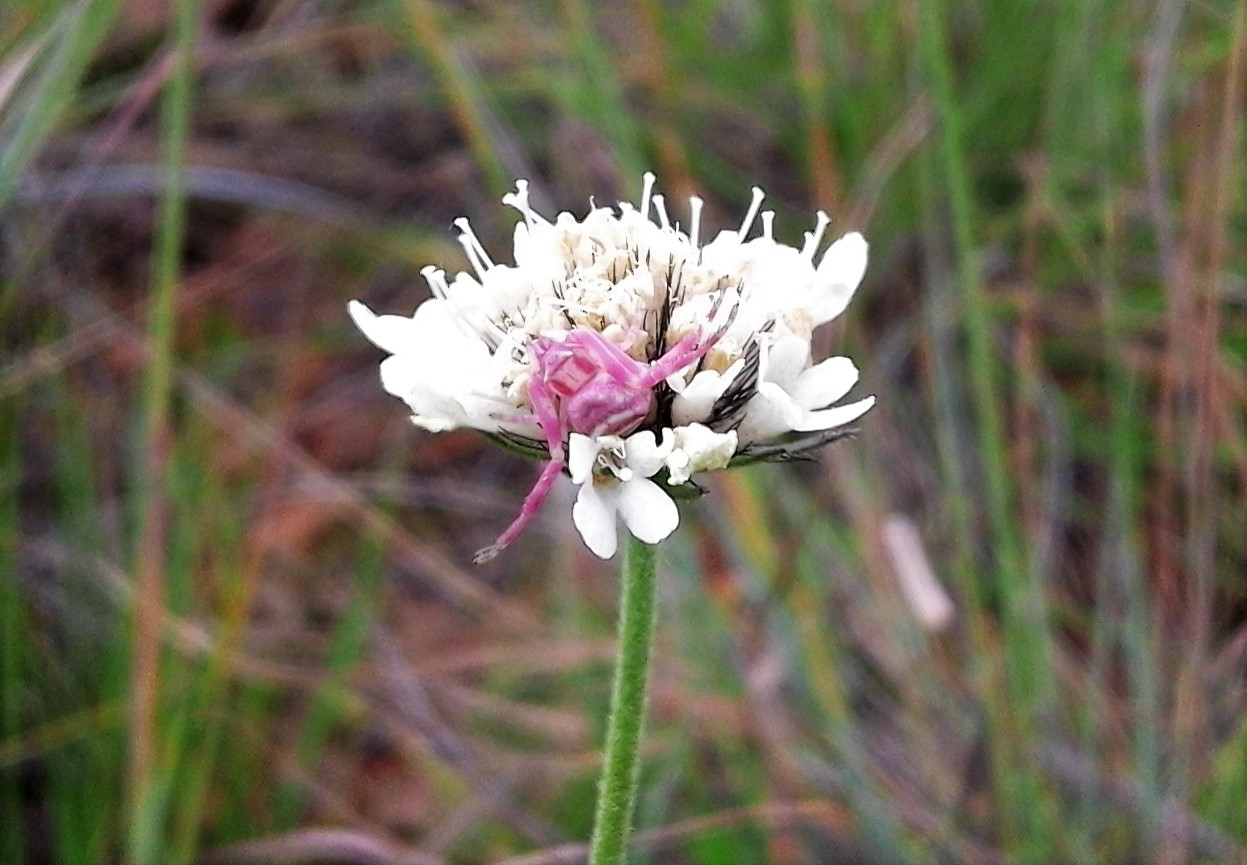
A beautiful Small Crab Spider, in shades of pink, prepares to blend with the Wild Scabious flower on which it is perched. The spider, from the Thomisidae family, has the ability to slowly change colour to the same shade as it's environment like a Chameleon! Once the spider is white like the flower, it disappears on it and waits for an unsuspecting pollinator to arrive on the flower, then, in a lightning flash, it grabs its prey and sucks it dry...


This is certainly a more benign creature but no less interesting! What you see is the mobile home of a Bagworm, from the Psichidae family, attached to her food plant, a maroon phase  White Stonecrop, Crassula virgata. The male bagworm is a typical flying moth with no mouthparts and a very short life-span in which to find a female and nothing else. The female is much longer lived and never leaves the bag that she constructs with silk and hardware that she collects from her surroundings. Once the male finds her, he manages to insert his long, extensible abdomen into the bag and fertilizes her, after which he promptly dies. The female continues eating while she lays up to 1500 eggs inside her bag until her body shrivels up and dies. The bag, attached to some substrate, protects the eggs till they hatch the following spring to allow the young to repeat the process.
 

A close up of a Fresh Water Crab, Potamonautidae, preparing to defend herself and her eggs which you can see are held closely to her body by her folded tail. The young arthropods complete all their larval stages within their eggs while kept safely beneath their mother and then the minute, fully formed young emerge and disperse.


A very young, and foolish, little Helmeted Guineafowl got left behind and confused when scattering from me although I did see it regain its family after I released it. This family consisted of a single male and female and their offspring. Very established flocks often lay communally in one nest with the most dominant female's eggs in the middle, giving rise to many more little chicks scurrying around!
 

Gee, this Fiery-necked Nightjar sure let me get close! You can clearly see the stiff bristle-like whiskers behind the small bill with a massive gape. It uses these bristles to feel insects, while in flight, so that it can snap its astonishingly wide mouth closed. The beautiful nocturnal call of this bird is a sound that is hard to forget and we often, in season hear them around the central area by the office. This one was near S4 on the Steenkamps.

Sue Harwood from Bulldozer Creek with a bunch of friends enjoying an amphitheater hike around the eastern edge of South Valley on a cloudy Sunday. We also visited a view point over the Haartebeesvlakte on the hike bringing it to about 13km in total.


We also enjoyed a traditional hike to the Brewery over the Easter weekend with a total of nine folks. We had all four seasons that day and just missed 26mm of rain which we could see falling over the office area as we were approaching the last leg of the hike. You know, the part when you can see the roof of the Brewery about 2km away and everybody's pace picks up for the last minute sprint.... 

It has been raining quite a lot in the past week since Easter and our seasons rainfall has risen from the high 500s to almost 700 mm. Late rains for sure. Enjoy this Autumn and see you in the mountains.

Friday, 16 February 2018

Visit by Mpumalanga Plant Specialist Group

VISIT BY THE MPUMALANGA PLANT SPECIALIST GROUP


Yesterday I decided to ascend to our work site at the base of Jackpot Koppie up a slope that I have not used before. I parked my bike at S12 on the Steenkamps river and headed South West up the very steep slope. At a point it became necessary to climb a cliff inside a little hammock of trees, and so I began to climb, struggling with the thorn branches of a Flame Thorn Acacia. I suddenly got a whiff of rotten meat and was immediately worried, considering my awkward situation, that I was intruding on a Leopard kill site. I cautiously ascended to a ledge and was gobsmacked at what awaited me in the shadows.....


For you maybe an anti-climax but for me, an event that I have been anticipating for four years!
It's a Stapelia gigantea, a carrion flower from the Milkweed Family that produces a pungent carrion smell to attract flies for pollination purposes, explaining the smell of rotten meat. I got so excited I nearly fell off the cliff! I have been lugging it up to the base of the cliffs bordering Potato Seed Production for the past four years (clearly at the wrong time of the year) to try get a photo of the flower. It feels as if the flower is made of rubber...spectacular!

This discovery marked the end of a four day journey with the Mpumalanga Plant Specialist Group, of which I am a member. The group consists of an array of botanists and passionists (like me) that move around the province and identify plants for the benefit of the hosting land owners.

Delia Oosthuizen, Barbara Turpin, Shane Burnes, Doug McMurtry and Troos Van Der Merwe inspecting a specimen of Schizocarphus nervosus in the newly burnt area off Loop road.

Doug and Shane enjoying lunch with Mount Anderson in the backround

They have helped me with our Finsbury plant list immensely by increasing the species count by thirty odd species so that our list now exceeds 550 species! Added to this, they collected samples for enough species that our list should exceed 600 species, which, considering elevation limitations amongst others, could be half of the total species count (considering that the species count for the Lydenburg and Long Tom centers of species diversity, of which we are part, includes just over 2260 species) in Finsbury. WOW!

Following is a gallery of flowering orchids we encountered in the last four days:

Corycium dracomontanum. Off the cycle path at about 1850 meters.

Cynorkis kassneriana.  In the Steenkamps waterfall gorge.

Disa amoena. On the new Kestrel Trail at about 1850 meters. VULNERABLE (SANBI red list)

Disa clavicornis. Just below the summit of Mount Anderson, 2260 meters. ENDANGERED (SANBI red list) 

Disa patula var. patula. On the new Kestrel Trail close to South Valley 1780 meters. I recently photographed a specimen of Disa patula var. transvaalensis which is an endemic.

Habenaria dives. At the base of Jackpot Koppie above Unit 16, 1850 meters.

Liparis bowkeri. In the Steenkamps waterfall gorge

Neobolusia tysonii. On the South Eastern slopes of Mount Anderson, 2000+ metres

Satyrium longicauda. All around the summit of Mount Anderson.

Schizochilus cecilii subsp. transvaalensis. Just below the summit of Mount Anderson, 2260 meters.
 
Jissis! My brain is full after their visit.

Till next time. We look forward to your visit.