Wednesday, 17 March 2021

FEBRUARY 2021

 FEBRUARY 2021


February, a nice short, wet month, flew by in a whizz! We had an average of 156mm rainfall over the estate during the month, bringing the average seasonal total to 904mm, which is our annual average already. The lowest recording was in the west from Patrick's gate at 106mm for the month and a seasonal total of 560mm. The highest measurement was from Pebble Creek in the north of the estate with 210mm for the month and a seasonal total, so far, of 1116mm. That is a vast difference considering there is only 6,3km between the two rain gauges, as the crow flies! Those of you who have visited recently will also notice that the roads have been repaired and are in great condition after our visit by Eloise in January. The estate is green and lush and life abounds! Below are some of the natural highlights of the month:  


A wet February is a super time to go on a mushroom hunt and, if you're lucky, in the depths of the moist forests on the estate, you may stumble upon these incredible little Fluted Bird's Nest mushrooms, Cyathus striatus. And yes, they look just like tiny (10mm X 15mm) bird's nests with eggs inside, don't they? Even though they belong to the Basidiomycota division of fungi that simply release spores in situ, they have a method of spreading spores similar to the more advanced Ascomycota that use water drops and other methods to disperse spores. The "eggs" are called peridioles and they produce spores within themselves. When it rains, a raindrop will hit the "nest" with force and the splash will eject the peridioles into the surrounds. The peridioles are attached to the "nest" by a thin cord with a mass of sticky mycelium at the end and so when the peridioles are ejected, the sticky end may attach to a piece of dead wood and, later, the surface of the peridiole will weather away and expose the spores which will then germinate. Besides being used in the production of certain antibiotics, in 2013 an Israeli professor, Prof. Solomon Wasser, patented a medicinal product derived from these little mushrooms that is to treat pancreatic cancer.


This massive, leathery caterpillar will one day become a beautiful Vine Hawkmoth, Hippotion celereo (see blog of September 2019). I found it on it's Impatiens host food plant in the forest around the Steenkamp's waterfalls. It hatched alone on the plant I found it on or perhaps one of its neighbours and began to eat voraciously to get to this size. It relies on it's camouflage to protect it from its many enemies but will regurgitate the contents of its foregut, together with toxins it stores there from its foodplants, as a defense from smaller predators like ants and other insects. I mention in that blog that many orchids rely on Hawkmoths, with their long proboscis, as specialised pollinators. Well, I learned an interesting fact to illustrate this: In 1822 a French botanist described a very rare orchid from Madagascar. The orchid has spurs (long nectaries) reaching as long as 29 centimeters. Darwin, knowing that the nectar of the flower is stored at the end of these spurs, predicted that there should be a moth on Madagascar that has a proboscis that can reach to the end of these spurs and his friend and colleague, Wallace, published a "wanted" article with a diagram of what the moth may look like. Twenty one years later, the moth was discovered and described and, yes, it's probiscis is 32cm long!  


This moss covered bracket mushroom is called a Cracked Bracket, Phellinus rimosus, and I found it on the lower trunk of a huge African Almond tree in the kloof forest near the Steenkamps waterfalls. The big differences between this fungi and the others I have been featuring on these blogs is that these are perennial, living for many years and adding a concentric ring each year as it grows, and that they are parasitic on their host tree, causing a brown heart-rot that weakens the tree over many years and finally kills it. Not very good for the tree but very medicinal for us; This bracket has been used in Japan, China, Australia (by the aboriginals) and Africa for thousands of years for many ailments but interest in its medicinal qualities was renewed after WWII when it was used on the Meshima islands to treat patients shipped there who were affected by the atomic bombings. In 2015 it was found that extracts from the brackets provided a significant protective effect against acute alcohol-induced lipid peroxidation in the liver, kidneys and brains of mice. It has also been found that ethyl-acetate and methanol extracts provide significant anti-tumor activity. Methanol extracts have also been proved to have successful activity against bacteria like Escherichia coli, Salmonella typhimurium and others. Besides being a great pharmacy, the Cracked Bracket is rather beautiful with it's barky, moss-covered roof with a velvet rim and it's soft, skin-like sporangium below.


Jeesh! I didn't see this little critter until it moved when I was trying to pick a leaf from an Escarpment Rice Bush high up above Kingfisher Lodge (unit 6) recently! It is a young Flower Mantid, Harpagomantis tricolor, and it uses the same strategy as the Crab Spider (see blogs of March 2018 and May 2020) to capture it's prey aside from two main differences: The Mantid does not have venom so it relies on its powerful "forearms" to subdue the insect prey before it chews it up; and the Mantid cannot change it's colour, like the spider, to the colour of the flower. Instead, the Mantid has to find a flower that matches it's colour or it has to wait in amongst the surrounding leaves for it's prey to land on the neighbouring flower. This has got to be one of the best examples of camouflage around. Even its eyes are camouflaged!


While working in the Kloof forests during February I noticed many blobs of white foam on the forest floor and on deadtree stumps and branches. Some of them even have slime trails behind them like a snail trail. No, they are not blobs of pollution. Or blobs of washing foam... They are blobs of Plasmodial Slime Mould. Not an animal or a fungi although it behaves like both. Slime moulds (see blog of January 2021) are single-celled organisms but this type of Slime mould, Fuligo sp. from the class Myxogastria is very different from the Physarum cinereum featured in that blog. I will give you a run-down on the life-cycle of this Plasmodial Slime Mould: A single spore finds itself in a suitable environment, it germinates a few flagellated (have a tail for movement) protoplasts called Swarm Cells (not to be confused with a bee hive). These cells move around their environment eating bacteria and when they meet up with a mate they form a zygote and grow into a plasmodia as they split nuclei. A plasmodia is defined as a living structure of cytoplasm that contains many nuclei, instead of individual cells each with a nucleus. This pasmodia (white blob) feeds on bacteria and other microorganisms and grows in size as other zygotes "swarm" to join and become an interconnected network of protoplasmic strands, with each strand's cytoplasmic contents streaming back and forth within itself. When this mass of single-celled organisms, that now behave like a multi-cellular organism, wants to move, the strand's contents stream in the required direction while protoplasm is withdrawn from the rear, allowing it to move at a top speed of about one millimeter per hour, leaving a snail trail behind. When food becomes scarce, the slime mould's behaviour becomes more fungus like and dries, forming a crust to which the nuclei migrate from within the cytoplasmic mass. This crust forms fungus-like fruiting bodies that produce millions of spores that are released into the air. This is certainly the weirdest living organism that I have ever come across!


I took this photo just below Lone Tree Cottage (unit 3) in the reeds between the road and the cliff. It is of a male Thick-billed Weaver, Ambliospiza albifrons, constructing a nest that he will present to his mate once completed. If she is not entirely satisfied, she will reject it and he will demolish it and construct another one nearby. Interestingly, when he builds the nest, he constructs a cup first and then builds up from there into a ball. Most other weavers construct a vertical ring as a foundation from which they expand into a ball. Thick-billed weavers are polygamous and usually nest in colonies so the scene can become quite frantic as male birds construct multiple nests for multiple mates and mates reject and males demolish then rebuild! In this instance, though, there is no colony and the male has only one mate which infrequently happens and the pair then appear monogamous. Although the male still has it easy and does not contribute to the rearing of the young like a monogamous male would. If the female accepts the nest, she will line the nest and lay two to four eggs, incubate them and feed the chicks once they hatch all on her own. Another difference between these weavers and most other species is that the chicks are fed with regurgitated blobs of mashed insect or fruit where other species feed the chicks with whole bits of food. The chicks are fledged and ready to fly in eighteen days when they leave the nest and learn to fly and feed for themselves. The enormous beak allows this weaver to feed on fruits that others cannot consume because they are too big or hard. Here at Finsbury, the Thick-billed weaver's preferred fruits come from Wild Peach, Forest Knobwood, White Stinkwood and Buffalo Thorn trees. They also jump at the opportunity to feed on Termite winged alates when they take to the air in spring.


I encountered this little Cape Centipede Eater, Aparallactus capensis, in the thickets beside the path that takes one to the Majubane waterfall. With an impressive average life-span of twenty years this slender little snake does not get any longer than 40 centimeters as it moves about under rocks in grasslands and leaf litter in forests and riparian bush in search of it's exclusive food item, Centipedes (see blogs of July 2019 and January 2020). As mentioned there, centipedes are extremely common but usually well hidden in these environments. Also, as mentioned there, centipedes are venomous hunters and so the snake is also venomous and when it attacks a centipede, it bites and chews the centipede, like other rear-fanged snakes, until the fast-acting venom takes effect. Apparently this can become quite a violent affair and may turn into an epic battle. The snake appears immune to the venom of the centipede although there are records of small Cape Centipede Eaters being attacked and eaten by large centipedes! The snake is also prey to hunting spiders and scorpions and other burrowing snakes like the Spotted Harlequin Snake (see blog of October 2020) in whose family it also belongs. It sure is a dog-eat-dog world out there! 


A field of Ribbon-leaved Nerines in a marsh that is the source of the High altitude stream that runs along the Zebra Trail on Goudkoppies. February was also the month when I partook in the annual four day MTPA (Mpumalanga Tourism and Parks Agency) Bioblitz hosted by Mount Anderson Ranch next door. Herewith, MTPA's introduction:

One of Mpumalanga’s key characteristics is its vast grasslands, which contains various rare and endangered species, and serves as an amazing biodiversity asset. However, they are difficult to properly account for in environmental impact assessments, because of their localized distributions and short flowering durations (MTPA, 2014). In addition to that, specialist skills are also required to locate and identify them reliably. Mount Anderson intersects three biomes, namely grassland, savanna and small patches of forest, with grassland being the dominating biome. The grasslands are home to the majority of Mpumalanga’s rare, endemic and threatened species, including various irreplaceable wetlands. Grasslands are vital water-production landscapes, playing a critical role in maintaining the quality and quantity of water entering rivers, streams and aquifers (MTPA, 2014). In addition to their undeniable importance, grasslands occupy approximately 61% of the surface area of the Province and are presently considered to be the most vulnerable and least well-protected of Mpumalanga’s biomes (MTPA, 2014). The source of Mpumalanga’s vast array of species and ecosystems is underpinned by diverse and often uncommon geology (MTPA, 2014). The Province has a myriad of wetlands and numerous important river systems, including, amongst others, the headwaters of the Vaal, Olifants, Nkomati, Crocodile and Usuthu Rivers (MTPA, 2014). Consequently, the natural landscapes of are not only essential for the rich biodiversity they hold, but also because they are critically important for regional and international water security (MTPA, 2014). BioBlitz entails the sampling of an area’s biodiversity over a short period of time, in order to determine which species (rare/endangered etc.) are present in the specified area, and whether they require protection. The goals of the BioBlitz was therefore to pinpoint the level of biodiversity at MAWR as well as its distribution and to identify the amount of endangered/threatened or species new to the area. As part of the BioBlitz program 2021, the MTPA scientists, the MTPA interns and other trained individuals, visited the Mount Anderson Wildlife and Water Catchment Reserve (MAWR). Mount Anderson is a water catchment reserve gazette(d) before 1994, set on 7 300 hectares of dramatic landscape. Although the reserve is still undergoing the process of being approved under the new act- National Environmental Management: Protected Areas (NEM:PA) (together with the rest of us in the MACNR - Jimmy), it is recognized as a protected area and is the first privately owned water catchment (area with high rainfall) reserve in not only the province, but the country as well.


The gang. From left to right: Mervyn Lotter (Control Scientist - Biodiversity Planning), Vaino Prinsloo (Zoologist Terrestrial - Large Mammals), Gerrie Comacho (Zoologist Terrestrial - Large Predators), Jimmy Whatmore (Botany), Willem Van Staden (Botanist), Trent Sinclair (Host, manager of MAWR), Tommy Steyn (Botanist), Malcolm Baines (Sterkspruit Reserve Manager - Entomology), Ronell Niemand (Botanist), Eulalia Jordaan (Student), and Lientjie Cohen (Zoologist Terrestrial - Small Mammals).


A long-legged Sugar ant, Camponotus eugeniae (see blog of January 2020), enjoying the sweet nectar of a Heart-leaf Ministar flower, Alepidea cordifolia. The plant is one of the species that we searched for on the Bioblitz as it is endangered due to uncontrolled harvesting for the traditional muthi trade. Sold at markets as "Ikathazo", the dried rhizomes of the plant are used for the treatment of respiratory tract infections, asthma related issues, sore throat, gastro-intestinal complaints, fever reduction, rheumatism and more. The wild population of the plant has been reduced by 50% in the last 60 years and in 1988 it was estimated that at least 250 000 plants were removed from the wild each year for the muthi trade! This figure has increased although the average travelling time for the harvesters has increased dramatically due to local extinctions of the plant near populated areas.


This is Ronell's field plant pressing station in the back of her bakkie. She pressed as many specimens as she could while we were in the field and here she is preparing to press a Helichrysum reflexum which grows into a beautifully rounded bush with copious flowers in rocky situations at high altitudes. She cares for her pressings like her children and once she has returned home, she "changes their nappies" each day for the first few days until they are dry enough. By this, she means that she will change the moist blotting paper with dry, recycled blotting paper!


Lientjie set up subterranean traps to capture moles and we eagerly joined her in the morning when she dug them up to check if anything was trapped. During the time, she managed to capture a Common Mole-rat (see blog of July 2020) and this special, very rare Golden Mole from the Amblysomus genus. The two are not even distantly related as the Mole-rat is a Rodent and it uses it's ever-growing front incisors to dig through the soil and the Golden Mole belongs to the mammal order Afrosoricida (formerly part of the Insectivora) and they use large, modified front claws to dig their tunnels. Anyway, DNA was extracted from the little chap and has been sent off to help identify the species. Can't wait for the results...


Malcolm Baines from Sterkspruit Nature Reserve next door is passionate about his arthropods. He set up pit-fall traps for spiders, scuttled through the vegetation chasing after numerous little critters and he became largely nocturnal as he spent most nights awake all night collecting moth specimens from his moth traps (above) where he attracted moths onto a white sheet for collection. I can't wait to see the list of species he collected.


Tommy, Willem and I spent a day searching for important plant species with mixed results. We found a lot we were looking for but missed some specials. Here Tommy searches for the illusive Heart-leaf Ministar (above) in it's habitat: Within a meter of running water beside high altitude streams.


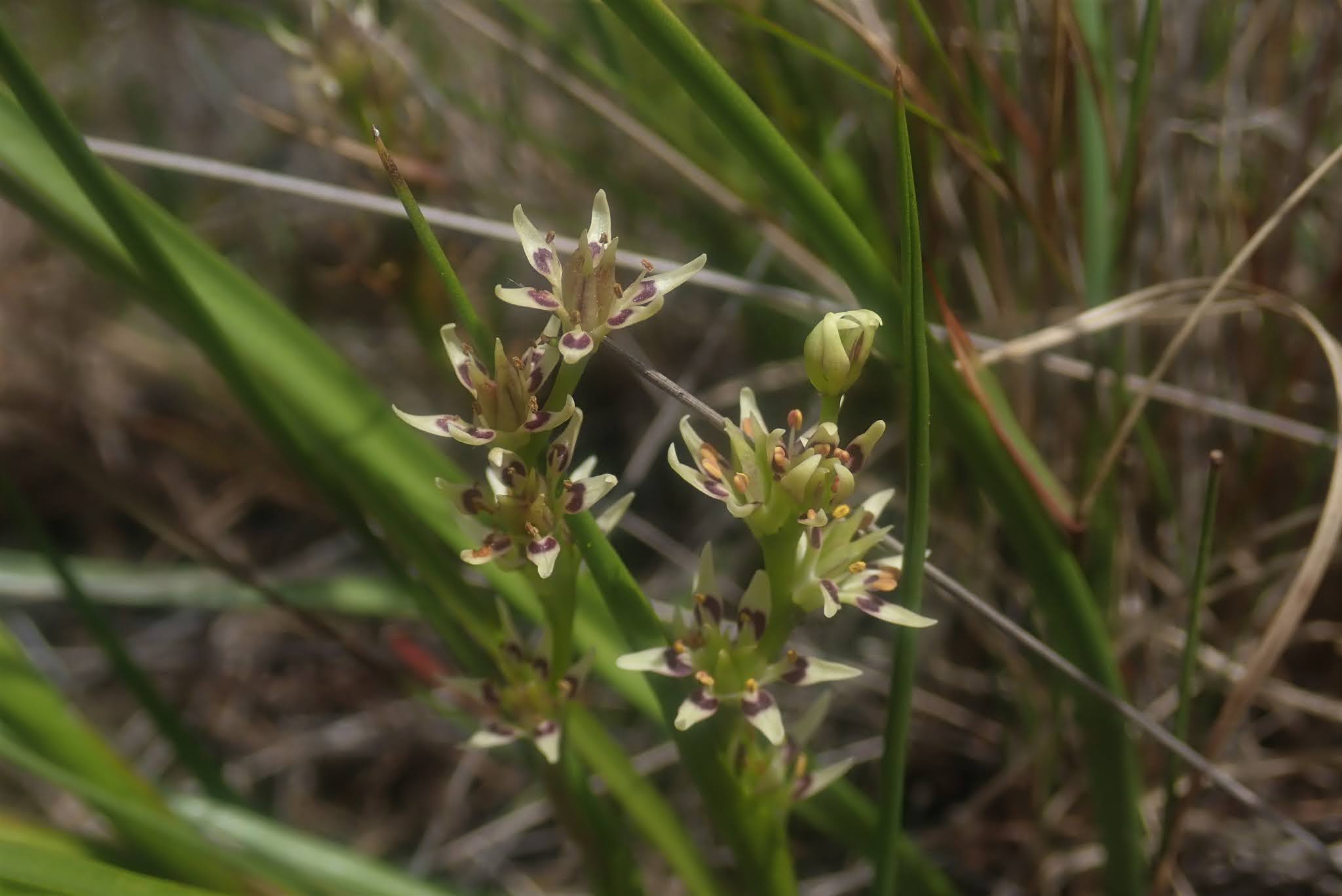
About two years ago a new species of plant from the same monocot family, Colchicaceae, as Finsbury's valley-dwelling golden Christmas Bells and the high altitude, pyjama-striped Men-in-a-boat, was being described by taxonomists, the Mpumalanga PSG (see blogs of 16 Feb 2018, Feb 2020 and Nov & Dec 2020) sent me photos and some info on the plant and asked me to keep an eye out for it. Since then I have had this search image in my head and so, while walking with Willem and Tommy very close to where the earlier photo of the field of Nerines was, I immediately recognised the salt-and-pepper flowers for what they were: The recently described Wurmbea burrowsii, named after famous South African botanist and author couple John and Sandy Burrows, part of the PSG group. I am extremely excited about this. It is always rewarding to find something after a long search.

Well, that's it for February. Lots of rain have filled the aquifers in the mountain grasslands so the streams are burbling, the rivers are gushing and the waterfalls are splashing in full force. March should be special. See you then. Adios.


Monday, 15 February 2021

JANUARY 2021

 JANUARY 2021


I'm sure I remember myself whining last blog about the lack of rainfall and how wrong the long-term forecasters were.... One must be careful of what one wishes for. Here at my house, the very first day of the year 2021 started off with 65mm of rain. And so, with 13 days of rain during the month and being on the edge of Tropical storm Eloise's path, 444mm of rain fell on the central area of the estate during January. The picture of K9 and Vakatsha above was taken from the end of the Rock Kestrel trail the day after Eloise hit (notice the tall waterfall to the right and behind Vakatsha). The lowest monthly figure, 254mm, was taken from Patrick's gate and the highest from Pebble Creek on the northern end of the Kliprots road at 532mm (in one month!). That's a lot of rain! Even so, I was able to experience a bunch of exciting things relating to our beautiful environment and managed to capture some of them as follows:


Of course, all this rain has resulted in lots of moisture so the fungi of the estate are thriving. These rubbery little elf cups with a diameter of about a centimeter are the fruiting bodies of a fungus that is consuming a dead branch on the forest floor. The spores, for reproductive purposes, are formed on the shiny, pink interior of the cup and when it rains, the cup fills with water and the inner surface absorbs some of it, creating hydrostatic pressure. When it evaporates and dries out, this causes a negative vapour pressure resulting in the tissue popping outward and shooting the spores into the environment like a catapult.


This is Diploschistes muscorum, a Crater Lichen that I found adorning the high-altitude quartzite rocks exposed on the summit of Mount Anderson. If one of the spores released from the smooth grey, crater-like apothecia of one of these Lichens settles in a suitable spot, like a forest of Cladonia lichens (see blog of August 2020 - Lipstick Powderhorn), it will begin to grow. It is important to remember that the spores of a lichen are the spores of the fungal component of the association between a fungus and an algae and / or cyanobacterium. The spore has to, by absolute chance, combine with a compatible algae and / or cyanobacterium, from the onset, to survive and form an adult lichen. These fungal spores, however, begin to grow in a parasitic form on the Powderhorn lichen and slowly begin to incorporate the algae present in the host Powderhorn, within itself, effectively stealing the associated algae from the Powderhorn - leaving the fungal component of the Powderhorn, sans it's associated algae, to die! Once the host has died, the mature Crater Lichen continues to live in an un-parasitic form, as pictured above, with the stolen algae as it's associated partner. Wow! It sure is a dog-eat-dog world out there! 


Still on lichens, These light maroon discs are the apothecia of Frilly-fruited Jelly Lichen, Leptogium sp. This foliose lichen is formed from jelly-like rosettes of wavy lobes that attach themselves to twigs and branches in the shadows of the dark, moist forests found in the steep gorges on the estate. The jelly-like texture is because the associated partner of the Leptogium fungus is a cyanobacteria from the Nostoc genus, whose bacterium form colonies of dark-green jelly, usually found on lawns. Cyanobacteria are the ancient living forms that started to pump oxygen, a by-product of  photosynthesis, into the atmosphere around three-and-a-half billion years ago, paving the way for all the other living things that we know today.


I snapped this tiny little fly, less than 8mm long, supplementing it's diet on the nectar from an equally tiny flower of an, as yet, unidentified cucumber vine I found in the gorge running from the bottom chain of the Razorback road up to Black-hawk down. It is a dagger fly, Empididae, so named for it's long, piercing proboscis that it uses more for sucking the juices of it's insect prey than sucking up nectar from flowers. In fact, it is like a miniature, fragile version of a Robber Fly, one of my favourites (see blogs of 9 January 2018 and 7 November 2016). It feeds on other small, flying insects like Mayflies which it captures in flight. In fact, the larvae, which live in moist conditions like leaf litter and debris on the forest floor, are also carnivorous and eat the larvae of other insects, particularly beetle grubs. This is a male, noticeable by his bulbous eyes meeting in the middle, like with male Horse Flies, and when he wants to court a female, he will capture a prey item, wrap it in silk and present it to the female so that she can feed while he mates with her. Unlike other flies but like spiders!


These stunning violet-like flowers peeking out from gaps in the sheer cliff face below Potato Seed Production are a sight to behold! The plant is called a Galpin's Nodding Violet, Streptocarpus galpinii, and it is in the same family as the African Violets which are  widely cultivated as pot or garden plants. The plant boasts one large, quilted, felty leaf in enclosed places or, as in more exposed places like this individual finds itself in, one large leaf with a few smaller ones in a rosette. What makes these leaves special is that an abscission line forms part-way across the leaves when conditions are too dry, and the leaf withers to this point, conserving water. In other plants, abscission lines develop at the base of the leaf or it's petiole, allowing the leaves to drop off, usually at autumn time. The specific name of the plant is in honour of Ernest Edward Galpin (1858-1941), a South African banker and serious collector of plants dubbed "The Prince of Collectors" by General Jan Smuts. He collected and pressed plants throughout South Africa and is fondly remembered for donating more than 16 000 pressed specimens to the National Herbarium in Pretoria.


Talking about Nodding Violets, I found this Harvestman or Daddy-long-legs (Family Phalangiidae) on the massive leaf of a Elephant's Ear, Streptocarpus dunnii up high above Hidden Valley. A Harvestman is an arachnid and although it looks just like a spider, it is only as closely related to spiders as a scorpion is. The biggest differences are: that it's body parts are fused together so it looks as if it has only a single body segment with a single pair of raised eyes in the middle of this, while spiders have segmented bodies with three or four pairs of eyes on the front and / or sides of the cephalothorax; spiders have booklungs, lungs that work like a concertina while Harvestmen have trachea like those found in insects; unlike spiders, Harvestmen have no silk glands and therefore cannot produce silk; Harvestmen also have no venom glands that all but one family of spiders possess; and unlike spiders that are pure hunters, Harvestmen are omnivorous, eating insects and other invertebrates, plant material and fungi, which it bites and swallows, unlike spiders that liquify their prey outside of their bodies with enzymes and then consume the juices; Harvestmen also have glands in the joints of their legs that emit foul-tasting chemicals that they use as a defense. If this fails, as a last resort, they can even detach a leg which have a pace-maker-like organ at the joints causing the detached leg to twitch for as long as an hour after it has separated from the body, holding the attention of the predator while the Harvestman escapes. This is very much like what happens when a lizard loses it's tail to a predator but a harvestman must be more careful of this because it cannot regenerate it's legs like a lizard can with it's tail. And finally, unlike spiders, Harvestmen males clean and protect the batch of eggs laid by the female after she has left. Depending on the time of the season, this could take from twenty days right up to six months...


A female Drakensberg Crag Lizard, Pseudocordylus melanotus, gives me the evil eye before retreating into a narrow crack in the rocks high up on the KLF road above Hidden Valley. The male Crag Lizard, during the mating time, is easily recognisable by his contrasting colours of dark grey above and bright orange on the sides (see blog of December 2019). These lizards are well adapted to live among the rocks with their flattened heads and bodies and long thin fingers enabling them to get into, and hide in the cracks found in rocks. Once they are lodged in these cracks, it is nigh impossible to pull them out because they wedge their tails, with rings of spines, into the cracks which act like an anchor. Another adaption to living in the temperate climate that exists in it's mountainous range, is that they can tolerate temperatures up to minus five degrees Celsius. which is about as cold as it can get in these mountain habitats.  


I found this massive moth. a False Emperor, Pseudobunaea epithyrena, from the Emperor moth family, with a wingspan of 120mm, resting on the bark of the huge Willow tree just behind the office. This family, Saturnidae, contains the world's largest moths, the Atlas moths from the forests of Asia, with a wingspan reaching 300mm, bigger than a dinner plate! The larva is a massive worm hatched from a cluster of eggs that were attached, by the mother, to the food plant of the larvae. Once hatched, the larvae radiate out from the egg cluster in different directions and become solitary feeders that undergo 6 moults before spinning a cocoon around itself and developing into a pupa. If the daylength is still long enough, meaning it is around mid-summer, the pupa will develop into an adult moth within a fortnight. If the daylength is short, indicating the approach of winter, then the pupa will develop and then enter a stage of diapause which will last until the following summer before the adult moth emerges. The larvae, in their final instar, eat extra food and build up and store lipids to supply the adult with energy when they emerge because the adult moth's mouthparts are only vestigial and the digestive tract is non-existent, allowing the adult moth only a short life-span of a week or less. The adult male moth, with his broad, comb-like antennae, immediately takes flight on emerging from the pupa and uses these antennae to seek out a female (see blog of December 2019). The adult female moth emerges from her pupa and, before she takes her maiden flight, sits beside the cocoon and releases airborne pheromones which the males will, hopefully, detect from up to two kilometers away! The male moth dies soon after mating. Only after she has mated does she take flight to lay batches of eggs on various foodplants in the vicinity before she too dies. 


I'm sure everybody knows the ubiquitious but delightful Cape White-eyes, Zosterops virens, that forage through the bushes, in groups, along all the river paths and in all gardens throughout the estate. Their diminutive size and soft, trilling contact call often only revealing them when they are an arms-reach away. Because they are so small, nestlings only have about a fifty percent chance of fledging because they fall prey to smaller predators as well, like Common Fiscals, Fork-tailed Drongos, Southern Bou bous and Olive Thrushes. They normally leave the nest by twelve days old but sometimes precocially at ten days old! Those precocial ones are usually eaten by a predator because of their inability to escape, like this one that I could have easily captured on the Loop road just opposite Pebble Creek (unit 25), although the parents sure let me know how upset they were about my presence! These tiny birds are the usual victims we find impaled on an Acacia thorn (Common Fiscal) or ensnared in the huge web of a Golden Orb-weaver Spider. High chick mortality aside, adults forage in groups and so enjoy herd protection and so are quite long-lived with a ringed bird recovered twelve years and eight months later. They are monogamous breeders with pairs roosting together in separate roosts. Just before sunrise, they move from their roosting site to a meeting tree where the groups will gather before foraging together through the bushes for insects, fruits and nectar. As the day progresses, the groups splinter into smaller groups until, by late afternoon, only pairs remain. They take part in allopreening and are among only a few species of African bird that take part in anting behaviour. This is when they pick up an ant in their bill, usually a Pugnacious ant (see blogs of March 2019 and August 2020), without killing it, and stroke it through their feathers. The ant, in deep distress, releases formic acid as a defense and this acid helps kill tiny mites and other parasites that live in the bird's feathers. The birds have also been observed using a stink bugs, and their toxic excretions in anting behaviour.  


Finally, a close-up photo of a Plume moth, Stenodacma sp., in the Pterophoridae family. I captured a photo of one with it's wings unfolded in my blog of May 2019. The ability to fold their wings allows them to move easily through their grassland habitat and when at rest, the narrow wings and spines on its legs help camouflage it against the grass. 


Well, that's it for January. As mentioned at the beginning of the blog, January was a very rainy month. Above is a photo of the crossing at Whisky 6 after the water subsided somewhat! This is pretty much what all the crossings look like right into February, which seems like it is also going to be a very wet month. So far the roads are in a very poor condition but, fortunately, most other infrastructure seems to be holding up. We will keep you updated...

Wednesday, 13 January 2021

NOVEMBER and DECEMBER 2020

 NOVEMBER and DECEMBER 2020


The jolly season is over and, unfortunately, it wasn't as jolly as usual, thanks to this pesky virus that has our world under siege! Also, I have neglected my blogs so I will combine November and December with this bumper issue:

The long-term weather forecast said that we should expect high rainfall in the first half of summer because Southern Africa's climate was to be influenced by a La Nina event (the opposite of El Nino) until the end of the year. Well, they couldn't have been more wrong! November had a measly 50mm (10 year average = 134mm) rainfall over seven days of rain, while December showed an improvement of 106mm (10 year average = 160mm) over eight days of rainfall. Anyway, the grasslands are still looking lush like you can see from the above photo of Hidden Valley, taken from the highest point above that valley on the Rock Kestrel Trail.

It's not even the jolly season that I enjoy so much over these two months but the abundance of life. I encountered so many things weird and wonderful over the last two months and I did manage to capture some of those moments with my little camera. Some of those you will find below...


It is amazing that once one is made aware of something, one tends to encounter it much more regularly. In October, I attended one of the very few outings this year with the Mpumalanga Plant Specialist Group up on Little Joker Koppie and the surrounds. Some of the members introduced me to a small, high altitude, low-growing bush that belongs in the Milkweed family that was not yet flowering. They showed me a picture of the tiny, hairy, hanging flowers. I was eager to see them because they looked delightful in the photo. Well, not even a month had passed and I stumbled upon one of these bushes far from Little Joker, up on Goudkoppies, that was flowering early. And the flowers are even more beautiful than they appeared in the book. I never thought that brown and black flowers would be so attractive. The bush has no common name but it is known as Anisotoma pedunculatus, and it is not particularly rare, just very easily overlooked. 


I encountered this tiny little male, inch-long, Sailing Bluet, Azuragrion nigridorsum, damselfly perched on the rank bush beside K33. Damselflies are much smaller and daintier than their robust cousins, the Dragonflies, but this damselfly is even small for a damselfly. Besides size, Damselflies perch with wings more folded than Dragonflies do, otherwise they resemble each other. Female damselflies spend most of their time far away from water and only approach water when they intend to breed. Males, on the other hand, spend all their time at the water's edge where they establish and vigorously defend territories, hoping that when a female comes to the water, she will come to his little spot. If she does, he will attempt to keep her within his territory while he courts her and ultimately mates with her. Once she is ready to lay eggs, she approaches a thin, tender, green stem of a plant that overhangs the water and cuts into it with the pair of slender saws that she has on the end of her abdomen. She then lays one egg within this slit and moves forward a little on the stem and repeats the process until she has laid about 40 eggs. This is very different to the laying habits of a Dragonfly who flies over the water and dips her tail into the water, in flight, and lays one egg per dip that sinks to the bottom. Anyway, once the nymph damselfly hatches, it drops into the water to begin it's amphibious stage of life which you can read about in my blog of August 2019. A unique behaviour of the Sailing Bluet, and where it gets it's common name from, is it's habit of landing on the water, often in groups, using the surface tension to avoid sinking, and sailing around, using it's closed wings as a sail. It is not known why they take part in this behaviour but it is diagnostic of the species.  


I encountered this very relaxed Night Adder, Causus rhomeatus, near Patrick's gate in the cool of the morning soon after sunrise. Usually a fast-moving, alert snake, this individual had it's body flattened against the substrate so as to expose as much of the surface area to the sun as possible. In this relaxed pose, it allowed me to approach much closer, without a reaction, than I have ever been to one of these lively snakes. The Night Adder confines most of it's activities to the darkness of night but, oddly, has the rounded pupils present in snakes that are active during the day (nocturnal snakes have cat-like pupils). Another rather unique feature of the snake is that it has enormous venom glands with a massive yield. Adders all have large venom glands but they still remain on the head-side of the neck, giving the head that diamond shape while the night adder's stretch along a quarter the length of the body. This venom is rather mild towards warm-blooded animals but deadly to amphibians, the snake's preferred food.


I found this beautiful Golden-scruffy Collybia, Cyptotrama asprata, growing from a fallen log in the darkness of the forest in Hidden Valley. Quite an enigma for taxonomists since it has undergone 28 name changes and placed in 14 genera since it's discovery in 1847! What we know as the mushroom is actually only the fruiting body of the fungus that appears when conditions are right. The gills (white in this case) produce spores (like primitive seeds) which drop out the bottom of the mushroom and are dispersed by the wind. The main body of the fungus is in the form of thin, interconnected threads called mycelium that grow into a net-like structure that forms a tangle within the substrate, in this case the log, and absorbs nutrients as it decomposes. These mycelium can cover quite an area when growing beneath the soil and, in fact, the largest living organism on the planet is a massive fungus growing beneath the soil and parasitising nutrients from tree roots in the Malheur National Park in Oregon, USA. The fungus, called Armillaria ostoyae, covers an area of 965 hectares (1350 soccer fields) and is estimated to be well over 2500 years old.


This Trailing Ice Plant, Delosperma cooperi, seems very comfortable growing from a crack in the wall at Rock Solid (unit 22). They are common on the estate and normally grow on cliff faces, providing a splash of purple with their multiple, long-lasting flowers. A popular garden subject, the plant can creep over rockeries and cover quite an area, and when in bloom, one can see why it's other common English name is Purple Carpet. The leaves and stems contain DMT and other hallucinogens and were fermented by the Khoi Khoi into a potent wine called "Khadi". I look more longingly to these glorious flowers since this darn alcohol ban...


This a handsome (in a nineties sort of way) Tussock moth, Euproctis sp., from the Lymantriinae. The name "Tussock" comes from the tufts of loosely attached, poisonous hairs present on the caterpillar. These poisonous hairs are even incorporated into the cocoon to further protect the pupa. Another characteristic of the sub-family is the presence of tympanal organs: hearing organs that resemble a membrane stretched over a round rim that picks up the vibration of sound waves. This a used as a defense against bats, who use echolocation to locate prey. Normally, when a bat is foraging, it releases loud pulses of sound that bounce back off of objects. The bat analyses these echoes and determines if the object is potential prey or not. If it is, say, a moth, the bat will home in towards the moth and begin to increase the frequency of the pulses so as to be more accurate as it approaches. Tussock moths can hear the bats and as soon as it hears a bat begin to increase the frequency of its pulses, the moth closes its wings and falls to the ground to avoid the incoming danger. Even more amazing is that there is a tiger moth, and probably more Lymantriids, that have extra organs, called "tymbals" that produce clicks like those produced from a pop can. If you depress a pop can, it makes a click and as you release it it makes another click. Well, these moths can produce up to 4500 clicks per second and when they hear a bat lock on to them and start approaching, the moth begins clicking with alternating frequency like a siren. This confuses the bat and so the bat breaks off the attack. Wow! How's that for an arms race? 


I noticed, for the first time, large, beautiful blossoms on that old, gnarled tree in front of the Steenkamp's ruins at the entrance to Bulldozer Creek (unit 21). These flowers helped me to finally identify the old tree as a European Crab Apple, Malus sylvestris. The old tree was probably planted between 1930 and 1940 making it 80 to 90 years old with the literature saying that they live up to 100 years old, meaning this tree is close to it's maximum attainable age. In it's natural range in Europe and China, this hardwood tree is never common and, because it requires lots of light, is usually only found on forest edges. The cultivated Apple fruit tree. Malus x domestica, is believed to be an ancient hybrid between this Malus sylvesrtis and Malus pumila, a wild apple tree species of which we have a single large individual growing at the parking of M3 which flowers and fruits prolifically every year. All apple species need to be cross pollinated to produce fruit and because this Crab Apple has such a long flowering time, it is often the species that is chosen to grow amongst an orchard of cultivated apples to help pollination. The seeds of the Crab Apple contain hydrogen cyanide and therefore should be discarded or swallowed whole. The small, tart fruit is suitable for cooking but is used mostly for it's high pectin content, a natural gelling agent used to thicken foods and particularly jams.


I found a huge baboon spider burrow in the grasslands where the path exits from the gorge towards the end of the Olinia waterfall walk in Hidden Valley. On closer inspection, I noticed a whole bunch of rather large spiderlings resting near the entrance to the burrow. After teasing the silk with the soft stalk of a grass plant, Mommy spider came up to make sure her little ones were okay! Once the male baboon spider reaches maturity, which only happens on the sixth year of some species, his lifestyle changes completely and he leaves his burrow to become a nomad with only one mission: to find a female, using pheromones released by the female when on the prowl. Once he discovers the burrow of a female, he transfers sperm from the genital opening on the underside of his abdomen onto his pedipalps and then begins to rhythmically tap on the burrows entrance. After she emerges and he finishes his little mating dance, he jams the mating spurs on his forelegs between her massive jaws so that she cannot bite him while he transfers the sperm from his pedipalps to her genitals. He then departs in search of more females. This behaviour by him is very dangerous and males therefore have a distinctly shorter lifespan than the females who can live for more than 25 years. The female constructs a waterproof, silken sack in the furthest depths of her burrow and lays her eggs within it. She tends the eggs and the spiderlings once they have hatched and this is the stage the spiders in the photograph have reached. Once the spiderlings have developed enough, they simply walk away from their mothers nest and construct their own burrow nearby, creating sort of colonies in certain areas. This is very different to the majority of spiders, spiders in the Araneomorph infraorder, who stand at the highest point of their mother's web and release a length of silk and allow the wind to blow them away, far from their mother, in a process called ballooning. 


I found a rock up on the mist-belt covered in dear-tongue ferns, mosses and a rather alien-looking, white, branching lichen called Elegant Fringe Lichen, Heterodermia leucomelos. This is a fruiticose lichen which forms loose tufts about 100mm across. The grey-white thallus is heavily branched and these branches are lined with stiff black whiskers up to 5mm long, which is characteristic of the species. As is the case with most lichens, this species is cosmopolitan but is rare and declining in most of the world where it is now protected. It is a lichen that prefers moist environments and is always associated with bryophytes (mosses) as it uses them for anchorage.


This day-flying lepidopteran, a Gold-spotted Sylph, Metisella metis, is sort of a mix between a moth and a butterfly. Notably lacking the comb-like antennae of moths and the club-tipped antennae of butterflies, the Gold-spotted Sylph has antennae hooked back like a crochet hook. It also has small wings relative to it's body size, like moths, although the rest of it seems butterfly-ish. Anyway, genetic studies put it as belonging to the superfamily Papilionoidea, in which butterflies are placed. It is a common butterfly and despite the bold golden splotches on it's wings, it's small size renders it inconspicuous.


Over the past few years I have introduced to you, via these blogs, a few species of grasshopper from the Pyrgomorphidae family. These, the Foam grasshopper (March 2019 blog) and the Koppie Foam grasshopper (March 2018 blog) retain the cardiac glycosides from their caterpillar's diet of the poisonous milkweed plants, in their bodies, after they have pupated, which renders them highly toxic. Both species have been the cause of death for domestic dogs. Well, this is a Green Stinkweed locust, Phymateus leprosus, and it also exudes a toxic foam when molested. This toxin, however, is even more potent than the others and more than one human death is attributed to it. 


This grey, mouldy mess that I found covering small patches of the lawn around my house may look like a fungus, but it is not. It is called Ashen Slime Mould, Physarum cinereum. When it comes to classifying living things, the highest level of classification is the Kingdom. For example, animals belong to the kingdom Animalia which includes earthworms, spiders, insects, amphibians, reptiles, mammals, birds etcetera; plants to the kingdom Plantae; mushrooms to the kingdom Fungi and slime moulds belong to the kingdom Protozoa, together with Amoeba proteus, the amoeba you studied in biology class at school; Plasmodium falciparum, the protozoan that gives us cerebral malaria and many others. So when not fruiting, the slime mould moves through it's moist environment engulfing bacteria, other protozoa, fungal spores and other non-living organic material in an amoeboid manner as it's food. Once they are ready to reproduce, they convert into the spore-bearing structures like in the photo above. 


This lovely photograph was taken by Fraser Moore from Rock Solid (unit 22) in the recently burned area just south of the staff village. It is a lone African Wattled Lapwing, Vanellus senagallus, and it was probably hoping to hook up with a mate while visiting this area that is attractive to this species. Recently burned veld makes it easier for the Lapwing to find the grasshoppers, beetles, caterpillars, crickets and termites that it feeds on. This is the time when a monogamous bond forms between a male and a female. They would then fly to a pre-used breeding ground, usually in wet grasslands where the male establishes a territory of between 3 and 6 hectares and prepares a few scrapes in the ground, in the complete open,  with his breast. The female then chooses which one of these scrapes she likes best and they both line the scrape with pebbles, grass, roots and animal droppings. The female then lays 4 cryptic eggs in the nest and the couple share incubation duties. If a raptor flies over the birds duck down onto the ground and freeze. likewise if ground dwelling predators are in view. But if something approaches the nest, the incubator sneaks off the nest and joins its mate and, together, they mob the visitor until it changes direction away from the nest.


A stunning Long-horned bee from the tribe Eucerini preparing to collect some pollen and or nectar from atop a Senecio flower. These bees dig tunnels in the ground and construct cells out of chewed vegetation and mud in series within these tunnels. Each cell is stuffed with pollen and nectar and a single egg is laid, after which the bee seals it and constructs the next one in front of it. After hatching, the larvae, resembling fat, white grubs, devour the sugar and vegetable meal provided by mom and then pupate in the cell.


Unlike the Elegant Fringe Lichen featured earlier, this fruiticose lichen prefers to grow on trees and also prefers a drier habitat. It is called Bushy-beard Lichen, Usnea strigosa, and it is closely related to the familiar Old Man's Beard that hangs down so beautifully from tree branches in the mist-belt. The smooth discs are the apothecium, which are concave surfaces made up of tightly interwoven hyphae (the strands that form the three-dimensional net that is the mycelium of the fungi). These apothecia contain millions of asci, which are the spore-producing cells of the fungus. They are designed so that when it rains, drops may hit the apothecium which splashes the spores into the surrounding environment.   


Now, I know that the colour scheme of Berg Adders, Bitis atropos, is variable. But over a ten day period during December, I encountered four different colour forms of the snake! This one was relaxing, in the open, beside my house and it is the typical colour form of a Berg Adder..


This one, a colour form that is as common as the above form, was tucked up against the cliff wall that leads up to Potato Seed Production in the Majubane Valley...


This one, encountered near the Troutkloof waterfall on the Zebra trail, was a blotchy brown colour that I have never seen before...


...and this one, a plain grey-brown colour phase, was encountered on the Kestrel trail. pretty much where the opening photograph for this blog was taken. I have also never seen this colour phase before.


That's all, folks! So far, January seems to be a good month for rainfall at the estate but I will let you know about that in my next blog. This virus is still getting worse so please all regard the rules: wear a mask, social distance...