Friday, 12 November 2021

OCTOBER 2021

 OCTOBER 2021


Well, October has certainly been a strange month weather-wise. We have had seven rainfall events during the month but only an average of 60mm has fallen. This is wonderful for the grasses as all the new seedlings can arise without being washed away, allowing them to establish themselves which, in turn, will minimise erosion when the big rains come. But it has not been all that wonderful for the anglers because the river levels are still critically low. The long forecast does suggest that we will be having an above average rainfall this season, so let's hope lots of rain is on the way. 

The only place in the whole country that claimed it was able to fix my little camera couldn't without needing to send it overseas! Can you believe? Anyway, I had them ship it back to me and I have replaced the lens glass myself, with the plastic from a cellular phone screen protector and although I will not take any more underwater photos, it seems to have worked because the photos are coming out clearly again. So below is a gallery of things I got to see this month past:


Well, this is the last underwater image I will take with my little camera. It is of Common River Frog's, Amieta quecketti, tadpole. River frog tadpoles usually take between nine and twelve months to develop to the stage where final metamorphosis begins, a drastic change of structure and organs which will allow it to leave the water as a frog. If there is a shortage of food or the surroundings are very cold, development could take up to two years. Once the very under-developed tadpole emerges from the egg, it immediately attaches itself to the bottom of the stream with the help of a sticky patch below its mouth, so as not to wash away with the stream current. External gills are immediately produced, allowing the creature to breath. Within a few days the spiracle, a slit on the left side of the body develops and a membrane encloses the external gills and they become internal gills over which water is pumped and expelled through the spiracle. Then the karatinised mouthparts develop with rows of teeth designed to scrape algae off rocks or bacteria and plant material from underwater stems, which is the main food of the tadpole. The eyes develop at the same time. By this stage the tadpole is free swimming and can begin to feed. After a few months, hind legs begin to grow from buds and forelegs begin to develop within the gill chamber, inside the tadpole. When the tadpole has developed fully and is ready to metamorphise, it stops feeding and hides away while the fore legs, already fully developed, erupt from the skin and internal organs develop, including lungs so that the tadpole has gills and lungs and can breathe through both, coming to the surface of the stream to breathe air. The mouthparts recede and widen, losing the keratinised teeth while the whole head changes shape. Finally, the tail is absorbed by a process called apoptosis, a controlled and rather complicated disintegration and absorption of the cells. The young Common River frog adult will now be able to leave the water for a terrestrial lifestyle. I don't know how long they live but it seems that they can live for surprisingly long. There are the following South African records: Cape Sand Frog 18 years; Red-legged Kassina 23 years; Common Platanna 30 years; and the Giant Bullfrog 35 years!    


In the last few months we have been priveledged to get numerous sightings of a juvenile Crowned Eagle, Africa's most powerful eagle, around the central and southern parts of the estate. I recently cleared some alien plants from the fringes of the forested gorge that runs in a southerly direction just opposite Grilse Cottage (unit 18), from the valley bottom up towards Little Joker koppie. About two thirds the way up the gorge I came upon a massive Cabbage tree, Cussonia spicata, like the one Lone Tree Cottage (unit 3) is named after, growing from a shelf in the side of the gorge slope, pictured above. The nest is most certainly that of a young pair of Crowned eagles and is very typical of their nests. The reason I say young is because Crowned eagles, well all eagles really, use the same nest over and over for their entire breeding lives unless the nest is destroyed or they are chased away by humans. They may rotate between two nest also, though. Each year they will add new sticks and branches to the nest so that it grows bigger and bigger. This particular nest appears as if it has only been used for one or two seasons so far so the pair was probably only formed a few years ago. About a year ago I watched a pair displaying and calling along the upper slopes and cliffs of Little Joker koppie and, after the female who is easily distinguished by being larger than the male, departed, the male swooped down on a small group of four Mountain Reedbuck and tried to catch one! But missed. The Reedbuck regathered nervously while the eagle circled overhead again and didn't seem to be aware that the threat came from above. That's what it seemed like, anyway. I am now sure that this pair is the same pair nesting in, what is now called Crowned Eagle gorge, just opposite Grilse Cottage in the Steenkamps valley. Incidentally, I have encountered what looks like an abandoned Verreaux's eagle (Black eagle) nest on the cliffs below Little Joker mine, above the gorge that runs the most east of the three gorges that spread out south from behind Bulldozer Creek (unit 21). Lovely to have a resident pair of Crowned eagles on the estate 


A few days ago, I went to inspect the raking of a tracer that we have cut along a part of the path of the Amphitheater hike, the ten plus kilometer hike that starts and ends in Hidden valley (South valley), for a burn we have planned. The clouds were quite low when I ascended in the morning, In fact, the heading photo for this blog was taken that morning during my ascent. By the time I had finished with the tracer, the clouds had lowered significantly and my vision was limited to only a few meters. I decided to test my directional capabilities and spiraled up to the summit of Mount Anderson, at a gentle trajectory, in the thick mist. Wow! It was eerily quiet and a Steppe Buzzard, I think, flew within a few meters of me, silently, and alighted on a nearby rock. A little further along, I noticed the silhouettes of two buck ,Reedbuck or Rhebok, staring silently at me. And then the raptor glided between us again. Gee, it was a spiritual experience, I tell you! Anyway, during this incredible experience, I did stumble upon a few flowers that I could not identify. This was one of them. I have since been able to identify it as a Shortstyle Uintjie, Morae brevistyla, an intricately designed Iris in the mists of the highest peak in the area. Interestingly, what separates our Moraea genus from the European Iris is the fact that European irises have a rootstock, while our Moraea have bulbs, a defense against the natural fires that have swept through the grasslands forever. Needless to say, fortunately, during my descent, I was able to intercept the path of the Rock Kestrel trail and get safely back to my motorcycle. What a gas!   


On that same lekker day, very close to where I found the very exciting Eucomis sonnetteana (see blog January 2020), I managed to photograph this tiny (3cm high flower and 3cm long leaf blade) Mokobulan African Hyacinth, Ledebouria mokobulanensis. The plant was discovered and described by Sandie Burrows, a well known and loved local botanist in 2008 and is decrared VU (vulnerable) in Red List. This is what they have to say: "This range-restricted endemic is known from three locations along the highest peaks of the Mpumalanga escarpment, amidst extensive forestry plantations. Potentially threatened at all three locations by mining, expanding forestry plantations and ... inappropriate fire management... This species is a range-restricted endemic. It is known only from 3 locations, growing on and around the high peaks of the Mokobolwane Mountain Range, in the Lydenburg Centre of Plant Endemism (Lötter et al. 2002), along the Mpumalanga escarpment in Mpumalanga, South Africa. The species occurs in short, high-altitude grassland, between 2 000–2 200 m altitude, and steep rocky slopes, usually amongst rocks and grass. At such high altitudes, the grasslands are bathed in mist on a regular basis, especially during the wet summers. Much of the precipitation is received as condensation from this mist." I had this hyacinth on my Finsbury plant list but had combined it with a, not so, similar looking species, Ledebouria cooperii, in my ignorance. This sort of thing is very exciting for me (:  


I like to try add a bird species to my blogs and, as you know, my camera is not suited to this sort of thing, and the lens was so terribly scratched at this time, so the picture is of poor quality (especially since it has been cropped). But this is my resident, extremely local, Cape Wagtail, Motacilla capensis. I was really not further than three meters from him/her when I took the photo. We've got to know each other, me him and her, and they have become very bold as they strut around, wagging their tales vigorously, while plucking unsuspecting arthropods from the depths of my lawn. I have never been able to find any literature explaining why they constantly wag their tails but the wagging does become more frantic when the bird is alarmed or anxious. The Cape Wagtail is monogamous and the breeding pair usually remain together for life. They defend a very large breeding territory, around twenty five square kilometers, from which they will evict any other adult wagtails of their species. They will then, together, construct four or five untidy cup-shaped eggs within this territory, either on the floor in rank bush, in the lower branches of a thick bush or even in a depression on a river bank, and finally choose their favourite from these in which to breed. Once the eggs are laid, both sexes perform incubation duties although the female usually spends the night in the nest while the male roosts nearby. Once hatched, all duties are again shared between the parents and the young are fully fledged in just over a fortnight. The parents will teach the young how to hunt and help feed them for about a month after that before they are evicted from the territory and the mating pair go at it again. They have an extremely long breeding season that lasts most of the year so one breeding pair can successfully raise up to six broods a year. Like a factory! Because they have taken to humans and their gardens, domestic cats are amongst their worst enemies. Other enemies include raptors and snakes. Another common enemy is the Red-chested Cuckoo, commonly known as a PIet-my-vrou, that finds the nest and lays its own egg within, forcing the Wagtails to raise chicks from a different species of bird. 


I have erected a pair of camera traps on the Zebra trail, just before you reach the Rock Pool (see Zebra Trail in your activities guide at the back of your house file) and have captured a bunch of mammals so far. Like leopard, klipspringer, mountain reedbuck, grey rhebok and regularly, an adult eland bull, (previously Taurotragus oryx), who is in his breeding condition where he becomes very much less sociable towards other bulls and cows uninterested in mating. Physically, he develops a tuft of black hair over his highly placed pre-orbital glands on his forehead which he rubs against any object standing still long enough so as to spread his personal scent as far and wide as possible, advertising his status to receptive females and potential male rivals. If two breeding males find themselves after the same receptive cow, they will not hesitate to fight, sparring and jostling with those short, compared to the cows', but sharp horns. No literature that I have consulted suggests that they will fight to the death, and I wouldn't believe it if it did, until I actually saw it myself a few years ago during one of our September game count operations with Trent, the manager of the Rattray's property next door. On this occasion, we saw, from the Rattray's game-drive vehicle, three eland in the distance up on the Goudkoppies flats. Two of the eland were large bulls and they were wrestling their horns while a cow observed. As we watched from a distance, one of the bulls turned around and walked off into a rocky thicket of trees and shrubs that formed an island in the open plains while the other bull and the cow ambled off together into the distance. When we approached the scene where they had battled, we noticed a large puddle of blood on the ground that had a trail into the thickets where the lone bull disappeared. We followed the blood trail on foot and found the lone bull, freshly dead on his side in the thickets with a fatal stab wound in his abdomen! Clearly they are prone to fight to the death over an oestrus cow, and so, with such high stakes, they must practice and this they do by sparring as youngsters and also by thrashing, when they fight a tree and usually win by breaking its branches or by felling it if it is small enough.


On the subject of camera traps, the Rivett-Carnac family at Pebble Creek (unit 25) have a camera trap set in one of our true wilderness areas, on the seldom used grass track (Loop road) that reaches the far northern portion of the estate. It was in the morning when condensation was high but it is clear that this leopard had just killed a Grey Rhebok ram and was busy dragging it out of peering eyes, But not the cameras'! It has been a month of many leopard sightings on the estate, starting with the sighting of an inquisitive young female lying on the Kliprots road near K12 by the O'Neill group from Lone Tree Cottage (unit 3). This inquisitive female was seen three or four more times by staff and visitors. Then a group from Whisky Creek (unit 8) got a thrilling sighting on foot of a large leopard on the Steenkamps river before Don, Anne and I got treated to multiple sightings of a pair of mating leopards who mated all night between our two houses! Don and Anne saw the pair just outside their pedestrian gate and I got to see the male twice, once from my bathroom window and once right outside my bedroom window. I went to sleep to the aggressive growling and spitting of these two mating leopards that night. Wow! In just over three months now, we can expect new cubs on the block.


Oh, it's so nice to have moisture again! The mosses, club mosses and hair mosses, the epiphytic ferns and lichens, like this Smooth Lungwort, Lobaria quercizans, have all absorbed the moisture that has been lingering over the estate, although not really turning into real rainfall. It has been very cloudy and misty, especially at higher altitudes and this is enough for these types of organisms. As mentioned many times in these articles, lichens consist of a symbiotic alliance between a fungus, that provides structural support and some minerals extracted from the anchor site, and an algae which provides the required sugars via photosynthesis. The orange-brown discs are the apotheca, the fruiting body. These apotheca are constructed of tightly interwoven hyphae (fungal strands that normally spread out from the body to access the substrate for food) with millions of asci, small discs that produce spores, the "eggs" of the fungus part of the lichen. These spores are spread when water splashes into the orange-brown disc and splash them away. The spores will have to meet up with the correct algae species before a new lichen will be formed.


I found this Cockscomb Fern, Schizaea pectinata, at the very top of a gorge, above Jackpot Cottage (unit16), where the gorge gives way to grassland. The head, which I am holding between my thumb and forefinger, is the reproductive part of the plant that releases the reproductive spores of the fern. This fern is rather common in the northern hemisphere but less so in the south. In South Africa it is common, together with another species, S tenella, in our fynbos biome in the Cape but much less common here in the summer rainfall areas. In fact, it is the first of the species that I have encountered on the estate so far. A new fern for our list. Groovy.


This is a photo of a Cape Hawk, Theretra capensis, one of those hawk moths with the long proboscis, rolled up under the chin here like an elephant's trunk, that sits on your beer can, or wine glass, and shares your sundowner with you. Quite common, this moth occurs from the point of the Cape all the way up through Kenya. The huge, smooth and fat caterpillar, bright blue-green with a tail horn, greedily eats the leaves of plants mainly from the grape family, the Northern Bushman's grape, Rhoicissus tridentata cunefolia, a creeping trifoliate plant that commonly grows on forest edges and rank bush is particularly favoured here on the estate.


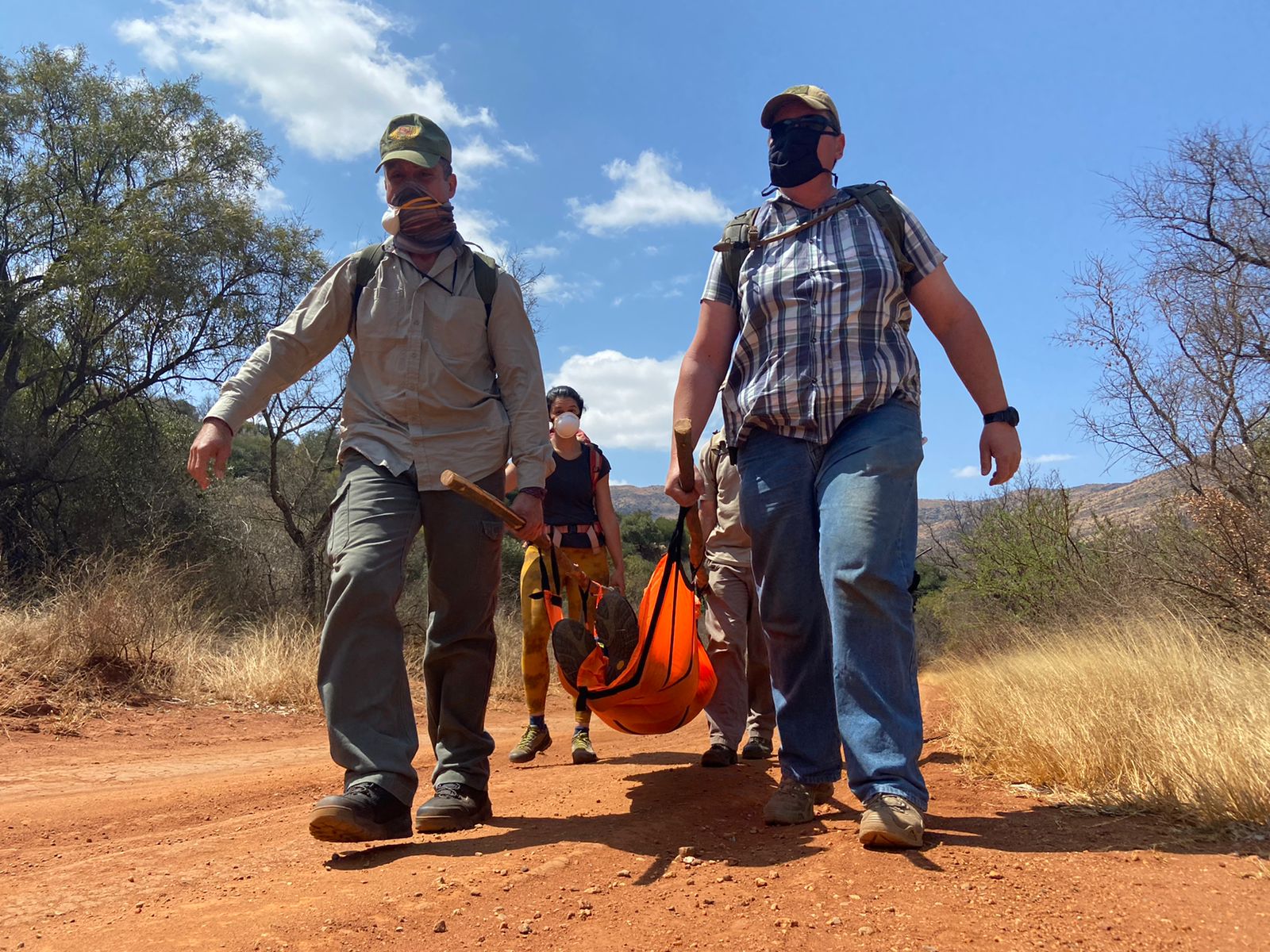
Luckily, we have had very few medical emergency situations on the estate but somebody does hurt themselves every now and again. As a past guide in the lowveld, I have had to complete my level I First Responder course quite a few times to remain validly licensed to guide. But one gets rusty quite quickly with the details of it all and so I mentioned this to the board and, Wammo! they sent me on a five day, level III Wilderness First Responder course, held in Bryanston and Magaliesberg. Wilderness is defined, in this sense, as an area where medical assistance is more than an hour away. So it is not just a matter of first aid but to keep the patient stable for a length of time. And so off I went on this course and found that, not only was I rusty, but a lot has changed. One must remember that first aid is an evolving art and is regularly modified as new information and experiences come to light. I particularly enjoyed this course because it dealt with situations that would more likely occur here at the estate and because of the practical element of the course that we practiced in the Magaliesberg range between Haartebeespoort dam and Rustenburg.


We covered all the usual topics like patient assessment but went into deeper detail with a primary and a secondary assessment, including a rapid trauma survey, vital signs and pain assessment and head to toe survey all to help establish a precise diagnosis of a patient in a far-away place. The advantage of this course is that we practiced these things in simulated exercises in a true wilderness area. We carried this "patient" for about a kilometer and had to then pass the make-shift stretcher, patient within, over a gate and proceed. Good practice, We also learned many other ways of carrying a person out of the wilderness.


We covered subjects like acute coronary syndromes like angina; respiratory emergencies including asthma and hyperventilation; bleeding, like abrasions, lacerations, contusions etcetera; fractures; burns including lightning strike injuries which is probably the biggest danger faced in an open grassland situation like that at the estate. We covered penetrating and blunt force trauma which, in the wilderness, could result from a fall here in the mountains. As a first for me, we covered the subject of diabetes in quite detail and then also all the allergic reactions that one may encounter in a wilderness area, including anaphylaxes. Importantly because it is such a real threat here, we covered thermoregulation including Hyper and hypothermia; drowning and high altitude emergencies like altitude sickness. We naturally covered spinal injuries and, pictured, is us practicing lifting a patient on to a spine board without moving their spine.


So there's the certificate. But please let me not have to use these skills.

That's it for October as summer approaches with the Christmas season just around the corner. Almost mid-November as I write this and the water levels are still very, very low. Here's to hoping for more rain to fall in the near future. 


Tuesday, 28 September 2021

EARLY SPRING TIME

EARLY SPRING-TIME


It has been more than two months since my last blog and the temperature has gone from freezing to quite hot in that time. We have also had three small rain showers delivering a combined rainfall of around that ten millimeters which is not much but hopefully an indicator of early rains during spring-time which is very beneficial for our grasslands. There has certainly been a lot of cloud cover and moisture recently as one can see in the photo of Mount Anderson above, taken from the road surrounding Little Joker Koppie.

The rivers, particularly the Majubane, are running very low at the moment. Some of the members told me that they have never seen Whiskey 6 weir as low as it is. One would think this is odd considering that we had above average rainfall last season but it just goes to show how important soft rains are: So even though we had above average rains last season, (mean average for the central area over the last 11 years is 890mm, last season's total was 1037mm) a lot of it was delivered to us in the form of flash floods during our visit from Cyclone Eloise. This deluge of water fell quickly and rushed off downstream without getting much opportunity to soak into the ground. Furthermore, most of the rains for the remainder of the season were also rather violent so did not have much time to soak in as well. In contrast, the previous season's average at the central area was 704mm which is almost 20% lower than the annual average but the little rains that did fall were soft and absorbing resulting in the rivers flowing very well right through the dry season.


Thick frost on the rose-like leaves of an Ouhout tree, Leucosidea sericea. Quite a lot of moisture has resulted in some mornings being very frosty, even up until now towards the end of September. I've even noticed new seasonal leaves dying from frost while they are still buds. During all this confusion, the Ouhouts have also bloomed together with the blossoms of the Prunus trees on the estate, a sure sign of spring-time.


A pair of Sugar ants, Camponotus valdeziae, communicating  while searching for food in a forest of desiccated clubmoss. Communication is achieved by the transfer of pheromones between the two individuals. These sugar ants are what is referred to as "catholic" in their diet, meaning that they eat pretty much anything they can get hold of, be it vegetables or meaty things either hunted or scavenged. I have, so far, identified fourteen of the very many species of ant on the estate and have posted information on these amazingly successful insects on many occasions (blogs: March 2018, September 2019, January 2020, May 2020, July 2020, October 2020, April 2021 and Finsbury Autumn Wildlife) so I will not go into them except to mention that they probably evolved from a stinging wasp about 168 million years ago before the Cretaceous (145 - 60 mya). But it was only after the emergence of flowering plants around 100 mya that they began to seriously diversify and they achieved the ecological dominance they enjoy today about 60 mya. Such dominance that, in the tropics, ants account for a quarter of the total animal biomass. That means that if you take all the animals, from insects to birds to mammals etc, and weighed them, twenty five percent of that mass will be ants alone! Regarding the Clubmoss forest that the ants are foraging in, a blog from October 2020 explains how clubmosses are like a bridge between the more primitive, non-vascular mosses and the more advanced flowering plants that have advanced vascular systems that carry water and nutrients around the body of the plant. This clubmoss is referred to as Ressurection Clubmoss, Selaginella dregei, and it is called that because it desiccates completely during the dry season and turns a pale grey colour like in the picture but, after sufficient rainfall, the primitive vascular system sees to it that the seemingly dead plant inflates, stands erect and returns to its healthy green colour.


While we're on the topic of mosses, A few members have referred to the white, moss-like plants noticeable at this time of the year on the estate, as a moss. In fact, they are not mosses at all but a clumpy, carpet-like (in botany, referred to as being caespitose) version of a typical Everlasting, called a Clumpy Strawflower or, more correctly, Snowball Everlasting, Helichrysum caespititium, with minute leaves, stems and flowers (see inset). I featured this plant in my blog of September 2019 but have since discovered some more interesting things about it: Besides the safe phlorogucinol extracted from the plant, and it's known anti-microbial actions, extracts have been proven to successfully treat all four strains of N. gonorrhea. This has been an exciting discovery because there has been concern over the continuing efficacy of the existing drugs that treat gonorrhea and this extract provides a suitable alternative. A further update from the blog in 2019 is that my list of Everlastings / Strawflowers / Paperflowers has increased from 19 species to 34 since then. 


As I've mentioned before, I have to be very close to a bird with this little camera of mine to be able to get an even half decent shot so you can imagine how close this male Buff-streaked Chat, Campicoloides bifasciatus, was to me, cursing me with some nasty language it seemed. All this while I identified the community of trees and plants protected by a rocky outcrop up on the grasslands on the slopes of Little Joker Koppie, high above Morrin Pools and Jackpot Cottage on the Majubane river. These birds are endemic to the grassland biome of South Africa, Lesotho and Swaziland and so are a prized lifer for many international birders. The loud, melodic jumble of whistles that the birds produce are easily recognisable and used to chase away, not just other Buff-streaked Chats, but other birds too, like pipits, other chats, Stone Chats and cisticolas, from their territory. In fact, this is what I think this aggressive male bird was trying to achieve when approaching me, although I could have also been very close to a nest but I think it was a little too early for them to be breeding. The nest is a large, untidy mass of grass and roots with a cup in it that is placed on the floor, usually on the down-hill side of a large boulder or in the crevices between boulders in the sort of rocky outcrop I was visiting that day. Interestingly, unlike many birds that re-use their nests. not just in the same season but also in successive years, the Buff-streaked Chat only uses a nest for a single breeding attempt, building a new one if they have a second brood in the season. Once the chicks have fledged, they usually remain with their parents for another full season and help to raise the new offspring before going out into the big wide world for themselves.


This strange, purplish growth with a solid crust is called a King Alfred's Cake, Daldinia concentrica, and is almost the only fungus, besides lichens, that can be easily found in the forests during the end of the dry season. The name King Alfred's Cake comes from the legend that King Alfred, later Alfred The Great, the king of the West Saxons and later the Anglo Saxons in the ninth century who, while fighting the Vikings, hid out in a village house. He was requested to remove a cake from the oven when it was ready but fell asleep instead, resulting in the cake being burnt. The fungus is presumed to resemble the burnt cake. Like most fungi, King Alfred's Cake is cosmopolitan and can be found in all continents except the Arctic and Antarctic wherever trees grow. The inedible flesh of the fungi is found beneath the hard shell and is arranged in concentric rings like that of the trunk of a tree with each ring representing a season of growth which will renew each year. One can therefore estimate the age of the fungus by counting the rings. The practical uses of the fungus range from using the dried flesh as tinder when starting a fire with flintstone, to producing a colourfast purple dye to extracting a metabolite called Concentricol, which is oxidised Squalene, an organic oil, originally extracted from shark liver oil, which is required to synthesize sterol, a precursor to steroid hormones. Other common names include Carbon Balls, Coal Fungus and Crampballs.  


I went and inspected the very north-eastern block of the estate, the very first block I burned since I have been in charge of the estate's burning policy in 2017. The block was infested with Pine and so I treated it to a hot burn in October of that year just after the first thirty millimeters of rainfall for that season. The burn was very successful in destroying the Pine infestation but naturally, because of the massive seed bed these infestations created, the Pine regrowth in the block was vigorous. So once again, in October last year, I subjected the block to another hot burn after the first rains of the season (see blogs of November 2017 and October 2020). This, once again, successfully destroyed all the new Pine growth and so, a year after again, I conducted a thorough inspection of the block and can report that the Pine problem in the block is very much under control. Now, the two consequences of under-burning mesic grasslands, which encompass the estate, is that the dominant grass tufts smother their neighbouring tufts, and that the exclusion of fire helps to promote the growth and ultimate dominance of woody plants, particularly those found in the fynbos biome, like Helichrysums and Ericas. Both of these maladies negatively affect the basal cover of the grasslands. When basal cover decreases, the distance between the tufts of grass increases, resulting in an increase of bare ground and therefore, an increase in sheet erosion and the loss of topsoil during rains. So in an area that is not burned frequently enough, even if the grass swathe looks good, a closer inspection will find large areas of open ground between the grass tufts and, ultimately, the dominance of woody shrubs. In the photo above, you can see how poor the basal cover was after the last burn because of the amount exposed ground. On closer inspection, though, you will see that the two burns, three years apart, are starting to achieve positive results. I counted thirty brand new grass tufts in the green rectangle I have drawn in the photo! After the next rainy season the basal cover in the photo would have closed over completely, thoroughly improving the health and the absorption ability of the grasslands which will reduce the loss of topsoil during rains and reduce space for the woody plants to grow. The increased absorption qualities of the grasslands will, in turn, ensure that less water from the rainfall is lost to run-off, which means that the aquifers on the estate are filled properly during the rainy season, resulting in strongly flowing streams during the dry season, the ultimate function of the grasslands in a water catchment area like ours. 


On the very western side of the Zebra trail along the high altitude mountain stream that falls over the Troutkloof waterfalls, there is a nice little pool where I take a drink before ascending to the top of Goudkoppies. At this little crystal clear pool, as with most others, if you look carefully at the bottom, you will most likely see strange little insects of differing sizes that resemble the one in the photo. They are Mayfly nymphs which are also discussed in blogs of September 2019 (nymphs) and September 2020 (adult). As mentioned there, the adults are very short-lived and their only function is to find a mate and mate and lay eggs. Their short adult life is attributed to the fact that the mouthparts are fused and so the insect is unable to feed. Their tummies are filled with air which makes them rather buoyant and so when their is a "hatch" you will find a cloud of adult males dancing lightly in the air above the water. The egg-laden female detects these clouds of males and flies into it when a male will grab her from underneath with his long, double-jointed forelegs which bend awkwardly backwards and hold her wings closed and out of the way for the brief moment he mates with her in mid-air. To achieve this, the male has double eyes, a top pair to solely seek the female, and a lower pair for normal activities. The nymph in the picture is therefore a well-developed male by the presence of double eyes and wing buds. Anyway, the male dies immediately thereafter while the female will just have enough resources to develop her eggs, which are  only a quarter of a millimeter in length, and then fly across the surface of the water depositing them one-by-one as she dips her abdomen in the water. These minute eggs sink to the bottom and rest for about three weeks before hatching into tiny nymphs who swallow detritus, extract the nutrients, and excrete the rest. The larvae moult about twenty times over a period of six months up to two years, depending on the species.  


Every year at around this time, a pair of Lesser Striped Swallows, Cecropis abyssinica, come and inspect my house as a place to build their nest, I guess, because they fly into the house when the door is open and often get themselves caught on the inside against a window, resulting in me having to remove them like the one in the photo above. The swallows are intra-African migrants with complex movements specifically as monogamous pairs in our area move to the South Eastern coast during winter, whereas those from just north of us migrate into Zimbabwe and the Zim birds migrate further north. All very confusing. They have not yet approved of my house because they have never built their nest there but, if they did, they would collect mud that they roll into pellets in their beaks and coat with mucus before regurgitating the pellets as tiny mud bricks that they use to construct an enclosed bowl with a long entrance passage beneath the eaves on my patio. This elaborate and strong nest takes more than a month-and-a half to build although the monogamous pair begin roosting in it long before it is completed. Once completed the birds line the bowl inside and lay two to four eggs that are incubated by the female alone for up to three weeks before the chicks hatch. Once hatched, the chicks are fed by both parents who also remove their droppings while they are still tiny. Larger chicks reverse out to the edge of the passage entrance and defecate over the edge. After less than three weeks, the fledglings exit the nest and are still fed by the adults, with who they roost inside the nest at night, for another three to four weeks before becoming self sufficient. The adults will re-use this well-constructed nest for many years to come with some minor maintenance although, sometimes the nest is taken over by Mocking Cliff-Chats, Southern Grey-headed Sparrows or White-rumped Swifts.   


The male Leptophatnus sp., a parasitic wasp from the Ichneumonidae family, is rather easily identified as a male by the absence of a long ovipositor extending from the rear of its abdomen, a characteristic feature of Ichneumonid females. I featured a female from this family in my blog of February 2020 and a pupal case in my blog of March 2021, where I give a run-down on the family. I did inquire to as many experts as I could to why the abdomen of this male seems to have collapsed but, alas, I received no advice but when the mystery is solved, I will let you in on it...


This little critter, measuring less than a half a centimeter, is invisible against its preferred habitat of lichen-covered rocks unless it moves and you are looking very closely. It is a Booklice or Barklice from the Psocoptera order of insects and the first species illustrating that order on my Finsbury insect list. These small, primitive insects are known as Booklice when they are found, as tiny brown insects, running over stored books feeding on the paste and glue of the bookbindings. They also feed on stored cereal products and can therefore become a major pest but most species are scavengers of insect carcasses and grazers of lichens (like the above individual). Beneath the huge jaws of the insect is an extended mouthpiece consisting of a rod on each side that moves forward and backward with a forked tip. This tool is used to scrape pieces of lichen off the substrate so that it can be eaten. 


I found this beautiful grass aloe in full bloom in the clouds right near the summit of Mount Anderson just recently. The grass aloes mostly flower in the summer like most other plants and the normal aloes flower in the winter. This aloe was flowering at the end of winter and the beginning of spring. I thought it was, and it could still be, an Aloe chortolirioides wooliana but this would be outside its typical flowering time. Then I remembered an article sent to me by Tommie Steyn, a botanist at the Mpumalanga Parks, and him asking if I had found a specimen of the very localised endemic called the Mount Anderson Grass Aloe, Aloe andersonii, which was described in 2014 and ONLY occurs on the eastern and north-eastern slopes of Mount Anderson, restricted to just above the cliffs a few hundred meters below where I found this specimen. I dug out that PDF and the aloe in the above picture sure does fit the description although I will need to measure some of the flower parts to confirm. The PDF has the following to say: "The plant is Rare and confined to Mount Anderson. However, it grows on and above sheer cliffs and is well protected by its difficult to reach habitat. Consequently it is not threatened and is assessed as Least Concern (LC) in the Red List of South African plants. Aloe andersonii is only known from Mount Anderson, which is one peak in the Mpumalanga Drakensberg Escarpment Mountains. It grows on the upper, east-facing slopes, on rocky ledges, just above the sheer cliff faces, at altitudes of 1 200–1 700 m. The plants are frequently covered in fog and cloud. The mineral-poor, quartzitic sandstone rocks give rise to a poor soil to which our plants are well adapted. The Mount Anderson grass aloe shares its habitat with other succulents such a Crassula pellucida subsp. brachypetala and C. sarcocaulis, Rhodohypoxis baurii and Ledebouria saundersiae. The habitat consists of grasslands, which usually burn in the winter months. The rocky habitat ensures its survival and if it does get burnt, the older leaf remains acts as an insulator. The vegetation of Mount Anderson is Lydenburg Mountain Grassland (Mesic Highveld Grasssland Bioregion) and Northern Afromontane Forest in protected kloofs (Mucina 2006)." Exciting stuff! 


We found this Free-tailed bat from the Molossidae family hiding in the hatchery. The name "Free-tailed" comes from the fact that the tail membrane does not reach the tip of the tail like most other bats. The family does have a unique adaption to its tail: It has a ring of cartilage that circles the tail vertebrae and can be moved backwards or forwards along the vertebrae to shorten or lengthen the membrane to suit its flying needs. This, together with long, narrow wings allows it to reach very high speeds with unmatched maneuverability, with limits of nearly 100 km/h at 3 kilometers up, higher and faster than any other bat family. The drawback of these long, narrow wings is that the bat needs to launch itself from a suitable height so that it can drop long enough to reach the speeds required to obtain lift. Because of this, they are extremely good climbers, enabling them to climb high enough for take-off. I didn't know this when I caught this bat but it explains now, why the thing didn't just fly off when my hands were open. I'm afraid I don't know which species this is but suspect it is an Egyptian Free-tailed bat, Tadarida aegyptiaca, and if it is, it normally roosts in caves or mine shafts with ten or twelve other individuals but, some species in the family, can live in colonies numbering up to fifty million individuals!


That's it for springtime. My little camera has been giving me hassles and is now in for repairs in Cape Town. I will be carrying a cell phone with me on my rounds so if I see anything interesting, I can still photograph it. The phone, though, does not have the macro abilities my camera does so I feel future frustrations on their way. Anyway, once my camera returns, it will be like new again so I can take a gazillion photos of everything again and produce monthly blogs again. Stay safe and see you soon!

Tuesday, 13 July 2021

MAY & JUNE 2021


 MAY & JUNE 2021

I was expecting a particularly cold winter this year with all the rain that fell last season but we have had very few mornings of severe frost so far, although we certainly have had some chilling winds. We have also had more cloud cover this winter compared to previous winters so by no means has it been a warm winter as can be seen by the grumpiness of the baboons in the mornings! The grasses have faded to white as they have entered their dormant stage which is noticeable in the above photo, taken from the top of Spioenkop looking east towards Mount Anderson in the background. But, life carries on and I have still encountered many exciting organisms during the last two months. In fact, I got to see a whopping ten mammal species on the Zebra trail just the other day, including Zebra, Grey Rhebok, Mountain Reedbuck, Common Duiker, Blesbok, White-tailed Gnu, Side-striped Jackal, Eland, Warthog and finally a breeding herd of Kudu! The most I have seen on any single excursion in all the time I have been here on the estate. Following are some of the other things I got to see this month:


When I encountered this old stunted and gnarled Tree Strawberry, Cephalanthus natalensis (see blog of May 2020), growing on what looked like the remains of an expired termite mound up in the grasslands high above Kwa Puleng (unit 12), I was amazed at the resilience plants require to enable them to survive in the dog eat dog world of nature. Now the Fruit of the Tree Strawberry resembles true strawberries with their tiny seeds attached to the outside of the fruit, instead of within the flesh like most fruits, and although they are edible for us humans, they are not as tasty as strawberries. But for baboons, they are a treat. So I can imagine a baboon defecating on a termite mound after using it as a vantage point one fine day after said baboon had feasted on the fruits of a Tree Strawberry. The manure provided a perfect environment for at least one of the seeds of the fruit to germinate and the bare soil surrounding it protected the little seedling from fire and root competition. The Tree Strawberry then created the perfect environment for a few other follow-on plants, like a nice semi-shade environment for the growth of a Cluster-leaf Asparagus, Asparagus larcinus, which can be seen growing on the right, beneath the Tree Strawberry; or a perfect support for a Northern Bushman's Grape vine, Rhoicissus tridentata ssp. cuneifolia, which, with its larger leaves, can be seen sticking above the Tree Strawberry just right of centre; or the nutrients required for a Rock Tannin Bush, Osyris lanceolata, to thrive, which is the scraggly little bush with the green leaves, that contrast with the autumn-coloured maroon leaves of the Tree Strawberry, in the centre of the Tree Strawberry. This little bush is a hemi-parasite that acquires all its water and minerals from the roots of the Tree Strawberry. No wonder the Tree Strawberry is so gnarled, it protects and supports all of these other plants while surviving grass fires, freezing frost in the winters and multitudes of browsing antelope wandering the grasslands.  


If you ever encounter a rust-tinged blob of white wax the size of a dice attached to the twig or branch of a tree or bush, you will now know what it is: It is the waxen shield that protects a female Wax Scale insect of the Ceroplastes genus in the Coccidae family of bugs (hemiptera order of insects). The female nymph of this rather odd insect starts off as a flat, oval "crawler" with six legs and  collection of wax projections erupting from its thorax and abdomen like the quills on a porcupine. She crawls around searching for a tasty bush or tree and then, together with a bunch of siblings, inserts her proboscis into the vein of a leaf and sucks out the sugars produced by the plant. She sucks on this vein for about a year while periodically moulting before she moves on to a twig or branch of the same plant. Here she moults for the last time and becomes an adult with no legs. In fact, she is just a bag designed to carry eggs. She inserts her proboscis into  the vascular system of the twig or branch and then emits pheromones into the air that are picked up by a winged male who then locates her and mates with her. After mating, she exudes a thick layer of wax that covers her entire body to protect it from predators and the elements. She stays in this sedentary position for the rest of her life. Once she is ready, she lays hundreds of eggs and then dies, still covered by the waxy layer and attached to the twig or branch. On hatching, the little crawlers climb out from under the wax dome and spread out to find a suitable vein from which to continue the cycle. The Wax Scale adds to its defense by producing honeydew, a sweet liquid that attracts ants who, in turn, protect the insect (see ants and aphids in blog of Jan 2020). This honeydew is produced so copiously that it spreads out around the insect and results the development of a black Sooty Mould which also damages the plant by covering the leaf surfaces and limiting photosynthesis. So if the plants in your garden have lost their vigour and have a black, sooty mould covering their leaves and branches, look closer and you will see that you have a Scale infection. If it only affects a small portion of the plant, the best is to remove the branch with the infection or if it is more widespread, rub Neem oil over the Scales and the mould to get rid of it. But, generally, if you do not have Scales, then you won't get sooty mould... 


I was sitting on a flat rock at high altitude enjoying lunch one day when I looked down and saw a tiny spider that resembled a squid! Upon closer inspection, I saw it was a spider with a small black ant clutched in its jaws. I later found out that it is a species of Crab Spider from the Thomisidae family (see blogs of May 2020 and March 2018) but, instead of being brightly coloured like those in the relevant blogs that change colour to match the colourful backround of the flower they sit on, the species from the Monaeses genus, as above, are pale earthy colours to match the grass stalks and leaves that they hide on while awaiting prey, in this case an ant, to stroll past. 


I was trying to differentiate between the endangered Red Candlewood tree, Pterocelastrus rostratus, and the more common Hedgehog tree, C. echinatus (pictured), when a tiny little bird, a Bar-throated Apalis, Apalis thoracica, popped out of the thick foliage of the tree just a meter or so away from me. It cocked its head sideways in a curious manner as I took a photograph and then continued foraging for insects hiding beneath the leaves. This is not the first time I have been so close to these dainty little birds. In fact, If you sit down beside a tree in which these birds are foraging, I can bet that sooner or later the bird will pop up right beside you as it gleans the bark and leaves of all insects, spiders and even the clusters of caterpillar eggs that are laid on the underside of leaves. Bar-throated Apalis's are easy to identify by their small size, the pale eye and, of course, the dark bar across its throat. They are monogamous and are never far from their mate, with whom they maintain constant contact with soft calls and every now and again, with an advertisement song which they sing in duet. They are also sedentary so are visible throughout the year in pairs, or during the latter part of the breeding season, in small family groups. During breeding, the female, with little help from the male, constructs an oval ball nest six or seven centimeters in diameter at about head-height in the thick, leafy part of a tree, with an entrance on the top and side. It is constructed with finer vegetation and camouflaged with lichens before being secured and wrapped with silk from spider webs. After incubating the eggs for a little more than a fortnight, they hatch and within a similar amount of time, after being fed by both parents, they are fledged and ready to leave the nest. They remain, though, with the parents for a prolonged period while the parents teach them how, and what, to forage for, creating little family groups.   


At first, when one encounters a Scorpion Spider, Platyoides walterii, one can be forgiven for thinking it has been trod upon, with its skewed, orange legs sticking in all directions. This happens because the spider has elongated trochanters (the leg segment between the coxa and femur), especially on the hind legs, and because the specialised loose leg joints . This adaption, together with the fact that the extremely flat body is only two millimeters thick while twenty millimeters wide, allows it to squeeze into narrow cracks and crevices like the narrow gaps beneath the bark on a tree or even under the pot plant in the courtyard. The same features also give it the common name of Scorpion Spider because scorpions share them too. These are wandering spiders and so they do not use silk to construct a trap (web) to ensnare their prey, instead, as night sets in, they emerge from their narrow refuge and begin to prowl a well known home range in search of their arthropod prey. Another unique feature of the genus is that the spiders have an extra, triangular tooth behind the usual fangs, enabling them to chew through the tough integument of, say, large beetles or some other speciality. Unfortunately, I could find no information on this so one can only speculate. The protruding jaws are intimidating but the venom is very mild and so the spider is harmless to people.    


It's funny, you know, I was always better with my tree identification in the lowveld than I was at identifying the smaller plants. But here at Finsbury, it is the other way around. This is mainly because it is so difficult to observe our trees in the Kloof Forests because they are so high and intertwined with other trees. Needless to say, I spend a fair amount of time trying to identify trees here on the estate. Usually I take photos and try to identify the tree when I return home but, inevitably, the book will call on me to check a part of the tree I did not photograph. The best for me is to carry my tree book with me but it weighs a good three kilograms so I only take it when my specific mission is tree identification. It certainly helps, though, to have a bit of knowledge about family traits, and that's what helped me identify this Rock Alder, Afrocanthium mundianum, that I found on the Steenkamp's waterfalls walk, on the level section of path just after the rope balustrade. It is in the Coffee family, Rubiaceae, which was easy to discern because of the opposite leaves with smooth margins, interpetiolar stipules and hairy domatia present on the axils between the midrib and the lateral veins of the leaves. These characteristics made it easy for me to establish that the tree belongs in the Rubiaceae and the fruits, which are edible, that were present, helped me narrow it down to species level in the book.


Soon after finding the above tree, I was moving through the forest above the trail at the bottom of the rope balustrade on the Steenkamp's waterfalls walk when I was snagged by some seriously hooked thorns that are strong (unlike bramble thorns), sharp and hurt like hell. I had encountered these creepers before but was unable to identify it. And so I returned with my tree book "Trees and shrubs of Mpumalanga and the Kruger Park" and set about identifying the culprit. Many tree books have a KEY system to help narrow the plant down to genus level or, if you're lucky, to species level. The problem with most of these keys is that, during the process, one is often required to peruse the flowers and fruits of the plant which are usually not visible at the same time and which are seasonal, making once-off identification difficult. I was pleasantly surprised to have narrowed this tree / creeper down to species level within a few minutes using the excellent key in the book. It is a Cat's Claw, Scutia myrtina, from the Buffalo Thorn family (Rhamnaceae) and although it is quite non-descript, it is easily encountered through feel before sight! 


I had this lovely sighting of a Black-backed Jackal, Canis mesomelas, on the Zebra trail up on the flat plains of Goudkoppies. This remarkable animal shares this mountain grassland habitat with its close cousin, the Side-striped Jackal, Canis adustus, and, in fact, I encoutered one in the same area just the other day. But it is the Black-backed Jackal that is renowned for it's amazing adaptability that enables it to survive in almost any habitat, even in areas with high human density. This adaptability is partly made possible by the animal's ability to eat any type of protein based food and also fruits and berries. This, together with a scheming mind and hugely diverse and adaptable hunting techniques and the ability to hunt cooperatively with other individuals make it possible for the animal to hunt alone, in pairs, family groups and even packs of unrelated family groups. Thus, prey items range from fruit, nuts, bird and reptile eggs, all invertebrates from mussels (on the Skeleton Coast), insects, spiders and scorpions, small vertebrates like frogs, birds, snakes and lizards, to mammals like rodents all the way up to adult Impala or Wildebeest calves, which are brought down by hunting packs after being harassed to exhaustion. To add to this, they are very successful scavengers and are also adept at stealing mouthfuls of food from carcasses while larger predators are still busy feeding off it! I am reminded of the time when I witnessed a lone Jackal taking advantage of heat stressed Grant's whistling Rats while driving in the Kgalakgadi in the hottest part of the day. The Jackal ran along beside us in the shade of the vehicle when suddenly it veered off and grabbed a rat before it could retreat into its burrow. After chewing only a few times, it swallowed the rat and repeated the process twice more before stopping in the shade to rest. Unlike most mammals, Jackals are monogamous with breeding pairs staying together for life, and, also unlike most mammals, often form extended family groups when the young, after a year, stay with their parents and help to raise the next set of pups before going out into the big wide world on their own. These pairs establish a strictly defended territory using scent markings via excrement, which they often deposit on top of a raised platform like a rock, a ball of elephant dropping or the droppings of a predator, and via vocal calls sung solo or in duet, a most beautiful sound in the wilderness. These territorial boundaries are sometimes breached when the pair, or family group, joins up with neighbouring families to form a hunting pack when circumstances call for it, like a wounded or crippled animal that is too large for the pair to bring down, or  during the foaling season of certain antelope species. In my experience, the only other animal a jackal seems to have any respect for is a leopard. Canids (dogs) are a favourite food item of a leopard and I have seen jackals harassing lions, cheetahs and every other carnivore while they eat but when a leopard is eating, jackals are nowhere to be seen.     


Although I did not experience this in or near Finsbury, I have to share it with you. I attended a Mpumalanga Plant Specialist Group (see blog of 16 Feb 2018) outing in the Manyeleti Game Reserve bordering Orpen gate in the Kruger National Park recently. We were beside one of the koppies visible in the east from Orpen reception when one of the members picked a curiously rolled-up leaf from a bush we were trying to identify. When he applied pressure, this minute little frog appeared from inside this rolled leaf and jumped into the bush where I managed to get this photo (my finger nail in the photo gives an idea of its diminutive size). We identified it as a Waterlily frog, Hyperolius pusillus, and, since it was very far from the nearest water body, we surmised it had rolled itself up in the leaf to protect itself from desiccation while it waits out  the dry season until a pan nearby fills up after next season's rains (although we didn't find a dry pan nearby either). 


I have been having a little trouble with my trusty old camera so photographs have been more scarce over the last two months, leaving me with less to work with for my blogs. But this will be sorted shortly so I will have more to work on soon. 

These lockdowns and restrictions caused by this pesky virus are very inconvenient and the only way to overcome it are for us to vaccinate enough people to defeat the virus. As we can see already, it is otherwise not going to go away and these restrictions will become a part of life. Worse, the longer the virus moves around, the more chance there is for it to mutate into a really deadly virus that will not be able to be controlled. So let's observe social distancing rules and get vaccinated already so we can go back to normal again.

Stay strong and we hope to see you all here in the mountains as soon as possible.