Wednesday, 21 September 2022

AUGUST 2022

 AUGUST 2022


I'm sure I remember starting off my previous blog (Winter 2022) with a statement that it was such a nice, mild winter. Well, it seems I spoke too soon. The month of August was very cold! With frost on most mornings right up till the end of the month! August was dry too, and windy like it usually is. It is also the month in which the rainy season officially begins although, as usual but unlike last season, it was without rainfall. 

It is interesting to note that rainfall occurred in each and every month of the previous rainy season with the following figures recorded around the estate: This is the second season that I recorded the rainfall in five different locations on the estate. The Central Area (where the office is located) is where the rainfall has traditionally been measured and the season figure for 2022/3 was 1085mm, the highest of the season; as expected, the lowest record was at Patrick's gate on the western border of the estate (only about three kilometers from the Central Area!) with 723mm which is about eighty percent higher than the average for the Lydenburg bushveld biome on which Rivendel is situated (so they had a very wet season); then, in the north of the estate the reading was the second highest, at 1014mm, recorded from the gauge at Pebble Creek (unit 25); the eastern recordings, from the gauge at Rock Solid (unit 22), gave us a seasonal total of 969mm, still higher than the annual average of 890mm; then, the south of the estate had a drier season for whatever reason. There, the gauge at Rainbow Rivers (unit 17) only recorded 793mm, less than the annual average. This is noticeable when one looks at the current lower levels of the Majubane river compared to the others, especially the Kliprots.


If you visited the estate during the end of July or during August, you will not have failed to notice the large, blooming Aloes on and around Klipspringer Hill on Rivendel farm from the access road to Finsbury. They are called Cat's Tail Aloes, Aloe casteana, the tallest of the Bottlebrush Aloes (ie. A. alooides, A. vryheidensis, A. spicata). Aloes are pretty odd-looking plants as it is, but the Cat's Tail Aloe is even more so with its randomly twisting inflorescences with their dull orange flowers twisting up them. The specific epithet casteana is the Latin genus name for Chestnut and refers to the copious, chestnut-brown nectar that is produced by the flowers, relished by the Rock Thrushs featured below. 

The Aloe genus is essentially an African endemic but for its presence on the Yemeni island of Socotra and just north of that in the Arabian Peninsula, although most species up there, especially on Socotra, are endemics to their tiny areas. They also occur in Madagascar where they have evolved from a common ancestor, quite differently from how ours have since this island separated from us here in Africa. The Madagascan aloes are all endemic to Madagascar. But Southern Africa, where the greatest species diversity occurs, also boasts about an eighty percent endemism rate and many of these are endemic to tiny little areas too. And so, although there are some widespread species, most aloes are evolved for a particular geography or microclimate and only occur there or more likely, since many species grow in gardens and nurseries all over the world, have relatively recently speciated and simply haven't had time to disperse widely. This Cat's Tail Aloe only occurs, naturally, in the odd-shaped triangle from Middelburg to Lydenburg to Polokwane and back to Middelburg.


Looks like a big Christmas tree with Baboons instead of decorations! It's the White Stinkwood, Celtis africana, in the north-western corner of the hatchery. Well. I think it is a White Stinkwood because the one just outside the front door of the office is, so I suspect a close neighbour to be too. The reason for my doubt is that the indigenous White Stinkwood is very difficult to tell apart from its exotic relative, the Chinese Hackberry, Celtis sinensis, which is a popular garden tree in South Africa. They occur in the estate around Morrin Pools (unit 14) and a very prominent specimen grows beside the M2 sign. The only way to tell them apart, really, is the indigenous one has hairy leaves as opposed to the smooth leaves of the exotics.

Anyway, I can't tell now because the leaves are still forming after dropping off the tree at the beginning of winter. What you do see on the tree, though, are the small green flowers. And obviously the baboons are relishing them! I watched for a while and the youngsters were playing about but still plucking the tiny flowers off the branches and popping them into their mouths. The females and slightly older males were concentrating on hastily picking as many flowers as possible, one at a time - pick-put-in-mouth, pick-put-in-mouth. The big male (top, left of centre) was guzzling the flowers down by putting his lips over the branch with flowers, and pulling the branch through his lips to strip the flowers off en-masse!

Baboons are great survivors and enjoy an incredibly varied diet from fruits, berries, seeds, grasses, sedges, shoots, roots, bulbs and corms to insects and other arthropods and even meat, like baby antelope hunted by the baboons themselves. Flowers, like on this White Stinkwood, are savoured for their pollen and nectar. Primatologist Andrew Whiten calculated on one occasion that a small group of five adult baboons consumed more than thirty thousand Iris (Moraea) flowers in less than three hours in the Drakensberg

A worried me went and checked the tree after the troop had moved off to see if there were any flowers left or if a whole generation was wiped out in one sitting! No worries, I found the tree no worse for wear. There were still plenty flowers. In fact, it was hard to see where they were removed. I suppose the greatest advantage of producing tens-of-thousands of tiny flowers assures that even a sustained onslaught by a ravaging troop of baboons is still not catastrophic. 


This is a female Red-head Black Velvet Cockroach, Deropeltis erythrocephala, and it is one of the many species of Wild Cockroach found in the grasslands of the estate. In other words, it is not one of the three domesticated species occurring in South Africa, although they have been reported to establish themselves in homes. Domesticated species cannot survive successfully outside of human dwellings.

Cockroaches are very primitive insects said to have evolved from a common ancestor, with Mantids, well over three hundred million years ago and up to four hundred and twenty years ago in the Devonian. I have always been taught that besides Mantids, cockroaches were the closest relatives to the Isoptera order of insects, Termites, and that the similarity of termites to ants was just because they had a similar social caste system to the ants, ants being much more advanced than termites and much more recently evolved. I was not surprised to learn recently that termites are now included in the same order as cockroaches, the Blattoidea. In fact, some species of cockroach are closer related to termites than they are to other cockroaches! 

So, cockroaches are really primitive termites and, like termites, are quite social, although not nearly as complexly social (eusocial with caste systems) as termites. In fact, entomologists have performed experiments where they have raised cockroaches in isolation and found that they were less likely to explore or even to leave their bases. They were slower eaters and took longer to identify receptive females, proving how important sociality is for them.

This species, the Redhead Black Velvet roach, is found in our open grassland and, in the dry season like now, they congregate in groups under rocks. Lift almost any rock up on Goudkoppies flats in August and there is a good chance you will find a group of males (with wings), females (without) and nymphs (babies that look like smaller females) in all growth stages. Males are attracted to females by pheromones that the female leaves as a trace on the ground, which the male follows up on. When he finds her, he stridulates and displays until she allows him to mate. Once mated, the female produces an egg sack with eggs inside within her body, and the whole egg sack comes out once formed. She will drop the sack in an appropriately secret place. Once the eggs hatch, the nymphs will take care of themselves.

Oh! And on the subject of how difficult it is to kill a cockroach: Experiments have found that the decapitated body of a cockroach can survive for many hours and still possess the ability to run away and steer. A decapitated head can still move its antennae and, if nourished, can stay alive even longer than a few hours!!!


There's a bunch of special plants and trees that flowered during that awkward time between winter and spring and this one is endemic to the Drakensberg mountain range of which our part is called the Mpumalanga escarpment. It is the hardy, fynbos-type shrub that grows in colonies in our open grasslands called a Drakensberg Heath, Erica drakensbergensis. The flowers are striking but one must get up close because of their small size. The flower is a white bell that hangs down with a dark maroon pistil and purple stamens. Beautiful! 

Of the over 850 species of heath, 690 are endemic with most of those occurring in the fynbos in the Western Cape. And only there. In fact, Erica is the largest genus of plants in the fynbos biome. Here on the estate, I have so far identified eight species with a potential few more to come. The Heath family, Ericaceae, also includes the Blueberries and Blackberries of the world. Here in Finsbury, we have the African Blueberry, Vaccinum exul, which fills up with fruit-shop quality blueberries at the end of summer each year. The flower of the Blueberry looks the same as the Drakensberg Heath's but is a little larger. The leaves, though, are much larger like a normal plant, whereas the heaths all have tiny, scaled leaves.


This is a Barbeton Groundsel, Senecio barbetonicus, growing on a narrow ledge high up beside the (usually) dry waterfall at the end of the path that leads to, and beyond, the mountain hatchery near Morrin Pools. It is a member of the Daisy family and the Senecio genus has a few species that are succulent. At least to a degree. 

It is a plant that I had encountered only once before, what? A good eight years or more ago, nearby, on an adventure with a, then, young Fraser Moore from Rock Solid (unit 22). Alas, it was not in bloom then.... and it wasn't easy to get there again. So I didn't try ;) And so I only had photographs of the plant and not the flower in my files. 

 I recently climbed up to this ledge and found a bunch of beautiful specimens. I returned before the middle of August when they were due to be flowering and they were, as pictured above.  They are not very common here because they are not frost resistant and so only occur where it is absent. And, the lowest point in Finsbury is right at the top of the elevation tolerance of the plant.

Anyway, as you can see, they are succulents with thick, finger-like leaves that point elegantly upwards and are popular in succulent gardens. They can be potted in small pots, big pots, in rockeries or just in the garden. You should find them on any succulent website where good advice is given. Nice find.


This is the office's pair of Cape Rock Trush, Monticola rupestris, foraging on the lawn in the central area of the estate. I say "the office's pair" because they are violently territorial with the male aggressively evicting other males and even other bird species. The male sits atop a vantage point and calls incessantly, with a rather pleasant jumble of whistles that doesn't sound too different than the Southern Olive Thrush most Joburgers know so well, to warn intruders off. All this means that it's probably the same pair we see around here all the time since they are sedentary and will only move to lower altitudes temorarily at the very coldest time of winter. 

The scientific name is very appropriate: Monticola = (L) Mountain Dweller; rupestris = (L) Lives on cliffs or rocks. They are endemic to South Africa, including Swaziland, and occur in rocky, mountainous areas from the Western Cape up along the eastern side of South Africa to the Limpopo province. Because these birds tame quite easily towards humans and enjoy the habitat they create, this monogomous pair probably nest on a ledge on one of the buildings here at central. But they normally nest on ledges on cliffs, building a scraggly cup-shaped nest lined with fine roots, a nest they often use year after year if not disturbed.

The three or so chicks hatch after two weeks of incubation by their mother and are fed a variety of arthropods like insects, spiders, millipedes, centipedes, lots of caterpillars and worms and even small frogs and lizards by both parents until they fledge in just over two weeks. Thereafter, they remain close to the nest for a further ten days or so and are tutored and cared for by both parents before being chased off to fend for themselves. 

It doesn't always go that smoothly, though, because these birds are one of the species that is targeted by the common summer visitor, the Red-chested Cuckoo or Piet-my-vrou. The pair of cuckoos continually attempt to access the nest and get violently chased off but are relentless! The male cuckoo ultimately attracts the vigilant Rock Thrushes away and all it takes is five seconds for the female cuckoo to land in the nest, push an egg out and lay one in its place. Five seconds and then she's off!

The cuckoo chick hatches together with the rock thrush chicks and then astonishing thing happens: Quite innocently. The cuckoo chick develops an incredible itch on the top of its back, out of reach. And as it stretches out with its tiny wings to try to reach the itch, it evicts the rock thrush chicks and unlaid eggs from the nest and off the ledge! The rock thrush parents then raise the remaining chick as their own.  


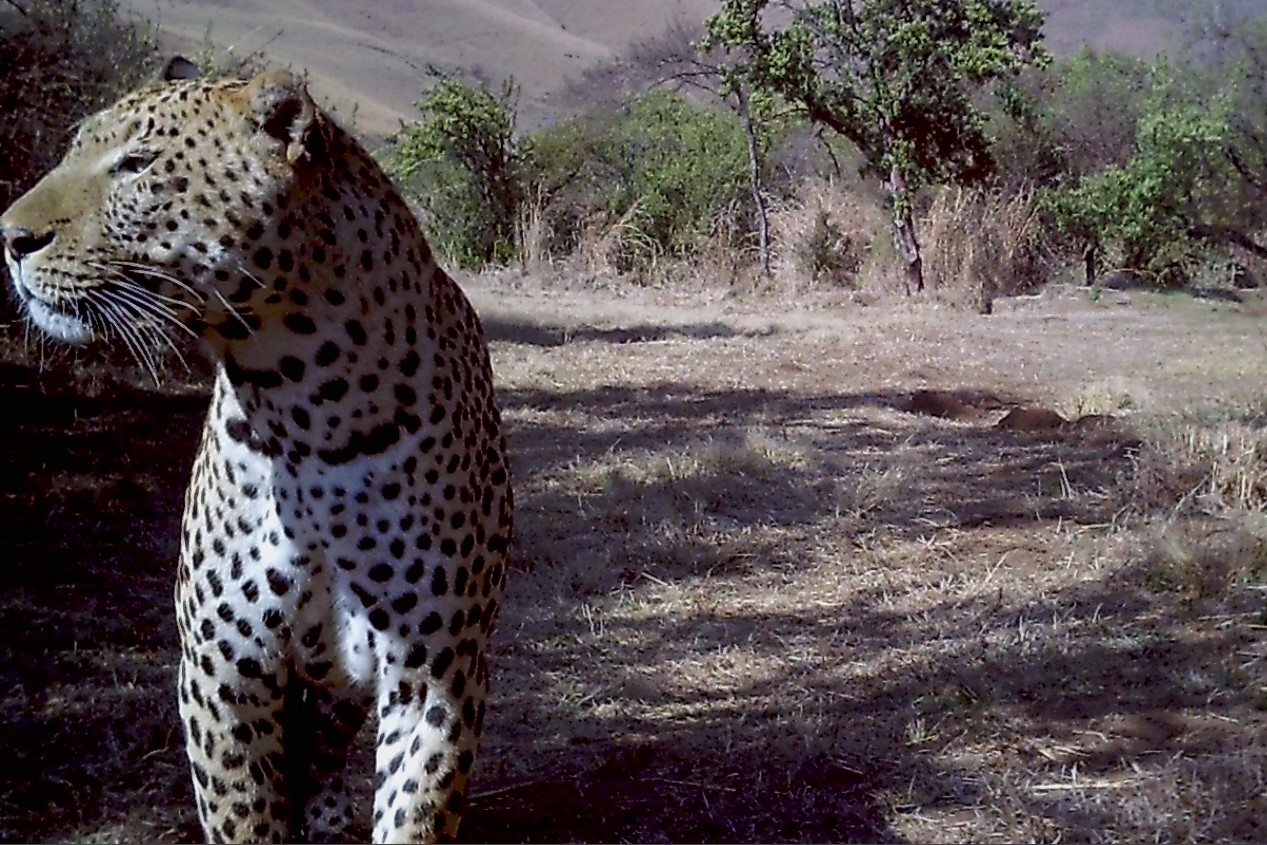
Wow, atta boy! This is our big dominant male leopard called the Spekboom Male by our neighbours at Mount Anderson Ranch. Recognisable by his asian eyes, he is young, hasn't developed a dewlap yet but he seems to have established himself on our property and our neighbours north and west according to the data collected from the many camera traps set up by the MTPA each year. Looking at the condition of his ears, it looks like he has no respect for electric fencing and therefore probably ranges even further west. When male leopards, with their large territorial ranges, range into unprotected areas they are vulnerable to being shot by landowners or killed on the roads by vehicles, the biggest cause of death in these semi-urban areas.

This photo was taken by the camera trap that is set up, facing south, on the northern side of K24, at five past nine in the morning on the twenty-sixth of August. I left the camera there for six weeks from the middle of September to the end of August and, wow, that little weir is busy! With animals much more than flyfishers! Remember the camera is fixed in position and only takes a photograph if something walks within the sensor's range. In that time the camera spotted eight visits by anglers. 

Animals were a different story: There were 33 visits of different duration (the camera keeps taking photos while the animal stays in its range while grazing or browsing, lying down and then getting up etc) and different Rams and ewes, some alone and some with lambs, of Bushbuck; 28 visits by various groupings of Warthog; 8 visits by Eland, usually at night for long periods; five visits by Leopard, at least one female and this male three times; 3 visits by a troop of Baboons passing through while foraging; 3 visits by Kudu, two lone males on different occasions and a breeding herd that spent a night there; 2 Civets passing by the camera about a week apart; 2 visits by a sounder of Bushpigs, both late at night; 2 visits by Porcupine, once a pair and once a large, solitary male; 1 visit by a Common Duiker ewe; and 1 visit by a Slender Mongoose! 

And that's only in the little spot within the range of the camera! Pretty cool stuff!

That's it for August and the beginning of September. Spring is in the air and the rains are on the way. Life is about to explode into a cacophony of colour and noise... 


Wednesday, 10 August 2022

WINTER 2022

 WINTER 2022


What a pleasant winter we have had here in the mountains! Usually every winter seems to get colder as I get older but this winter was very bearable. I only made a fire in my house when I had guests. We had three weeks of severe frost from the fist of June  till a week before the end of the month but that was about it. Well, we have had a few cold snaps since then... It was also rather moist, with many overcast days and three days of rain over J-J-June and July, albeit with only 16mm falling over the central area in all those times. 

So the vegetation is very green for this time of the year but, as you can see in the photo above of SPK 11, also lots of browns, oranges and reds. Try sitting down, facing the cliffs, with a pair of binocuars, at SPK 11 and you can spend a long time admiring the myriad cremnophytes (cliff-loving plants) attached to those cliffs. There's also a nest site for Giant Kingfishers and one for a pair of Red-winged Starlings and the Hadedas roost in the Flute Cape Willow tree on the left side. If you go there really early in the morning you may get a chance to flush them, which is quite satisfying after how often they wake us up!

The river levels are also still quite high for this time of the year. It's already August and the water is still running over the W6 monkey bridge, even though the southern part of the estate got a lower rainfall this previous season than average. I am, though, hoping for another rainy season like the last one. Where the rain started in springtime and fell gently right through the rainy season, synchronising with the growing time of the plants. It is the most productive way and is supposed to be the norm but, until last year, it seemed like the rains were coming later and later each year. 

Even though winter is supposed to be the least active, wildlife-wise, I still got to see lots of interesting stuff here at Finsbury. Check some of them out below: 


I mean, look at this foliose lichen I found on the southern side of a cluster of huge boulders just below the summit of Little Joker koppie right at the end of July, when it should be driest. It was so moist that the mosses were swollen and wet to the touch. This foliose lichen is called Rock-shield Lichen and it is from the genus Xanthoparmelia. And, as you can see, the lichens are "fruiting" which is something they normally do in the wettest times of the year. The brown discs are the apothecia, where the reproductive spores of the fungal part of the lichen are produced. Rain drops hitting these concave discs are supposed to spray the spores away for dispersal. 
I've only managed to photograph and identify fourteen species of lichen on the estate so far but, with one-thousand-seven-hundred species of lichen so far described for South Africa and an estimated thousand more, these strange organisms are another world all to themselves! Check back at my posts from Jolly Season 2018; May 2019; January 2020; and January 2021 to learn more about some of the remarkable lichens found here on the estate.


This is a Grassveld Sheepsdaisy or Geelblombos, Phymaspermum acerosum (which means: Swollen seeds, needle-like leaves). I mentioned in my last blog that these and the Wilms' Paperflower (see previous blog) were very dominant during autumn this year. The Sheepsdaisies are bright yellow when in bloom and there were fields of them during autumn this year. They have all now gone brown as the flowers die and the seeds develop but there have been a few early mornings where they have been white like the one above from the frost, making them quite beautiful again. 

This bush also makes a fine garden subject. Just one individual at the rear of the bed, against the wall, will make a huge difference in autumn when all else is beginning to fade. I do remember a few years back when Liz Steyn, from Finsbury House (unit 23), sprinkled the dry seeds of the Sheepsdaisy on a bare patch of hard ground that had been thrown over a ditch containing building rubble and the following season it was covered in them, showing how readily the seeds germinate. 


I've had quite a time recently with spiders. This chap, a Long-jawed Ground spider, Austrachelas bergii, belongs to a genus comprising nineteen rather rare species that are endemic to South Africa and of which there are very few photographs available (making this photo quite a prize according to the Spider group of Southern Africa). It is a medium sized spider that is free-living (does not use a web to catch prey), running around on the ground, during the day, in search of its preferred prey, ants. Once it has achieved its quota of prey it will retreat to it's nest, a woven, silken bag hidden among the stones, to rest overnight. 

The spider belongs to the Gallieniellidae, a small family of mostly ant-eating spiders that was thought to be endemic to Madagascar but has since been found in Southern and Eastern Africa and in Australasia. All ants are protected by the presence of formic acid within their bodies which will make any animal that regularly eats them "specialised predators" who have evolved physiological ways to process the acid during digestion. It would be interesting to see the interaction between this spider and an African Queenless ant (see blogs of "The jolly season 2018; and March 2020) which is huge with a mighty sting! I say this because the massive jaws on this spider seem like overkill for a spider that eats ants unless they catch and kill the African Queenless ant and, unfortunately, because of the rarety of the spider group, there is very little information available for them and their behaviour.


This is another spider that I encountered during the winter but this one was in my house! Besides the colour and the fact that it is hairier, it is a similar size to the above Long-jawed Ground spider, and it has long, black jaws and eight eyes in two rows just like the spider featured above. They both also construct silken sacks into which they retreat when resting. This here is a Sac Spider from the Cheiracanthium genus, probably C. lawrencei, and the two spiders featured in this post were originally classified as belonging to the same family because of these similarities but since the age of genetic research, have been allocated to different families because, genetically, they are quite different. 

One very notable difference is the venom that the two spiders carry: The Long-jawed Ground spider has a rather mild venom compared to the Sac spider. The Sac spider, with a more potent venom, is also behaviorally different in that it is very aggressive and it takes the least bit of provocation before it will bite. The Sac spider is definitely responsible for the great majority of reported spider bites in South Africa and so, is one of the four groups of medically important spiders occurring here, although it certainly is the least dangerous of them all. 

There were thirty five recorded spider bite cases in South Africa over a recent ten year period and they were represented by all four groups of medically important spiders in South Africa. They are the Button spiders from the Latrodectus genus (four of those thirty-five reported cases), and are the only members with a nerve-attacking venom; the Violin spider from the Loxosceles genus (eleven of those cases); the Six-eyed Crab spiders from the Sicarius genus (two of those cases); and then the Sac spiders which were responsible for eighteen of those reported cases. The latter species all carry a cell-destroying venom that will turn the site of the bite into a necrotic lesion within a few days from which a secondary infection may erupt. Of course, this is the worst case scenario. As with snakes, venom is an expensive process to make and so the biter (be it a spider or a snake) tends to be reluctant to use more than is necessary so, if the victim is not a severe threat to the biter, the biter will inject less venom (sometimes even no venom, resulting in a dry bite) whereas, if the victim is rather an aggressor, the biter will inject a full dose of venom. 

The least studied of the above dangerous spiders is the Six-eyed Crab spider, from the Sicarius (which means "assasin' in latin) genus because they dwell in caves in deserts and so do not really come into contact with people and so are less of a worry. The venom is cell-destroying but also thins the blood (like the venom of a Boomslang and Twig Snake) and a small dose killed a rabbit in five hours! Quicker than all the others, suggesting that the Six-eyed Crab Spider, a close relative to the Recluse spider in North America, is possibly the most venomous on the planet! I am lucky enough to have had a chance to photograph these spiders when I found a bunch of them in a cave in the middle of the Namib desert more than twenty years ago (and not to have got bitten!). I will make an effort to try and recover the slides.  


What a stunning tree! It's a Brittlewood or a Common Wild Alder, Nuxia congesta, in full bloom while festooned with Old Man's Beard lichens hanging randomly from the branches. This beautiful individual resides on the forest edge, high up above the Steenkamps' southern waterfall, close to our boundary with Emoyeni and the presence of so many lichens in the area is an indicator of clean, unpolluted air.

It is a frost-resistant winter flowering tree that reaches three to five meters in height and is a super garden subject, especially smaller gardens. The abundant inflorescences of small cream flowers are very showy and exude a lovely perfumed scent. As you can see, the tree has a very artistic manner of growth and it is also a fast growing tree that will get you about seventy centimeters per year. If that's not enough, then add the fact that it does not have an invasive root system which makes it suitable to plant near pathways and walls without lifting them later on. This feature also makes it a great candidate for large pots although it also happens to be a sought after bonsai subject!


I was clearing out a bunch of pesky young Black Wattle trees on the hill between Tranquility (unit 15) and Jackpot Cottage (unit 16) when I dislodged and then nearly trod on this remarkable insect. It's a full-grown, twenty centimeters long (maybe thirty with legs outstretched), Giant Stick insect, Bactricia bituberculata, with her pair of tubercles, referred to in the specific name, clearly visible in the inset photo as a pair of horns. I have found a male here before and he was very much slimmer, a bit shorter and his little "horns" were sharp and pointed forward like a Mountain Reedbuck ram. He also had a pair of claspers, like a male Dragonfly, at the end of his abdomen to clasp the female during mating.

Stick insects belong to the primitive order of insects called the Phasmida (Old Greek for phantom / ghost - because they appear to be plants but are actually animals) and they are generally flightless, nocturnal vegetarians. They are primitive insects and so have an incomplete metamorphosis, which means that the life cycle comprises an egg, nymph, then adult (a complete metamorphosis has a life cycle comprising an egg, larva, pupa, then adult). They are gentle giants and certainly amongst the most helpless of insects who, unfortunately for them, are highly prized as food by many predators, particularly birds. But, by spending the day looking just like a stick and feeding at night, these perfectly camouflaged insects are usually only discovered by accident, like the way I found it. And then if they are disturbed, they usually play dead, well, not really. Insects are not intelligent enough to think about these things (apparently) so when they play dead (called thanatosis), they actually incur a cataleptic fit. This is when the victim temporarily seizes up with muscles rigid while losing contact with its environment, making it look even more like a rigid twig. If this does not convince the potential predator the Stick Insect may start to bleed foul-tasting haemolymph from it's joints as a defense. But that's about it for this species, before it becomes dinner. There's a species I know from the Lowveld (which should occur here too) in the Bactrododema genus that has a pair of cryptic wings attached to its thorax (like most insects). It doesn't fly with these wings but if the thanatosis doesn't work, it suddenly flashes these wings, which have big eyes painted on them (like many moths), wide open with a flourish and this usually scares the predator away. 

The nymph hatches from its egg, looking just like a miniature adult, and immediately begins feeding, chewing up leaves from trees and bushes. Once it begins to grow, it must shed its skin, a laborious process, and emerge with its new larger skin before it continues to graze. The female on my hand here would have undergone five or six of these processes before she was an adult and was then mated with to reach the egg-laying stage for the final three months of the season.

There is absolutely no parental care involved with Stick Insects. It's as if the female doesn't even know that she is laying eggs when she lays one per night for the three month period. She simple drops an egg randomly as she is munching on a leaf with no further worry about where it lands or anything regarding the future of the offspring. The eggs are also extremely well camouflaged, though, resembling a plant seed to a tee.  I found this female at the beginning of June so I'm sure she was in the late stages of her life when we found each other. Once the female has laid all her eggs, she dies.

These insects make very popular pets with more than 300 species being tamed in the past, to as far back as the Han Dynasty in China around 200AD! The most common pet, and laboratory specimens, are the Indian Stick Insect, Carausius morosus, which get to about ten centimeters long and are very fond of lettuce. They are normally kept in a small bird or rodent cage. An odd but very gentle pet indeed!       


Anyone who has been here over the winter could not have failed to notice the little purple bushes all over the estate and entrance road, especially in dry, rocky places. It is a Wild Aster, Felicia filifolia, and, although it normally blooms copiously, this season it has been unforgetful! I found this individual up on the Miner's cottage road (you can see the soccer field in the valley far below) and chose it to photograph because of the lovely view but there were much fuller bushes elsewhere on the estate. Felicia = Felix (L) Cheerful, alluding to the attractive splash of colour (or maybe after a German named Felix, I prefer the former); filifolia = (L) fine leaves. 

The little mauve daisies, with a yellow center, are so crowded on the bush, that the dark green, needle-like leaves are barely visible and that just creates this splash of colour right through winter. Not to mention the beautiful aroma that accompanies it. Strangely, though, all the literature I can find on them suggest that they flower at spring time but I have always known them to flower in mid-winter here at Finsbury. The flowers also persist for a long time, the whole of June and July for most the bushes here. The tufts of seeds produced after the flowers are also very attractive. Like soft, puffy flower heads.

It will remain a mystery to me why these bushes are not planted in everyone's gardens in this country. The bush is indigenous to both the summer and winter rainfall regions, which means it is supposed to grow wherever you are. It is frost resistant and requires very little care. Rainfall in your region should be enough for them so they don't even need to be watered! They prefer full sun but can still thrive in semi-shade, although they will produce more leaves and less flowers there. The attractive dark green leaves make it handsome even when it is not in flower. It also responds well to pruning, so can be shaped. In fact, I can only find one negative thing relating to this bush and that is that it is poisonous to sheep. So if you don't keep sheep, you should plant some in your garden.


Finsbury has just purchased a teleconverter for my little camera and already I can see an improvement to the photos of distant things like birds (it must have been my constant reference to my camera being bad at bird photography in my posts...). This is a very common bird around the estate and it is sedentary, which means it stays here right throughout the year. No migrating, even locally (to lower altitudes close by) like many of our "sedentary" birds do because our winters can be very cold. It is a male Cape Weaver, Ploceus capensis, and is plain, bright yellow right now. Very soon, as spring arrives, he will get a dark chestnut wash over his face as he enters his breeding phase. The female is much paler with a white belly and dark eyes (very rarely light eyes) often seen together, in groups, with males.

When the breeding season starts, a bunch of males will each build a nest in a colony, usually on the same tree and begin to make a racket to attract females to come and inspect the quality of his nest. This becomes a rather noisy affair and is easy to observe at Coch-Y-Bunddhu (unit 1) in the Flute Cape Willows on the edge of K32. The thing that creates such a commotion is the fact that each male establishes a territory directly around his nest and aggressively defends this with displays and attacking intruders. You can imagine the cacophony!

If he can display handsomely enough, a female may be attracted to his nest where he will dance around singing while she enters the nest and inspects it by pulling at the walls and the floor, testing its strength. If she is not satisfied, she will depart and visit another male to inspect his handiwork. If this happens, the rejected male will often tear the nest down and rebuild, taking about a week. If she approves of the nest, then she will lie down in it, facing forward, looking out the door, before she flies out and invites copulation. Between then and egg-laying, the female will line the nest with fine grasses and her own down feathers while the male adds a tunnel to the entrance. Then she will lay three or so eggs and incubate and then brood the chicks while the male spends his nights in an adjacent non-breeding nest built for the purpose. Once the chicks begin to grow, she will also spend her nights in their non-breeding accommodation next door and before three weeks is up, the chicks are fledged and ready to leave the nest

The birds are catholic in their diet (which means they eat anything!) which includes diverse foodstuffs from crawling insect which are prised from their hiding places like Woodhoepoes do; to flying insects that are "hawked" like flycatchers do;  to licking nectar from flowers like sugarbirds do; to plucking seeds from grasses like Queleas do; to fruits picked off trees like Turacos do; to picking seeds off the ground like Canaries do; to catching grasshoppers like Shrikes do; and to picking spiders off their webs like sunbirds do! Wow! Can't go hungry with so many skills.


So I was walking along the edge of K33, the newly repaired dam on the northern Kliprots, when I noticed these pretty patterns an top of the stones and also on sticks in the shallow waters. I photographed it and found out that they are casings constructed by little worms that live in them when at rest. I returned and collected a rock and submerged it in water in an ice-cream container and took it home to study it. 


I managed to remove one of the little worms from its casing and magnified it fifty times under my little digital microscope and this is what I saw, a red worm about five millimeters long and half a millimeter or less wide. It's called a "Bloodworm" and it's not actually a worm but the larvae of a Non-biting Midge from the Chironomidae family of flies, closely related to mosquitoes or Biting Midges. They feed on nutrients and micro-organisms on the muddy bottom of waterbodies where there is very little oxygen available and so they contain Haemoglobin, a protein capable of storing oxygen. Haemoglobin is responsible for transporting oxygen in vertebrates and that is why our blood is red.


The following day I found this little pupa floating in the water of my ice-cream container. It measured about eight millimeters long. In a natural situation, the pupa develops within the case and when ready, swims to the surface of the water where it splits longwise and the adult emerges.


And because I kept the lid on the container, the following day I found this tiny adult, about two millimeters long, struggling to stay afloat. I removed it, allowed it to dry out and then managed to photograph it. It looks just like a tiny mosquito but without the biting mouthparts. Also, like mosquitos, I can tell this is a male because he has feathery antennae. Mosquitos males use these antennae, like many moths, to locate phermones released by the female, and then follow them until he finds her. This cannot be the case with Chironomid midges because the males, once emerged from their pupa, gather in swarms, like Mayflies do, and the females find these swarms and barrel into them. The first male that can hang on to her drops with her to the floor where they mate. She then flies off and when her eggs have developed, she drops them one by one into the water where they sink to the bottom and lie there until hatching. The newly hatched larvae float in the water and eat microorganisms and, only after the first moult, do they sink to the bottom, build their case, and become bottom feeders.

Most lakes, dams and streams are home to fifty to a hundred different species of Chironomid, making this family of midges the most abundant primary consumer in these waterbodies. Collectively, they harvest an enormous amount of energy from detritus in water, making them vitally important in aquatic ecosystems. And they occur all over the world. In fact, they are the largest permanent terrestrial species of animal found year-round in the antarctica!

As winter comes to a close, the days are becoming longer, quickly, as we approach springtime! We hope to see you all this spring. Please don't hesitate to ask me if you want me to guide you and your visitors on an amble, walk or hike here on the estate while you are here. You can email me before hand at jimmy@finsbury.co.za, or radio me when you are already here. See you then :)
 

Thursday, 2 June 2022

ERRATUM

 ERRATUM


Oh dear. I made an error in this most recent newsletter, AUTUMN 2022. 

The photograph I presented (above) was actually taken during an experience I had just three days before the one I expressed in the article on Baboon spiders, Harpactira tigrina. On this occasion, the previous Saturday, I was walking with the Beaumonts, from Coch-Y-Bunddhu (unit 1) and others when one of the group displaced a stone on the pathway. I noticed this Baboon spider resting restlessly, where the stone used to be, beneath the hammock-type web I explained in the article. That's when I managed to maneuvre it onto my hand for the photograph. This individual, darker in colour and with a more patterned carapace, is probably a male, like the other one, that had secured a refuge between forays in search of a female. Or it could be a female whose burrow had been damaged. 

Whatever. The photograph below is of the spider, lighter in colour and with sparser markings, I was referring to in my blog. I stumbled across it while working on the Rock Kestrel trail on the Tuesday after the previous sighting.... Got mixed up there.... In ten years I have only seen two Baboon spiders here on the estate (although the one in the burrow I know of, I have seen often - even her spiderlings) and suddenly I see two within a week!


I do remember how this one ran over the grass with ease, using its long legs to distribute its body weight like a longclaw would do. Beautiful specimens and I am very fortunate to have bumped into two of them in such close succession.


AUTUMN 2022

 AUTUMN 2022


Autumn has come and gone and with it, the warmth! But even though the morning temperatures have dropped significantly, we still received 74mm rain over the office during the month of April and 75mm during May. Our average since 2010 during April is 61mm and the average for May is 13mm so we have had a great rainfall season all around! Our first rains for the season were in August and we have had good, absorbing rains ever since. In the last five or six years, the rains have only arrived well into the summer, around October and November, which excluded a lot of the growing time from rainfall. The bush here is lush and green and the aquifers are topped up nicely so the rivers are at a good level for this time of the year.

 What has probably been the most noticeable change during the Autumn time, though, are two species of plant that are flowering en masse. The first is the bright yellow Geelblombos, Phymaspermum acerosum, that grows in the valleys (note: I have told everybody that I couldn't find an English name for this plant. I now have. It's called "Grassveld Sheepsdaisy"). The second is the Wilms' Paperflower, Helichrysum wilmsii, which grows up in the grasslands. In the picture above you can see Mark and Theresa Cotterell and their pooch, Charlie the poodle, from Rainbow Rivers (unit 17) hiking into a field of these paperflowers on the Amphitheater hike above Hidden Valley. 

Although these paperflowers are very beautiful with the outer side of the petals (actually bracts) a deep maroon and the inner sides white, with these petals surrounding a bright yellow center, and all the flowers facing the same way as they follow the sun (like sunflowers), having fields of them dominating the grasslands is a sign of environmental stress. These are the woody plants that I was going on about in my last blog that, if they dominate, indicate that that area has not burned frequently enough which is, in turn, allowing woody plants like these to overtake the grasses in a grassland. This will ultimately kill the grasses and the absorptive quality of the grasslands will be compromised (see last blog), affecting the healthy flow of our rivers.

The burning projects that we have undertaken in the last few years have reformed lots of our grasslands but there are still some areas that are affected, as seen above. No worries though, I'm on it: I'm hoping, if we have nice spring rains next season like we had this season, to burn this area in spring with a hot fire so that it is nice and green by Christmas time, sans the everlastings. Well, the everlastings will still be there but, with a proper fire regime, will never dominate and choke the grasses out.


These fields of Wilms' Paperflowers are vast magnets for generalist pollinators like bees, beetles and butterflies who are attracted to the nectar and pollen produced. Here we see a Painted Lady butterfly, Vanessa cardui, sucking up nectar from one of these flowers. 

The Painted Lady butterfly is the most widespread butterfly in the world and occurs everywhere except Antarctica and South America. They also take part in massive migrations in Asia and North America. In the largest of these migrations, it takes six generations of the butterfly to migrate, in generational steps, using the sun for direction, from Tropical Africa right up to the Arctic, a fourteen thousand five hundred kilometer round trip. That's, like, almost two thousand five hundred kilometers per butterfly per generation!

Most butterfly species have a very limited amount of plant species that they use as host plants for their caterpillars to feed on and the gravid female butterfly finds these plants by recognising the unique volatile chemicals released by those particular plants and then lays her eggs on them. This ensures that the caterpillars are on the correct food plants when they hatch. This system ensures that there is less competition between species for food and therefore increases the survival rate of the offspring. The migratory habits of the Painted Lady make this strategy impossible to follow because very few plants are widespread enough to be available to the butterflies over the massive areas that they roam. There are more than three hundred species of plant that the caterpillars of the Painted Lady have been observed feeding on. The gravid female Painted Lady butterfly does not select particular plant species to lay her eggs on, she chooses the plants that have open flowers and nectar for the adults to feed on as the host plants, no matter which species they are.

This strategy negatively affects the survival rate of the caterpillars but these butterflies do not have a mating season and so breed throughout the year, laying batches of eggs over and over, ensuring that, at least, there is enough offspring to counter the massive mortality experienced by their caterpillars.    


While walking the Spekboom river footpaths recently, I noticed that the base of many tree trunks in the thick riparian bush on the north side, had two or three of these hollow exuviae, sloughed skins left by Cicada bugs once they emerged from their final nymph stage into their winged, adult stage.

Cicadas are best known to us by the loud, high-pitched, incessant buzzing sound that the males produce to attract the attention of a potential mate. The females hear this with with their tympanal organs which pick-up and analyse sounds, particularly the mating buzz of the males. The males also have these hearing organs but must disconnect them when calling because the sound he produces can reach, in some species, one hundred and twenty decibels (a gunshot is around 130db) and that would damage his own hearing.

If you manage to catch one of these bugs and turn it on its back, it is easy to distinguish between male and females: The female will have a sharp, scythe-like appendage (ovipositor) at the tip of her abdomen while the male will not. Instead, he will have two semi circular plates at the rear underside of his abdomen which cover his sound-producing organs. Both sexes' "ears" are situated here in the abdomen too. The sound-producing organ of the male are, in effect, two separate membranes supported by powerful muscles that vibrate and "pop" the membranes up and down, very much the same as you pressing the bottom of a tin in and out. Most of the remainder of the male's abdomen is hollow which helps amplify the sound. The hollow cavity in the males' abdomen also has folded membranes on each side that can be unfolded and re-folded to adjust the volume of the sound produced and when the bug calls it constantly adjusts the volume and this helps to create a ventriloquist type of scenario where it is difficult for predators (and curious human beings) to pin-point the insect.

Once the female responds to the mating call and mating is complete, she will cut a slit into the bark of a branch or twig and lay an egg within, repeating this process until she has laid all her eggs. After about six weeks, the nymphs hatch from the egg and drop onto the floor and immediately burrow into the ground with their powerful, folding forelimbs. They dig down until they encounter the roots of a plant and then create a little chamber in which they will reside while they puncture the root and the xylem within with their rigid proboscis and suck the juices out. The xylem is the vascular pathway that transports water and minerals from the roots to the rest of the plant.

These Cicada nymphs will reside underground, burrowing from root to root, until they are fully developed. Most species are referred to as "annual cicadas" and their nymphs will spend from two to nine years feeding like this underground before they are fully developed and ready to transform into an adult. But at least two species in North America (and more than likely in Africa too) are referred to as "periodic cicadas" and they synchronise their breeding and egg-laying activities so that the nymphs emerge thirteen and seventeen years later respectively en masse! This strategy is employed to increase the survival rate of the insect by flooding the "market" with youngsters so that, even with a high predation rate, the survival rate will be adequate for the species' survival. Also, it reduces the chances of a specialised predator from evolving because the long time frame between the emergence of the generations is longer than most insect will live, forcing them to find other prey species. 

Periodic cicadas or not, when the nymph emerges from underground, it climbs up the base of a tree trunk and secures itself there with it's powerful forelegs and rests. After a while, the skin on the back of the nymph splits open and the adult slowly emerges, wings and all. Adults retain productive mouthparts and, instead of feeding underground from the roots of a plant, they puncture the stem of the plant above ground, and suck the juices from there. The big rounded "nose", easily visible on the nymph and the adult, houses the pumping muscles that suck the fluids from the host plant. If one manages to find a bunch of these insects together on a branch of a tree, one can safely deduce that it comprises a mixed sex grouping at a feeding site.     


How cool is this relatively small Golden Baboon spider, Harpactira tigrina? It certainly is a large spider but they grow a lot bigger than this, big enough to fill my hand almost completely. And, as you can see, although they appear menacing, they are actually rather placid and tame quite easily, making them popular pets the world over. Unfortunately, this results in people collecting them from the wild which put natural populations under stress. Even making them locally extinct! 

Although Baboon spiders prefer subtropical and tropical climates, they are still quite common in our grasslands but are seldom encountered because they are active almost strictly at night-time only. The days are spent resting within the safe confines of a neatly constructed burrow that extends about thirty centimeters vertically underground with a sharp corner at the bottom that opens up into a small chamber. The whole affair is thickly lined with silk and, often, once the spider is in attendance, the circular burrow entrance is closed over with a silken barrier (See my blog dated November and December 2020 where you can see a huge female spider, with spiderlings, right at the entrance to her burrow). 

I encountered this chap in the open grasslands, in the daytime, far from any burrow. This leads me to deduce that it must be a sexually mature, wandering male, in search of the scent trail a mature, unmated female left behind her while out hunting in the nights before (see same blog for an explanation of his actions after he finds a scent trail). The lifespan of the male is very much shorter than that of the female (who lives to 25+ years!) because he spends so much time outside the safety of his burrow and is thus exposed to more predators.

The burrow is dug and modified over a period of many years as the spider grows and sheds skin. Once an adult and fully grown, the spider loses the ability to dig efficiently and so no longer modifies the burrow, mainly because she has reached full size. And so, if the burrow is exposed and damaged, the spider will be forced to abandon its home which puts it under significant risk because it is unable to construct a new home. In this case, it will usually build a roof of silk in a concealed spot and spend its resting time beneath this hammock-like web where it is exposed to more predation and fires and weather dangers than it otherwise would be.


I just had to add this photo to this publication! I arrived at K24 while it was still very early and the sun had not yet risen. Unbeknownst to me, I parked on the stem of a Wild Stockrose, Hibiscus canabinus, and off I went to complete my chores. When I returned to my bike a few hours later I noticed how the strangled flower still stubbornly opened up to fulfill it's function of attracting pollinators. I gingerly removed the front tyre from the neck of the plant and it immediately stood up proudly! See, even plants can be stubborn :)


This nasty looking critter is, well, just that: Nasty! This terrifying beetle is a Ground beetle from the Carabidae family of beetles. The main feature that separates beetles from other insects is the fact that the first pair of wings have hardened and serve as armour over the abdomen. The second pair of wings are folded up beneath these hardened wings and, when the beetle wants to fly, the hardened wings open up on hinges on the top of the abdomen, nearest the thorax, and the wings unfold and the beetle flies away with the rigid front pair of wings awkwardly folded open like this. Many species of beetles' first pair of wings, like this Ground beetle, have fused together and they have lost the second pair, rendering them flightless but extremely well armoured. 

Ground beetles have a pair of glands at the tip of the abdomen that store and then, when its life is in danger, mix and expel noxious gasses like formic acid which, in some species, has an audible "pop" as it explodes. Other species, like one I know from the Lowveld, squirt the formic acid, with precision, towards the attacker's face and eyes. The common Afrikaans name for this species is "Oogpister" for that reason. In fact, the newly hatched babies of the Bushveld Lizard look nothing like the cryptic coloured adult lizard. Instead they are black with two yellow spots on the side of their bodies and when they are molested, the lizard arches its back and walks slowly just like the Ground beetle it is mimicking and, hopefully, scares the attacker off. This is one of the very few examples of vertebrates mimicking an arthropod! 

Either this individual belongs to the few species that do not have this ability or this beetle was not upset or afraid enough to use this defense (the formic acid is expensive for the beetle to produce so it will only use it in extreme circumstances) because it remained quite relaxed in my clutches. The jaws, though, are something that needs to be avoided because they are quite capable of administering a painful bite. These jaws are used to grab and subdue their prey items as they run across the ground in search of anything they can overcome. A seriously well-armoured insect with massive jaws and a chemical defense system is not to be trifled with!


These are the leaves and fruit of a Narrow-leaved Sand-olive, Dodonaea viscosa ssp. angustifolia, very widespread with a tolerance of a wide variety of habitats from semi-arid deserts to forest fringes in high rainfall areas. They occur in tropical, sub-tropical and even temperate climes from South America, through Southern Asia and into Australia, New Zealand and the Pacific islands. Possibly the tree with the most common names because each country has its own name for it. Probably best known as a Hopbush, one of the Australian names that has been adopted by nurseries around the world. Hopbush comes from the fact that it was used instead of hops in the brewing of beer in Australia. The tree is resistant to salinity which has made it the preferred tree to plant to stabilise dunes. It is elasticky (not really a word) which affords it resistance to high winds, and it is thus used for windbreaks. It also has a tough, durable wood and has been the wood of choice for weapons, walking sticks and implements in all the countries it occupies. 

Although the tree is more like a large, shapeless bush, the shiny leaves, pretty little clusters of flowers and attractive fruit (the fruit in the picture is newly formed and will turn a shade of pink as it develops) make it a good garden subject. An easy place to find them on the estate is on the steep bank that leads down to the carport of Kingfisher Lodge (unit 6).  


In my blog of November 2019 I featured a little blurb on Bark spiders, Caerostris sp. There I mentioned how they spin a massive orb web in the evening and then dismantle it by eating it around dawn the next morning and then lay up against the bark of a tree during the day, almost invisible thanks to their camouflage. I also mentioned how my daughter and I witnessed a Bark spider eat its web in less than two minutes (it's a huge web!). In fact, it was dazzling because, I'm sure if I scrunched the web up in my hand and rolled the silk into a ball, the ball would be bigger than the spider, not just its stomach! If the spider did not do this, the web would simply be too expensive to build because it would have to build a new one everyday. This is because it would most certainly get damaged during the day because the web is usually spanned across a large open area and would be in many an animal's way during the day. 

Anyway, what is exceptional about this spider is that, although it is the same species as the spider I previously featured, this individual has a snow-white patch on the forepart of it's abdomen which would negate the effectiveness of it's camouflage in the habitat that the other one occurred but here, where I found this one, there was a ton of white lichens attached to the stems and trunks of the trees, making this spider's camouflage even more effective! Just goes to show how local conditions can affect the morphology of a species. 

In my blog of December 2019 I featured a photograph of a male Drakensberg Crag lizard with his mix of cryptic colouration and bright orange. They are endemic to these parts of the Drakensberg where there is an abundance of Firedot lichens (see blog of May 2019) attached to the rocks and boulders. The Firedot lichens are bright orange making the bright orange on the lizard an efficient camouflage! This spider goes one further: a single population of  spiders of a specific species is marked differently to the rest of the species because of it's immediate surroundings. Now that's adaption! 


This is a picture of a completely defoliated Common Sugarbush, Protea caffra, taken on the crest of a hill high above Pebble Creek (unit 25) and Kliprots Creek (unit 24). Since the beginning of the rainy season I have noticed that at least half of the Common Sugarbushes on the estate have been under severe stress. The leaves have been discoloured and the flowers were dying while they were still mere buds. I checked the entire property and noticed that the problem was occurring throughout the estate and was affecting from a third to a half of the population. But only the Common Sugarbush was affected, not the Silver Sugarbush which is just as widespread and lives together with the Common Sugarbush in our grasslands. I took photos of the infected leaves and flower buds and sent them off to some of my botanist friends at the Mpumalanga Plant Specialist Group and, fortunately, they responded that it looked merely like a fungal infection, possibly caused by the long, wet rainy season we have endured, and that I shouldn't worry but need to keep observing the situation. 

Now recently, all of those dead leaves have dropped off and brand new, bright red leaves are emerging (in Autumn!) on all the affected trees. This is good news because it means that the trees are still fine and it was just a single generation of leaves and flowers that may have been affected. We'll see next growing season if the sickness has gone or not.


As you can see by the date stamp, this photo was taken, by one of our camera traps, during the month of May six years ago. The reason I am publishing it is because just the other day I was a spectator to a severe battle between two male Natal Spurfowl, Pternistis natalensis, in my garden that persisted for some time and I did not manage to get a decent photograph because they were so very mobile! Afterwards I walked around the garden and found tufts of feathers all over the place! 

I went through my francolin photos and found this one which I think it is appropriate because the photo was taken extremely close to where my house is now. In fact, I think the house may be on top of the place that this photo was taken. If you look carefully at the photo, you will notice a large spur at the back of the bird's leg, just before it is covered by feathers. That feature distinguishes the bird as a male because the female does not have this spur as it is used exclusively as a weapon and the males are the ones that get into fights. This will mean that there is a good chance that the francolin, sorry, spurfowl, in the picture is the great great (many times removed) grandfather of one of the two spurfowls that were fighting so enthusiastically around my house. How cool is that?

Natal Spurfowl are monogamous and sedentary, meaning that the two males were more than likely fighting because of a territorial dispute. They groupings of Spurfowls and Francolins are called "coveys" and a covey of Natal Spurfowl consists of the mating pair and their offspring who remain strictly within this territory, with the youngsters dispersing when they are sufficiently confident to do so.. The female lays up to eight eggs in a shallow scrape on the floor, in thick bush, lined with only a few feathers and the eggs hatch within three weeks. The chicks are born altricial, which means their eyes are opened immediately and they can run around with their mothers as they hatch from the egg. They are so well developed at hatching that they can fly within ten days!

For the younger folks: We used to call all of these partridge-like birds Francolins but, even though they appear similar, they are now classified into different clades after genetic research. Generally, the Spurfowls tend to be bigger, live in denser environments and have harsh, crowing calls which they often emit from an exposed position (like a rooster from a perch). While the Francolins tend to be smaller, live in open environments and have whistling, melodic calls that are made from the ground. So in Finsbury then, we have Natal and Red-necked Spurfowls in the thickets mainly in the river valleys, and Red-winged and Grey-winged Francolins in the open grasslands


Meat product manufacturers use meat preservatives to prolong the onset of oxidation, enzyme reactions and microbial spoilage, and thus extend the shelf-life of their products. I'm sure we all remember the Listeriosis breakout a few years ago that killed many people who ate the infected meat products. 

Synthetic preservatives have been, and still are, used in meat production but there have recently been concerns over the potential carcinogenic threats these preservatives pose to the consumer. Also, it has been found that the microbe Listeria monocytogenes, amongst others, are resistant to these synthetic preservatives (hence the Listeriosis outbreak a few years ago). Even more worrying, adding these synthetic preservatives to meat products has resulted in the emergence of resistant strains of microbe that are difficult for the industry to manage, creating a need for natural, organic preservatives.

This tiny, delicate little flower is that of a Fever Woodsage bush, Teucrium trifidum, found here on the estate and widespread over Southern Africa. It is used widely in traditional medicine for its anti-microbial activities and, because there has been a recent demand for natural preservatives, scientists at the Govan Mbeki Research and development centre at the university of Fort Hare have tested it, in 2020, to determine its potential as a source for natural meat preservatives.

This was their conclusion: " The aqueous acetone, ethanol and methanol T. trifidum extracts contained condensed tannins, flavonids and phenolic compounds which showed significant free radical mopping capabilities. In addition, the extracts demonstrated anti-bacterial activity against gram-negative and gram-positive bacteria. The T. trifidum extracts can potentially be used as a natural source of antioxidant with antimicrobial components and can therefore be used as preservatives..."

Funny how we moved from natural to synthetic and now we are moving from synthetic back to natural. When will we learn?

Well, that's it folks! Autumn has now come and gone as we now enter w-w-winter, the big chill. See you next time!