Wednesday, 1 February 2023

THE FESTIVE SEASON 2022-23

 THE FESTIVE SEASON 2022-23


The festive season was lots of fun but, alas, it's over :( The weather, in the first half of the season, was exciting, mostly wet and tempestuous with glorious hour-long breaks of sunshine pretty much every day. So, even though it rained regularly, it was still possible to get out and have fun between the wet spells. And so, in December it was wet, with an average of 243mm falling on the estate over seventeen rainy days in the month. The most falling on the eastern parts of the estate, with 318mm recorded from the gauge at Rock Solid (unit 22), and the least falling on the southern parts of the estate, with only 208mm falling over Patrick's gate in the west (only 4,94km west north-west away, as the crow flies). Conversely, January has been dry, with an average of 110mm falling over the estate in just six days of rainfall! It looks, though, we may be getting some good rains in February. Let's hope. 

As far as I am concerned, the rain, unlike last season, has been hard on the environment. When it has rained, it has rained hard, with leavy drops, and lots of them. This is a recipe for erosion and run-off, but it certainly is better than too little rain. As you can see by the photo above, taken from the Miner's cottage road, close to the second zebra trail sign (see the cottage on the left), the estate is lush and green. And everything is just growing like crazy. Wow, I love all the life! 


Like the US postal service boasts about rain or shine, most of the families that visited did not let the rain dampen their spirits and were out and about in spite of it. I bumped into one such family, coincidentally, at a similar place to where the photo I just spoke about was taken (this time the Miner's cottage is in the back-round just to the right of the family). The Joostes from Coch-Y-bunddhu (unit 1) were all over the estate during their time here. In fact, I saw more families and groups exploring the wilderness areas of the estate than I have ever seen before.


An East African Lowland Honey bee, Apis mellifera ssp. scutellata, searching the flower of a Ribwort Plantain for even more pollen, although it appears its pollen sacks are overflowing already. Even that common name is quite a tongue-twister, eh? Well, you see, the taxonomy of Honey bees has been very difficult to interpret, mainly because they have been domesticated for at least 2600 years and have, therefore, been interbred and inbred since then and now occur, in abundance, on all continents. 


It is believed that the Apis genus originated in southeastern Asia and the Philippines, and the A mellifera type species then spread into Africa. Thereafter, the desertification of the Middle East separated the species which isolated the African genome. This genome went on to adapt to two very different climes within the continent, the summer rainfall regions which occur throughout the continent and, of course, the winter rainfall region which only occurs on the very south-westerly tip of the continent. So, in South Africa we have two indigenous species of honey bee from the Apis genus: Apis mellifera scutellata and Apis mellifera capensis separated by climate.

In 1990, beekeepers moved a bunch of Cape Honey bees from the winter rainfall areas to the summer rainfall areas of South Africa, which swiftly became a big problem for the indigenous East African Lowland Honey bees, residents of the summer rainfall areas! A queen bee of a hive produces pheromones in her mandibular glands that control the behavior of her worker population. These pheromones recognise her as the queen; prevent the workers from attacking her; ensure she receives better quality food; and prevents workers from developing their ovaries and laying their own eggs (although, if this does happen, these eggs are usually weeded out of the cells by more closely related workers of the Queen anyway, and those that do hatch are males and are therefore evicted the following winter). 

Unfortunately, Cape Honey bee workers can enter the hive of an East African Lowland Honey bee colony, can develop her ovaries and lay haploid eggs, by parthenogenesis, which are female, in cells which are ACCEPTED by the young workers who tend the eggs and pupae. By doing this, the Cape Honey bee paratisises the East African Lowland Honey bees' colony. The new female Cape workers do not forage for food or anything else that benefits the colony, and so, as the population of Cape bees grows, the indigenous workers' population decreases and finally the hive collapses. The female Cape workers then move to other East African hives and the process repeats itself many-fold! 

A barrier separating the two subspecies was established 1993 and beekeepers are not allowed to take the Cape Honey bee across it. This has saved the beekeeping industry in South Africa. 


Shaggy Ink Cap, Coprinus comatus, found on the Hidden Valley road around Christmas time. This mushroom is a close relative of the Snowy Ink Cap mushroom that I featured in my previous blog. The specific name, comatus, is the latin term for "long hair" or "leafy" referring to the hair-like scales on the cap, also the reason for the common name: Shaggy. This mushroom also has a negative effect on individuals if they consume alcohol as in the previous species, although not as pronounced. The fact that the effects are not as acute and the fact that they taste really good has made these popular eating. But only if one eats the young, unopened individuals like the one on the right in the picture above. 

To recap: The "Inkcap" part of the name comes from the ability to extract a permanent, browny-black ink from the mushroom. Once the spores are produced in the gills, the gills begin to deliquesce into a black, gooey slime. That which drips to the floor, impregnates the floor with spores. The stink of the slime also attracts flies who transport the spores that stick to its legs and when the remaining slime dries, the spores flake off and are transported by wind to far-away places. For those that want to get the ink from the mushroom, simply place a few whole mushrooms into a glass jar and seal the jar for a couple of days until the jar contains a gooey black mess. Sieve the contents through a baking sieve and, Viola, what remains is a good quality ink, albeit a stinky ink! 

The tall individual here was quite a robust mushroom, standing more than 400mm tall. Upon closer inspection, the shaggy cap is actually quite beautiful, with many colours and a lovely texture. One of the prettier mushrooms I have seen on the estate.


A poor photo because of very poor light, but a remarkable creature! This is an Ant-mimicking Jumping spider, Myrmarachne formicaria, that I found on the patio of my house. The male apparently has the long chelicerae, as in the photo, but I cannot seem to find the reason for that adaption. Besides the long chelicerae and the huge, forward-facing 'headlight' eyes, the mimicry is superb! Experiments have proved that these jumping spiders are preyed upon four to five times less that a non-mimicking species, so that is obviously the reason for the mimicry. Ants bite, sting and are filled with formic acid and so are preyed on less than other insects in general. There is also speculation that the mimicry allows the spider to get much closer to insects, like scale insects (see "ants and aphids", blog of January 2020; and "Scale insects", blog of May & June 2021), which it then attacks and devours. There have been no reports of this being observed yet, though.

But looks are not enough. The spider also behaves like an ant: When running, it purposely runs on a windy trajectory that changes every ten or so body lengths, mimicking an ant that is following a pheromone trail left by another ant in the colony. Also, although it runs on eight legs, like a spider, and not six like an insect, it stops periodically and lifts its front legs off the ground and waives them around, just like an ant does with its long antennae. This was all noticeable as I followed this guy around my stoep. A really clever survival tactic. Amazing stuff!


This lovely, colourful photo, taken by Ally from Ally D Photography (guest of the Bands of Finsbury House (unit 23)) of an adult Malachite Kingfisher, Corythornis cristatus, on the left, feeding pieces of frog to his / her fledged offspring. The photo was taken at K13, a weir where these spectacular little birds are regularly spotted. After the Pied Kingfisher, these are the most common and abundant kingfisher found on bodies of fresh water. They do prefer slower-moving water than what we get here at Finsbury, which explains why we don't see them at every second weir, because, along slow-moving rivers, you will find a pair on every two-hundred-meter stretch! So, along rivers where populations are saturated, a monogamous pair of Malachite kingfishers establish a linear territory stretching about two-hundred meters along the river, with perching space on both sides.

After brief displays by both sexes, copulation occurs and then both sexes begin digging a narrow (about 40mm in diameter) hole into a vertical sand bank. The tunnel is dug to a depth of about a meter, at a slight incline, and then a fist-sized chamber is hollowed out at the end. The adults, stooped, fit snuggly along this tunnel when accessing the nest and the constant backwards and forwards shuffling creates parallel ruts along the floor of the tunnel, a characteristic feature of an active Malachite kingfisher's nest tunnel. Once completed, there is no extra comforts or bling added, the female lays two to four eggs on the floor of the chamber.

Both sexes incubate the eggs, and within two days they will hatch. The chicks are fed minnows, tadpoles, insects and their larvae and nymphs, pieces of frog, crab and lizard, for just over two weeks when, suddenly, a few days before fledging, the constant supply of food slows dramatically, and the chicks visibly lose weight. It is believed this weight-loss allows the chicks to negotiate the tunnel easier, as they prepare to fly for the first time. Once fledged, the chicks will remain with the parents, as is the situation in the above photo, while the parents teach them how to hunt and what to hunt. The chicks are then evicted from the territory and must fend for themselves.

Then the whole show starts again! Although, if the nest was built in a suitable spot and there were no problems, the pair will use the same nest over and over again, raising as much as four broods in a season. Even using the nest again in the following seasons. One problem, though, is they do not clean the nest of scraps, bones, or even faeces. In fact, it's so gross in there that, at the stage before fledging, there is usually a slimy, stinky ooze dripping out of the hole entrance (the reason for digging the tunnel at a slight incline)! 


This is a nice close-up shot of a Dancing Acraea butterfly, Hyalites eponina, waking up on its night-time perch. It's a small (wingspan less than 40mm), common butterfly found in riparian bush and on the edges of forests on the estate. In fact, it is ubiquitous throughout the eastern side of southern Africa in wooded habitats. The female, whose colouration is very variable, can be seen flying slowly, low to the ground as she searches for plants belonging to the Malvaceae (Hibiscus family), particularly Triumfetta and Hermannia species, so she can then lay a batch of eggs on the underside of the leaves. The larva, a prickly little worm, will devour the leaves on the host plant before it will anchor itself to the bush and enter its pupa stage. If this happens early enough in the season it will exit the pupa in the same season, or if later, then it will over-winter in the pupa stage.  


Goody Gumdrops! A new species for our list. This is a Purple Gorse, Muraltia flanaganii, and I found it in a rocky area on the high-altitude grasslands above Knife-edge Ridge, in the extreme north-east of the estate, while hiking over Christmas time. It is in the Milkwort family (Polygalaceae), in the same order as the Pea family, all with a familiar flower design. The plant was described by Harry Bolus (1834 - 1911), a very well-known botanist from the day. He was an accomplished businessman, a philanthropist, a botanist, and a botanical artist. In fact, to those orchid fanatics, he is very well known for the immense work he did on the orchid family.

Of the 115 different species from the Muraltia genus, this one and only four more occur outside of the Cape Floral Kingdom, making it a typical fynbos plant, hardy and able to survive in nutrient poor soils with erratic temperatures and rainfall. Its close cousin, M. heisteria, is a popular garden subject because of these attributes and, so, this one should be a good one too, outside of the winter-rainfall areas. Perfect for a rockery, the rounded shape of the bush, the attractive leaves and copious white, mauve and purple flowers make for a jolly sight.


The hairy caterpillar of the Mountain White-spot moth, Mesocelis monticola, feeding on the leaves of a low-lying plant in our high-altitude grasslands. This species is the only one in the genus (monotypic), which is placed in the Lasiocampidae family. Lasio (Gr)= Hairy; Campa (Gr)= caterpillar; Meso (GR)= middle; ocelis (Gr) = eye (referring to the eyespots in the middle of the wings); monticola (Gr) = to love mountains. Very descriptive!

Once the caterpillar has had its fill, it will spin a tough, papery cocoon on a twig of a tree or bush that serves as a food source for the caterpillars. After pupation, the male emerges from the cocoon as a drab, bulky, brownish moth with a white spot on each forewing. The female is apterus, meaning she has little stumps instead of wings and she cannot fly. She will remain in the cocoon and release her reproductive pheromones into the air and the male will, hopefully, pick these up and find her and impregnate her while she is in the cocoon. She will then emerge and lay her egg batch on the host plant and the cycle will repeat itself. 


This is very exciting! This is the first confirmed sighting and photograph of the super-elusive Natal Cascade frog, Hadromophryne natalensis, from the very primitive family of frogs, the Heleophrynidae, the Ghost Frogs. The photograph was taken by Don Robertson while he and Heidi Robertson (Rainbow Rivers unit 17) were hiking to the Steenkamps' waterfalls!

In this ancient linage, the frogs lack ribs and have no dentate upper jaws. They have thin, translucent belly skin, through which the muscles and organs can be seen, and it is believed that that is where its family name, Ghost Frogs, comes from. Another primitive trait is that they perform amplexus, which is when the males clasp the females during mating, the old inefficient way. In frogs and toads, fertilisation is external, so the female lays the eggs while the males fertilises them immediately as they emerge from her. The males of modern frogs clasp the female under the armpits whereas, the more primitive and inefficient method sees the male clasping the female around the waist (inguinal amplexus).

The entire family contains only two genera and six species, five of them, the Ghost frogs, endemic to the Eastern and Western Cape and one species, this Cascade frog, alone in its genus, is endemic to the Drakensberg escarpment. 

Now there are some problems that a frog may face when living in cold, fast-flowing streams high up in the mountains that these frogs have adapted to overcome: Among a few unique traits of the tadpoles' head is the presence of a large suction cup around the denticles that help it stick to the rocks while still feeding; the adults have expanded disks at the tips of fingers and toes for the same reason; they have fully webbed feet to fight the current better; flattened bodies to fit inside cracks in rocks; and the eggs, from one to two hundred per laying, have a sticky surface to stick on rocks after amplexus.

Although the adults are hard to find for most of the year besides late summer when they breed, the tadpoles are apparently easy to find because they are quite unique, they are also visible throughout the year because, the water being so cold, it takes two years to develop into a froglet. I have also read that the adults like to emerge during full moon time so I will endeavour to visit the Steenkamps' waterfalls during a full moon soon. Thanks Don and Heidi :)


When I was doing the electricity readings in December, I found fresh male leopard tracks coming from the northern parts of the estate all the way down to the southern areas. So, after I had photographed the meter at Rainbow Rivers (unit 17), the last meter to photograph, I was headed back, on my motorcycle, to the office when I saw a huge African Black eagle / Verreaux's eagle standing on the grassy slopes just above the Majubane road as it passes the entrance to Tranquility (unit 15). 

I rode past so as not to scare it away and parked a little further along the road. I unsaddled and snuck closer using the bank on the side of the road as cover. I got to about twelve or so meters from him and was about to expose myself to get a good close-up shot of it when my foot disturbed a mass of flies on the floor. I looked down and saw the innards of a medium-sized mammal, covered in said flies, on the side of the road by my feet. This unexpected movement alerted the eagle and I just managed to get a couple of shots off while it was flying away. What an enormous bird! It's like a hang-glider! 

Anyway, I climbed the bank and approached the spot where the eagle was and found the freshly cleaned skull of a young warthog. I pictured what an amazing sight it must have been to see a Black eagle take a young warthog. It must have been a noisy affair indeed! On the way back to the road I found the fresh tracks of the big male leopard that I had been seeing the whole morning, moving quickly from the carcass to the thick riverine bush of the little gorge where unit 15 gets its water from.

So, I deduced that the leopard killed the warthog early in the morning (after it was light of course) and was eating it, under the watchful eye of a perched Black eagle, when I approached on my motorcycle on the way to Jackpot Cottage from Morrin Pools. This chased the leopard into the thickets and, after I had passed by and the leopard did not return, the eagle moved in to scavenge the remains, which is when I rode back after taking photos of the meters at those two houses. What an exciting turn of events!


Another first! This is a photograph of a Stonefly from the Notonemauridae family in the primitive Plecoptera order and this is the first photo of any individual from that order to be added to our insect list. 

The first true insects appeared in the middle Devonian, about 390 million years ago. They were rather simple and had no wings and resembled the only slightly more advanced Silverfish / Fishmoths that we find in the cupboard eating our books. Then, about 320 million years ago, the first winged insect appeared on the scene. They were the common ancestors of Mayflies (order Ephemeroptera) and Dragonflies and Damselflies (order Odonata). Now this was obviously a great improvement for their survival and, because of this, almost all insects today have, or have had, wings. The only problem these insects have, is that the wings are unable to fold over their backs, making it difficult for them to squeeze into small spaces.

Then, less than 300 million years ago, the first insects with wings that could fold closed over their backs appeared on the scene and these are the ancestors of the Stoneflies like the one photographed. They could finally fold their wings over their backs and could occupy many more niches in the ecosystem. 


I have been compiling lists of all the living creatures, fungi, protists and plants as I have found, photographed and identified on the estate since I got here ten years ago. Protists are sitting at only two species; then fungi, including lichens, at more than seventy species; Plants are sitting at 836 species; and Animalia, which includes earthworms, snails, arachnids, other athropods, insects, birds and mammals, at 560 species. 

These lists all occupy my laptop and iNaturalist (see after this), and so I decided to remove the animals from this digital habitat and into the real world! In the photo, you see an A2 sized, leatherbound list of all the estate's animals, which will be updated periodically, in their taxonomical order with a thumbnail photo of each. All the photographs, except for most of the birds, and the odd other of which I only had very poor photos of, were taken by me on the estate.

I will put this list, together with a magnifying glass, in the Natural History part of the museum where it can be accessed by members and their guests.


A screengrab as an example of the layout of the Finsbury Animalia list. The columns start at Phyllum, then move to Subphyllum; Class; Order; English Order (in bold); Suborder; Family; English Family (in bold); Subfamily; Taxon (scientific name); Common name (in bold); then there is a thumbnail photo bordered in white for the white columns and green for the green ones; then body length, the current SANBI Red List status; and finally a column for photo credits. You can use the list to compare against animals you have encountered on the estate and that will help you identify it. Once you have the proper name, you can google it and find out more or enter it into the search bar on this blog site and it will show if or when I featured it on one of my blogs.


iNaturalist is a website you must visit if you are interested in the identification and recording of any species, from plants to animals etcetera. It is an international site with members in any and every country who post their observations (photos or sounds) and specialists and others help you to identify them. So please visit iNaturalist.com, open a free account and get started!


I have created a project on iNaturalist called "Finsbury Estate Biodiversity" and, once you have opened your account, you can search the projects for it. If you go into the project, you can become a member and contribute to the species that have been found here so far. So if you are hiking in the Finsbury mountains and you come across an animal, plant or fungus that you would like to identify, just take a picture and post it as an observation and I, or somebody else will help you. Simple and fun!

So that's it! Another fun festive season done with and another beautiful year ahead! Remember to ask me for our new digital map of the estate so I can send it to you to load onto your device so that you and your guests will never get lost on the estate, even on the longest hikes. And, of course, if you want a guided walk or hike, contact me at jimmy@finsbury.co.za and we can arrange it. See you then!


Friday, 9 December 2022

SPRINGTIME 2022

 SPRINGTIME 2022

What a lovely spring it turned out to be! It was initially dry with a small sprinkle of unproductive rain and then the heavens opened. More precisely, September was dry, with an average rainfall, over the month, of a mere 9,6mm. Patrick's gate recorded the lowest figure of 5mm and Rock Solid in the east with the highest of 14mm. October was much wetter with an average of 70mm. The lowest figure of 59mm recorded at Rock Solid and the highest, 81mm, here at the office. Then November was even wetter with 14 days of rainfall and an average of 129mm falling on the estate. Pebble Creek in the north had a significantly higher recording of 186mm while Rainbow Rivers in the south recorded the lowest figure of 105mm, 74mm difference!

I realised that if I got started on my seasonal patch mosaic burns, the high rainfall would ensure that the affected areas were nice and green again by the jolly season. And so, I ignited two fires at the end of the first week of November and the two fires covered about 400 hectares with the smaller of the two burning the area north of Solitude valley, east of the Kliprots and south of Hidden valley. The larger fire burned south of Solitude valley, east of the Kliprots and north of Rock Solid, covering the latter half of the Rock Kestrel trail. That was three weeks ago, and the entire area is green and lush now.

The above photo of Mount Anderson with a little "cap" of clouds was taken on one of the rarer, clearer mornings just before sunrise from the trig beacon atop Mount Prospect, just east of where the larger of the two fires stopped burning. I think the Rock Kestrel trail will be productive with game during the festive season with its lush grasses, so you'd better start warming up for it. 

Below is a little gallery of some of the things I encountered while traversing this wonderful estate during this pleasant spring:


This is a Lydenburg Opal, Chrysoritis aethon, a small, rather special butterfly, restricted to this area. Although the butterfly was first collected in 1879, near Lydenburg, it was only properly recognised by Pennington (the famous lepidopterist), also near Lydenburg, when the gold rush was in full swing, in 1934. I did feature this butterfly in my issue of January 2020, but I will repeat some of the information because it is espescially interesting. 

In almost all ecosystems in which ants exist, they dominate in sheer numbers and ecologically as the major predator of arthropods. This dominance attracts associations with other species in the same ecological system and, generally, positive associations between ants and other species, be they plants, fungi, mollusks, insects or other arthropods, even birds, is called myrmecophily, which means "love of ants". Most myrmecophiles benefit defensively from ants' aggression and numbers, be it out in the field like scale insects (blog of June 2021, also aphids October 2020), or within the ants' nest (This butterfly and more than half of the butterflies in the Lycaenid family) like, my favourite example, the Hoover mite. This little mite has been used by ants for so long as a vacuum cleaner that it only survives in ants' nests. They are provided with safe, warm and cozy accommodations, in return for eating up all the nests litter, unwanted bacterium and harmful fungi. Many of these associations are "facultative", meaning they are not necessary for the survival of the species involved, but are a benefit. Like with the wax scales and the aphids. The Lydenburg Opal, the majority of Lycaenids (and the little Hoover mite), are obligatory myrmecophiles. This means that they need the association with the ants for their species' survival.

This is how it unfolds: The female butterfly searches for a species of host plant, in this case a Quilted Bluebush, very common on the estate, but she does not settle for one until she finds it infested with Cocktail ants, Crematogaster genus, while they are tending to facultative myrmecophiles like aphids or wax scales, or the site of a Cocktail ant colony's nest (see blog of July 2020). Only then does she lay a single egg amongst the ants, and the ants immediately pick the egg up and carry it back to their nest where it will be protected until it hatches. Once the caterpillar hatches, it exits the ant nest during the hours of darkness, following the well-used ant trail, feeds on the Bluebush and returns to the nest by dawn. All the caterpillar has to do is produce a small drop of extra-rich honeydew for the ants when they ask (by stroking the caterpillar with their antennae) in return for the accommodation and protection from these normally extremely aggressive predatory ants!


I found this Snowy Inkcap mushroom, Coprinopsis nivea, or Tippler's Bane, as the Europeans used to call it, on the Loop Road, standing proudly atop a lone warthog dropping! The proper name is very descriptive: Coprinopsis (Gr) = similar to Coprinus; Coprinus (Gr) = Living on dung; Niveus (L) = Snow-like, snowy, referring to the flaky white remains of the veil on the cap. Very appropriate.

Anyway, unlike most mushrooms that grow on dung, it is edible, although not tasty (says the literature for I have not tasted it). But if you do decide to eat one, make sure you do not drink alcohol for at least five days! The mushroom contains a mycotoxin called Coprine, a toxin that inhibits the development of the enzyme that breaks down alcohol in your system. So, if you eat the mushroom and then drink a beer, expect to get violently ill! Very much like those Antabuse tablets that are prescribed for alcoholism. The more alcohol you consume, the sicker you get. If you stop drinking, then the symptoms disappear within an hour or two. If you resume drinking within the following five days, you get ill again.

The "Inkcap" part of the name comes from the ability to extract a permanent, browny-black ink from the mushroom. Once the spores are produced in the gills, the gills begin to deliquesce into a black, gooey slime. That which drips to the floor, impregnates the floor with spores. The stink of the slime also attracts flies who transport the spores that stick to its legs and when the remaining slime dries, the spores flake off and are transported by wind to far-away places. For those that want to get the ink from the mushroom, simply place a few whole mushrooms into a glass jar and seal the jar for a couple of days until the jar contains a gooey black mess. Sieve the contents through a baking sieve and, Viola, what remains is a good quality ink, albiet a stinky ink! 


This is a pair of Flea Beetles, most likely Diamphidia species, from the Alticini tribe of Leaf Beetles from the Chrysomelidae family of beetles (see blogs of Christmas 2021 and May 2020). A massive family of well-over 35000 described species and about the same amount yet to be described! All leaf beetles are plant feeders, in their larval and adult stages. The female lays her clump of eggs on the underside of a leaf and covers them with her concrete-like faeces to protect them. Once hatched, they munch the leaves of the tree they are born on, very much like the caterpillar of a moth or butterfly. Once developed, the larva drops off the tree and buries itself in the ground to pupate or, like the species in the article in my blog from last Christmas, hangs its pupa from the underside of a leaf. Then, out comes the adult beetle.

Now, one big difference between the alticini tribe and the rest of the Leaf beetles is the fact that they have enlarged back legs. Like that of a flea. And like a flea, used to quickly jump away from danger. No wonder they are so successful. In fact, it is difficult to imagine that they have enemies at all! First line of defense, they have the hard outer chitinous shell that all beetles possess. Then they have wings with which to fly away from predators; then they have these extraorinarily large hind legs enabling them to flick themselves away from predators; And finally, they are filled with toxins to protect them if a really persistent predator still manages to catch them! 

I think I can narrow this species down to the Diamphidia genus, which is the genus whose species contain diamphotoxin, the toxin used by bushmen to poison the tips of their arrows. To achieve this, the San Bushmen would have to dig the larvae, that looks a lot like a "chicken worm" from the ground (A chicken worm is that fat, pale grub with an orange sclerotised head that we see in our compost heaps - the larvae of Scarab beetles) and then simple squeeze the juices from the larva onto the tip of the arrow.


Super! Another species of Dung Beetle for our list, making five species so far recorded on the estate. This is a small species (that is a single Mountain Reedbuck pellet it is preparing to roll) with no common name that I could find. Its proper name is Epirinis validus. Please refer to a blog on Dung beetles I posted during the first lockdown, on Wednesday 6th May 2020, to get some cool information on these remarkable beetles 


This extremely scruffy moth, clinging to the very tip of a twig, is a Golden Tussock moth, Euproctis chrysophaea. They are a common site in the wooded riparian areas in the estate during a short time during the spring months, looking very much like small orange butterflies as they flutter around the river paths during the daylight hours. The species has a very short adult stage where all energy and resources, since the adults do not eat at all, are used solely for finding a mate and procreating. The pupal stage, within a silken and hairy cocoon, is also very short, a month or less.

The caterpillar stage is long, up to eight months in tropical areas, and the caterpillar is not very fussy which plants it eats either, so they can grow quite large. They have long, shaggy hairs, arranged in tufts or tussocks along the body, from whence the common name is derived. Hidden within these long, soft hairs are shorter, stiffer, barbed urticating setae which are hollow hairs attached, at the base, to a tiny venom gland, like a hypodermic needle with venom inside. These protect the caterpillar during this phase of its life and, when it spins its cocoon, it incorporates these setae into the silk which acts as a great defense against potential predators while it is a vulnerable pupa.


Now this is an eye-catcher! It's a Superb False Tiger, Heraclia superba, that I encountered very near the mysterious Southern Steenkamp's waterfall in the shaded gorge. The crumply wings indicate that it must have very recently emerged from its cocoon, which I searched for but didn't find. Most pupal stages during our spring and summer time are short, eight days to a month, suggesting this individual is the second generation this season. The last generation that pupates at the end of the season will over-winter in the pupal stage and emerge after the very first rains of the following season. Once the wings harden on this female, they will fold over her back like a black triangle blotched with white. The red secondary wings are only visible in flight, very much like the Knysna Turacos that flash crimson at the tips of their wings in flight here on the estate.


The resident pair of Southern Boubou, Laniarius ferrugineus, at the office brazenly built their nest in the cubby area of the old landrover from Coch-Y-Bunddhu (unit 1) while it has been parked here at the central area. Southern Boubou are not all that often seen but their sound is loud and I'm sure everybody has heard them as the monogamous pair sing in duet from thick bush. Both sexes initiate a duet but usually the male starts with a loud "Boobooboo!" (from whence the common name comes) and the female responds from nearby with a "Huhoowee!" 

They are sedentary, meaning they are here all year round, with one recorded pair maintaining the same territory for eleven years!  Not often seen because they are usually sneaking through the thick undergrowth searching for their arthropod prey, together with snails, small vertebrates like lizards and geckos, and even small mammals like mice! They also eat fruit and nectar, being a minor pollinator of Cliff Aloes here on the estate.

They build a nest, like in the photo, usually very well hidden in thick bushes but on this occasion, they decided to try the landrover dashboard out. It worked because within a month the chicks, two of them, had fledged and left the nest. The adults could indeed have a second brood but, unfortunately, they will have to build a new nest elsewhere because the old landrover will be washed and used soon.


The very hairy caterpillar of a Clay Monkey moth, Pyllalia patens, which I discovered beneath a rock in the high-altitude grasslands up on Goudkoppies plains. These caterpillars feed on Couch / Bermuda grass, Cynodon dactylon, which is the grass that grows in what were Blesbok middens, circles about a meter to two meters in diameter, up in the high-altitude areas of the estate (I usually point these circles out on the hikes that I conduct). They construct a little nest with an entrance tunnel under a rock nearby one of these circles of Couch grass where they rest up during the day. In the night-time, they come out and munch on the grass before returning to the safety of their nest again before daybreak.

Once they are fully developed, they spin a silken cocoon on the underside of the rock and, after pupating, emerge as a medium-sized, drab, brown moth. Incidentally, these caterpillars also have urticating setae (see above article on Tussock moth) strategically placed among those glorious long, soft hairs. They also, like the Tussock moth caterpillar, incorporate these hairs and setae into the construction of the cocoon which protects the pupa during that vulnerable stage.


I was sitting atop the mountain at the base of Little Joker koppie when I noticed a wasp fly underneath a rock on the ground. I climbed down and found a small wasp's paper nest, with only about eight compartments, so a tiny nest, hanging from the bottom of the rock on a level between the rock and the ground. I thought "gee, that's well hidden!" Even for a Paper wasp colony like that of these Polistes smithii wasps.

Now, if you go back and read the articles on Paper wasps in my blogs of June 2019 and October 2020, you will get a good idea of how the primitive social system of these wasps work. And also learn how they find and capture caterpillars to feed their young in the nest, like birds at a bird nest. They chew the caterpillar into pieces and feed the pieces to the young in the nest. But on this occasion, I saw worker wasps fly to the nest and give the pieces of caterpillar to the wasp who, instead of feeding them to the babies, she ate them herself (pictured)! 

After further research, I found that the babies had probably not yet hatched in the nest and the workers were feeding the Foundress, the wasp that started the colony originally. Feeding the foundress is a gesture of subordination from the workers and helps establish the relationship between the foundress and her subordinates. 


Deep in the forest butting up to the (currently dry) waterfall at the end of Solitude Valley, I encountered the strange Spider flowers of the Forest Poison Rope tree, Strophanthus speciosus. In fact, it can take the shape of a small tree, a shrub, or it can become a scrambling woody climber. Once again, it has a very descriptive scientific name: Strophos = (Gr) Twisted cord; Anthos = (Gr) Flower; Speciosus = (L) Showy.

These Trees make a beautiful garden subject as a pruned small tree, or as a potted plant, or as a creeper and they are quite easily grown from seed or even transplanted as a truncheon. The thick foliage makes the tree a favourite for birds to build their nests in and, of course, the flowers are quite beautiful and, on good years, can cover the whole tree.

The tree contains a watery sap that is poisonous as with many members of the Oleander family (Apocynaceae) and the poison, containing cardiac glycosides, has also been used in the past to treat the end of spears and arrows. The fruit is also typical of the family and consists of a pair of horn-like projections that crack open on a seal to reveal seeds with long filaments of pure cellulose attached to act as sails to enable wind dispersion. These cellulose filaments are highly flammable and were used as a substitute for guncotton for the old musket guns.


An extremely photogenic Equine Maiden, Thyretes hippotes, posing beautifully on a vertical grass stalk. If you go back to my blog of Christmas 2021, you will see that I was quite excited to identify this moth here because the distribution maps indicate that they are a species found in the winter-rainfall areas of South Africa only. Well, I have now found quite a few so the distribution of the species needs to be revised. But what a beautifully designed animal, wow!


The Warthog sounder of a single female. Mommy warthog, on the right, with her son (front left) and daughter (behind) from her previous litter last season and three new little additions for this season. This photo was taken from the fixed-point camera situated at K24. productive, as always! The photo, taken in the last week of spring, shows how nice and lush it is right now!

One thing about the photo, though, is it is skew. I hate that! I always go to such pains to make sure the cameras are set level to the ground. Mmmn, something must have nudged the camera..... 


All one needs to do, is go back on the timeline of photos and see who was responsible for nudging the camera and... here we go! Two days, three-and-a-half hours earlier...


That's it for the spring of Twenty twenty-two. Now the summer begins and so does the wonderful Jolly season! The estate is green, lush, and although the river levels are still not very high, we have quite a lot of rain forcast for the first two weeks of December. I will be here over the festive season so, if you want to take a guided hike or walk on the estate, please don't hesitate to call me over the radio once you are here, or you can send me an email checking my availability at jimmy@finsbury.co.za. I am looking forward to seeing you this festive season!


Wednesday, 21 September 2022

AUGUST 2022

 AUGUST 2022


I'm sure I remember starting off my previous blog (Winter 2022) with a statement that it was such a nice, mild winter. Well, it seems I spoke too soon. The month of August was very cold! With frost on most mornings right up till the end of the month! August was dry too, and windy like it usually is. It is also the month in which the rainy season officially begins although, as usual but unlike last season, it was without rainfall. 

It is interesting to note that rainfall occurred in each and every month of the previous rainy season with the following figures recorded around the estate: This is the second season that I recorded the rainfall in five different locations on the estate. The Central Area (where the office is located) is where the rainfall has traditionally been measured and the season figure for 2022/3 was 1085mm, the highest of the season; as expected, the lowest record was at Patrick's gate on the western border of the estate (only about three kilometers from the Central Area!) with 723mm which is about eighty percent higher than the average for the Lydenburg bushveld biome on which Rivendel is situated (so they had a very wet season); then, in the north of the estate the reading was the second highest, at 1014mm, recorded from the gauge at Pebble Creek (unit 25); the eastern recordings, from the gauge at Rock Solid (unit 22), gave us a seasonal total of 969mm, still higher than the annual average of 890mm; then, the south of the estate had a drier season for whatever reason. There, the gauge at Rainbow Rivers (unit 17) only recorded 793mm, less than the annual average. This is noticeable when one looks at the current lower levels of the Majubane river compared to the others, especially the Kliprots.


If you visited the estate during the end of July or during August, you will not have failed to notice the large, blooming Aloes on and around Klipspringer Hill on Rivendel farm from the access road to Finsbury. They are called Cat's Tail Aloes, Aloe casteana, the tallest of the Bottlebrush Aloes (ie. A. alooides, A. vryheidensis, A. spicata). Aloes are pretty odd-looking plants as it is, but the Cat's Tail Aloe is even more so with its randomly twisting inflorescences with their dull orange flowers twisting up them. The specific epithet casteana is the Latin genus name for Chestnut and refers to the copious, chestnut-brown nectar that is produced by the flowers, relished by the Rock Thrushs featured below. 

The Aloe genus is essentially an African endemic but for its presence on the Yemeni island of Socotra and just north of that in the Arabian Peninsula, although most species up there, especially on Socotra, are endemics to their tiny areas. They also occur in Madagascar where they have evolved from a common ancestor, quite differently from how ours have since this island separated from us here in Africa. The Madagascan aloes are all endemic to Madagascar. But Southern Africa, where the greatest species diversity occurs, also boasts about an eighty percent endemism rate and many of these are endemic to tiny little areas too. And so, although there are some widespread species, most aloes are evolved for a particular geography or microclimate and only occur there or more likely, since many species grow in gardens and nurseries all over the world, have relatively recently speciated and simply haven't had time to disperse widely. This Cat's Tail Aloe only occurs, naturally, in the odd-shaped triangle from Middelburg to Lydenburg to Polokwane and back to Middelburg.


Looks like a big Christmas tree with Baboons instead of decorations! It's the White Stinkwood, Celtis africana, in the north-western corner of the hatchery. Well. I think it is a White Stinkwood because the one just outside the front door of the office is, so I suspect a close neighbour to be too. The reason for my doubt is that the indigenous White Stinkwood is very difficult to tell apart from its exotic relative, the Chinese Hackberry, Celtis sinensis, which is a popular garden tree in South Africa. They occur in the estate around Morrin Pools (unit 14) and a very prominent specimen grows beside the M2 sign. The only way to tell them apart, really, is the indigenous one has hairy leaves as opposed to the smooth leaves of the exotics.

Anyway, I can't tell now because the leaves are still forming after dropping off the tree at the beginning of winter. What you do see on the tree, though, are the small green flowers. And obviously the baboons are relishing them! I watched for a while and the youngsters were playing about but still plucking the tiny flowers off the branches and popping them into their mouths. The females and slightly older males were concentrating on hastily picking as many flowers as possible, one at a time - pick-put-in-mouth, pick-put-in-mouth. The big male (top, left of centre) was guzzling the flowers down by putting his lips over the branch with flowers, and pulling the branch through his lips to strip the flowers off en-masse!

Baboons are great survivors and enjoy an incredibly varied diet from fruits, berries, seeds, grasses, sedges, shoots, roots, bulbs and corms to insects and other arthropods and even meat, like baby antelope hunted by the baboons themselves. Flowers, like on this White Stinkwood, are savoured for their pollen and nectar. Primatologist Andrew Whiten calculated on one occasion that a small group of five adult baboons consumed more than thirty thousand Iris (Moraea) flowers in less than three hours in the Drakensberg

A worried me went and checked the tree after the troop had moved off to see if there were any flowers left or if a whole generation was wiped out in one sitting! No worries, I found the tree no worse for wear. There were still plenty flowers. In fact, it was hard to see where they were removed. I suppose the greatest advantage of producing tens-of-thousands of tiny flowers assures that even a sustained onslaught by a ravaging troop of baboons is still not catastrophic. 


This is a female Red-head Black Velvet Cockroach, Deropeltis erythrocephala, and it is one of the many species of Wild Cockroach found in the grasslands of the estate. In other words, it is not one of the three domesticated species occurring in South Africa, although they have been reported to establish themselves in homes. Domesticated species cannot survive successfully outside of human dwellings.

Cockroaches are very primitive insects said to have evolved from a common ancestor, with Mantids, well over three hundred million years ago and up to four hundred and twenty years ago in the Devonian. I have always been taught that besides Mantids, cockroaches were the closest relatives to the Isoptera order of insects, Termites, and that the similarity of termites to ants was just because they had a similar social caste system to the ants, ants being much more advanced than termites and much more recently evolved. I was not surprised to learn recently that termites are now included in the same order as cockroaches, the Blattoidea. In fact, some species of cockroach are closer related to termites than they are to other cockroaches! 

So, cockroaches are really primitive termites and, like termites, are quite social, although not nearly as complexly social (eusocial with caste systems) as termites. In fact, entomologists have performed experiments where they have raised cockroaches in isolation and found that they were less likely to explore or even to leave their bases. They were slower eaters and took longer to identify receptive females, proving how important sociality is for them.

This species, the Redhead Black Velvet roach, is found in our open grassland and, in the dry season like now, they congregate in groups under rocks. Lift almost any rock up on Goudkoppies flats in August and there is a good chance you will find a group of males (with wings), females (without) and nymphs (babies that look like smaller females) in all growth stages. Males are attracted to females by pheromones that the female leaves as a trace on the ground, which the male follows up on. When he finds her, he stridulates and displays until she allows him to mate. Once mated, the female produces an egg sack with eggs inside within her body, and the whole egg sack comes out once formed. She will drop the sack in an appropriately secret place. Once the eggs hatch, the nymphs will take care of themselves.

Oh! And on the subject of how difficult it is to kill a cockroach: Experiments have found that the decapitated body of a cockroach can survive for many hours and still possess the ability to run away and steer. A decapitated head can still move its antennae and, if nourished, can stay alive even longer than a few hours!!!


There's a bunch of special plants and trees that flowered during that awkward time between winter and spring and this one is endemic to the Drakensberg mountain range of which our part is called the Mpumalanga escarpment. It is the hardy, fynbos-type shrub that grows in colonies in our open grasslands called a Drakensberg Heath, Erica drakensbergensis. The flowers are striking but one must get up close because of their small size. The flower is a white bell that hangs down with a dark maroon pistil and purple stamens. Beautiful! 

Of the over 850 species of heath, 690 are endemic with most of those occurring in the fynbos in the Western Cape. And only there. In fact, Erica is the largest genus of plants in the fynbos biome. Here on the estate, I have so far identified eight species with a potential few more to come. The Heath family, Ericaceae, also includes the Blueberries and Blackberries of the world. Here in Finsbury, we have the African Blueberry, Vaccinum exul, which fills up with fruit-shop quality blueberries at the end of summer each year. The flower of the Blueberry looks the same as the Drakensberg Heath's but is a little larger. The leaves, though, are much larger like a normal plant, whereas the heaths all have tiny, scaled leaves.


This is a Barbeton Groundsel, Senecio barbetonicus, growing on a narrow ledge high up beside the (usually) dry waterfall at the end of the path that leads to, and beyond, the mountain hatchery near Morrin Pools. It is a member of the Daisy family and the Senecio genus has a few species that are succulent. At least to a degree. 

It is a plant that I had encountered only once before, what? A good eight years or more ago, nearby, on an adventure with a, then, young Fraser Moore from Rock Solid (unit 22). Alas, it was not in bloom then.... and it wasn't easy to get there again. So I didn't try ;) And so I only had photographs of the plant and not the flower in my files. 

 I recently climbed up to this ledge and found a bunch of beautiful specimens. I returned before the middle of August when they were due to be flowering and they were, as pictured above.  They are not very common here because they are not frost resistant and so only occur where it is absent. And, the lowest point in Finsbury is right at the top of the elevation tolerance of the plant.

Anyway, as you can see, they are succulents with thick, finger-like leaves that point elegantly upwards and are popular in succulent gardens. They can be potted in small pots, big pots, in rockeries or just in the garden. You should find them on any succulent website where good advice is given. Nice find.


This is the office's pair of Cape Rock Trush, Monticola rupestris, foraging on the lawn in the central area of the estate. I say "the office's pair" because they are violently territorial with the male aggressively evicting other males and even other bird species. The male sits atop a vantage point and calls incessantly, with a rather pleasant jumble of whistles that doesn't sound too different than the Southern Olive Thrush most Joburgers know so well, to warn intruders off. All this means that it's probably the same pair we see around here all the time since they are sedentary and will only move to lower altitudes temorarily at the very coldest time of winter. 

The scientific name is very appropriate: Monticola = (L) Mountain Dweller; rupestris = (L) Lives on cliffs or rocks. They are endemic to South Africa, including Swaziland, and occur in rocky, mountainous areas from the Western Cape up along the eastern side of South Africa to the Limpopo province. Because these birds tame quite easily towards humans and enjoy the habitat they create, this monogomous pair probably nest on a ledge on one of the buildings here at central. But they normally nest on ledges on cliffs, building a scraggly cup-shaped nest lined with fine roots, a nest they often use year after year if not disturbed.

The three or so chicks hatch after two weeks of incubation by their mother and are fed a variety of arthropods like insects, spiders, millipedes, centipedes, lots of caterpillars and worms and even small frogs and lizards by both parents until they fledge in just over two weeks. Thereafter, they remain close to the nest for a further ten days or so and are tutored and cared for by both parents before being chased off to fend for themselves. 

It doesn't always go that smoothly, though, because these birds are one of the species that is targeted by the common summer visitor, the Red-chested Cuckoo or Piet-my-vrou. The pair of cuckoos continually attempt to access the nest and get violently chased off but are relentless! The male cuckoo ultimately attracts the vigilant Rock Thrushes away and all it takes is five seconds for the female cuckoo to land in the nest, push an egg out and lay one in its place. Five seconds and then she's off!

The cuckoo chick hatches together with the rock thrush chicks and then astonishing thing happens: Quite innocently. The cuckoo chick develops an incredible itch on the top of its back, out of reach. And as it stretches out with its tiny wings to try to reach the itch, it evicts the rock thrush chicks and unlaid eggs from the nest and off the ledge! The rock thrush parents then raise the remaining chick as their own.  


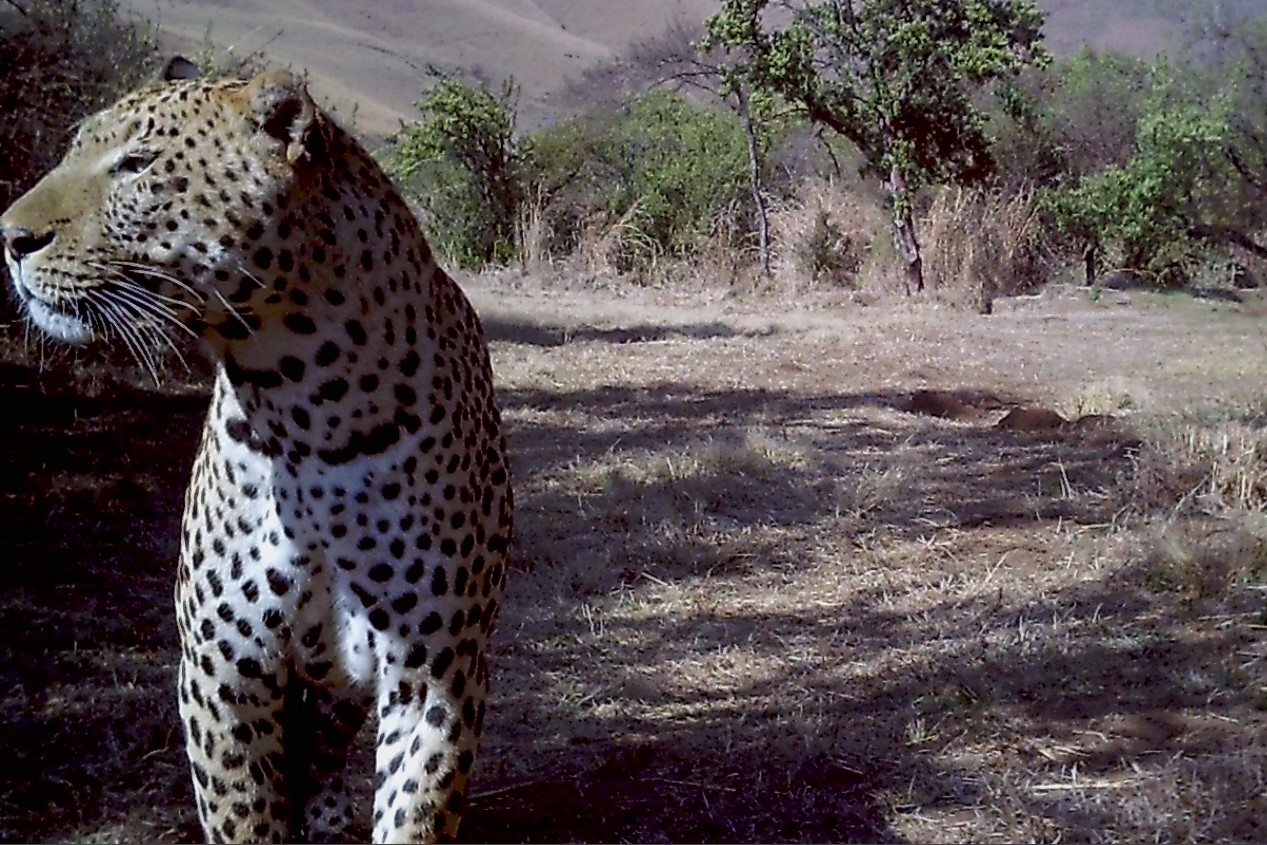
Wow, atta boy! This is our big dominant male leopard called the Spekboom Male by our neighbours at Mount Anderson Ranch. Recognisable by his asian eyes, he is young, hasn't developed a dewlap yet but he seems to have established himself on our property and our neighbours north and west according to the data collected from the many camera traps set up by the MTPA each year. Looking at the condition of his ears, it looks like he has no respect for electric fencing and therefore probably ranges even further west. When male leopards, with their large territorial ranges, range into unprotected areas they are vulnerable to being shot by landowners or killed on the roads by vehicles, the biggest cause of death in these semi-urban areas.

This photo was taken by the camera trap that is set up, facing south, on the northern side of K24, at five past nine in the morning on the twenty-sixth of August. I left the camera there for six weeks from the middle of September to the end of August and, wow, that little weir is busy! With animals much more than flyfishers! Remember the camera is fixed in position and only takes a photograph if something walks within the sensor's range. In that time the camera spotted eight visits by anglers. 

Animals were a different story: There were 33 visits of different duration (the camera keeps taking photos while the animal stays in its range while grazing or browsing, lying down and then getting up etc) and different Rams and ewes, some alone and some with lambs, of Bushbuck; 28 visits by various groupings of Warthog; 8 visits by Eland, usually at night for long periods; five visits by Leopard, at least one female and this male three times; 3 visits by a troop of Baboons passing through while foraging; 3 visits by Kudu, two lone males on different occasions and a breeding herd that spent a night there; 2 Civets passing by the camera about a week apart; 2 visits by a sounder of Bushpigs, both late at night; 2 visits by Porcupine, once a pair and once a large, solitary male; 1 visit by a Common Duiker ewe; and 1 visit by a Slender Mongoose! 

And that's only in the little spot within the range of the camera! Pretty cool stuff!

That's it for August and the beginning of September. Spring is in the air and the rains are on the way. Life is about to explode into a cacophony of colour and noise...